p.20 #1 · lens repair, modification and disassembly guide thread
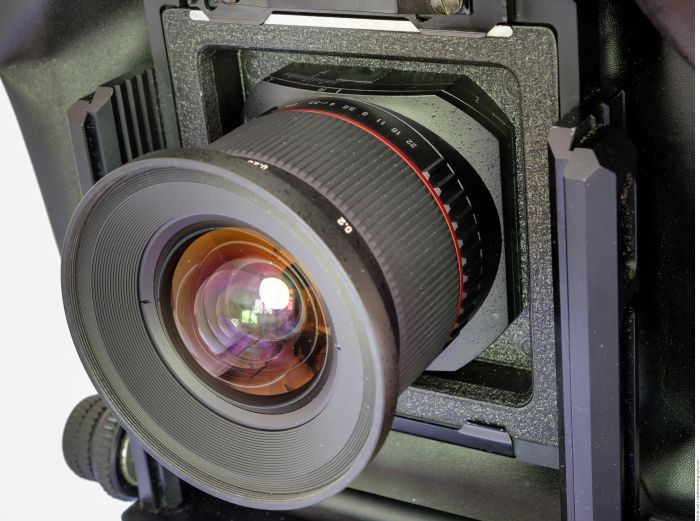
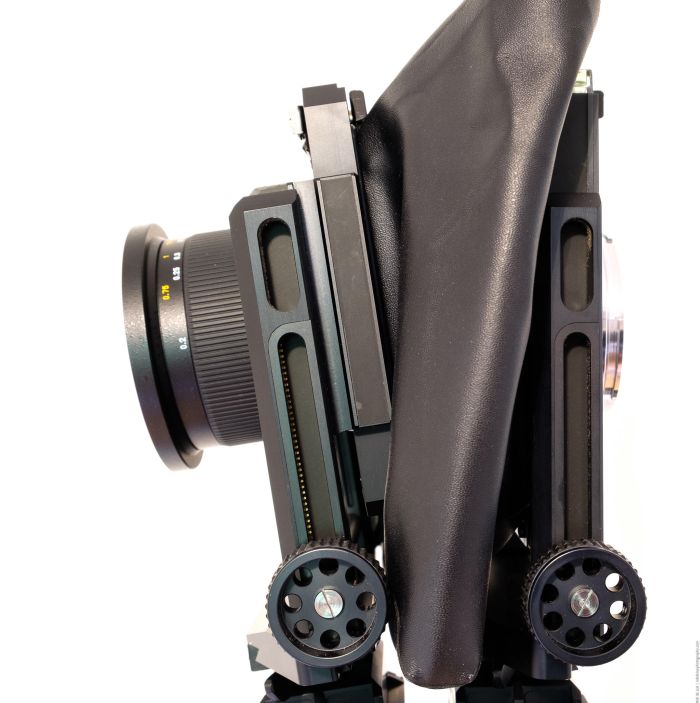
The Samyang 24mm f/3.5 Tilt Shift lens disassembles easily and offers a few relatively easy adaptation choices.
I turned it into a lens for my Toyo VX23D + Fuji GFX 50R outfit. Here's a post on DPReview that focuses on the strengths and weaknesses of the lens: https://www.dpreview.com/forums/thread/4577550
p.20 #2 · lens repair, modification and disassembly guide thread
gregon wrote:
I do not have PMs available... Could you, please, send me the files to [email protected] ?
Did you by any chance find any rings? How suitable do you think the prototyping rings would be?
Thank you!
I do have prototype rings, but I think they won't allow infinity focus on a converted lens that uses correction filters for improved performance on digital sensors.
p.20 #4 · lens repair, modification and disassembly guide thread
LightShow wrote:
Hey sebboh, hope all is well in your circle, do you have any rings for the g21 and g35?
Afraid not, my latest design works for all 3 lenses (g21, g28, and g35), but I only have prototypes that were too thick to work with some of the lenses (there seems to be some variance in how thick a spacer is need at least with the g21). If enough people are interested I could generate another order though.
p.20 #7 · lens repair, modification and disassembly guide thread
Fred Miranda wrote:
That's an important one as this lens is famous for getting some play on the aperture/focusing rings after a while.
Probably aperture ring play is also related to long time use and lubrication issue. It's relatively easy to disassemble that area, and I'll probably find time and add pictures to the article.
Steps for accessing aperture ring are:
1. Dismount lens core from focusing frame as mentioned in the article
2. Unscrew two black bolts holding the aperture transmission plate located in the inner side, and remove that transmission plate.
3. Unscrew CCW the front nameplate (few drops of acetone may be required required to the filter thread for factory glue dissolving). I'm using thick double-sided adhesive tape for that, attached to plastic tube of similar diameter to grab that ring firm.
4. Unscrew three black bolts holding the front ring and remove it.
5. There is a thin black securing ring holding aperture ting, compress it and pull out.
6. Slowly lift aperture ring up - there is a spring loaded ball, do not let it jump too far.
After relubrication, put the metal ball on the top of its socket, and then put the aperture ring back by fitting the F2 aperture position where the groove is longer, check that aperture ring rotation is smooth and clicks are snappy. Then assemble everything in a reverse order.
p.20 #8 · lens repair, modification and disassembly guide thread
sebboh wrote:
Afraid not, my latest design works for all 3 lenses (g21, g28, and g35), but I only have prototypes that were too thick to work with some of the lenses (there seems to be some variance in how thick a spacer is need at least with the g21). If enough people are interested I could generate another order though.
If you decide to make another run, I'm interested in 1 or 2 sets.
p.20 #11 · lens repair, modification and disassembly guide thread
rdeloe wrote:
The Samyang 24mm f/3.5 Tilt Shift lens disassembles easily and offers a few relatively easy adaptation choices.
I turned it into a lens for my Toyo VX23D + Fuji GFX 50R outfit. Here's a post on DPReview that focuses on the strengths and weaknesses of the lens: https://www.dpreview.com/forums/thread/4577550
Interesting. Did you keep part of the bellows to keep the aperture ring in place or because you were mounting it on a recessed board? When I did mine, I put it on a Cambo Actus M39 lens board, which was perfectly round, so I removed the bellows entirely and printed a spacer to keep the aperture ring in place and functioning.
p.20 #12 · lens repair, modification and disassembly guide thread
freaklikeme wrote:
Interesting. Did you keep part of the bellows to keep the aperture ring in place or because you were mounting it on a recessed board? When I did mine, I put it on a Cambo Actus M39 lens board, which was perfectly round, so I removed the bellows entirely and printed a spacer to keep the aperture ring in place and functioning.
I considered doing what you did (removing the tilt mechanism and replacing it with a part that served as mount and held on the aperture ring). However, I chose the other option (leave tilt mechanism on and lock it down) for a few reasons:
* I don't have a 3D printer, so making a replacement would not be simple
* The flange distance with the tilt part on is a good match for my Toyo. I didn't need more room between the standards, and I don't have to change the spacing between the standards when I use this lens.
* Most importantly, there's not much room in my pack and things are tight. I wanted that rear lens section to be protected. With the design I use, the rear lens section can be pulled completely inside, so nothing sticks out and can be damaged.
p.20 #13 · lens repair, modification and disassembly guide thread
rdeloe wrote:
I considered doing what you did (removing the tilt mechanism and replacing it with a part that served as mount and held on the aperture ring). However, I chose the other option (leave tilt mechanism on and lock it down) for a few reasons:
* I don't have a 3D printer, so making a replacement would not be simple
* The flange distance with the tilt part on is a good match for my Toyo. I didn't need more room between the standards, and I don't have to change the spacing between the standards when I use this lens.
* Most importantly, there's not much room in my pack and things are tight. I wanted that rear lens section to be protected. With the design I use, the rear lens section can be pulled completely inside, so nothing sticks out and can be damaged.
It looks very good (and safe). That might be a good arrangement for the Nikon PC 85/2.8D (striping the mount and shift mechanism and mounting the lens and tilt mechanism on a board). It would probably be safest to go with a copal 1 or maybe even a 3 board to make sure you're not limiting the projection. It's a D lens, so there may be a ribbon cable you'd have to deal with (something has to communicate the settings between the focus ring and the mount ROM chip) but you'd end up with a nice flat field, low distortion lens with a floating element for macro and a 90mm+ IC. The non-E versions have become very reasonable on the used market.
p.20 #14 · lens repair, modification and disassembly guide thread
freaklikeme wrote:
It looks very good (and safe). That might be a good arrangement for the Nikon PC 85/2.8D (striping the mount and shift mechanism and mounting the lens and tilt mechanism on a board). It would probably be safest to go with a copal 1 or maybe even a 3 board to make sure you're not limiting the projection. It's a D lens, so there may be a ribbon cable you'd have to deal with (something has to communicate the settings between the focus ring and the mount ROM chip) but you'd end up with a nice flat field, low distortion lens with a floating element for macro and a 90mm+ IC. The non-E versions have become very reasonable on the used market....Show more →
I wasn't sure about the lens because it does have a reputation for being so-so, but I'm pleased. Like I say in that long review on DPReview, you have to respect its limits (of which there are many). But if I work within those limits, it's a good solution for me.
Thanks for the tip on that Nikon. I did not know about that one. I had a look at some pictures and it does look like it has disassembly potential. I do have that focal length covered though on my Toyo. I picked up a Schneider-Kreuznach Apo-Componon HM 90/4.5 in the industrial Makro-Iris mount. It's very tiny but absolutely superb.
p.20 #15 · lens repair, modification and disassembly guide thread
Hello community,
I'm wondering if there is a guide to dissasemble the Contax Zeiss 135 f2.8 AE version (which I believe it may be a bit different than the "newer" MM version).
My copy has two issues: the focus barrel is a bit loose. It rotates just fine, so I think it's not a problem with the helicoid but rather with how the tube is attached to the helicoid. I've removed the rubber on the ring and found the screw that I guess I should adjust, but it's just too stuck. I've tried acetone but it just doesn't move... I'm wondering if maybe there's a way I could fix it by dissasembling the lens.
The other issue is that there seems to be some fungus on the inside of the rear element and on one of the middle elements. So there's that...
It's the cheapest lens on my set, and, since I'm not afraid to use tools, I figured it would be a nice way to get started on this.
p.20 #16 · lens repair, modification and disassembly guide thread
sebboh wrote:
Afraid not, my latest design works for all 3 lenses (g21, g28, and g35), but I only have prototypes that were too thick to work with some of the lenses (there seems to be some variance in how thick a spacer is need at least with the g21). If enough people are interested I could generate another order though.
Sebboh, I'm in for a g28 ring (for Rokkor 55mm F1.7 donor).
p.20 #17 · lens repair, modification and disassembly guide thread
This may have been looked up thousands of times but I can't find much info: mount swap Contax 645 lenses to Mamiya 645 mount.
In theory flange focal distance of Mamiya 645 is 1mm longer than Contax 645 so it may be possible to get a Mamiya mount from an adaptor/lens and put it on a mount-removed Contax lens, with the extra screw holes to align them?
With 3D scanning and printing technology, I hope someone would be able to advance this experiment.