p.12 #1 · Sony RX1 FF Mirrorless (Original 2012 thread)
ricardovaste wrote:
Can you elaborate
A snap on OVF would have no metering information. When I use my SLR, I'm looking at the numbers, judging the scene, changing metering modes etc. With this, you're just looking through a glass hole AFAIK. This is why I ask the question - if I misunderstand it, please tell me.
I don't understand the difference, as long as you don't use manual mode. You don't know how your SLR is gonna expose either, because there is no live histogram.
p.12 #2 · Sony RX1 FF Mirrorless (Original 2012 thread)
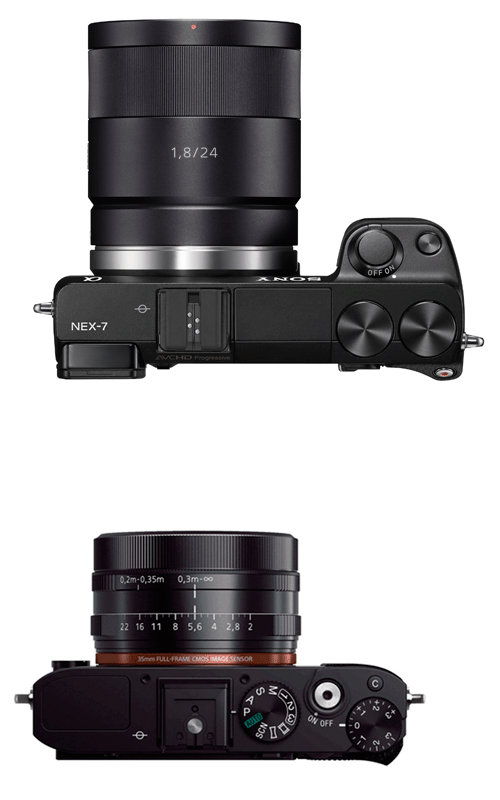
While it may not be the mythical full-frame interchangeable lens camera you were dreaming of, or the fixed-lens full frame camera that is only 9mm thick, I think it’s still an impressive technical achievement.
To size this image, I first matched the NEX-6 image to the NEX-7 body using the E-Mount as a reference. I then sized the RX1 image to the NEX-6 using the hotshoe mount.
I have to imagine that a full-frame NEX would be significantly larger—it’s not like full-frame lenses for it are going to be smaller than what Sony are putting out for it now, are they?
Ok, so it seems this camera is as wide (and probably high) as a MFT camera, and little more than a cm deeper than a MFT camera with a pancake lens. Anyone still complaining about the size? Seriously?
Thinking of this and looking at the above comparison to the 24/1.8 (which after all is for APS-C), I would hazard a guess that maybe the lens is in fact collapsible and we're looking at it in it's collapsed state. It just seems too small to be true. Also, the way the lens barrel looks from the front (lens hood bayonet has a pretty small diameter and is surrounded by other stuff), I think it is well possible that the lens will extend somewhat to make it ready for use. If it doesn't, the lens is indeed remarkably compact.
p.12 #4 · Sony RX1 FF Mirrorless (Original 2012 thread)
edwardkaraa wrote:
I usually shoot in manual mode. For film I use a handheld incident meter, for digital, I take a Polaroid shot adjust the exposure and use it for subsequent shots
I never use the camera meter.
One advantage of using a P&S (or live view) is you can preview the photo on the rear screen and make live adjustments if the cameras metering is not accurate.
p.12 #5 · Sony RX1 FF Mirrorless (Original 2012 thread)
Makten wrote:
I don't understand the difference, as long as you don't use manual mode. You don't know how your SLR is gonna expose either, because there is no live histogram.
What I know how my SLR is going to exposure. I've learnt how it meters. This is how I get it to do things consistently, the way I want it to. I use CWA, mostly Spot, lock exposure. It's very quick, efficient. It's clear we just use our cameras very differently though I guess...
p.12 #6 · Sony RX1 FF Mirrorless (Original 2012 thread)
EOS20 wrote:
One advantage of using a P&S (or live view) is you can preview the photo on the rear screen and make live adjustments if the cameras metering is not accurate.
It amazes me that even though we now have DSLRs and large sensor compact cameras (interchangeable or fixed lens) none of the big manufacturers show a live YRGB histogram, or have any histogram/clipping options for RAW data. (it’s based off the JPEG preview)
Casio of all companies managed it back in 2005:
ricardovaste wrote:
What I know how my SLR is going to exposure. I've learnt how it meters. This is how I get it to do things consistently, the way I want it to. I use CWA, mostly Spot, lock exposure. It's very quick, efficient. It's clear we just use our cameras very differently though I guess...Personally, almost nothing I shoot is time-sensitive, so I always manually expose the image and look at the histogram. (live luminance histogram on NEX, and I’ll look at the RGB one if there are bright colours in the scene)
This way I can expose to the right to maximise SNR, rather than meter the image so that it looks good on the camera screen. (usually under-exposed for RAW)
Ok, so it seems this camera is as wide (and probably high) as a MFT camera, and little more than a cm deeper than a MFT camera with a pancake lens. Anyone still complaining about the size? Seriously?
Thinking of this and looking at the above comparison to the 24/1.8 (which after all is for APS-C), I would hazard a guess that maybe the lens is in fact collapsible and we're looking at it in it's collapsed state. It just seems too small to be true. Also, the way the lens barrel looks from the front (lens hood bayonet has a pretty small diameter and is surrounded by other stuff), I think it is well possible that the lens will extend somewhat to make it ready for use. If it doesn't, the lens is indeed remarkably compact. ...Show more →
p.12 #8 · Sony RX1 FF Mirrorless (Original 2012 thread)
One of the coolest things about this camera to me is that its such a niche product - essentially a FF version of the Fuji X100/Leica X2 - something Sony is not exactly prone to produce. I still can't get over how a $2800 P&S got past the bean counters other than the fact that it further marginalizes the sunk cost of developing the 24mp FF sensor - but one thing is clear - Sony is dead serious when it says imaging is one of its core divisions moving forward, especially when you include the new sub $10,000 video cameras. Makes me wonder what's next, FF EVIL? Medium format that also shoots video? A compact camera with the FS100's S35 sensor that does 240fps? Or This is exciting, especially if Leica and other niche players are the target.
p.12 #9 · Sony RX1 FF Mirrorless (Original 2012 thread)
ricardovaste wrote:
That is what I thought, and is what I was getting at. Makten has confused the matter slightly :S
I was just wondering what people do for metering is all... As it's pretty important, at least to me, to know what you're metering for, or how you're metering, unless you want to spend all day fuddling exposures in LR.
It remains to be seen regarding the info available in the add on finders. EVF of course would have everything. OVF might not - unless Sony has been working with Fuji (the Fuji OVF does provide all info and is unique in this way. A result of the combined EVF/OVF Hybrid). I highly doubt we will see this (due to the size this thing would likely have to be) but Fuji just included the brand new, higher end Sony EVF in their new XE-1 so who knows.
p.12 #10 · Sony RX1 FF Mirrorless (Original 2012 thread)
joychris wrote:
One of the coolest things about this camera to me is that its such a niche product - essentially a FF version of the Fuji X100/Leica X2 - something Sony is not exactly prone to produce. I still can't get over how a $2800 P&S got past the bean counters other than the fact that it further marginalizes the sunk cost of developing the 24mp FF sensor - but one thing is clear - Sony is dead serious when it says imaging is one of its core divisions moving forward, especially when you include the new sub $10,000 video cameras. Makes me wonder what's next, FF EVIL? Medium format that also shoots video? A compact camera with the FS100's S35 sensor that does 240fps? Or This is exciting, especially if Leica and other niche players are the target....Show more →
I think too much is being made of the R&D required to bring this thing to market because, after all, it's R&D that would have been required anyway for future compact mirrorless FF solutions (so can be spread out over many, many products).
Yes, what's next - the rumor is Sony has a larger than FF cmos sensor coming. That could really shake up the MF market. We could see FF moving into the mainstream and MF re-establishing its superiority over the smaller FF format with such a development (since the sensor technology would finally be equalized between the two).
p.12 #11 · Sony RX1 FF Mirrorless (Original 2012 thread)
joychris wrote:
Sony is dead serious when it says imaging is one of its core divisions moving forward
Sony is super serious about making digital imaging one of its three main divisions. If you're buying a camera, there's a good chance it has a Sony component in it. The sensors in the Nikon D7000, D600, D800, and Olympus OM-D are from Sony. So is the EVF in the Fuji X-E1.
p.12 #12 · Sony RX1 FF Mirrorless (Original 2012 thread)
Tariq Gibran wrote:
....
....
1. I can't remove that "awesome" 35 f/2 lens and stick something else on there when I need to use other focal lengths. Loosing that versatility pushes the price out of line for me as it's easier to justify a high price for a body that can serve many uses and accommodate many lenses. I tend to agree with those who say it really does not matter if it's a FF sensor or APS once you stick a fixed lens on it - unless the price is really attractive.
....)
p.12 #14 · Sony RX1 FF Mirrorless (Original 2012 thread)
Tariq Gibran wrote:
I think too much is being made of the R&D required to bring this thing to market because, after all, it's R&D that would have been required anyway for future compact mirrorless FF solutions (so can be spread out over many, many products).
To clarify, I wasn't thinking R&D - its essentially a sunk cost after the sensor is finished. I'm sure the A99's R&D costs are many times higher than this camera. Its more along the lines of it being a niche product in a niche that previously didn't exist - a $2800 FF with a fixed lens - that will likely be a relatively low volume seller compared to something like the RX100.
Its obviously not a competitor to X100 and the X2, otherwise why not go APS-c (because we know Sony really lacks APS-c cameras ) and price it at $1200? Its a halo product to get people talking about Sony again and generate interest in its cameras. Mission accomplished.
What if we get a FF RX with a zoom lens along the lines of the old DSC-828? Sony seems to really be attached to the whole "big lens/small body" thing. The RX100 is a major hit, I can see Sony dropping larger sensor versions of that camera ... RX200 (aps-c) ... RX300 (FF).
p.12 #15 · Sony RX1 FF Mirrorless (Original 2012 thread)
Unless we have the actual sale number of the X100 compared to a similarly priced SLR/CSC of the time, I would not believe that camera is that successful. This RX-1 is such a disappointment. A fixed lens camera with such a price tag would not be a game changer. $2000 (or the same rumored price of the D600) might be, though I wouldn't pay for one either way. Still waiting for a FF CSC...
p.12 #16 · Sony RX1 FF Mirrorless (Original 2012 thread)
photo.guy wrote:
While it may not be the mythical full-frame interchangeable lens camera you were dreaming of, or the fixed-lens full frame camera that is only 9mm thick, I think it’s still an impressive technical achievement.
To size this image, I first matched the NEX-6 image to the NEX-7 body using the E-Mount as a reference. I then sized the RX1 image to the NEX-6 using the hotshoe mount.
I have to imagine that a full-frame NEX would be significantly larger—it’s not like full-frame lenses for it are going to be smaller than what Sony are putting out for it now, are they?
Exactly. Aps-c lenses are already pretty large on NEX. FF lenses will be huge. If anything, I maintain that the RX1 is pushing off any FF NEX development, and it shows just how much of a size advantage that you get from using a fixed lens.
p.12 #18 · Sony RX1 FF Mirrorless (Original 2012 thread)
Regarding the size comparisons: I just found this cool site: http://camerasize.com/compare/#183,33
It doesn't have the RX1 (or RX100) yet, but it's pretty useful.
p.12 #19 · Sony RX1 FF Mirrorless (Original 2012 thread)
AhamB wrote:
Regarding the size comparisons: I just found this cool site: http://camerasize.com/compare/#183,33 It doesn't have the RX1 (or RX100) yet, but it's pretty useful.
Yes, it's a VERY useful site. I use it often when considering one camera vs another.
p.12 #20 · Sony RX1 FF Mirrorless (Original 2012 thread)
_julian_ wrote:
Also, existing WA short flange lenses (eg biogons/leicas), sit well inside the throat of the NEX cameras. There is nothing unique in having elements situated closer to the sensor than the flange distance.
There is a difference between elements sitting well into the throat and very large elements a few mm away from the sensor. The latter you only see in fixed lens cameras.




 ) and price it at $1200? Its a halo product to get people talking about Sony again and generate interest in its cameras. Mission accomplished.