This topic is in the 2011 archive. You can read it and like its posts here. It is read only.
Archive 2011D700 vs. CoolScan5000ED
p.3 #1D700 vs. CoolScan5000ED
carlitos wrote:
What was the f-stop used on the 55/f3.5 to copy the slide? Just curious how much of a difference there would be if f3.5 was used versus, say, f8.
f/8. At f/3.5 the images are not nearly as sharp.
John
What was the f-stop used on the 55/f3.5 to copy the slide? Just curious how much of a difference there would be if f3.5 was used versus, say, f8.
f/8. At f/3.5 the images are not nearly as sharp.
John
Aug 24, 2011 at 03:06 PM
p.3 #2D700 vs. CoolScan5000ED
Incandescent is to warm to make for a reasonable CCT in slide imaging. A halogen spotlight with a daylight balancing filter, or remote flash are the two best options.
I'd recommend F8 also, anything less would make slide film planacity a bigger problem than diffraction. On the D700 F11 wouldn't be a problem (sharpness wise) either. It's mostly a question of what reasonable shutterspeeds you can get (if not using flash).
I'd recommend F8 also, anything less would make slide film planacity a bigger problem than diffraction. On the D700 F11 wouldn't be a problem (sharpness wise) either. It's mostly a question of what reasonable shutterspeeds you can get (if not using flash).
Aug 24, 2011 at 04:18 PM
p.3 #3D700 vs. CoolScan5000ED
theSuede wrote:
Incandescent is to warm to make for a reasonable CCT in slide imaging. A halogen spotlight with a daylight balancing filter, or remote flash are the two best options.
I'd recommend F8 also, anything less would make slide film planacity a bigger problem than diffraction. On the D700 F11 wouldn't be a problem (sharpness wise) either. It's mostly a question of what reasonable shutterspeeds you can get (if not using flash).
Thanks - It looks like a SB-400 is in my future . . .
John
Aug 24, 2011 at 04:48 PM
p.3 #4D700 vs. CoolScan5000ED
Actually - does anyone have any suggestions for a cheap flash to use with this slide imaging setup that is compatible with my D700, D300, and possibly a near future D7000?
I've seen some SB-28DX flashes locally for pretty cheap, but I have no idea if they will work with these bodies.
Thanks - John
I've seen some SB-28DX flashes locally for pretty cheap, but I have no idea if they will work with these bodies.
Thanks - John
Aug 31, 2011 at 09:27 AM
p.3 #5D700 vs. CoolScan5000ED
as long as you're having fun with your gear 
I'll stick to my ED4000 with batch feeder until I am through 10,000 more slides and 8000 negatives, then it goes to ebay for about 300% profit (prices on these things have exploded since Nikon stopped making them).
I cannot imaging trying to clean the dust and scratches off old slides manually any longer, and these are slides processed at the pro lab and stored properly for now 10-15 years.
And color neg scanning is an artform even with a scanner and software optimzed to get you good results. Proper workflow requires that you scan the leader of every roll and recalibrate the scanner's light source color intensities by channel, as every roll could have gone through different chemicals and have a different hue, even if from the same batch of film.
I guess I am all geeky on the scanner end of the hobby :-)
Aug 31, 2011 at 12:28 PM
p.3 #6D700 vs. CoolScan5000ED
pburke wrote:
as long as you're having fun with your gear
I'll stick to my ED4000 with batch feeder until I am through 10,000 more slides and 8000 negatives, then it goes to ebay for about 300% profit (prices on these things have exploded since Nikon stopped making them).
I cannot imaging trying to clean the dust and scratches off old slides manually any longer, and these are slides processed at the pro lab and stored properly for now 10-15 years.
And color neg scanning is an artform even with a scanner and software optimzed to get you good results. Proper workflow requires that...Show more →
As my original post suggested and or stated, this project is intended for scanning some problem slides (that the CS5000ED does a poor job on) as well as having some scanning ability once the 5000ED is sold off. The vast majority of my slides have been scanned already, so this is not for production volumes for sure. My newer slides don't have nearly the scratch and dust problems of my older, cardboard mounted slides do.
John
Aug 31, 2011 at 02:43 PM
p.3 #7D700 vs. CoolScan5000ED
jhinkey wrote:
Actually - does anyone have any suggestions for a cheap flash to use with this slide imaging setup that is compatible with my D700, D300, and possibly a near future D7000?
I've seen some SB-28DX flashes locally for pretty cheap, but I have no idea if they will work with these bodies.
Thanks - John
Any flash that can be set to "stupid remote" is ok. You can then trigger the flash by the in-camera flash set at manual strength 1/32 or something.
The SB26 and the SB80DX does this, but I don't think that the 28DX does. But it does have a PC sync port in. A normal PC 3m cable would normally cost a few bucks, not more. For the D7000 (that has no PC sync out) you'd need a hot-shoe - PC-cable adapter. Can also be found for a few bucks.
Aug 31, 2011 at 06:50 PM
p.3 #8D700 vs. CoolScan5000ED
theSuede wrote:
I've seen some SB-28DX flashes locally for pretty cheap, but I have no idea if they will work with these bodies.
Thanks - JohnAny flash that can be set to "stupid remote" is ok. You can then trigger the flash by the in-camera flash set at manual strength 1/32 or something.
The SB26 and the SB80DX does this, but I don't think that the 28DX does. But it does have a PC sync port in. A normal PC 3m cable would normally cost a few bucks, not more. For the D7000 (that has no PC sync out) you'd need a hot-shoe - PC-cable adapter. Can also be found for a few bucks.
Thanks - since I don't do dedicated flashes and have no idea, this is exactly what I was looking for.
- John
jhinkey wrote
Actually - does anyone have any suggestions for a cheap flash to use with this slide imaging setup that is compatible with my D700, D300, and possibly a near future D7000?I've seen some SB-28DX flashes locally for pretty cheap, but I have no idea if they will work with these bodies.
Thanks - John
The SB26 and the SB80DX does this, but I don't think that the 28DX does. But it does have a PC sync port in. A normal PC 3m cable would normally cost a few bucks, not more. For the D7000 (that has no PC sync out) you'd need a hot-shoe - PC-cable adapter. Can also be found for a few bucks.
Thanks - since I don't do dedicated flashes and have no idea, this is exactly what I was looking for.
- John
Aug 31, 2011 at 08:42 PM
p.3 #9D700 vs. CoolScan5000ED
Hi everybody, I am new here and glad to find this forum and this thread, because I do some slide coping test with my DSLR too, so happy to find someone interested in this field.
My equipments are so similiar to jhinkey's, here are my gears:
Nikon D3s
Nikon AF-S micro 60mm f/2.8G ED (one of the sharppest digital AF lens)
Nikon Nikkor AIS 55mm f/2.8 micro (one of the sharppest old MF lens)
Nikon ES-1 slide copier (with a 62mm-52mm adaptor you can mount it to 60mm f/2.8G)
Nikon PB-6 bellow + PS-6 slide copier
Nikon R1C1 (which include a SU-800 wireless commander and two SB-R200 small flash unit)
a CRI>85 LED light source
some stuffs bought from the carema shop here or made by myself to finish the whole setup
In the beginning I expect the PB-6+PS6+AIS 55mm micro to get best result, but it turn out that it won't work with my D3s. Because of it's large profile camera body, you need to add a nikon pk-13 extension tube between the D3s and PB-6 or the the PB-6 will damage the camera mount. This pk-13, however, add the distance between camera and lens so the angle of view and the distance of focus is changed. No matter how you adjust the position/length of bellow or PS-6, you won't get full-frame cover of the slide, something like a APS crop of the image. As you can see in jhinkey's setup picture, the bellow must be squeeze to minimal distance to get the view in viewfinder to cover the slide's whole frame, but the pk-13 just make this distance longer. It's a design issue of Nikon. So if you want to shoot slides with PB-6+PS6+55mm micro digitally, the only way is to get a small-profile (no vertital grip) full-frame DSLR, that means D700 (the only one in the market by now).
So I turned to the ES-1. I used my laser cutter to make some adaptors with acrylic plates to work with ES-1 to get it work perfectly, that means (1)it's round front part won't turn anymore and will always be maintained horizontally, (2)mounted slides inserted in the ES-1will be fixed to a place perfectly matched the camera view, (3)I even made a special slide holder that can be inserted into ES-1 to shoot unmounted slides, just like the PS-6.
The best thing to copy slides with ES-1 is you can retain the autofocus function with the new nano-coated 60mm f/2.8G micro lens. The sharpness is VERY good.
About the light source, Nikon SB-R200 and my LED both worked well, the good side of LED is you can clearly see the images before shooting, from the viewfinder the slides look so beautiful and you can even change the exposure setting through Live-view w/ histogram to get the right exposure setting before shooting, that's what a flash can't do. The down side of the LED is it's so harsh to my eyes, so again I use my laser cutter to make a paper shade to cover between the LED and the end of the ES-1 diffuser. It works perfectly now, shooting slides becomes so comfortable and fast.
BUT, I encountered the same issue of the dynamic range, I tried so many way to solve this problem, but it seems impossible to get a single image which can retain both the highlight and shadow details. With RAWs I can adjust with Lightroom or Capture NX2, but the result seems unatural. So I turn to the HDR thinking, I found a interesting video to teach people using Nikon DSLR shoot in-camera HDR with multiple exposures:
but it turn out to be a fake, because no body can repeat the result of the video with D3/D3s. By now the only Nikon DSLR which can do in-camera HDR is D5100:
http://www.nikon.com/news/2011/0405_d5100_01.htm
So, my advise to jhinkey: don't buy a flash. Just wait the next full-frame DSLR with in-camera HDR (D5100 won't work with PB6+PS6 since it's APS sensor size), or you can spend some time in post-shoot HDR making skill, like Photomatix or something.
That's my experience in slide shooting, hope it will help.
Sep 02, 2011 at 09:29 PM
p.3 #10D700 vs. CoolScan5000ED
Sounds complicated hehe
Do you have photos of your rig to share, Acon? Having a hard time imagining
Do you have photos of your rig to share, Acon? Having a hard time imagining
Sep 02, 2011 at 09:56 PM
p.3 #11D700 vs. CoolScan5000ED
Acon -
Hey thanks for the great input into this thread.
In fact I tried in camera HDR with my D700 and although I could technically get it to work, the difference in the dynamic range was almost imperceptible. I tried all sorts of combinations of exposure values and the final image would be different, but I could never get the dynamic range to be larger. It just seemed to shift the final exposure value around some. The effect was very subtle at best.
I started to use my D300 to see if when I get a D7000 if I could frame the image - it was a quick test, but I think you will need to move the PS-6 1.5x farther away than when using the D700, which is doable, perhaps with an extension rail.
My desire to use the D7000 was due to the reports that it has about 1.5 to 2 stops better dynamic range at base ISO then the D700 (though about a 1 stop worse DR at high ISOs), and thus may be able to get more info out of the slide.
I have not tried blending in photoshop - it would be nice NOT to have to do that. I would expect the D800, whenever it comes out, to have likely at least 2 stops better DR at base ISO based on the technology used in the D7K sensor.
Regarding the D3s and the PB-6 - can't you slide the camera mount all the way to the back of the rail, and then use a PK-11a or maybe the PK-12 to minimize the extension distance?
- John
Sep 02, 2011 at 10:21 PM
p.3 #12D700 vs. CoolScan5000ED
John,
I tried the so-called "HDR" with my D3s too, the same result. It is not HDR at all, I mean, how could a function be HDR if you can't sense any dynamic range improvement by your eyes? The nature of how multiple exposure works make it impossible to work as HDR. I finally figured out that it's a fake. If Nikon make a DSLR which can do in-camera HDR, it would say it can do that and make a HDR option in it's menu, just like D5100. If they don't add this feature into any existing model by firmware update, obviously we can't achieve HDR with these cameras.
I am not sure if APS DSLR can fit PB-6/PS-6, maybe it'll works. Maybe you can focus properly when moving the PS-6 farther. But that won't work with D3s because the pk-13 make the focus distance shorter than mounting the camera directly to PB-6; when moving PS-6 farther, you're out of ocus no matter how you turn the focus ring on the lens.
The kp-13 is such a problem, I don't have pk-11a or pk-12, but I think they may fail too because I tried my FM2 with this system and the view is JUST fit the frame of a slide, any more space between PB-6 and camera will ruin the coverage I think. It's a pity because PS-6 has a great design. But I don't care because with my self-made stuffs, ES-1 works well now.
About the DR of new coming models, I expect the improvement too, but I don't think there will be a huge leap. 2 stops of DR is revolutional, hope it's real but not so confident of the rumors.
Maybe I will put some pics of my ES-1 setup recently.
Sep 03, 2011 at 10:00 AM
p.3 #13D700 vs. CoolScan5000ED
Keep in mind that the designers of bellows/slide copier units like the PB-6 clearly(I think) assumed that if you were going to be duping slides, you'd be using a Nikon 105mm lens--so, there'd never be 'too much' extension.
Acon, it's nice to see that someone has had the skill and facilities to fix the alignment issues with the ES-1.
Acon, it's nice to see that someone has had the skill and facilities to fix the alignment issues with the ES-1.
Sep 03, 2011 at 12:42 PM
p.3 #14D700 vs. CoolScan5000ED
To be fair - I don't think Nikon has ever advertised in-camera HDR with these bodies. It's just a multiple exposure capability that some folks are trying to make work like in-camera HDR.
That being said, it would be a fantastic capability to be able to do true HDR, or at least dynamic range expansion (DRE - my term) in-camera or in capture NX using NEF files.
John
That being said, it would be a fantastic capability to be able to do true HDR, or at least dynamic range expansion (DRE - my term) in-camera or in capture NX using NEF files.
John
Sep 03, 2011 at 03:52 PM
p.3 #15D700 vs. CoolScan5000ED
No, they have never called the multishot-function "HDR", since they very well know that it isn't HDR. What it is is a way to decrease noise in the shadows (well, everywhere - but you can only see it in the shadows - in brighter aparts you can measure it, but not necessarily see it).
A three-shot ISO 200 gives you an ISO 66 result. In the D3x it's a really usable function in the studio, in the D3's - less so.
What you need to maximize DR in a reprophotographical capture of a slide is a total control of stray light... A scanner does this by nature, it only illuminates the small part that the machine is currently "reading". When you shoot a slide (or a lead-lined window painting, or a sunrise, to give some examples) with a normal lens you get light "leakage" from the bright parts to the darker parts. Let's say that a normal macro lens has a total transmission of 90-92%. 1% of the loss is pure absorption, light is converted to heat. the rest, 7-9% is internal reflections. Half of this is converted to heat in the black non-reflecting innards of the lens - and now we have ~4% of the total scene light left. Half of this goes forward, out from the camera, half goes INTO the camera in a random diffused manner. This gives ~2% stray light at the sensor.
2% may not sound like much, but its only 5,5Ev down from the average brightness of the scene.... And this is quite detrimental to the total achievable DR
Less diffused backlighting decreases stray light. Hence, it increases DR in the slide reproduction. And the you have to weigh this against purely practical problems like illumination field flatness and so on.
You must also make sure to keep the insides of tubes, slide-holders and so on free from metallic reflections. Light-blocking baffles are there for a reason.
Sep 03, 2011 at 05:13 PM
p.3 #16D700 vs. CoolScan5000ED
Here is my setup with ES-1:
w/o paper shade
w/ paper shade
w/o paper shade
w/ paper shade
w/o paper shade
 |
||
| http://www.better-design.com.tw/download/ES-1_1.JPG | ||
|
w/ paper shade
|
||
| http://www.better-design.com.tw/download/ES-1_2.JPG | ||
|
w/o paper shade
|
||
| http://www.better-design.com.tw/download/ES-1_3.JPG | ||
|
w/ paper shade
|
||
| http://www.better-design.com.tw/download/ES-1_4.JPG | ||
|
Sep 04, 2011 at 01:51 AM
p.3 #17D700 vs. CoolScan5000ED
theSuede wrote:
No, they have never called the multishot-function "HDR", since they very well know that it isn't HDR. What it is is a way to decrease noise in the shadows (well, everywhere - but you can only see it in the shadows - in brighter aparts you can measure it, but not necessarily see it).
A three-shot ISO 200 gives you an ISO 66 result. In the D3x it's a really usable function in the studio, in the D3's - less so.
What you need to maximize DR in a reprophotographical capture of a slide is a total control of stray light... A...Show more →
Well, I must say that the 5000ED does a poor job of controlling stray light since it has noted problems with flare, which I see in my own slides and not with the 55/3.5 + D700, so that is not the culprit. From what I see the 16bit TIFF that NikonScan or Vuescan puts out just plain has more DR than the 14 bit lossless compressed NEF from D700.
What I need to do to investigate this is to make a transverse slit mask across diagonal of my test slide that includes the brightest and darkest parts of the frame and see if that improves my DR.
This and finally get that D7000 and see if it at base ISO can recover more highlight and shadow details than the D700 using the same lens, illumination, etc.
John
Sep 04, 2011 at 09:14 PM
p.3 #18D700 vs. CoolScan5000ED
Here's and update to this thread.
I now have a D800 and my D700 (before I sell it shortly) and I took some time tonight to directly compare the two at ISO 200 with that same slide and same setup with the PB-6/PS-6 and the light table light source.
Wow!
The D800 is easily better than the D700 under identical exposures at ISO 200. Note that the upper right corner of the D800 does not go to black like the D700 and my friends red jacket is now visible and has not gone to black as in the D700 image. Note that the exposure of the mid-tones is about the same (my yellow-green helmet and the snowfield). Also the sun star is about the same degree of being blown out. If I adjust the D800
So my poor D700 results compared to the 5000ED were not due to the the light source nor the lens transmittance/contrast - it was the sensor dynamic range. It appears that the D800 has approximately the same dynamic range as the 5000ED (but no batch scanning and no IR scratch/dust removal ability!).
The second image is 4 shots - Left column is D700 at ISO 200 1/4 s and 1/2 sec. The right column is the D800 at ISO 200 1/4 sec (top) and ISO 100 1/2 sec (bot). The ISO 100 image is just slightly better than ISO 200 on the D800.
So, this initial look at the D700 vs. D800 shows just how good this new 36MP sensor is.
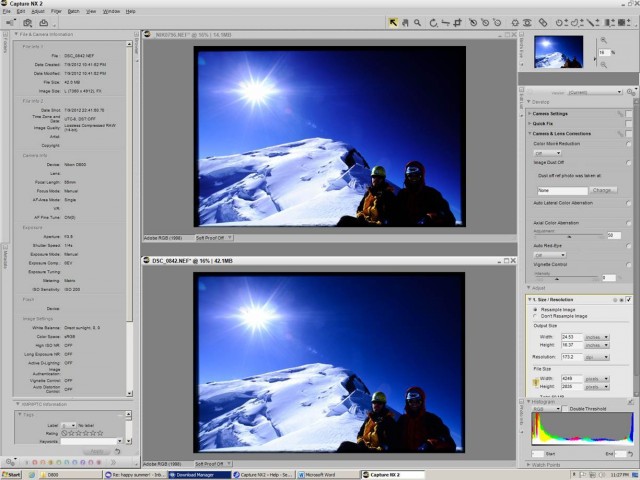
Which Is The D800? You Can Probably Guess.
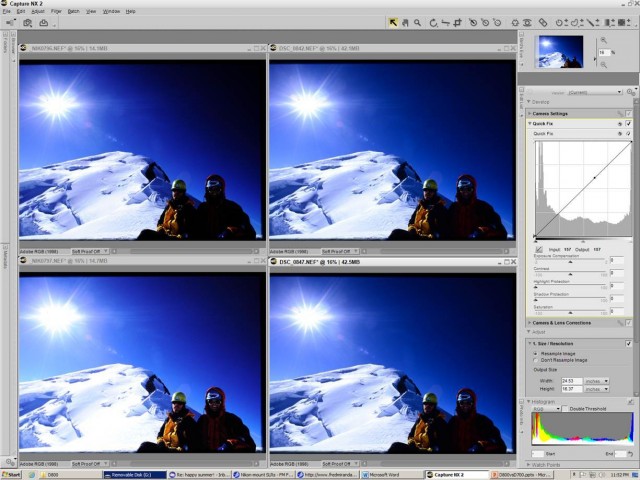
Left Column - D700 @ ISO 200 : Right Column - D800 ISO 200 and ISO 100
I now have a D800 and my D700 (before I sell it shortly) and I took some time tonight to directly compare the two at ISO 200 with that same slide and same setup with the PB-6/PS-6 and the light table light source.
Wow!
The D800 is easily better than the D700 under identical exposures at ISO 200. Note that the upper right corner of the D800 does not go to black like the D700 and my friends red jacket is now visible and has not gone to black as in the D700 image. Note that the exposure of the mid-tones is about the same (my yellow-green helmet and the snowfield). Also the sun star is about the same degree of being blown out. If I adjust the D800
So my poor D700 results compared to the 5000ED were not due to the the light source nor the lens transmittance/contrast - it was the sensor dynamic range. It appears that the D800 has approximately the same dynamic range as the 5000ED (but no batch scanning and no IR scratch/dust removal ability!).
The second image is 4 shots - Left column is D700 at ISO 200 1/4 s and 1/2 sec. The right column is the D800 at ISO 200 1/4 sec (top) and ISO 100 1/2 sec (bot). The ISO 100 image is just slightly better than ISO 200 on the D800.
So, this initial look at the D700 vs. D800 shows just how good this new 36MP sensor is.
Which Is The D800? You Can Probably Guess.
Left Column - D700 @ ISO 200 : Right Column - D800 ISO 200 and ISO 100
Jul 10, 2012 at 01:07 AM
p.3 #19D700 vs. CoolScan5000ED
I have recommended this method (ES-1 + 60 Micro) to others before but nobody seems to take is seriously..
if you use Kodakchrome ...ICE doesn't work anyway you might or might not miss the ICE of filmscans.
I guess I might get better result doing the duplicating work with NEX-7 than D700 (NEX-7 seems to have better highlight retention) but i haven't done this for a long while.
OK.. filmscan can deal with negatives, not just slides. I briefly tried to do that with negatives but the result doesn't look good.
Jul 10, 2012 at 01:30 AM
p.3 #20D700 vs. CoolScan5000ED
And here's a comparison between the D800 image and the 5000ED. I had to tweak the 5000ED image by cranking up the saturation to the max. in NX2 and use -.35 EV in EC and lots of shadow recovery for the D800 image to get it to roughly match.
In the end, the 5000ED still has a slight edge over the D800, especially in the area of noise when viewed at 100%.
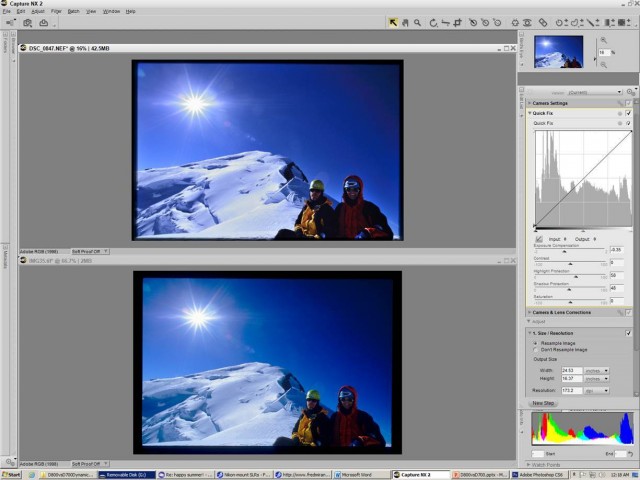
D800 Top, 5000ED Bottom
In the end, the 5000ED still has a slight edge over the D800, especially in the area of noise when viewed at 100%.
D800 Top, 5000ED Bottom
Jul 10, 2012 at 01:39 AM