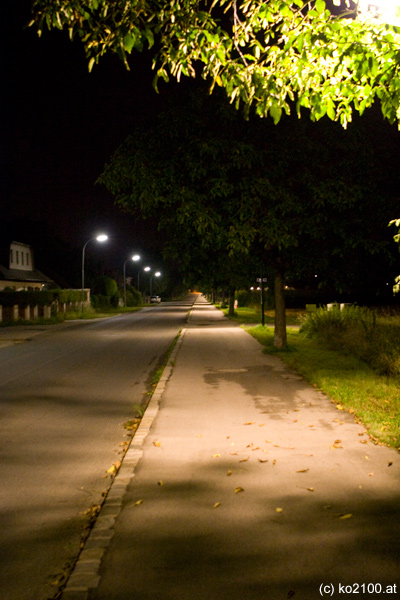
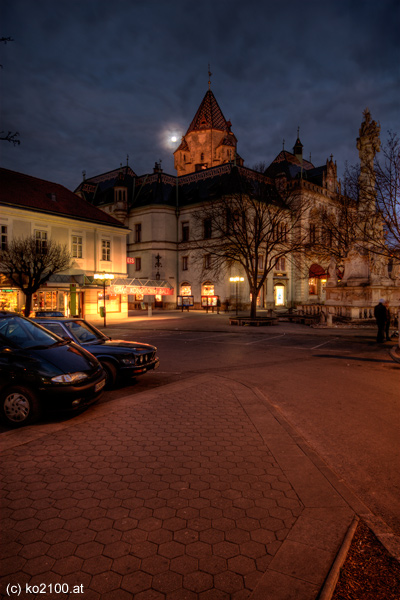
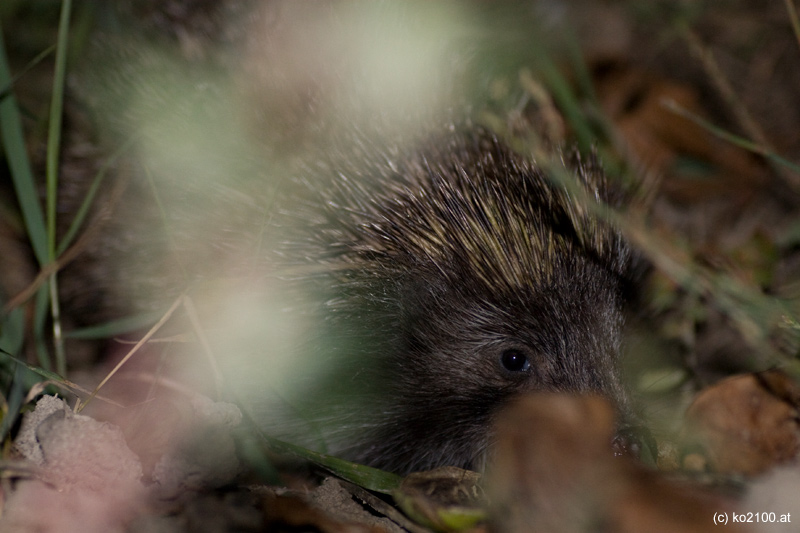
I have some technical questions. I have a Canon 30D, All kind of lenses, amongst them the Sigma 30/1.4, Canon 24-70/2.8, Canon 70-200/2.8, Sigma 10-20, Tamron 90mm Macro and Canon 100-400. Flashes include two 580EXII + a ST-E to trigger them, the Sigma Ringflash and of course the on-cam flash of my Canon 30D.
The funny thing is, that until now I had the best experiences in night photography (for me equals "almost no ambient light") with the internal flash of my 30D. Which is annoying not only because of the tons of flashes it does until the picture finally is taken.
My Questions:
a) how would I shoot in darkness without a flash, still getting a sharp image? Is there any way of "helping" the camera with an external light? Funnily enough, my compact PowerShot S2 has focus assist built in, was a lot cheaper and just works. Too bad, I cannot use the EF lenses on it :-)
b) how do I know the shutter speed needed for low ISO values? Apparently, the Av / Tv meter only goes up to 30 seconds, but I could also use bulb mode as I have the canon remote timer. If I need an external light meter for that, which one would you recommend and why?
c) Do you know of a way to make my Sigma Ringflash help focussing? I once tried to do a picture of a hedgehog in darkness with it -- and failed miserably. I could only get the picture by using the internal flash, which of course scared the hell out of it.
Long exposure. But that wont help with critters like that, unless they are perfectly still, or dead. Long exposure just takes some time to learn. You can open your lens up all the way, bring your iso to its highest, and if you get any sort of reading from there, then as you stop down and lower iso just translate that into time. As far as focusing goes, your kind of on your own there, especially if theres no light. You can use a flash light sometimes, but that kind of defeats the purpose, you just have to practice that.
a) Only MF works reliably. Trust somehow the distance scale on your lens (take a small flashlight with you to read the scale!)
b) Yes, stay at low ISO numbers otherwise your noise will dramatically increase in the photos. Good exposure times are between 1-15 sec depending on available light sources in your photo. You need to guess a bit and try several photos with different exposure times of the same frame.
c) I also use the Sigma ringflash, but only for macro shots. If you use it, make sure that you have it set to ETTL mode (camera in M mode) to avoid over- or underexposure.
(a) if you use an external flash, many of them (including the Canon and Sigma flashes) have a built-in focus assist light that is quite useful. You can set the flash not to fire, but the assist lamp will still be active.
(b) Trial-and-error is the best method for this. Use the histogram to guess how much longer/shorter the ideal exposure should be. Use as low an ISO as you can for best noise suppression.
mpmendenhall, that was my cue, thanks :-) Do you know, how I can make the Canon 580EXII not fire while still assisting with auto focus? The next big thing would be to also make it stop using 1/60 in P mode all the time...
Trial and error... That's what I do. But still, that takes a lot of time... Sure there must be another way?
retrofocus, that's what I figured, too. So... To get everything sharp, I'd dial in a high f-number, set the focus 2/3 from infinity and fire away, right? 1-15 seconds don't shock me, but mostly my shutter speeds are way beyond that in night photography. That's why trial and error gets very frustrating...
Funnily, I haven't had any over / underexposure with the Sigma Ringflash yet. My only grief is it's lack of auto focus assist. The "modelling lamp" is a bad joke and doesn't do anything for me. Too bad the Canon offering doesn't go up to 77mm filter diameter, like my L-lenses do...
And thanks. 2 doesn't seem very sharp to me. But looking at Lightroom, I've seen that I took it with f/2.8. That's explains a lot. 4 on the other hand is a HDR image. As the place was well lit even at night, I had no problems letting the cam do the rest and merge everything with Photomatix later on.
Hey.Underpands, the long exposures help me getting the exposure right, but how would I get sharp pictures with a flash light? Any tips on that? Sounds interesting.
Anyone any experiences using a light-meter for night photography?
I meant that you can use a flash light to shine on your subject to help achieve better focus. Less annoying than the strobing flash, but still not always ideal.