Just picked up a Vivitar 135mm f/2.8 on ebay for $65. I think it has an AI mount, but I won't know until I get the lens in my hands (hopefully it is, then I won't need to worry about metering).
On my D300 it should work like a 200mm f/2.8, which will be quite handy. I've had some good experiences with Vivitar lenses in the past - I've got a 17mm f/3.5 for my Olly OM cameras that I love. So hopefully this one will be a success as well. I'll post some samples as soon as it arrives.
Does anyone have any experience with this lens? Everything i've found on the internet is rather vague, though I gather it's quite a close-focussing lens - which is always nice.
Mark, your note reminded me of a couple of Vivitar lenses I had tucked away, dug them out to peek. One's a 200 f3.5, the other is a 28 F2.8, however, both of mine need an adapter to put them on the Nikon mount, of which I only have one. The 200 is a heavy beast, too. Show some pics from it when you get it.
I bought several Vivitar Series 1 lenses back in the early/mid 70's. Based on the price I really liked them!
I ended up buying the Nikon 135 f3.5 (still use it) so I never had a chance to try the one that you bought. I'm betting that it will be sharp, but lacking contrast and will probably suffer from CA - but that's being picky!
If it's not AI, be sure that it won't damage your camera lens mount!
Well we've had our first rain in a LONG time down here, and I couldn't resist the chance to shoot some of it - this is first time I've really been able to have much of a play with the Vivitar 135mm, so I thought you guys might like to see the results.
Most of these were shot wide-open or close to it I think, between f/2.8 and f/4 - which is definitely not the lenses strong point, I think it performed pretty well considering. Chromatic Aberration is fairly intense on this lens until you stop down to f/5.6 or so - but I get the feeling that the D300 takes a lot of the edge of it, I'd be interested to see how some of the older DSLRs compared.
It's at least an F-mount. Maybe an AI mount. No adapter is needed in either case.
Mark, these are nice images. Is this the 52mm filter size 135/2.8, or the 62mm close focus version? I've been after the latter for over a year now with no success, not for a reasonable price anyway. I doubt you got that one for $65, but if you did, it's the steal of the year!
I'm about to do a review of the Series I 135mm f/2.3, which is actually an f/2.0. We just had an in-depth discussion about the original Vivitar Series I lineup somewhere else. When they made the decision to come up with a pro line of lenses to compete head-to-head with OEM lenses, Vivitar hired Opcon Associates to design the new lineup. They in turn came up with and patented the first effective floating element group that actually changed the focal length of the lens to facilitate closer focusing. A vari-focal design. So their normal tele lenses were capable of reaching 1:2 magnification without extending excessively like macro lenses. Kiron was then hired to actually produce the lenses. Anyway, this stuff can get boring as hell for those not into it, so I'll stop here
The 135/2.8 is a par-focal design. The close focusing version is actually a macro lens with front and rear extension. Neither has the design mentioned above.
Now that I think about it, there was also a 55mm filter size version made by Komine. If that's the one you got it should be very good. There was yet another 135mm that had a 58mm filter size, a Tokina made late version. But that one was an f/2.5, so not a possibility here. Anyway, it wasn't anything special.
Elan II wrote:
It's at least an F-mount. Maybe an AI mount. No adapter is needed in either case.
Mark, these are nice images. Is this the 52mm filter size 135/2.8, or the 62mm close focus version? I've been after the latter for over a year now with no success, not for a reasonable price anyway. I doubt you got that one for $65, but if you did, it's the steal of the year!
I'm about to do a review of the Series I 135mm f/2.3, which is actually an f/2.0. We just had an in-depth discussion about the original Vivitar Series I lineup somewhere else. When they made the decision to come up with a pro line of lenses to compete head-to-head with OEM lenses, Vivitar hired Opcon Associates to design the new lineup. They in turn came up with and patented the first effective floating element group that actually changed the focal length of the lens to facilitate closer focusing. A vari-focal design. So their normal tele lenses were capable of reaching 1:2 magnification without extending excessively like macro lenses. Kiron was then hired to actually produce the lenses. Anyway, this stuff can get boring as hell for those not into it, so I'll stop here
The 135/2.8 is a par-focal design. The close focusing version is actually a macro lens with front and rear extension. Neither has the design mentioned above.
No adaptor needed, it's got an F-mount. Is this an AI mount? I'm not sure, but I assume that's what it is. http://img184.imageshack.us/img184/5503/wholefd4.jpg Elan II wrote:
Now that I think about it, there was also a 55mm filter size version made by Komine. If that's the one you got it should be very good. There was yet another 135mm that had a 58mm filter size, a Tokina made late version. But that one was an f/2.5, so not a possibility here. Anyway, it wasn't anything special.
I've got the 55mm filter thread version, which only close focusses to 1.5m (that's about 5 feet), so I'm now on the lookout for that close-focussing version - not that I really need it, because having the 55mm version means I get to use all of these: http://img186.imageshack.us/img186/7647/filterseo0.jpg
Amongst which are three Vivitar close-up lenses.
Marc Kurth wrote:
That's actually interesting to me - I always wondered if Kiron or Tokina was making some of the Vivitar lenses that I bought way back when.
Marc
That's the easy part. Vivitar didn't make any of the lenses they branded. They were all made by other companies, even the ones where the design was commissioned by Vivitar. They did very conveniently code each lens to identify the actual manufacturer and assigned the first two digits of the serial number to that code. This is the known list:
There are a few others that have not been documented, 77 is one of those. I believe 77 is Cosina as well. So again, this is the easy part. The more difficult part is picking out the gems from the hundred plus lenses Vivitar branded. Kiron is the first brand people think of when gems come to mind, with lenses like the 24/2.0 and the 105/2.8 macro, which was also sold under their own brand as as Lester Dine. Tokina's major contribution is the 90/2.5 macro, the famous 'Bokina', as well as many other fine primes like the 17/3.5, and the amazing 35-105/3.5 vari-focal macro-zoom. But to me, the real standout is actually Komine, with lenses like the 200/3.0 (really a 2.8) and the 135/2.3 (again a 2.0) and some fine macro lenses like the 55/2.8 (1:1), 90/2.8 (1:1) and 135/2.8 (1:2).
Btw, to confuse things even further, other brands picked up Vivitar's idea and started to sell some of the same lenses under their name. So you can now find an Elicar, Panagor, or Spiratone lens that has a Vivitar twin and possibly the OEM version on top of that. Anyway, here I go again.. This gives you a decent overview, even though it's only scratching the surface. If you really want to get into it try to find publications by Robert Monaghan. He did more research on the subject that anyone else. His semi abandoned website is at this link:
Mark, that's a new one on me. Thanks for posting the pics! I actually have the 52mm version, but it's kind of a nothing lens and I have so many better 135's, so I never use it. This is the 135/2.8 close focusing lens I was speaking of (not my site):
The good news is that your lens is also a Komine, obviously AI and very clean looking. This explains the nice pics you posted. I see a velvet lined slide out hood too. You'll need it to be sure. Coatings were not Komine's strong suit.
The Vivitar close-up lenses you have are junk, toss them. What is this Cozo Mirage 3P (3 power?) filter you got in that stack? It looks thick enough to be an achromat diopter. That would be good. The Olympus MCON-40 is a superb achromatic close-up lens with a 55mm thread that you should be able to find for less money than the Nikon/Canon versions.
I still can't get over how beautiful this lens is. The Komine build is such a treat! I can imagine that when you picked it up at first it was much heavier than you expected for the compact size. Oh well, I guess I'll add it to my already stacked list of lenses to be on the lookout for..
That Mirage filter sure is useless
The MCON-40 is a a +2.5 diopter with a 55mm thread. That's very close to the discontinued Nikon 6T at +2.9 and 62mm thread. You'd be lucky to find a 6T for much less then $200, if you can even find one. The MCON-40 is well under $100 when found used.
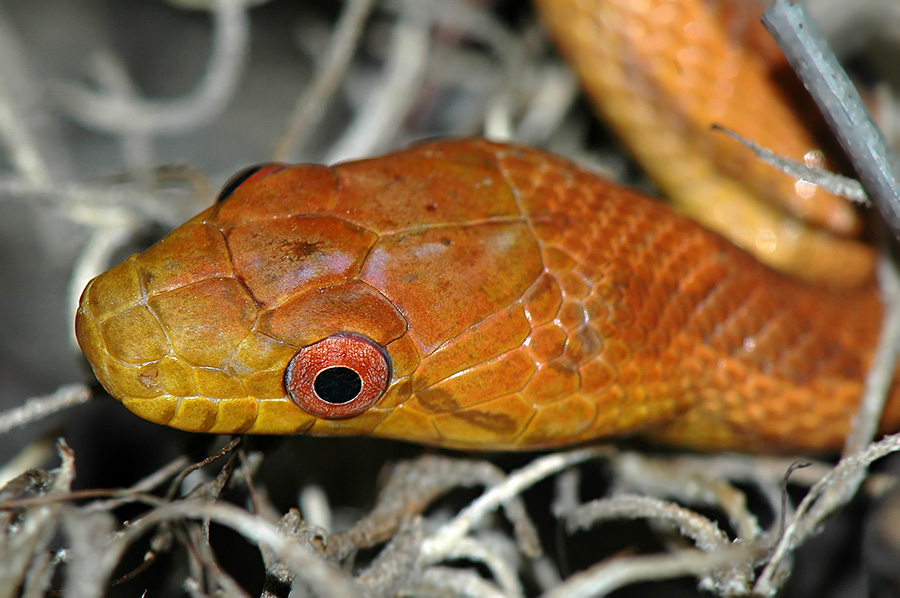
Here's a somewhat over-processed pic of a little snake shot with the MCON-40 on a cheap, 70-210 zoomer. It was also shot through glass that was less than clean. You can see that the DOF is shallow enough, but not non-existing. This is at 210mm & f/13.
Haha! Very sharp result, but I don't think you'll find me taking Macro photos of snakes anytime soon! (though perhaps that has something to do with us having almost all of the world's most venomous snakes!)
It's an interesting concept though - buying a $100 filter for a $50 lens
Mark Kenfield wrote:
It's an interesting concept though - buying a $100 filter for a $50 lens
Ahhh, I see your point. The lens you got is probably more of a portrait lens anyway. I was inspired by your use of it with my suggestion. But if macro use is of interest, a cheap set of tubes will do the job just fine. A vintage, non-AI set can be had for all of $20 on ebay. I know a lot of folks think that you need the AI version to get metering and TTL flash, but that's not the case. Just set the aperture where you want it, enter the same data in the non-CPU setting and shoot away. You'll have full metering and TTL just like with an AI set.
Elan, thanks for that list, seems the two I have are both Tokina made if that list holds true for the mount I have, and after feeling inside the built in hood on the 200, it also has the velvet lining on it, never really felt inside it before.
And Mark, that's a heck of a stack of filters there,
very interesting thread, nice find and beautiful pictures...
the story about Vivitar is very interesting.
The only Vivitar lens I used was a zoom on my Canon camera...
NightOwl Cat wrote:
Elan, thanks for that list, seems the two I have are both Tokina made if that list holds true for the mount I have, and after feeling inside the built in hood on the 200, it also has the velvet lining on it, never really felt inside it before.
And Mark, that's a heck of a stack of filters there,
The codes hold true regardless of the mount. Only thing is, I don't think Tokina ever made a 200/3.5 prime. It sounds like what you actually have is the early Komine 200/3.5. If I'm right, the serial actually starts with 28 and the hood only extends out 3/4" or so. That lens had a more primitive design, with a laborious focus ring and a barrel that makes you feel like you're holding a steel pipe. I also felt that she meters more like a 4.0 than a 3.5. But the optics are very good and I think I also remember good flare resistance. 95% chance the mount is non-AI. Let me know if I'm right.
What is the filter thread size of the 28/2.8? I don't have that one, but the 24/2.8 Tokina I have is 58mm, so I'm wondering if it's the same.