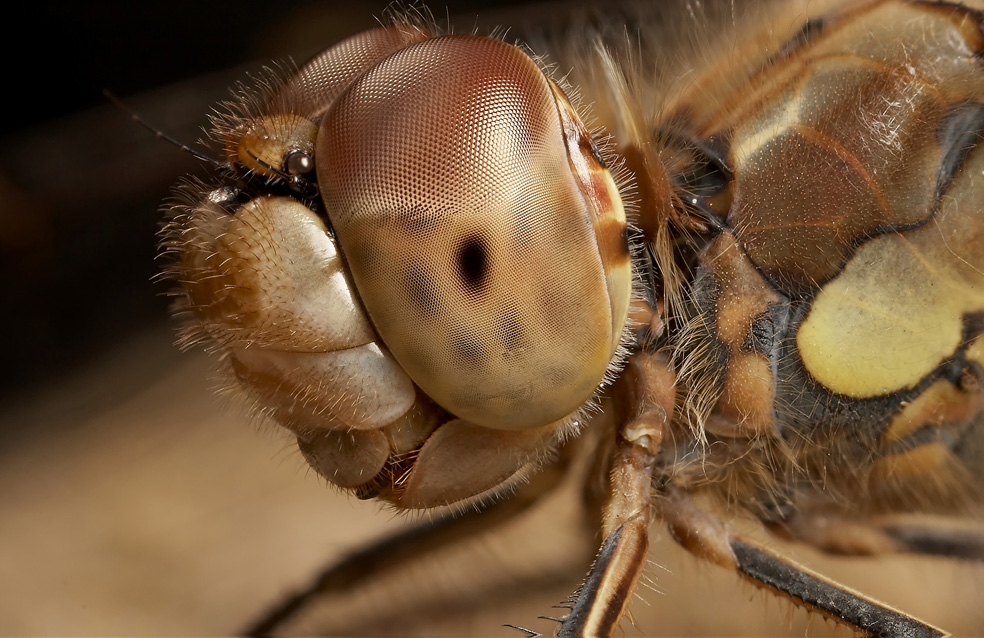
Have to admit I'm a bit of a detail freak often with macros. I tend to shoot at fairly open apertures (very rarely above F11 at 1:1 and down to F6.3 at 5:1) to avoid diffraction softening. This of course tends to give fairly shallow DOF. To make up for this I often focus stack images. There is a tutorial I did a while ago here- http://www.flickr.com/groups/macroviewers/discuss/163367/
but it's a way of combining a series of shots taken at different focus depths into one shot.
Example results below.
Brian V.
Brian , wonderful job, I have tried this but was doing it wrong, I was changing the focus point which was changing everything I think I should have just changed F stops . are you doing this in PS or are you using one of the other programs like Helicon. if you are doing it in PS explain how , I'm really not that good in PS, don't experiment enough. SSSShhh don't tell this to anyone.
Tom - read the tutorial link in the first post- all will be explained.- It's done with software fairly automatically. You do sometimes have to clean up a bit after in PS but nothing complicated. I normally just used fixed focus and move the camera in between shots. The software takes care of the slightly changing FOV, the only thing it will not deal with are rotational differences between pics. Does take a while to get used to the technique but it's very good focus practice
You did pretty well though with your PS job
Brian V.
Wow, you have been an inspiration! I had no idea you could get such stunning results with this technique! Those are incredible! I used to work at the entomology lab at The Ohio State University, I'm definately going to drop by to try this out.
I have a question. There is no focus ring per se in macro lenses (I use 105mm and 200mm Micronikkors). At reasonable magnification (still under 1:1) extension built into the lens kicks in changing magnification with each shot as we change the point of focus.
When we try to stack them up in either PS or in Helicon or similar softwares, the different sets of pics are not necessarily aligned. How exactly do you take care of this aspect ?
Second part of the question is whether fixing a particular magnification on the lens + moving the lens itself using a focussing rail help keep the subject perfectly aligned (same magnification for all shots) ?
I know there is a mount for canon body to use nikon lenses but is there a way to get the canon mpe-65 to work on a nikon camera? I know it's the photographer not just the tools but even I would like to use that lens.
Absolutely amazing work Brian! Like others, I'm curious if these are handheld and you quickly popped off a few shots while moving, or if they're tripod mounted and you racked the camera on a macro slider. That's pretty spiffy that the software can handle the slight perspective changes.
Stephanie, unfortunately Canon mount lenses won't work on Nikon's mount due to the differences in the size of the physical mount so there's not really a way to get the MP-E on a Nikon.
Thanks for the comments/compliments
Rampai65 and Ariel , The software resizes and realigns the pictures for you- it also colour/exposure matches the pics.
Using a focus rail undoubtably increases the success rate of stacking pictures, I did my first stacks of flowers using one. I have not in practice though seen any difference between using a macro rail and using a tripod and adjusting the focus ring. They both change the FOV as you focus.
I don't use tripods for bug work. All the shots above were taken at fixed focus by moving the camera by hand. I often just rest the lens on the same surface the bug is on (or on my hand resting on something). In this case I start shooting from the outside of the subject and then move the camera in for each shot. If the subject is on a leaf or similar I effectively use a monopod (it's actually a 7 foot beanpole which I grip in my lefthand along with the camera) and use the fixed focus sway technique method of focusing and shoot whilst moving. You just do this several times at different focus points on the subject.
As you really need to do the shot sequence quickly for bugs, I mentally note where the subject is slightly OOF when I'm doing a shot and use that as the next sharp focus point. I don't always get this right and you can end up with oof bands going across the pic.
One good thing about trying to focus stack is that even if you do not get a succesful stack (eg the subject moved between shots) you do normally get at least one shot with exactly the right focus- almost like doing focus bracketing.
Last thing to mention is that you do sometimes get halos around sharp edges but these can be easily cloned out and you also need to check the number of legs on bugs
Brian V.
These can not get any better imho. I have used the Combinez software a few times but the files always had a bit of a halo around the sharp parts in focus.Your samples show that is all possible with a very good result.Thanks for sharing.