I currently have a Tamron 90mm Macro lens from about 3 years ago (Canon Mount). I wrote about it before because I had problems with the AF and the focus overall. I had to send it back to Tamron because it wasn't sharp even when focused manually. Tamron fixed it.
I have always been impressed by both Leica and Zeiss lenses and I own a couple of each, but I've been thinking about selling the Tamron and getting a Contax version of the Zeiss. KEH has some really good deals on the Contax 60mm F/2.8 Makro Planar T* for around $400 for an "excellent" and a little bit more for the Excellent+ version. They also sell the Contax 100mm Makro Planat T* and both are fairly close, but I always hear negative things about the 100mm version in regards to handling of light, similar to the problems with the Zeiss100mm Makro.
The 60mm Contax seems like an excellent Macro lens and is very specialized for macro as well. I don't ever use my Tamron for anything other than macro work, so I don't think I would do the same with the Zeiss either. Do you think it would be worthwhile selling the Tamron and getting the Contax 60mm?
How much would the Tamron bring in? I would like to break-even if I can and the Tamron still has four years left on the warranty (7 year warranty and transferrable).
Also, I noticed that KEH sells one version of the 60mm Makro with an "S" in the name and one without, but both are Makros. What does the "S" stand for?
Your comments would be greatly appreciated, especially if you have a Contax 60mm Makro.
Thanks,
Bill
PS. Although I've been taking more macro photos lately, I've enjoyed it and I'm thinking about taking a lot more, especially of flowers, insects, and possibly minerals. I'm a wildlife biologist so this is where some of that interest stems.
Check the B&S boards here to see what that Tamron is fetching. I had an SP DI version of that lens that I returned because my ~30yr old Bokina was sharper. I didn't bother trying to get it looked at.
The downside of the 60mm is you've got relatively little working distance. I love the Contax Zeiss lenses, and own 5 or 6.
I thought about picking up the 60mm Macro, but opted for the 100mm F2.0 Zeiss Makro Planar, as it's reportedly noticeably improved over the Contax version. Plus I've got a 90mm Bokina, MInolta 50mm macro, and a Kiron LD 105mm macro as well.
I’m sure the 60mm is a very good lens, but I've never used one. KEH is great too. I've never heard of an "S" designation. You might email KEH and ask.
Doesn't really answer your question, but a little commentary for whatever it's worth:
I think this is a question of focal length change more than of any two particular lenses. 50-60 macros have VERY short working distances and you need to be sure it'll be sufficient for you. Now, if you were doing flowers or minerals it usually wouldn't matter but insects and small animals it can be a major problem. At 1:1, I find even the working distance of a 100mm macro to be quite tight. I've bumped into flowers more than once. If I were really into doing insects I might be thinking about actually *increasing* working distance (Sigma 150/2.8 or 180/2.8, perhaps), not decreasing.
Google tells me that the S-Planar was the first version of the 60/2.8 and has the same optical formula as the regular Macro-Planar version and the third "C" version (which had a smaller barrel that only went to 1:2). Can't say if it's true or what the differences are.
The S-Panar, so far as I know, is the only Contax 60 that goes 1:1 natively, but they didn't change the optics when they moved to the 1:2 helicoid.
I've owned the S-Planar. It's a good macro, but there's not a lot of working distance as others have pointed out. It's also not very good at mid-to-landscape distances (distortion, field curvature). Leica made a better all-around 60 with the Elmarit-R and Zeiss made a better all-around macro with the Contax MP 100/2.8, which is a big lens, but optically, it's ready for whatever you want to throw at it.
C stands for "Compact" and only goes to 1:2 allowing it to be smaller. I'd personally get the C if I never or rarely went past 1:2. If you want to do 1:1 often I'd get the S. Not sure what S stands for.
From Googling it looks like there were *three* versions, not two. The S-Planar is the original, then the Makro-Planar which had the same optics and still went to 1:1, and then the Makro-Planar-C version which changed the helicoid and smaller body in exchange for the 1:2 limitation was the third. I haven't figured out the difference between the first two.
arduluth wrote:
C stands for "Compact" and only goes to 1:2 allowing it to be smaller. I'd personally get the C if I never or rarely went past 1:2. If you want to do 1:1 often I'd get the S. Not sure what S stands for.
I think the "S" designation was used for reproduction-quality lenses. I believe that's where it started for them and it carried over to the taking lenses. They used it for the Hassy S-Planar 120 and 135, which eventually got the MP branding. They didn't change the optical formula in the 135 throughout it's run and it's still a stellar lens at any distance. The 120, IIRC, did get updated when they rebranded it.
Lee Saxon wrote:
From Googling it looks like there were *three* versions, not two. The S-Planar is the original, then the Makro-Planar which had the same optics and still went to 1:1, and then the Makro-Planar-C version which changed the helicoid and smaller body in exchange for the 1:2 limitation was the third. I haven't figured out the difference between the first two.
Interesting. I've never seen an MP-branded lens that could do 1:1, or have and was't aware of it, but it wouldn't surprise me. It must've been a pretty limited run, though.
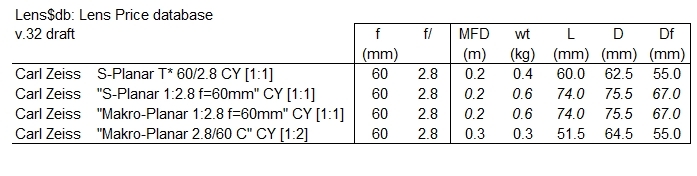
Lens$db tracks four versions of the Contax Carl Zeiss 60/2.8 Macro.
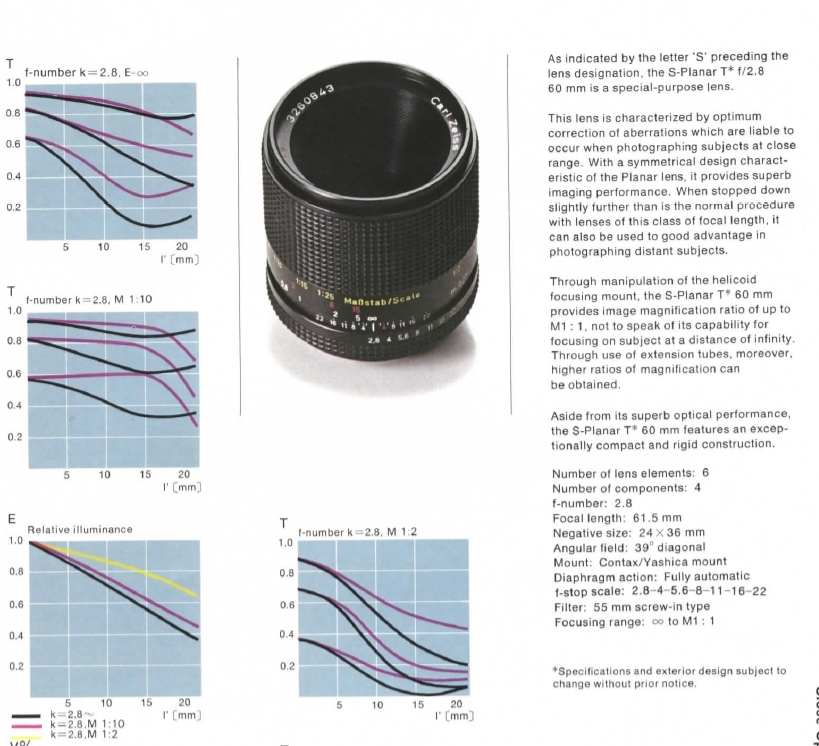
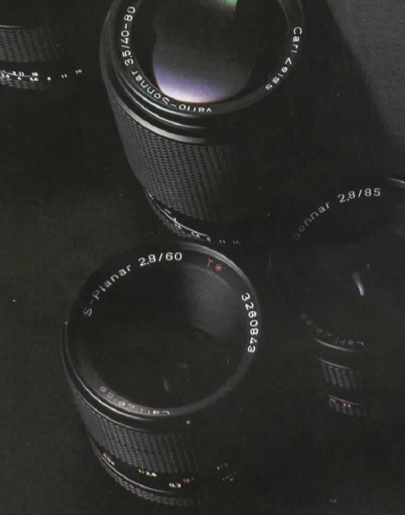
The first variant, with [1:1] mag. and a 55mm filter, is an early and rare version of the [1:1] "S-Planar" with 67mm filter. Both are labeled "S-Planar". I've attached below two images of this early S-Planar lens, from the Zeiss brochure, "The Finest Optics by ZEISS, Interchangeable Photographic Lenses with Contax/Yashica Mount" (October, 1975).
The third variant is indeed a "Makro-Planar" lens with [1:1] mag. I suspect that it's a re-badged version of the 67mm S-Planar lens.
Some sample pictures from C-Planar 60/2.8 C/Y at different apertures,cameras and applications.Very good for handheld closeups,can also serve very well as a standard lens.
It really depends on the OP's intended use, as Lee pointed out. Personally I had the Tamron 90 SP when I shot macro (plus extension tubes and the superb Raynox clip-on magnifiers) and it remains one of sharpest lenses I've ever used, plus it made a beautiful portrait lens too.
There is a superb Polish macro shooter (forget his name now - I clipped his comments and only have his online moniker) who in his words : To get really big closeups I use 2 sets of extension tubes (6 rings - total 130mm long), Tamron 90/2.8, Tokina teleconverter 2x, Raynox DCR-250, external flash Metz 48af with a huge diffuser, attached with a synchro cord to a body.
Generally speaking I can't see any need whatsoever to go down to a 60mm unless you are shooting product photography (and even then a longer lens will give you easier lighting options) and if the OP is shooting insects then the Sigma 150/2.8 is the next lens up to go to unless you want to be the next Sahan ! Then you'll need a MP-E 65mm f/2.8 1-5x macro.
Search for top macro shooters on Google. Look out for Shikhei Goh and Thomas Shahan who's probably the best known in the USA and I adore the work of Magdalena Wasiczek (Poland).
These miniature caterpillars (1 cm long) were shot with the Tamron 90 SP with a Raynox 250 attached and diffused flash. At f22 on a Pentax K7 ... so diffraction and a limited sensor is also compromising the sharpness !
As mentioned, S-Planar 60mm does 1:1, Makro-Planar does 1:1 with the same massive barrel, and Makro-Planar C does 1:2 with a barrel similar in size to CZ C/Y 50s (55mm filter size). All use the same optical formula that is optimized for 1:10 and goes rapidly pear-shaped outside that ratio. The "S" stands for Spezial, Special in German, and is classic nomenclature used by Oberkochen to denote process lenses (those optimized for finite distances or unusual spectrum). So, "S" lenses like SP60 are made in (West) Germany, while MP60 is made in Japan. The other "S" lens in Contax mount is the mighty SP100 for t/s bellows. I own the SP60, and admit it is overshadowed by modern lenses, but it sure is fun to mount on a Contax SLR (or a puny A7ii). Contrast is medium, bokeh is smooth:
Peire wrote:
Some sample pictures from C-Planar 60/2.8 C/Y at different apertures,cameras and applications.Very good for handheld closeups,can also serve very well as a standard lens.
Your photos of the fern and the flowers below it have the brilliance that I think you only get from Zeiss lenses and they're very sharp from what I'm seeing. They are much sharper and have better definition than the photos I get from my Tamron 90mm. I know it's not the camera because I'm using both a Canon 6D and a Canon 5DSR, especially the 5DSR is an exceptional camera. That's why I fault the lens.
I'm glad to see that the 60mm did a nice job on those photos.
I was thinking about a used version of the 50mm Zeiss Makro ZE because it would be easier, but they're still more than I want to spend and I have had good luck with the Contax lenses as I have a couple of them and they've been great even though they're older. I'm open to Leica as well (I just bought two in recent months, a Summicron 50mm & an Elmarit 28mm, both are "R" lenses), but I don't think they're as simple as the Zeiss lenses because some seem to require an adapter and they're also more expensive than the Zeiss Makros.
If YOU had a choice between the 50mm Makro, the 60mm Makro, or the 100mm Makro, which would YOU get for macro work of things that don't move much (not insects)? I'm thinking about flowers, minerals, and close-up photos of fish organs (dead), etc.
I also have a 3-piece lens tube set, so a 60mm lens wouldn't be that bad even if it's not 1:1. I would like a lens that CRYSTAL SHARP, BRIGHT, AND GOOD RETENTION OF COLORS.
Thanks.
billsamuels wrote:
Your photos of the fern and the flowers below it have the brilliance that I think you only get from Zeiss lenses and they're very sharp from what I'm seeing. They are much sharper and have better definition than the photos I get from my Tamron 90mm. I know it's not the camera because I'm using both a Canon 6D and a Canon 5DSR, especially the 5DSR is an exceptional camera. That's why I fault the lens.
I'm glad to see that the 60mm did a nice job on those photos.
I was thinking about a used version of the 50mm Zeiss Makro ZE because it would be easier, but they're still more than I want to spend and I have had good luck with the Contax lenses as I have a couple of them and they've been great even though they're older. I'm open to Leica as well (I just bought two in recent months, a Summicron 50mm & an Elmarit 28mm, both are "R" lenses), but I don't think they're as simple as the Zeiss lenses because some seem to require an adapter and they're also more expensive than the Zeiss Makros.
If YOU had a choice between the 50mm Makro, the 60mm Makro, or the 100mm Makro, which would YOU get for macro work of things that don't move much (not insects)? I'm thinking about flowers, minerals, and close-up photos of fish organs (dead), etc.
I also have a 3-piece lens tube set, so a 60mm lens wouldn't be that bad even if it's not 1:1. I would like a lens that CRYSTAL SHARP, BRIGHT, AND GOOD RETENTION OF COLORS.
Thanks.
For what you intend it to use,100mm macro would be my choice.I currently have 11 macro lenses with fl 100-105mm,but the one I prefer most is the Makro Planar 100/2 ZE.
For high sharpness and good colour rendition,Tokina ATX AF 100//2.8 - either older 1:2 or latest 1:1 is also worth considering.
Anyone want to comment on Contax 60MP vs Leica 60ME?
Frogfish wrote:
These miniature caterpillars (1 cm long) were shot with the Tamron 90 SP
Gorgeous shots Kevin.
Peire wrote:
Some sample pictures from C-Planar 60/2.8 C/Y at different apertures,cameras and applications.Very good for handheld closeups,can also serve very well as a standard lens.
Gorgeous images Peire. I'd characterize these colors as more organic or a little "gentler" than the 100AME, which fits our generalizations of the style of these two lens families.
Thank you Lee.As for Leica Elmarit R 60/2.8 - it is a special lens either.It has less microcontrast than the 60/2.8 MP -C,but colours are very deeply saturated and rich.
rico wrote:
As mentioned, S-Planar 60mm does 1:1, Makro-Planar does 1:1 with the same massive barrel, and Makro-Planar C does 1:2 with a barrel similar in size to CZ C/Y 50s (55mm filter size). All use the same optical formula that is optimized for 1:10 and goes rapidly pear-shaped outside that ratio. The "S" stands for Spezial, Special in German, and is classic nomenclature used by Oberkochen to denote process lenses (those optimized for finite distances or unusual spectrum). So, "S" lenses like SP60 are made in (West) Germany, while MP60 is made in Japan. The other "S" lens in Contax mount is the mighty SP100 for t/s bellows. I own the SP60, and admit it is overshadowed by modern lenses, but it sure is fun to mount on a Contax SLR (or a puny A7ii). Contrast is medium, bokeh is smooth: