Bellows are generally not very useful for wide angle stuff where dedicated T/S lenses excel.
Bellows can be fairly inexpensive and good for products, time lapse, most general photography (I mean where infinity focus is required, not just close ups or macro) where control of the plane of focus matters.
Bellows can be cumbersome, potentially heavy and a general pain compared to using a T/S adapter or T/S lens but using them on a tripod is not a problem (if you are happy using tripods, not everyone is). I use a Nikon PB-4 with enlarging lenses a lot and have few complaints. I like the Nikon PB-4 because it has swing and shift, but unfortunately not tilt.
I have a Mamiya 4/120 macro with a Mirex Tilt/Shift adapter and although this is a very nice lens, and the Mirex adapter is also excellent, I far prefer to use enlarging lenses with the Nikon PB-4 for most of the product shots that I do in a studio environment. Once outdoors the Mamiya 4/120/Mirex is the better option. So it really depends on what you like to do.
Some other options I've been thinking about: http://www.dpreview.com/forums/post/56827404
The Cambo is cool, but doesn't do enough for the price.
The Spiratone Bellows Master SST would be ideal if it was better made, it's a bit sloppy.
I think a T-S lens is the best solution for getting lens movements at infinity focus, especially with wide and really-wide angle lenses. I use the Canon TS-E 17/4L and 24/3.5L II. I also use the Mirex T-S M645 to EOS adapter with Mamiya 645 lenses C 55/2.8N, C 80/2.8N, and A 150/2.8. The TS-E 24/3.5L II + 1.4x III Extender is better than the Mamiya 645 C 35/3.5 on Mirex. I also use the M645 C 80/4N Macro, A 120/4 Macro, and A 200/2.8 APO, but generally only "straight up" on a fixed adapter.
For close-up and macro shooting (and for messing around with MF & LF lenses), I use a Mamiya 645 Auto Bellows N, and sometimes a small Kopil bellows (35mm) with tilt plus front & back shift, but it has fewer independent movements than the M645 bellows.
I don't use the system myself, but I have some good friends who swear by the Mirex adapter with medium format lenses.
The pluses of this system include:
- you can use just any MF lens and get your movements, even zoom lenses — that is what my friends do.
- there are still some really good values among older MF lenses, if you know what you are looking for. (The super deals may have diminished a bit as some of the older gear has been snapped up by digital MF photographers and others.)
The minuses include:
- the need to add one more piece of gear between your lens and the camera.
- you essentially work in fully manual mode.
Dan
JohnJ wrote:
Bellows are generally not very useful for wide angle stuff where dedicated T/S lenses excel.
Bellows can be fairly inexpensive and good for products, time lapse, most general photography (I mean where infinity focus is required, not just close ups or macro) where control of the plane of focus matters.
Bellows can be cumbersome, potentially heavy and a general pain compared to using a T/S adapter or T/S lens but using them on a tripod is not a problem (if you are happy using tripods, not everyone is). I use a Nikon PB-4 with enlarging lenses a lot and have few complaints. I like the Nikon PB-4 because it has swing and shift, but unfortunately not tilt.
I have a Mamiya 4/120 macro with a Mirex Tilt/Shift adapter and although this is a very nice lens, and the Mirex adapter is also excellent, I far prefer to use enlarging lenses with the Nikon PB-4 for most of the product shots that I do in a studio environment. Once outdoors the Mamiya 4/120/Mirex is the better option. So it really depends on what you like to do.
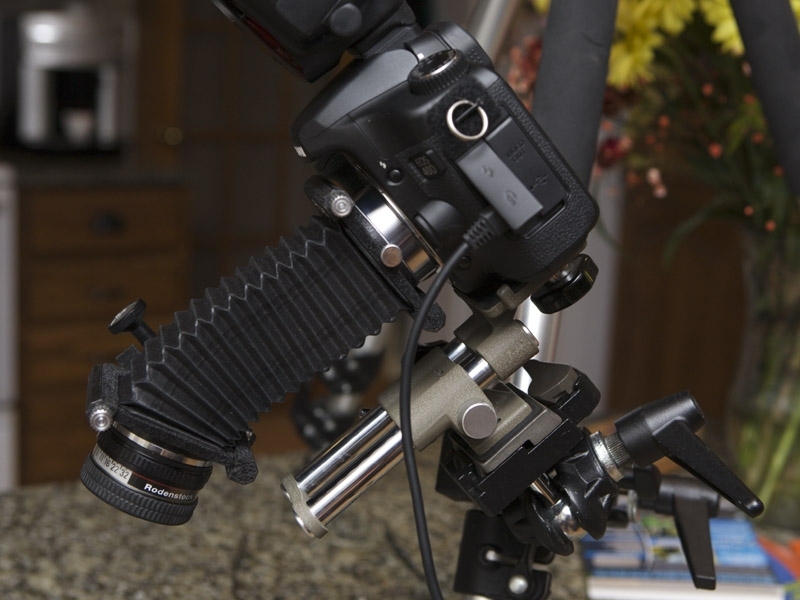
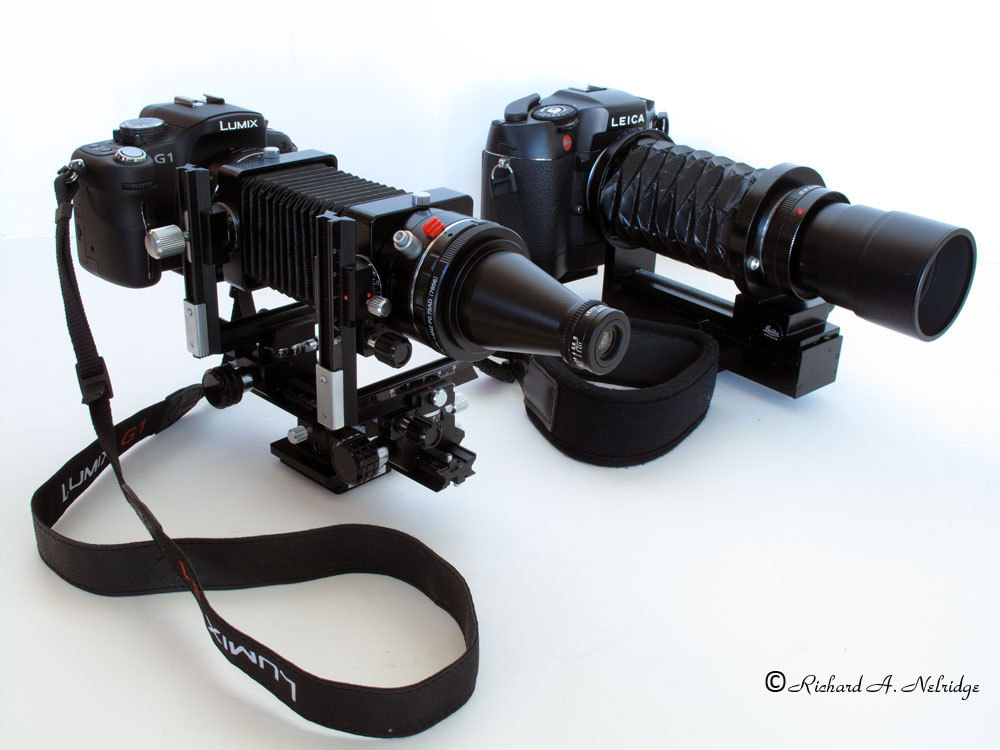
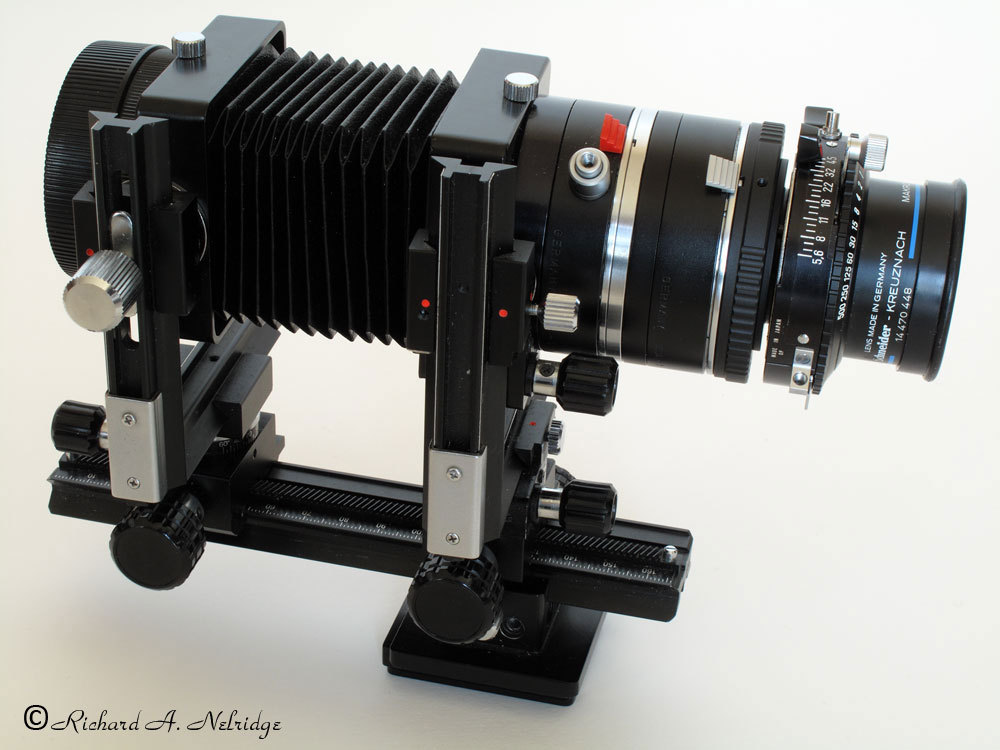
Bellows will offer much flexibilty but must be used with some care. You can get simple bellows like my Leica R bellows seen in the first and 2nd images at the rear or much more flexible with all or most ot the movements of a View camera like my Spiratone Bellows Master SST in the front of both of the first 2 photos. I wish my Spiratone Bellows were more rigid.
Bellows can use a wide assortment of macro lenses, Photo Macro lenses (like Leica/Leitz Photars), enlarging lenses, large format and large format macro lenses and medium format lenses. If you want a lot of magnifications you can get a cone made to work with the bellows and the RMS (royal microscope screw) Photo Macro lenses like the Leica/Leitz Photar lenses. These can be seen in the 3rd image.
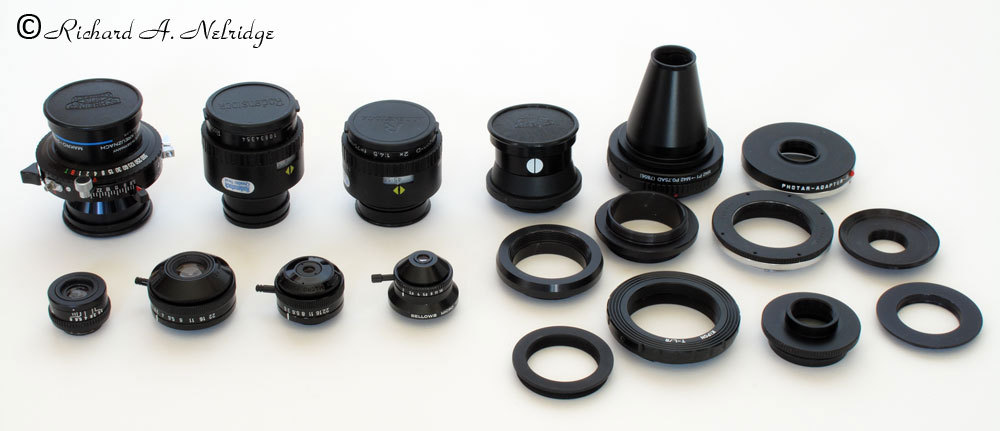
Using a LF camera camera also allows for the usage of these lenses and Linhof had the special Macro Photo Tube which with adapters had/has a Copal Shutter and allows for special usage Macro lenses like the Schneider M Componons (shown) whcih can be swapped with adapters for the RMS thread photo lenses. The same special Schneider M Compon lenses can also be used on a bellows. These can be seen in the 4th image.
You can even adapt LF macro lenses to the bellows with special adapters as seen in the last image.
thebmrust wrote:
...If you have example images that might show the difference between bellows and TS those would be appreciated too.
That's probably not as simple as it sounds.
There is no comparison at the very wide end (17, 24mm) because it's generally the realm of dedicated t/s lenses anyway. Same could be said for the long end where there are no dedicated t/s lenses longer than 90mm whilst you can adapt lenses longer than 90mm to either a t/s adapter or bellows (I've done both with 150mm Mamiya M645 lens on a Mirex t/s adapter and several 180mm enlarging lenses on a bellows).
Dedicated t/s lenses can often be very similar in operation/functionality to primes used on t/s adapters so comparisons can certainly be made however I've not done that so I can't offer samples. I suspect that differences would largely be due to the rendering of the lens itself as obviously different lenses are being used.
There are no fast dedicated t/s lenses but you can potentially use faster lenses on a t/s adapter. I use a Mamiya M645 1.9/80N lens on a Mirex t/s adapter some times and the combination of shallow depth of field and control of focal plane can be interesting.
In general, bellows usually allow more swing/tilt (for example Nikon PB-4 offers about 25 or 30 degrees IIRC) than a dedicated t/s lens or a t/s adapter however this doesn't mean that a lens is capable of rendering a useful image with so much movement. Some lenses can so the extra movement can be useful, especially at close range.
I particularly like to use enlarging lenses, I have more than a casual interest in them http://photocornucopia.com/1061.html , so this is the main reason that I use a bellows so much, but not necessarily with tilt or shift. If I were shooting street scapes, interiors, landscapes I'm not sure I'd ever go near a bellows. Although some of the t/s adapters might be OK, you would be limited to maybe 35mm at the widest which probably isn't enough (in general). I really do like the Mamiya 3.5/35 so have no hesitation using it as a t/s lens with the Mirex adapter. As I said before, it really depends on what you want to do. If you are looking at lenses in the 24mm focal length range then a t/s adapter or bellows is no good to you, only a dedicated t/s lens.
naturephoto1 wrote:
... a View camera like my Spiratone Bellows Master SST in the front of both of the first 2 photos. I wish my Spiratone Bellows were more rigid....
I've heard this comment many times about the Spiratone bellows. It's a shame as it looks like an ideal device for 35mm use, and in high demand too.
Wow... Kind of mind blown actually. All the combination possibilities and applications. You have all provided enough information that this has opened a whole new huge world of possibilities.
One reason for using bellows is because you have a bellows lens—presumably a lens with compelling qualities. A bellows unit often offers more movements than can be found on an ordinary T/S lens. I own the Contax RTS bellows with dedicated 100/4 macro, and particularly like rotation capability on the rear standard. Example below shows wafer-thin DOF and a crazy plane of object focus:
JohnJ wrote:
There is no comparison at the very wide end (17, 24mm) because it's generally the realm of dedicated t/s lenses anyway. Same could be said for the long end where there are no dedicated t/s lenses longer than 90mm whilst you can adapt lenses longer than 90mm to either a t/s adapter or bellows (I've done both with 150mm Mamiya M645 lens on a Mirex t/s adapter and several 180mm enlarging lenses on a bellows). <...>
Some good information here. I would just add that with view cameras and perhaps some bellows -- but not T/S lenses or most bellows -- you have control over the tilt/swing axis. Rear tilts and swings affect perspective, front do not. Rear is also more forgiving of image circle, though with digital cameras (DSLRs especially) this is compromised by the registration distance. With some view cameras you can also choose to tilt from the base or somewhere in the lens/sensor plane. Differences in the latter case are mostly operational but if you get serious about it it's at least worth knowing about.
jcolwell wrote:
I think a T-S lens is the best solution for getting lens movements at infinity focus, especially with wide and really-wide angle lenses. I use the Canon TS-E 17/4L and 24/3.5L II. I also use the Mirex T-S M645 to EOS adapter with Mamiya 645 lenses C 55/2.8N, C 80/2.8N, and A 150/2.8. The TS-E 24/3.5L II + 1.4x III Extender is better than the Mamiya 645 C 35/3.5 on Mirex. I also use the M645 C 80/4N Macro, A 120/4 Macro, and A 200/2.8 APO, but generally only "straight up" on a fixed adapter.
For close-up and macro shooting (and for messing around with MF & LF lenses), I use a Mamiya 645 Auto Bellows N, and sometimes a small Kopil bellows (35mm) with tilt plus front & back shift, but it has fewer independent movements than the M645 bellows....Show more →
Hi, what adapter do you use on the OLY to the Mamiya bellows ? I can't find any adapter for any lens to the Mamiya 645 body.
andreleon wrote:
Hi, what adapter do you use on the OLY to the Mamiya bellows ? I can't find any adapter for any lens to the Mamiya 645 body.
Hi. I can't check right now, but it's almost certainly an OM to EOS adapter, glued (ShoeGoo'ed) into a plastic Mamiya 645 body cap, with its centre drilled out.
Yes, it's been working for me, for four years. I also have similar adapters for M42, M39, M55, and a couple of LF lens boards, some of which I've been using for over ten years.




 A bellows unit often offers more movements than can be found on an ordinary T/S lens. I own the Contax RTS bellows with dedicated 100/4 macro, and particularly like rotation capability on the rear standard. Example below shows wafer-thin DOF and a crazy plane of object focus: