This topic is in the 2013 archive. You can read it and like its posts here. It is read only.
Archive 2013Sony a7/a7r limited by E-Mount?
p.1 #1Sony a7/a7r limited by E-Mount?
This question for the Brainiacs. Given that the Nikon F-Mount seems unable to support super-fast AF lenses like Canon’s 50mm F/1, 50mm F/1.2, and 85mm F/1.2 due to the diameter of the lens mount. Will Sony’s E-Mount be able to support such lenses? I ask because the announced lenses seem slow and I wonder if it because they are trying to keep the lenses small or is it a mount limitation. I figure, again this is from a layman in the field of optical engineering, that the E-Mount is fully capable of having fast APS-C lenses, but so far I have not heard anyone chime in on the FF lenses for the E-mount.
Note: I am aware that Nikon made a Nikon 58mm f/1.2 Noct-NIKKO, but that was manual focus and with their recent 58mm F/1.4, it appears they are not able to do faster than F/1.4 with AF, because if they could they would. Canon is enjoying a significant marketing advantage with their 85mm F/1.2.
Note: I am aware that Nikon made a Nikon 58mm f/1.2 Noct-NIKKO, but that was manual focus and with their recent 58mm F/1.4, it appears they are not able to do faster than F/1.4 with AF, because if they could they would. Canon is enjoying a significant marketing advantage with their 85mm F/1.2.
Oct 19, 2013 at 11:28 AM
p.1 #2Sony a7/a7r limited by E-Mount?
The E-mount throat is actually 2 mm larger in inner diameter than the F-mount and the M-mount. The reason Nikon "can't" do f/1.2 (they could) is that the aperture lever and the electrical contacts is interfering with the rear lens element, if this element sits where the throat is. Which it does on all shorter focal lengths.
Now, of course the E-mount throat could cut off rays from a large exit pupil (which isn't necessarily the case just because the entrance pupil is large), if the distance to it is large from the sensor. The closer it is to the sensor, the less the throat will interfere with the infalling light. But on the other hand, the more problems with color shift and such we will get.
Now, of course the E-mount throat could cut off rays from a large exit pupil (which isn't necessarily the case just because the entrance pupil is large), if the distance to it is large from the sensor. The closer it is to the sensor, the less the throat will interfere with the infalling light. But on the other hand, the more problems with color shift and such we will get.
Oct 19, 2013 at 12:04 PM
p.1 #3Sony a7/a7r limited by E-Mount?
Because the throat is relatively small AND so close to the sensor, the mount itself creates interference issues. As theSuede has pointed out, most lenses that Sony designs that are faster than f2 or so are going to end up being about as long as their DSLR counterparts with an adapter attached. See: link 1 and link 2
Oct 19, 2013 at 12:43 PM
p.1 #4Sony a7/a7r limited by E-Mount?
douglasf13 wrote:
Because the throat is relatively small AND so close to the sensor, the mount itself creates interference issues. As theSuede has pointed out, most lenses that Sony designs that are faster than f2 or so are going to end up being about as long as their DSLR counterparts with an adapter attached. See: link 1 and link 2
Well, the second link indicates that you won't have any problems with lenses that have an exit pupil that isn't very large AND very far from the sensor. I think most ~50/1.4 lenses will "pass" this, since the exit pupil will be significantly smaller than the mount, even if the distance is greater.
I measured the rear lens element of two of my f/1.4 Nikon lenses, and they are 31 and 33 mm respectively. So, with a 46 mm throat minus a few millimeters for the attaching flange, and a ~40 mm distance (the rear lens element protrudes beyond the flange), it will probably work fine.
Perhaps the outmost parts (~2-3 mm) of the corners could get some cutting of the blur discs wide open, but what the heck.
Oct 19, 2013 at 01:02 PM
p.1 #5Sony a7/a7r limited by E-Mount?
MadManAce wrote:
This question for the Brainiacs. Given that the Nikon F-Mount seems unable to support super-fast AF lenses like Canon’s 50mm F/1, 50mm F/1.2, and 85mm F/1.2 due to the diameter of the lens mount. Will Sony’s E-Mount be able to support such lenses? I ask because the announced lenses seem slow and I wonder if it because they are trying to keep the lenses small or is it a mount limitation.
It's a deliberate choice, which was obvious to Sony for a few reasons:
1. The sensor is considerably larger than in competing m4/3 and APS-C cameras, but they have to keep up appearances of this being a "compact" camera, thus the slow apertures and consequently smaller lenses.
2. Even with a slow aperture, an f/2.8 lens on the A7/r is going to have the DoF of an f/1.4 m4/3 lens, and the loss of low light ability is compensated by the fact that a bigger sensor has much better high-ISO performance.
3. Sony is aware that both of the models they are releasing have fairly high resolution, it wasn't that long ago that even 24mp was considered creme of the crop, so the lens designs need to be conservative to maximize sharpness rather than exotic functionality.
On a side note, I don't think that Nikon can't produce ultra-fast glass, Nikon used to make a 50mm f/1.2 lens too after all... Perhaps they are being conservative? The bigger limitation happened when lead was banned from lens manufacture, and it was the reason the Canon 50mm f/1 died off. Lead used to be the secret sauce for fast lenses for a while.
Oct 19, 2013 at 01:06 PM
p.1 #6Sony a7/a7r limited by E-Mount?
I guess you are referring to the new 58/1.4? I presume that the electrical contacts on the new lens take up too much room inside the mount to make an f/1.2. The older lenses didn't have those contacts.
Oct 19, 2013 at 01:18 PM
p.1 #7Sony a7/a7r limited by E-Mount?
douglasf13 wrote:
Because the throat is relatively small AND so close to the sensor, the mount itself creates interference issues. As theSuede has pointed out, most lenses that Sony designs that are faster than f2 or so are going to end up being about as long as their DSLR counterparts with an adapter attached. See: link 1 and link 2
Thanks for providing the links to the insightful posts from theSuede. Very interesting, I will wait a few generations and revisit the A7 series again. For now, I will continue with my two-system setup (m.4/3 & Canon FF), hopefully, Canon gets off their a55es and introduces the ultimate solution. Because my change from Nikon to Canon after nightmare service with three D800s was expensive and I do not want to lose my top tier lenses again.
Oct 19, 2013 at 01:31 PM
p.1 #8Sony a7/a7r limited by E-Mount?
MadManAce wrote:
hopefully, Canon gets off their a55es and introduces the ultimate solution.
I thought the A55 was a Sony camera? This gives a whole new way to think about that camera name, doesn't it. Kinda matches Sony's marketing too
hopefully, Canon gets off their a55es and introduces the ultimate solution.
I thought the A55 was a Sony camera? This gives a whole new way to think about that camera name, doesn't it. Kinda matches Sony's marketing too
Oct 19, 2013 at 01:33 PM
p.1 #9Sony a7/a7r limited by E-Mount?
carstenw wrote:
I presume that the electrical contacts on the new lens take up too much room inside the mount to make an f/1.2. The older lenses didn't have those contacts.
The older f/1.2 lenses also had a non-round rear element to clear the aperture lever. I've had the 50/1.2, 55/1.2 and tried the 58/1.2, and they all look the same.
This is the 55/1.2 AI (K) that I still own:
http://img.photobucket.com/albums/v621/Makten/00001017_zps8639a531.jpg
Oct 19, 2013 at 01:50 PM
p.1 #10Sony a7/a7r limited by E-Mount?
Makten wrote:
Well, the second link indicates that you won't have any problems with lenses that have an exit pupil that isn't very large AND very far from the sensor. I think most ~50/1.4 lenses will "pass" this, since the exit pupil will be significantly smaller than the mount, even if the distance is greater.
I measured the rear lens element of two of my f/1.4 Nikon lenses, and they are 31 and 33 mm respectively. So, with a 46 mm throat minus a few millimeters for the attaching flange, and a ~40 mm distance (the rear lens element protrudes beyond the flange),...Show more →
Sorry, I didn't mean to imply that f1.4 lenses aren't possible on the FF e-mount. My point is simply that, because the mount is both so relatively narrow and so close to the sensor, Sony has to make fast lenses longer than they'd need to if the mount was larger in diameter, especially on the wider end.
douglasf13 wrote
Because the throat is relatively small AND so close to the sensor, the mount itself creates interference issues. As theSuede has pointed out, most lenses that Sony designs that are faster than f2 or so are going to end up being about as long as their DSLR counterparts with an adapter attached. See: link 1 and link 2I measured the rear lens element of two of my f/1.4 Nikon lenses, and they are 31 and 33 mm respectively. So, with a 46 mm throat minus a few millimeters for the attaching flange, and a ~40 mm distance (the rear lens element protrudes beyond the flange),...Show more →
Sorry, I didn't mean to imply that f1.4 lenses aren't possible on the FF e-mount. My point is simply that, because the mount is both so relatively narrow and so close to the sensor, Sony has to make fast lenses longer than they'd need to if the mount was larger in diameter, especially on the wider end.
Oct 19, 2013 at 07:39 PM
p.1 #11Sony a7/a7r limited by E-Mount?
Which in return completely defies reason why they made this in first place (as compact FF system camera).
I think it was rather stupid choice..
I think it was rather stupid choice..
Oct 20, 2013 at 06:13 AM
p.1 #12Sony a7/a7r limited by E-Mount?
Some people have been crying out for a small FF body for a long time. I guess Sony listened. We will find out what everyone will actually do, now that it is here.
Oct 20, 2013 at 12:48 PM
p.1 #13Sony a7/a7r limited by E-Mount?
douglasf13 wrote:
Sorry, I didn't mean to imply that f1.4 lenses aren't possible on the FF e-mount. My point is simply that, because the mount is both so relatively narrow and so close to the sensor, Sony has to make fast lenses longer than they'd need to if the mount was larger in diameter, especially on the wider end.
I think that's a misunderstanding. If anything, they will have to get the exit pupil further back not to cut off any peripheral rays. And that would probably mean that they as well could go with less telecentric designs, making them shorter (if the sensor allows it).
Of course it would have been better with a slightly larger mount, but for some reason they chose the E mount instead of making a new one (why would anyone use E lenses on this camera?). For other manufacturers with already existing FF lineups, it was wise to use the existing mount for compatibility before they actually had any FF camera.
-------------------
I hear people thinking the 55/1.8 is "large". Well, is it? Lets see how it compares to a smallish MF prime, for example the Nikkor 50/1.4 AI-S, which is a very compact little lens:
Length: 40 mm lens barrel (without the flange inside the mirror box) + 28.5 mm adapter = 68.5 mm total.
That's only 2.5 mm shorter than the Sony FE lens.
Weight: 250 grams versus 281 for the Sony. And that's without an adapter, which probably is about 100 grams or so.
Even the tiny ZM 50/2 is 61.3 mm long with adapter, and weighs 230 grams. Not much of a difference, right?
Oct 20, 2013 at 01:09 PM
p.1 #14Sony a7/a7r limited by E-Mount?
Makten wrote:
I think that's a misunderstanding. If anything, they will have to get the exit pupil further back not to cut off any peripheral rays. And that would probably mean that they as well could go with less telecentric designs, making them shorter (if the sensor allows it).
"If the sensor allows it" is the crux of the issue. As theSuede has pointed out, we won't likely see a sensor that allows it soon. Because of the relatively narrow throat being so close to the sensor, you have to either design more symmetrical lenses, which are sensor edge nightmares, or go with much longer, more tele centric designs.
The new FE primes seem to indicate as much, too. The 35mm is only F2.8, and the 55/1.8 is longer than a Nikkor 35/1.8 on a NEX adapter would be. Granted, the FE 55 looks like it'll be a fantastic performer.
douglasf13 wrote
Sorry, I didn't mean to imply that f1.4 lenses aren't possible on the FF e-mount. My point is simply that, because the mount is both so relatively narrow and so close to the sensor, Sony has to make fast lenses longer than they'd need to if the mount was larger in diameter, especially on the wider end."If the sensor allows it" is the crux of the issue. As theSuede has pointed out, we won't likely see a sensor that allows it soon. Because of the relatively narrow throat being so close to the sensor, you have to either design more symmetrical lenses, which are sensor edge nightmares, or go with much longer, more tele centric designs.
The new FE primes seem to indicate as much, too. The 35mm is only F2.8, and the 55/1.8 is longer than a Nikkor 35/1.8 on a NEX adapter would be. Granted, the FE 55 looks like it'll be a fantastic performer.
Oct 20, 2013 at 07:50 PM
p.1 #15Sony a7/a7r limited by E-Mount?
Makten wrote:
I think that's a misunderstanding. If anything, they will have to get the exit pupil further back not to cut off any peripheral rays. And that would probably mean that they as well could go with less telecentric designs, making them shorter (if the sensor allows it).
Of course it would have been better with a slightly larger mount, but for some reason they chose the E mount instead of making a new one (why would anyone use E lenses on this camera?). For other manufacturers with already existing FF lineups, it was wise to use the existing mount for compatibility...Show more →
No, it's not a misunderstanding. F1.4 at 35-40mm exit pupil distance creates an outer angle of >40degrees. F1.4 at 28mm exit pupil distance gives more than 50 degrees. It seems the A7 sensor gets into trouble at about 25 degrees...
Regarding size from sensor:
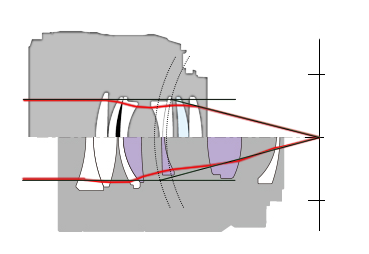
The lens on top is the Nikkor 50/1.8AFS.
I checked against the Sony ZA50/1.4 too, but the question to which I made the illustration included the 50/1.8 - can't be bothered to remake it. End of story: the ZA50/1.4 is both shorter and smaller than the 55/1.8, all measurements starting at the sensor surface.
But considering the extreme quality of the images from the 55/1.8, I couldn't care less. I doubt anything short of the Zeiss 55 or the Nikkor 58 will get close in the corners - the Leica Summilux asph certainly doesn't. And the 50AA that is ridiculously expensive for what you get is probably about equal. Just waiting to see some images on the -R that really stress the LoCA too, but it seems incredible in both relative value and absolute performance.
I think that's a misunderstanding. If anything, they will have to get the exit pupil further back not to cut off any peripheral rays. And that would probably mean that they as well could go with less telecentric designs, making them shorter (if the sensor allows it).
Of course it would have been better with a slightly larger mount, but for some reason they chose the E mount instead of making a new one (why would anyone use E lenses on this camera?). For other manufacturers with already existing FF lineups, it was wise to use the existing mount for compatibility...Show more →
No, it's not a misunderstanding. F1.4 at 35-40mm exit pupil distance creates an outer angle of >40degrees. F1.4 at 28mm exit pupil distance gives more than 50 degrees. It seems the A7 sensor gets into trouble at about 25 degrees...
Regarding size from sensor:
The lens on top is the Nikkor 50/1.8AFS.
I checked against the Sony ZA50/1.4 too, but the question to which I made the illustration included the 50/1.8 - can't be bothered to remake it. End of story: the ZA50/1.4 is both shorter and smaller than the 55/1.8, all measurements starting at the sensor surface.
But considering the extreme quality of the images from the 55/1.8, I couldn't care less. I doubt anything short of the Zeiss 55 or the Nikkor 58 will get close in the corners - the Leica Summilux asph certainly doesn't. And the 50AA that is ridiculously expensive for what you get is probably about equal. Just waiting to see some images on the -R that really stress the LoCA too, but it seems incredible in both relative value and absolute performance.
Oct 20, 2013 at 08:18 PM
p.1 #16Sony a7/a7r limited by E-Mount?
-Addendum:
What sticks out further on the DSLR lenses is all "lens hood", not optical elements. I find that part ridiculously large on all ~50mm DSLR lenses. I'd rather have the 90's style lenses that were about half in volume, with a good, removable hood in stead.
Addendum 2:
The mechanical optical limit for the F-mount is almost exactly F1.1. This includes the lever and the electrical contacts. This is a center-only value, but the F1.2 lenses on the larger Canon EF mount suffer quite a bit of mechanical shading towards the long side edges - which doesn't seem to bother people. See the truncated OOF highlights.

-85L on 5Dmk2
What sticks out further on the DSLR lenses is all "lens hood", not optical elements. I find that part ridiculously large on all ~50mm DSLR lenses. I'd rather have the 90's style lenses that were about half in volume, with a good, removable hood in stead.
Addendum 2:
The mechanical optical limit for the F-mount is almost exactly F1.1. This includes the lever and the electrical contacts. This is a center-only value, but the F1.2 lenses on the larger Canon EF mount suffer quite a bit of mechanical shading towards the long side edges - which doesn't seem to bother people. See the truncated OOF highlights.
-85L on 5Dmk2
Oct 20, 2013 at 08:30 PM
p.1 #17Sony a7/a7r limited by E-Mount?
theSuede wrote:
The mechanical optical limit for the F-mount is almost exactly F1.1. This includes the lever and the electrical contacts. This is a center-only value, but the F1.2 lenses on the larger Canon EF mount suffer quite a bit of mechanical shading towards the long side edges - which doesn't seem to bother people. See the truncated OOF highlights.
http://dawei.zenfolio.com/img/v3/p71236181-4.jpg
-85L on 5Dmk2
sure bugs me.
Oct 20, 2013 at 09:14 PM
p.1 #18Sony a7/a7r limited by E-Mount?
sebboh wrote:
sure bugs me.
Me too, just saying...
To get rid of it completely (even at F1.4) the E-mount would have to about 7-10mm larger in diameter to make a symmetrical 70-85mm lens possible without any mechanical shading in the mount throat. 35mm f/1.4 is no problem, but then you get into corner angle problems in stead.
Oct 20, 2013 at 09:44 PM
p.1 #19Sony a7/a7r limited by E-Mount?
theSuede wrote:
Me too, just saying...
To get rid of it completely (even at F1.4) the E-mount would have to about 7-10mm larger in diameter to make a symmetrical 70-85mm lens possible without any mechanical shading in the mount throat. 35mm f/1.4 is no problem, but then you get into corner angle problems in stead.
so does that mean we'll see similar results to the canon when we mount our 85/1.4 and 85/1.2 lenses on the a7(r) or are most of their designs already attempting to mitigate this effect?
sebboh wrote
sure bugs me.To get rid of it completely (even at F1.4) the E-mount would have to about 7-10mm larger in diameter to make a symmetrical 70-85mm lens possible without any mechanical shading in the mount throat. 35mm f/1.4 is no problem, but then you get into corner angle problems in stead.
so does that mean we'll see similar results to the canon when we mount our 85/1.4 and 85/1.2 lenses on the a7(r) or are most of their designs already attempting to mitigate this effect?
Oct 20, 2013 at 09:55 PM
p.1 #20Sony a7/a7r limited by E-Mount?
And me.
The Canon RF 50/0.95 has a relatively small rear element and mount.
I love this pic, so obsurd.
http://www.uxcrew.com/wp-content/uploads/2009/11/3674631408_dbb16dd3b8.jpg
http://1.bp.blogspot.com/-swS6MTY0YMI/TpSl5U8lyWI/AAAAAAAAGg4/rO7ZIiXVBkY/s1600/20091029_6676738c22409a9e0c17MIxuA3v5l55I.jpg
(Not my pics, from google omg search)
Edited on Oct 20, 2013 at 10:10 PM · View previous versions
Oct 20, 2013 at 10:01 PM