Hey, I'm interested in learning how to get better control over my macro lighting, and I've come across comments about using polarized filters. It sounded like something that would come in handy, but it doesn't seem to be something a lot of people are doing or talking about.
So are there any resources out there that talk about the subject? I have a book that describes the subject briefly, but I don't quite understand. There was something about using polarized filters on the flashes and also on the lens to cut down on specular highlights? I should find that book again...
I'm interested in how to use the technique and what results one can get with it. Examples of gear and resulting images would be great.
I don't know of anyone who uses polarizers to control highlights, have heard of it though not seen any actual results. AFAIK most here use flash, properly diffused and of appropriate apparent light size (apparent to the object). The https://www.fredmiranda.com/forum/topic/780820 thread will give you an idea of gear people use - of which the lighting end/configuration is probably the most important - and finding what they shoot with it is logical ...
You can do this to reduce specular highlights from a flash without using a diffuser but there are two problems. First shiny subjects do not look shiny anymore (ie can look flat) but more importantly you lose more than 4 stops of light doing it which is a bit of a limitation.
A couple of comparison shots below using a naked flash gun (ie no diffuser)
Brian V.
CPL on the lens but not the flash - no effect on highlight
polarising filter on flash head and CPL on lens
no diffuser but polarising sheet on flash CPL on lens at wrong angle
No diffuser but polarising sheet on flash CPL on lens at 90' rotation to above shot
Not too much to add after Mark and Brian's excellent post, other than to say that I tried it at one point and didn't like the effect -as mentioned by Brian the light seems to come out looking flat. IMHO if you're having trouble with specular highlights then check out the Apperant Light Size Principle -that article helped me immensely when I was building my own diffuser for Canon's MT-24EX (practically a bare bulb flash that's brutally harsh out of the box). The tl;dr version: Either get your flash closer to the subject, get a bigger diffuser, or both (although you really should read that article).
I like the results with the foil/candy bug with the polarizer, and having the polarizer set correctly seems to have improved the exposure with the lady bug (or is it the asian beetle?)...unless compensation was made between shots?
I can see the use for it, though. I once tried to photograph a lollipop, and my best result came when I surrounded it with a white dome. But then it was reflecting the white surroundings, so it still looked a little wrong.
Dalantech wrote:
Not too much to add after Mark and Brian's excellent post, other than to say that I tried it at one point and didn't like the effect -as mentioned by Brian the light seems to come out looking flat. IMHO if you're having trouble with specular highlights then check out the Apperant Light Size Principle -that article helped me immensely when I was building my own diffuser for Canon's MT-24EX (practically a bare bulb flash that's brutally harsh out of the box). The tl;dr version: Either get your flash closer to the subject, get a bigger diffuser, or both (although you really should read that article)....Show more →
I must admit that I have gotten a lot about macro lighting from your blog, and it's been really helpful. I'm "coming back" to macro as it were...I'm rebuilding my set-up. I used to have the mt-24ex with my own custom diffusers, but now I opted for two 270ex II flashes because of the wireless capability, and because they're much cheaper than the mt-24. I'm just now discovering the wireless flash controller on my 7D, which works really well for multiple flashes. (The 270's only function as group "A", which is okay considering the ability to change the "ratio" by adjusting distance or angle of the flash.)
Just a small addition, I tried this as well. Actually cross-polarization in which a linear polarizing sheet is put in front of the flash in addition to the polarizer on the lens. This cuts out all reflections and highlights. Although it works for very shiny subjects, the saturation that comes through seems almost unnatural and isn't a great look. I quickly abandoned the idea and went back to NL with very well diffused flash wherever possible.
Where you would want to use a polarizer is if your subject is wet, or if you are shooting something underwater since the reflections are simply overwhelming otherwise.
Darren Neff wrote:
...I used to have the mt-24ex with my own custom diffusers, but now I opted for two 270ex II flashes because of the wireless capability, and because they're much cheaper than the mt-24. I'm just now discovering the wireless flash controller on my 7D, which works really well for multiple flashes. (The 270's only function as group "A", which is okay considering the ability to change the "ratio" by adjusting distance or angle of the flash.)
I'd like to know how well that setup is working for you -sounds very interesting!
Dalantech wrote:
I'd like to know how well that setup is working for you -sounds very interesting!
I'm literally just putting it together, but so far I'm really happy with the 270 flashes. The features for macro use are really good. The combined output is very similar to the MT-24, the weight is the same (but the distribution is different), it's wireless, and the flashes have button that functions as a wireless shutter release which is great if you are hand holding one of the flashes. The flashes have a "zoom" feature--I expect with some creativity the zoom will be useful to vary lighting. Recycle time is not an issue (I'm experimenting with NiZn batteries, which seem to recycle much faster than alkaline batteries).
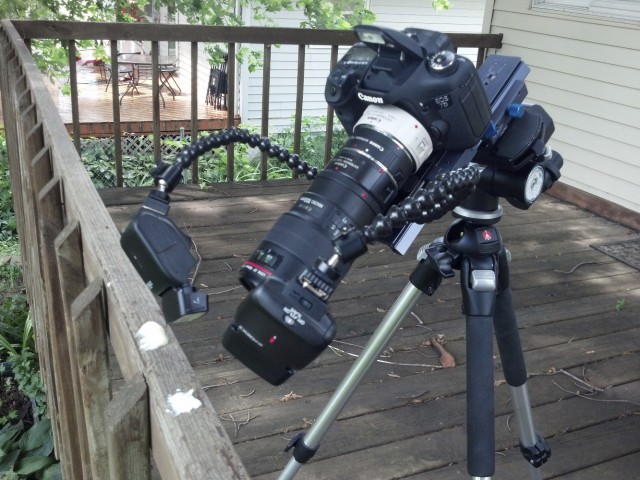
Right now I'm shooting with a 100L, and the flashes are mounted on the cheap ebay bracket with two flexible arms. The arms are much better than I expected, but are prone to shaking, which shakes the camera. The bracket is okay for a tripod, and I expect it'd be very useful with the mt-24. But I think I'll spring for a Novoflex bracket--the two flashes + Novoflex bracket is equivalent to the cost of the mt-24.
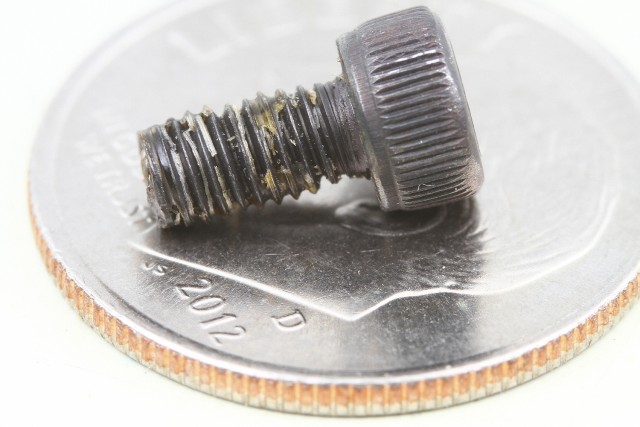
Here are a couple images. These are just test images from the first two times I played with the set-up. Diffusers are "impending"...
This is what the set-up looks like right now
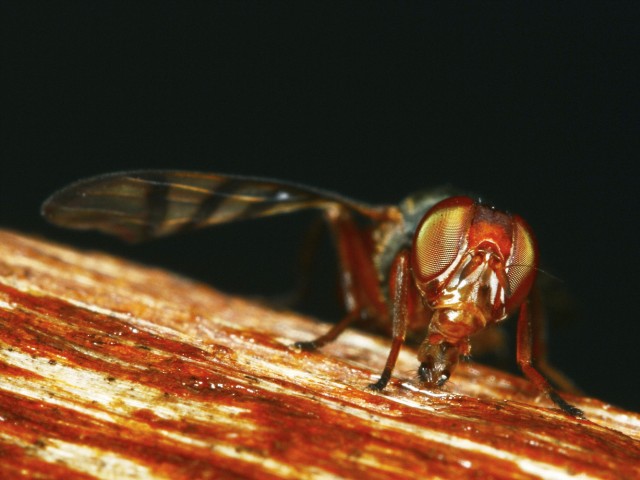
First insect photo with dual 270ex II flashes--bare flashes a 10:00 and 2:00, somewhere around 2-3 inches away from subject.
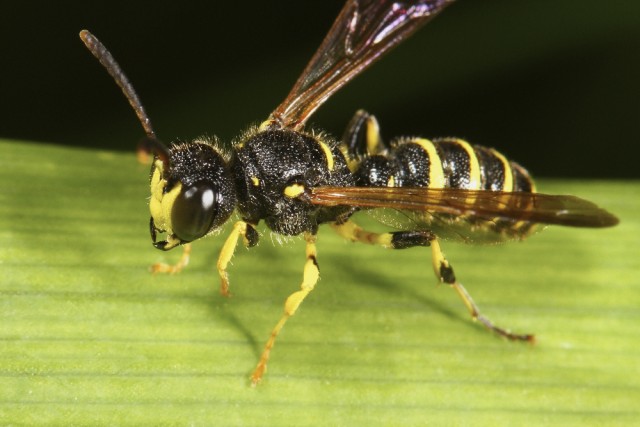
Test image, dual 270ex II flashes to right and left, with 430ex directly behind. Again, just a test image...
Here's another photo. It's better than the previous ones. Still no diffuser, but I'm pretty happy with what I've gotten so far.
Only issue with the dual 270ex II flashes is that the sensor needs to face towards the camera's pop-up flash in outdoor situations. When shooting indoors, the flashes seem to function fine regardless of the orientation of the sensor, likely because they pick up light reflecting off the walls/ceiling.
I use polarizing filters on flash and camera when shooting a subject underwater. I learned the technique from my brother who used it for shooting animation cels. He did special effects animation before computers were used.
I bought Linear Polarizer Sheet from B&H. Make sure you get the orientation of the sheet the same on all lights. Then use a standard polarizing filter on the lens.
Robin Casady wrote:
I use polarizing filters on flash and camera when shooting a subject underwater. I learned the technique from my brother who used it for shooting animation cels. He did special effects animation before computers were used.
I bought Linear Polarizer Sheet from B&H. Make sure you get the orientation of the sheet the same on all lights. Then use a standard polarizing filter on the lens.
When you say "standard" polarizing filter, do you mean a circular polarizer? I just want to make sure I'm understanding you. They do have linear polarizers for lenses too, I think...
AFAIK a Circular polarising filter for a lens is simply a linear polariser in a rotating holder.
Another source for polarising sheet filters are defunct LCD screens - they always have a polarising filter in them.
Brian v.