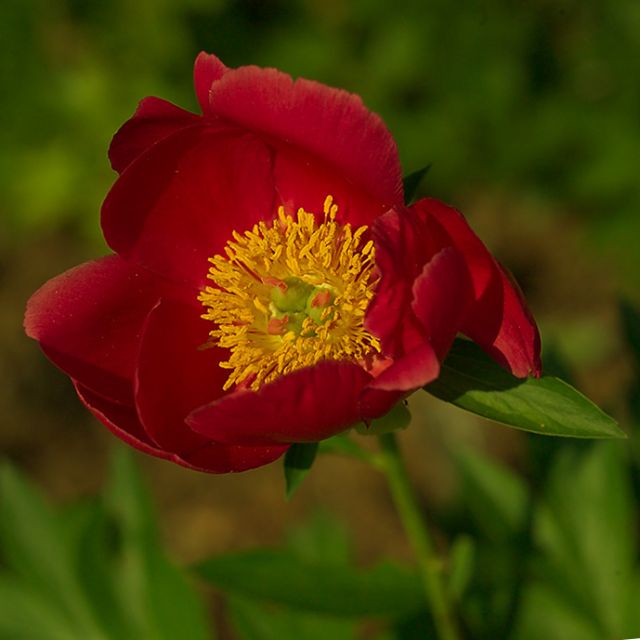
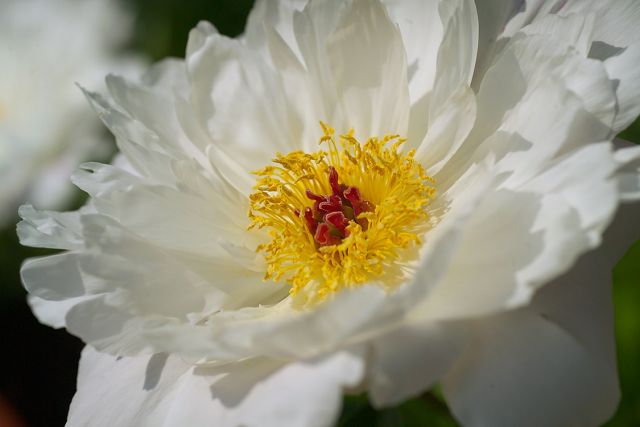
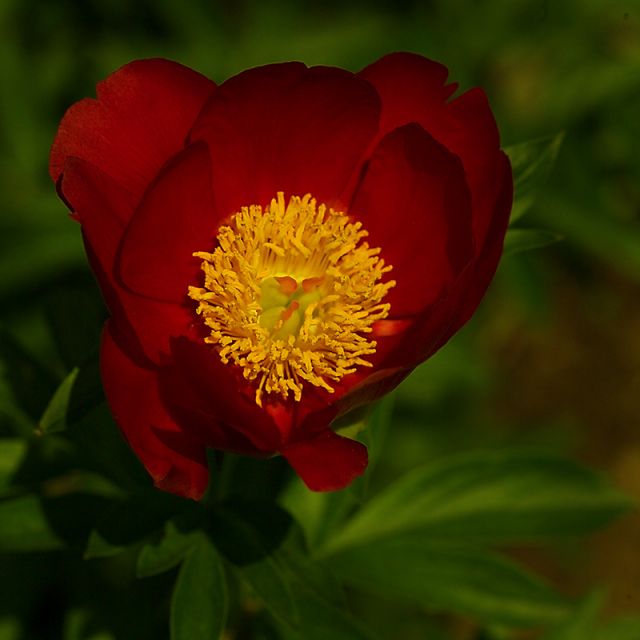
Here's a different angle that doesn't have as much petal interference. Access (higher angle) was somewhat restricted in the first, but this one seems a bit "straight on" / static ... pick your poison, I guess.
I think these are too centered for my taste. The center of each flower is pretty close to the center of the image. I guess that could be good but for me the compositions seem a bit static.
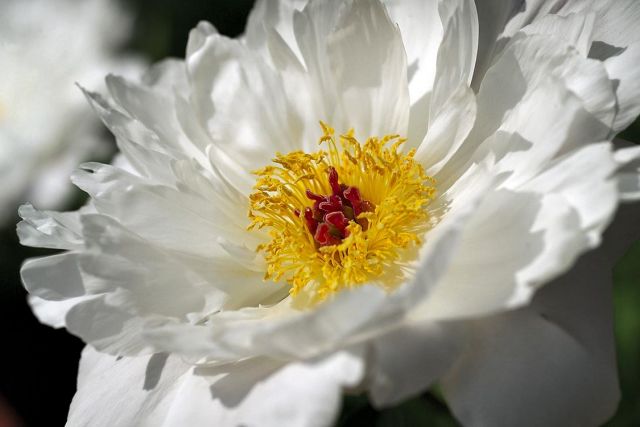
Nice job on these Kent. I like the second the best. Nice job maintaining the detail in the whites. The angle you chose gives it depth. Centered, not centered, it's subjective..it's all about feel and sometimes centered feels right.
I like the colors, but somewhat centered and somewhat closely cropped in square frames combine with negative synergism to make the first and third too static to my eyes. That's why I like the second better. The oblong side ratio and the flow of the visual lines makes it seem more dynamic.
I normally shoot manual exposure, but I these were a couple end of the day shots using camera metering @ aperture priority. I might have to rethink my willingness to let the camera do the math (few more test shots of course) as I was a bit surprised by the color rendering (following camera setting changes).
I normally shoot manual exposure, but I these were a couple end of the day shots using camera metering @ aperture priority. I might have to rethink my willingness to let the camera do the math (few more test shots of course) as I was a bit surprised by the color rendering (following camera setting changes).
I know several photographers who routinely use manual exposure. I usually fix the ISO, use aperture priority which means the camera adjusts shutter speed. I check all the settings before hitting the shutter. Regardless of the exposure mode it seems we are always relying on the camera's light metering and the choice of exposure mode is just a matter of preference. Is there something I am missing or don't understand?
I've been trying to find the optimal technique/strategy for retaining detail without blowing a channel. As I have started to take an interest in floral it seems that they have a tendency to have a "purity" of color that is easily blown in a given channel, that doesn't necessarily correspond to "proper exposure" techniques.
Given that even in a "regular" scene, meters can be readily fooled, I was surprised by how well this seemed to work for these two. I guess my question is simply what value (0-255) should be the maximum value in a given channel that will reveal detail/not blow the channel?
These turned out a bit to my liking, but since it was "Av" mode, I'm not sure why / why not I can trust this setup for future shooting. It seems as though the same metering mode handled two very different kinds of scenes/subjects. If I don't "understand the why", then I typically don't trust it very much, so I'm at "Hmmmm" atm.
Simply put, I have found a light meter to be the best measure of exposure values for any given shot since you can measure light beyond a vertical plane, which I believe is what causes most "blown" channels when using the camera's metering system. For instance, when you frame a shot, even if you are using evaluative metering, or "matrix" metering, wherein the camera uses the whole scene to calculate an average, it is only "seeing" a flat vertical plane. In this case, anything on the plane that averages low, will pull the curve to the right, and anything on that plane to the highlight side will pul the curve to the left. Having the ability to meter exactly where you want, and set the exposure accordingly, gives you an advantage......
I've been skipping out on using an incident meter, trying to do things off of histo and RGB values, and using Sunny 16 as a baseline for those times when I've not got an incident meter with me. I realize the differences in metering @ reflective vs. incident, but I think I've been struggling to properly place the values for such "pure color".
After looking at theses a bit, I'm inclined to think that the "expose to the right" mantra when dealing with such channel oriented subjects may not be my approach.
I think I've been striving for a wrong target in my RGB values (expose to the right), which has been resulting in an overexposure/toning of the colors, and thus a corresponding tendency for me to "multiply" or "gamma" correct in pp. I've run some numbers using the 32 bit 0-1 scale in Excel and think I know why/where things have been going awry for me now.
It'll be interesting to test out a few things, but I think I've got "half-a-clue" at where I've been off before ... we'll see.
+1 @ bracketing is an option ... but I'm the kind who'd prefer to calculate than guess, when I've got the option. The fact that my calculations haven't been yielding my desired results means I've been calculating wrongly (based on a wrong premise, I now believe). Too much boring math to present here, but if things test out I'll share my findings if anyone is interested.
ETTR is more of a shooing scheme of those that typically shoot people, where minute detail isn't the goal (who wants to see skin pores?). I tend to go more ETTL and pull the shadows a bit in post....