p.9 #1 · Nightscapes using AstroTrac Tracking Mount
For those that are using the iOptron, have you had any issues with significant play in the latitude adjustment? I just received mine and it seems to have some issues. The latitude lock does not lock anything, and the latitude adjustment screw has significant plan along the axis of the screw. The result is that the SkyTracker body can move back and forth, a lot about 4 degrees. My concern is that this play will lead to issues with obtaining sharp images. I guess I am calling iOptron in the morning and then deciding on whether or not to send it back to B&H and get the Astrotrac.
p.9 #2 · Nightscapes using AstroTrac Tracking Mount
AvianScott wrote:
Fred - What alignment method did you use? Did you simply align using the polar scope, or did you drift align, or a different method?
Many believe the Astrotrac polar scope is not adequate but imo, if used correctly, it's very precise. The newer Astrotrac mount reticle has the 2000-2030 polaris placement and we need to align polaris exactly in the middle. The manual that comes with it has not being updated and uses the older reticle years as example. That has caused a lot of confusion to many Astrotrac users. I have spoken with Richard (Astrotrac developer) and a new manual is on the works. We have exchanged emails about the correct alignment for our current year.
Lucky, the second star should be placed right along the long line coming from the center axis.
So, once you have polaris and the second star precisely aligned and use an auto guiding camera for the RA axis, there is no need for drifting alignment IMO. I highly recommend the Astrotrac Wedge to align these stars with precision and stability.
On the image below, I've marked where to place polaris and the second star for the year 2013 which should not change much for many years to come...
p.9 #3 · Nightscapes using AstroTrac Tracking Mount
havent read the entire thread but the first pages show some awesome shots. That being said I want to start shooting landscapes and some shots like the ones shown what is needed for this from A newbie's starting point? What gear should I invest in ? Lens? tripod ? etc any intel is appreciated. I have the 5D2 and 7D mostly shoot portraiture . My longest reach lens is the 70-200mk2 will this work ? I have the 16-35mk2 in the mail due tomorrow for starters will be using that for the Architectural type shots of the city's buildings not sure if this is used for night shots?
Roger
p.9 #4 · Nightscapes using AstroTrac Tracking Mount
Rodger you really should read the entire thread. It's very educational for a newbie and you'll pick up on what you need to buy. One of the messages Fred gives a short list of some main items. Like most things there are a lot of likes and dislikes from folks so pick out someone you trust and get their advise. From a fellow newbie, I believe you have the camera and lens to get started. Actually that's what suckered most of us into this new money pit.
p.9 #5 · Nightscapes using AstroTrac Tracking Mount
CPWarner wrote:
For those that are using the iOptron, have you had any issues with significant play in the latitude adjustment? I just received mine and it seems to have some issues. The latitude lock does not lock anything, and the latitude adjustment screw has significant plan along the axis of the screw. The result is that the SkyTracker body can move back and forth, a lot about 4 degrees. My concern is that this play will lead to issues with obtaining sharp images. I guess I am calling iOptron in the morning and then deciding on whether or not to send it back to B&H and get the Astrotrac. ...Show more →
I have noticed this as well, and I have started to grow quite frustrated with the device. I keep telling myself to have patience with it since I still feel as though I'm still getting used to it. It might have been a better idea to get the Astrotrac, but I'm going to continue playing around with it since I really don't feel like returning the iOptron device to B&H.
p.9 #6 · Nightscapes using AstroTrac Tracking Mount
CPWarner wrote:
For those that are using the iOptron, have you had any issues with significant play in the latitude adjustment? I just received mine and it seems to have some issues. The latitude lock does not lock anything, and the latitude adjustment screw has significant plan along the axis of the screw. The result is that the SkyTracker body can move back and forth, a lot about 4 degrees. My concern is that this play will lead to issues with obtaining sharp images. I guess I am calling iOptron in the morning and then deciding on whether or not to send it back to B&H and get the Astrotrac. ...Show more →
I have used the iOptron only once before clouds took control of San Clemente's skies!
From my limited experience, one must tighten the latitude adjustment "lock" as much as possible while still allowing the latitude adjustment "screw" to turn. When aligning Polaris in the field, the Lat. Adjust. screw will be harder to turn but much firmer and reliable. (The same is true for the Astrotrac's Wedge)
p.9 #7 · Nightscapes using AstroTrac Tracking Mount
danws6 wrote:
Fred, what's the largest lens that you estimate you could use with that set up? It looks like a really nice set up.
Hi Dan,
The heaviest combination I've tried using a guiding camera was with the 7-pound Canon 500mm f/4L IS II lens on my Canon EOS 6D. The Astrotrac was attached to the "Wedge".
So, it's possible to use heavy super telephoto lenses with the Astrotrac mount and guiding gear.
The maximum focal length I have tried is 640mm (Canon T4i, 400mm f/5.6L) and there was no trailing. Precise polar alignment is crucial though.
My next try will be the T4i on the 500mm f/4 for a 800mm FL...
p.9 #9 · Nightscapes using AstroTrac Tracking Mount
Wow what a thread. Learning so much and loving the images & gear stuff.
I think I'm mostly interested in wide field shots but its so tempting to think about the astrotrack. I'll more likely go for the iOptron or something tho. I mostly shoot shorter shutter length wide stuff like a lot of people start with I guess...
p.9 #10 · Nightscapes using AstroTrac Tracking Mount
It might be interesting to have a nightscapes/astrophotography subforum here, although there are enough dedicated astrophotography forums/email groups out there that I'm not sure how much traction it would get from the serious astrophotographers.
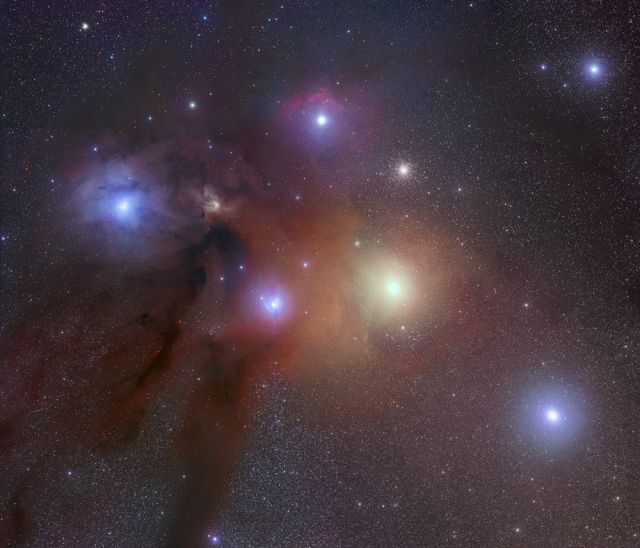
Anyway, here's my personal favorites of mine; it's an 8-panel mosaic of the Rho Ophiuchi region:
p.9 #11 · Nightscapes using AstroTrac Tracking Mount
StarNut wrote:
It might be interesting to have a nightscapes/astrophotography subforum here, although there are enough dedicated astrophotography forums/email groups out there that I'm not sure how much traction it would get from the serious astrophotographers.
Anyway, here's my personal favorites of mine; it's an 8-panel mosaic of the Rho Ophiuchi region:
Beautiful shot. What kind of equipment did you use fog this.?
Harsha
p.9 #12 · Nightscapes using AstroTrac Tracking Mount
Fred Miranda wrote:
Many believe the Astrotrac polar scope is not adequate but imo, if used correctly, it's very precise. The newer Astrotrac mount reticle has the 2000-2030 polaris placement and we need to align polaris exactly in the middle. The manual that comes with it has not being updated and uses the older reticle years as example. That has caused a lot of confusion to many Astrotrac users. I have spoken with Richard (Astrotrac developer) and a new manual is on the works. We have exchanged emails about the correct alignment for our current year.
Lucky, the second star should be placed right along the long line coming from the center axis.
So, once you have polaris and the second star precisely aligned and use an auto guiding camera for the RA axis, there is no need for drifting alignment IMO. I highly recommend the Astrotrac Wedge to align these stars with precision and stability.
On the image below, I've marked where to place polaris and the second star for the year 2013 which should not change much for many years to come......Show more →
Thanks Fred.
This clarifies a lot for me. I was confused where to place the Polaris. At first I assumed the place for the Polaris is the center cross. I am glad that they are updating the manual.
How difficult to find the second and the third star? . I use star walk on my ipad to navigate.
Due to poor seeing conditions I haven't had much time to spend with the setup.
Harsha
p.9 #15 · Nightscapes using AstroTrac Tracking Mount
nburwell wrote:
I have noticed this as well, and I have started to grow quite frustrated with the device. I keep telling myself to have patience with it since I still feel as though I'm still getting used to it. It might have been a better idea to get the Astrotrac, but I'm going to continue playing around with it since I really don't feel like returning the iOptron device to B&H.
-Nick
I think I am going to return it and go with the Astrotrac. I spoke with their customer service and the person had no knowledge at all about their own device. At that point I decided to send it back to B&H and I will look for an AstroTrac.
p.9 #16 · Nightscapes using AstroTrac Tracking Mount
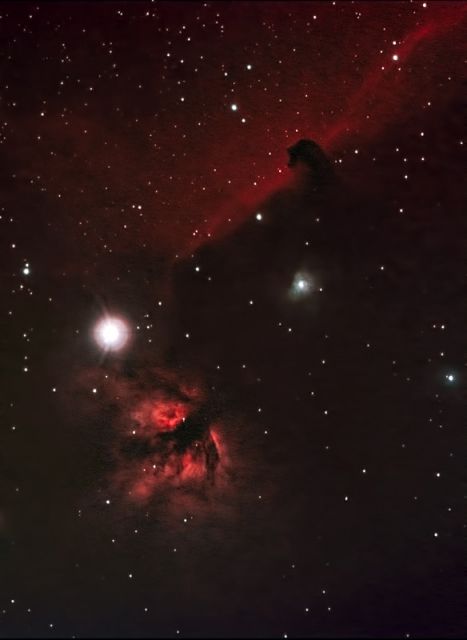
Following up on the question of how much one can push the focal length with the Astrotrac...
I decided to try my modded Canon T4i with the 500mm f/4L + 1.4x extender for a total FL of 1120mm.
I took 9 shots of 360 seconds each @ ISO 800 and stacked them in DeepSkyStacker (Calibration files as well).
It was almost full moon and the sky was pretty bright, but it was the only clear day in 2 weeks...so, I had to try.
The final image was still pretty noise.
Next time, I will set the T4i to ISO 400 and shoot at least 18 shots. I much prefer shooting full frame!
p.9 #18 · Nightscapes using AstroTrac Tracking Mount
harshaj1 wrote:
Beautiful shot. What kind of equipment did you use for this.?
Harsha
Thanks!
Technical Information:
This is a mosaic of 8 panels, each of which is comprised of at least 15 hours of imaging time, taken through clear, red, green and blue filters. All panels were LRGB composites, where the luminance layer typically consisted of a blend of the clear-filtered and blue-filtered data. All individual images were 15-minute exposures through Astrodon type 1 filters. All images unbinned.
Equipment: Takahashi FSQ106 quadruplet fluorite f/5 apochromatic refractor, SBIG STL11000M camera (cooled to -15C) with internal color filter wheel (Astrodon Type 1 filter set), on a Bisque Paramount ME German Equatorial Mount.
Image Acquisition/Camera Control: Maxim DL, controlled with ACP, working in concert with TheSky v6.
Processing: All images calibrated (darks and dawn flats), aligned, combined and deconvolved (luminance data only) in CCDStack. Color combine in Photoshop. Finish work (curves and levels, adjustment of saturation and contrast) was done in Photoshop CS5.
Location: Data acquired remotely from Fair Dinkum Skies, Moorook, South Australia.
p.9 #20 · Nightscapes using AstroTrac Tracking Mount
Fred Miranda wrote:
Following up on the question of how much one can push the focal length with the Astrotrac...
I decided to try my modded Canon T4i with the 500mm f/4L + 1.4x extender for a total of 1120mm focal length.
I took 9 shots of 360 seconds each stacked in DeepSkyStacker. It was almost full moon and the sky was pretty bright, but it was the only clear day I had to try.
Here is the result Horsehead Nebula result:
Very impressive to get this kind of a shot with the astrotrac IMHO.
Well done Fred.
Harsha