Ever since everything went digital, especially television, I've noticed a certain "blockiness" to shadow and dark areas of the images.
I haven't seen it as much in still photography, but it does seem to pop up once in awhile.
Is it lack of dynamic range that causes it or is it the sensor itself?
Also currently, what are the better Canon cameras for capturing low light images ?
I'm really hoping the new(when it comes out) 7D II will be able to handle low light as well as fast focusing, but I'm not sure how many MP it will have, as I just don't need 18 or more MP, at least for my needs.
There are two sources of noise in the shadows, photon shot noise and electronic/read noise. The first is the result of low light levels and is unavoidable; the second is the result of limitations in current sensor technology. Of the two, electronic/read noise is perceptually the most objectionable/nasty as it's appearance is unnatural to the eye. We will have sensors with near-zero read noise in our lifetimes - some are already pretty close.
RobDickinson wrote:
"Blockiness" in video is down to compression artefacts.
+1
Some of the channels on our Saterlite service are compressed way more than others .
I notice that with one of the channels that have a +1 catchup service (same programming an hour later) . The +1 service is obviously compressed a lot more than the standard one and it notices
Bsmooth wrote:
Ever since everything went digital, especially television, I've noticed a certain "blockiness" to shadow and dark areas of the images. ...Is it lack of dynamic range that causes it or is it the sensor itself?
Yes.
And no. DR is a parameter of the sensor/amplifier, and some sensors have more DR than others.
However, noise from amplifying low light levels usually appears as scattered speckles of colored pixels, not as "blockiness."
Blockiness, also known as pixelation, is -- as mentioned above -- more often an artifact of image compression. The JPEG format doesn't record/transmit all the pixel information in a scene, but to save space/time will send information on large sections of equal -- or nearly equal -- tone as if it were a single larger pixel. Also, instead of saving, for example, thousands of shades of blue, it might save a gradient of all those blues as "bands" of only a few hundred different tones...or even fewer.
You can test this yourself if you have image-editing software by taking a sample image and doing several "Save as..." operations in .jpeg format, each one at ever smaller file sizes. The smaller the file, the more pixelated it will appear.
For example, here are two resized and saved versions of a picture I took several years ago. The first one has a 453kb file size (minimal compression) and the second one is only 48.5kb (maximum compression).
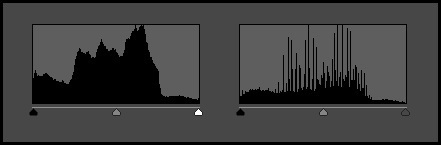
Yes, the DR exceeded that which my camera could capture (it was more than 12 stops' difference), so I exposed for the most important parts and let the whites and blacks clip, but in the larger file the range of tones that did record is more-continuous, as shown in the third image.
Bsmooth wrote:
...Also currently, what are the better Canon cameras for capturing low light images ? ...I just don't need 18 or more MP, at least for my needs.
The current king of Canon cameras for fast auto-focus in low light is the 6D, which can focus down to -3EV. (It also has the highest DR of any Canon camera according to DxOLabs' testing, at 12.1EV.) The 1D X and 5D III are almost as good in the low-light department.
A used 5D (the original) takes very good pictures in low light because of the huge sensels a full-frame sensor of only 12.8Mp allows, but the auto-focus isn't very good compared to newer bodies.
BrianO wrote:
A used 5D (the original) takes very good pictures in low light because of the huge sensels a full-frame sensor of only 12.8Mp allows, but the auto-focus isn't very good compared to newer bodies.
I own and use all three 5 Series cameras, the 5D is not even in the same ballpark as the 5D3 in low light (or anything else), not even close
dhphoto wrote:
I own and use all three 5 Series cameras, the 5D is not even in the same ballpark as the 5D3 in low light (or anything else), not even close
The 5D is almost exactly 1 stop behind the 5D3 at High ISO.
BrianO wrote:
A used 5D (the original) takes very good pictures in low light because of the huge sensels a full-frame sensor of only 12.8Mp allows, but the auto-focus isn't very good compared to newer bodies.
dhphoto wrote:
I own and use all three 5 Series cameras, the 5D is not even in the same ballpark as the 5D3 in low light (or anything else), not even close
I didn't say it was; I said it takes very good pictures in low light. Do you dispute that?
snapsy wrote:
There are two sources of noise in the shadows, photon shot noise and electronic/read noise. The first is the result of low light levels and is unavoidable; the second is the result of limitations in current sensor technology. Of the two, electronic/read noise is perceptually the most objectionable/nasty as it's appearance is unnatural to the eye. We will have sensors with near-zero read noise in our lifetimes - some are already pretty close.
And compression blocking (this is more of an issue for video and not so much for stills unless you use really awful jpg settings or something) and perhaps color filters not being able to distinguish certain similar deep shades.
snapsy wrote:
The 5D is almost exactly 1 stop behind the 5D3 at High ISO.
although assuming it's like other cameras of the era the high iso banding is so much worse and becomes objectionable so much more easily that for many scenes I'd bet it feels more like 2 stops and even 3 if you push things to super high iso and the scene is largely very bright tones
Bsmooth wrote:
Ever since everything went digital, especially television, I've noticed a certain "blockiness" to shadow and dark areas of the images.
I haven't seen it as much in still photography, but it does seem to pop up once in awhile.
Is it lack of dynamic range that causes it or is it the sensor itself?
Also currently, what are the better Canon cameras for capturing low light images ?
I'm really hoping the new(when it comes out) 7D II will be able to handle low light as well as fast focusing, but I'm not sure how many MP it will have, as I just don't need 18 or more MP, at least for my needs....Show more →
There are a whole range of things that might account for your observation about "blocky" (a.k.a. "blocked") shadows:
Most people today are only creating images for monitor display, and very dark shadow areas that (sort of) work on a monitor (which glows) in low light, don't work well at all on a monitor in brighter light and especially not on prints.
As people - correctly - avoid blowing out highlights with digital capture, they end up with darker shadows and may not take the time to do recovery work to bring up enough shadow detail.
Truly optimizing digital (and film) photographs usually requires some work in post, and quite a few folks aren't doing all that they could or should there. The best photographs usually are not just the result of great composition but also of skillful work in post.
With video/film, it may also be partially a stylistic issue, along with a way of drawing attention to better lit primary subjects.
To generalize, full frame cameras can do a better job of capturing low light images than cropped sensor cameras, though the best croppers can do a fine job, too.
As far as television goes there quite a few factors at work.
Compression of the broadcast signal
Less TV shot on super 35 nowadays and more on HD cameras that can't match the dynamic range of film or the best digital capture systems like Arri Alexa. This is really a shrinking budget issue tied to so many channels of TV and shrinking ad revenue.
Budgets shrinking cuts into how much shots are lit
Less color finishing work being done after edit. Many shows just have a quick pass.
Your TV is unlikely to reproduce the "golden" areas of the shadows that cinematographers live so much unless it has the proper tech and is set right. I went for a Panasonic plasma with "infinite black" which is the old pioneer kuro tech
Try watching some films on blue ray and see if it is your TV.



 and even 3 if you push things to super high iso and the scene is largely very bright tones