R10
Offline
•
Upload & Sell: Off
|
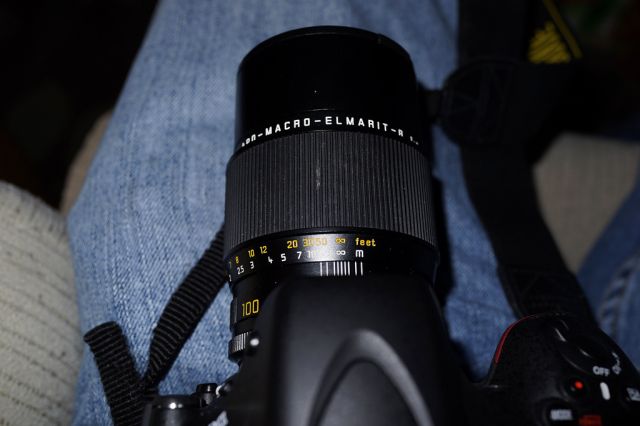
 p.2 #4 · Leica 100mm f/2.8 APO-Macro MFD p.2 #4 · Leica 100mm f/2.8 APO-Macro MFD | |
alundeb wrote:
It was measured at a very low contrast rate, it is not calibrated but definitely not above 10%. The measurement target was a printed siemens star.
When speaking about resolving power / absolute resolution, and 400 lp/mm like Thrice mentioned, it is not common to use the 50% criterion, more likely 10%. The Rayleigh diffraction limit criterion uses 9%.
If you are seeing any sharpness / micro contrast limit with the 70-200 2.8 IS II in the center with normal cameras, I don't know what is going on. My copy as said outresolves a sensor with 3-4 times the (linear) pixel density.
I would low to try the APO-Macro 100 2.8 and the APO-Telyt 280 4 on the Pentax Q. I have the APO-Telyt 180 3.4, and it does not resolve nearly as fine detail as say the Canon 70-200 4 IS ( at near infinity). But it is better in the corners and the color correction is exceptional.
...Show more →
Ah, thanks.
Well, “when speaking about resolving power”, I prefer criteria with some more practical relevance, i.e., visible impact on usual photographs, looked at from reasonable viewing distances. The “50%/5-40lp/mm” criterion, or even more %, have their reasons in this respect while 9 or 10% is of rather indirect importance here (and more for the engineers). I bet, these reasons cause Leica and others to use the 5-40lp/mm in their MTFs. Btw, Canon only shows 5-30lp/mm. I may have missed it, but I’ve never come across a Canon MTF with a 40lp/mm graph...
Don’t get me wrong, I’m pretty interested in the more ‘academic’ aspects too, and really appreciate such information.
As for the 70-200 2.8 IS II (I used two copies, btw), it may ‘scientifically’ outresolve a Pentax Q sensor (as the AME100 does with ease) but, ‘even’ on the 5DII or D800, its ‘visible resolution limits’, which have a lot to do with color and tone rendition and separation, and with the level of micro contrast way above 50% and below 100lp/mm, come to light way before those of a Leica 4/80-200 or even the AME100 do - throughout the field.
The AME100 is, for me, close to a perfect balance of optical qualities (throughout the frame and on an insanely high level). Nevertheless, the more 3D-ish fingerprint of the Zeiss Contax T* Macro-Planar 2/100mm has always temped me, albeit the underlying even higher (micro) contrast and (center) resolution comes at the expense of a less creamy color rendition. Life is a tradeoff...
PS: Btw, I’m a scientist but, all in good time...

|