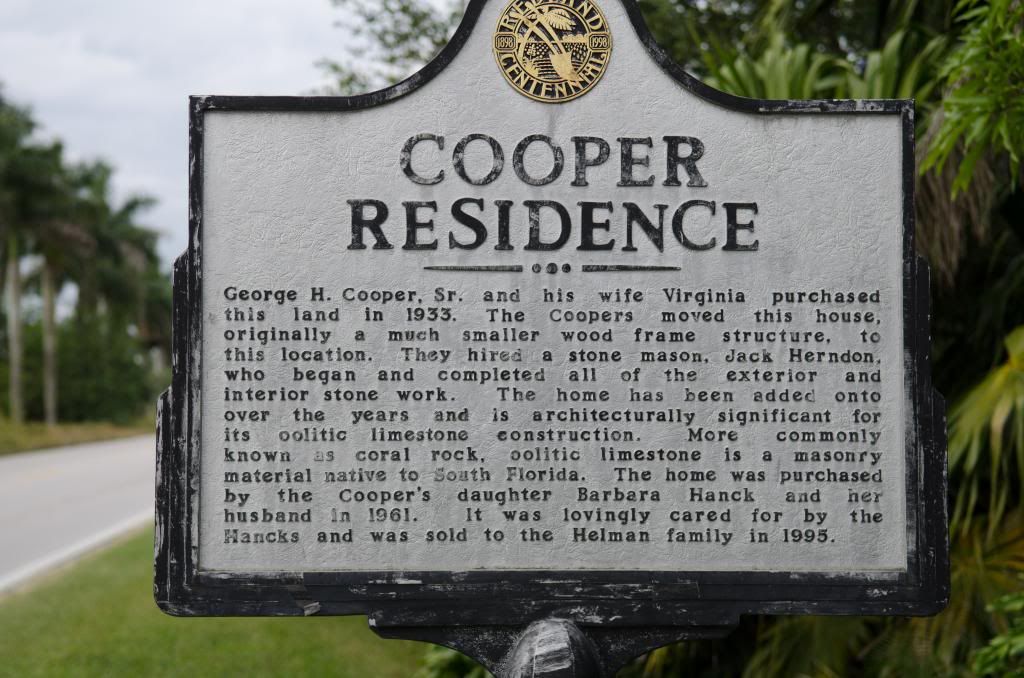
I finally got my D7000 and 17-55 f/2.8 back from the Nikon repair center near me. I was up at 5:15 to drive 20 minutes to the Cooper Residence in the agricultural area called the Redland of South Miami-Dade County. I believe this is the barn but the property is private and this is all that is visible from the street. I have wanted to shoot it for a while just to experiment with architectural photography.
Heavy cloud cover kept the light very flat, but after almost two hours I spotted a hole in the cloud cover to the east. I waited patiently while the wind blew the clouds and the hole moved to a point directly between the sun and my subject, and got about a minute of sweet sunlight.
I really enjoyed shooting with a tripod and being able to stand back and watch the light, the clouds, and still maintain the composition I wanted. I also learned to observe more, shoot less, anticipate, and be patient. I haven't used the tripod much in the past.
Here is my processed version and I can say I have a lot to learn about LR 4, but it seems pretty intuitive.
Nikon D7000
Aperture Priority
ISO 200
1/200 second
f/11
Nikon 17-55 mm @ 17 mm
White Balance Auto
Looking at this now I can see that I need to try and bring more detail out in the limestone.
What other processing changes would you recommend?
Also, would you shoot it differently than the exif data I posted?
Old school says something like ... "the best second lens you can get is a good tripod".
In today's world of high ISO mania, people think that a tripod isn't necessary ... but as you seem to have quickly realized, tripods can be great as a compositional tool ... in addition to reducing camera shake and allowing for longer exposures.
Totally diggin, the watch & wait, rooted in anticipate. If your tripod has a quick release mechanism, you can still shoot some handheld shots while you're watching & waiting. Then, when the time is near, put it back on the pod, with registration for your composition still in tact.
As to the EXIF info, shooting as wide as 17 mm, I'd likely shoot @ f8 rather than f11. Two reasons for this ... first, most lenses are sharpest around 2-3 stops stopped down from wide open, or around 5.6 - 8. Second, diffraction starts creeping in a bit as well. While it might seem that you get more DOF @ f11 (which you do), f8 is likely still going to be more than enough with a UWA like 17mm.
Seems a bit cramped on either side. Perhaps open the shadows a bit and rotate about 0.41 degrees CW and darken the grass in the foreground to avoid losing the eyes when they wander down.