Recently purchased a Canon 24mm TSe Mk2, due to the rave reviews about the suitability of using it as a landscape lens.
After a few months of use, I am slowly getting the hang of it but it seems to be sometimes hit and miss when focussing.
Does anyone have any tips/hints regarding focusing this piece of equipment. The technique I'm using at present is (on a 5D Mk2):
1. Set Apeture to F11
2. Go into Live View (x10)
3. Focus on the furthest point and get that sharp.
4. Use depth of field preview, check the nearest point and make sure that is in focus.
5. Re-check the furthest point again to make sure still in focus.
6. Add any filters and then take the shot.
This same technique is used, irrespective of the amount of tilt (if any).
Although this produces good results it doesn't always seem to be 100% accurate.
None of your steps involved using the tilt feature, which is what it's all about.
First off, it's always tricky. Basically, you need to try different amounts of tilt while moving your live view point from top to bottom to check focus. It's a pain actually. Remember, it only takes a small amount of tilt for a good amount of effect. The good part is that once you get it all in focus wide open, you are free to use your aperture in any creative way you want. That's what it's all about, too.
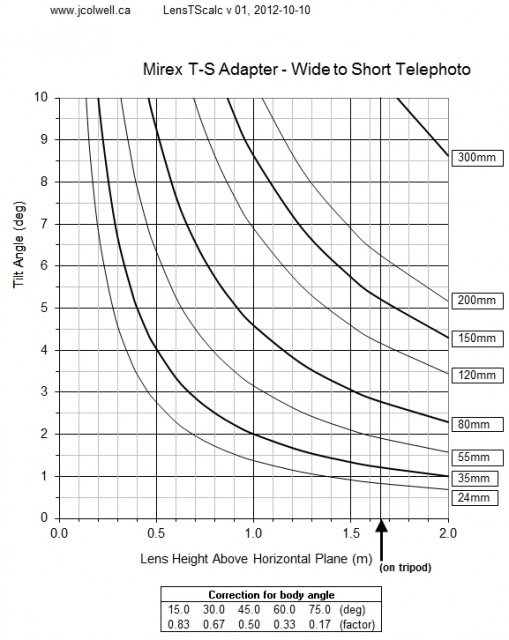
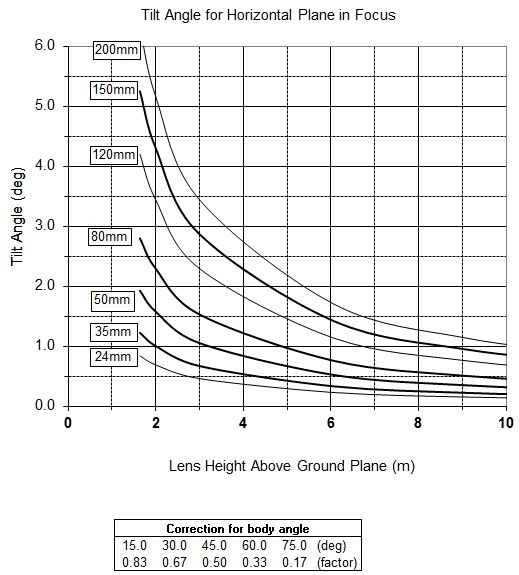
I usually use just one degree of tilt as I set my tripod to the highest setting - and for this distance from camera to the ground, the stated tilt amount is 1 degree. So, I tend to set just the amount of tilt recommended and then focus from there.
Basically, I have already set the correct amount of tilt - just wondered if the technique I'm using is there, or thereabouts to get maximum depth-of-field.
From experience, when focus is accurate, then I can see why I paid so much for this lens. Just want the focus technique to be as fool-proof as possible.
I had thought about a focus screen - but would probably prefer to stick with Live View.
When you have adjusted tilt so that the plane of focus is parallel to the ground, then from nearest point to horizon, the ground will be in focus. Closing the aperture to increase DOF is then needed to make objects that extend upward (away from the plane of focus) sharp. Stick with live view. You can set the degree of tilt from calculated tables, as it appears you are doing, or you can do it with LV with the lens wide open. Use subtle iterations of focus adjustment and tilt adjustment until the ground is sharp (wide open). Then stop down the lens and see if things like treetops (or buildings, etc.) have become sharp. There may be some situations where your final adjustment would be to move the focus slightly away from the ground to get tall objects sharp. Then you would use DOF preview to see if you've gotten the ground and the high stuff sharp (using LV).
Hi, I have been using Canon's 24 TSE's for years. (I have both the mk 1 and mk 2 versions)
I most times avoid using the tilt feature when making landscape images unless I have part of the subject very very close to the lens and want focus all the way out.
Best sharpness is when focusing at or close to infinity and using f8-f11. That works best with the subject about 10-15ft out up to infinity. When making images of waterfalls. If im close to the stream I try to focus on a point in the middle.
I'll often use tilt to avoid having to stop down too much. If I want sharpness from near to far I'll do something like this.
1) Set M mode, WB preset, set exposure
2) Enter LV
3) Set lens at f/8
4) focus at ~ hyperfocal distance
5) Magnify 10x and check focus at near and far points while DOF button is pressed.
6) If I need to, apply 2 degrees of tilt as starting point
7) Recheck near and far focus while pressing DoF button, alter focus distance if
necessary to ensure near to far sharpness.
8) If needed alter tilt amount and recheck.
9) Possibly stop down a bit more if near far sharpness can't be achieved. at f/8, however, sometimes you can go the other way
On the 24mm lens it's rare to need much more than 2 degrees of tilt.
Alternately I will use focus stacking for extra DoF.
P.S. calculated 'ideal' tilt angles assume the lens is pointing horizontally. If the lens is pointing down, you need less tilt. If the lens is pointing up, you need more.
My simple method.....
1. Tripod
2. Check composition and then level camera
3. Live view.... Shift to desired spot
4. Focus far object
5. Tilt until near object sharp
6. Repeat 4-5 til perfect
7. Add lee filters to taste
8. Fumble like an idiot with exposure....
Awesome thread. When I had a T/S lens it was a lot of trial and error and fumbling around. Would have been terrific to have these kinds of resources and helpful suggestions available when I was learning.
1) frame image using ballhead (I don't worry about starting with the camera level - except side to side).
2) using LV, focus at infinity.
3) using LV, focus on point(s) nearest the camera (quite close to my feet).
4) repeat steps 2) and 3) several times (it's an iterative process).
5) since I shoot mostly at the ocean's edge (where there are no other objects such as trees to be concerned about), I often use this lens wide open (f/3.5), particularly with the diminished light of a sunset.
Some people level the camera both ways (jerbear above), and use Shift to compose. This works too.
I don't use tables at all.
Incidentally, I bought a 2.0 EX for use with this lens - providing a FL of 48 mm. Useful, but can't shift too much or the image will be off the image circle. Another reason I don't use Shift in the above procedure.
I copied your charts. If I'm violating your copyright, let me know and I'll delete them. If I can use them, a word or two of explanation would help me a lot. 6 months ago I got a 24mm f/3.5L TSE II. Only new lens I've ever owned and an absolutely awesome piece of glass even if you never use the TS function. I'm also struggling with where/how to focus on tilt or shift: where to focus and also how to figure aperture. Most of my pix have been wildly over tilted (or shifted). It appears a little goes a long ways. Calculating f-stop and exposure are also a challenge.
I'm looking at the chart labeled "tilt angle for horizontal plane in focus." At about 1.5 meters, I think the chart suggests just under a degree for focus horizontally as in side-to-side across say a landscape. I assume this can be +/ depending on what the photography needs. What does one do when the subject needs more than a degree just to bring it into the field of view? (Have I just confused tilt and shift?)
OK, here's a recent real world failure. Trying to shoot a dramatic tree such that it is in focus from root to crown. I took 3 shots shifting (probably too far down) for the root, level for mid-section, and then up (again probably over shifted) to get the crown. I then tried to combine (in PS) but found that the exposure to be so varied that, for example, the sky at mid-section and at crown had very different blues ruining the picture.
Any thoughts on how to approach a problem like this. (Other attempts have included cliff faces, wide canyons, and so on. I love this lens and will figure it out, but it sure can be dang frustrating at times. I sure have taken some odd pix so far.
Thanks,
Robert
BTW this is a superb thread. I'm grateful to everyone who has contributed.
(I've been reading everything I can find and there are a number of new links here. Thanks for that, also.)