Roland W
Offline
• • • •
Upload & Sell: On
|
You have some advice on flash shown above, but it may be a big jump for you to rent it and learn more about using it and then use it all in a short time (one day?). So just be aware, or see if you can find a resource to borrow a Canon flash to experiment and learn with ahead of time. In general, you should learn first, and then do important shoots. If this shoot is repeatable if you mess up, which it may be if it is a friend, then there is less pressure to make it all happen right the first time other than rental expenses.
I want to mention more about reflectors. The shiny silver or gold ones are useful, but they tend to be very bright and very hard to aim just right. And even if it is later, the direct sun on a reflector is the same brightness no matter how late it is in the day. You may want to consider adding a larger white reflector to your collection. They are not shiny, and they produce a more diffuse light. They are usually used fairly close to the subject, but they do not tend to blind them. They are also much less critical for aiming. And for head shot stuff you can even sometimes get your subject to hold the reflector. An assistant is also still useful too. With reflectors you can see the effect you are getting with your eye, and there is no technology type learning required for using flash with manual or ETTL settings, and getting the flash all configured.
For reflector only shooting, or even for flash shooting, you should likely scout out locations, including seeing them at the time of day you want to shoot. You can even practice on any willing subject (victim) to learn about the lighting, and then the real shoot can go much smoother, and perhaps get to several different locations.
You mentioned liking to shoot from a tripod. You might consider doing that, and using a remote release on a cord for the camera, and then holding a reflector your self, with the release in one of your hands. Just another way to approach shooting when you do not have enough hands.
Find some on line or book resources that cover lighting. The principles are the same for both reflectors and for flash, and the variations really are related to how many sources of light you have or create. And you can also do a lot with one flash and still use a reflector or two added to it. Obviously as things get more complicated you may end up needing lots of assistants, or need lighting stands for flashes or reflectors, but that will likely be later in your experience.
If you really want to go the flash route, find one of the good on line resources that covers using Canon flashes, and get an idea of how complicated it can get. Using basic ETTL with a flash on the camera and adjusting the flash with Flash Exposure Compensation is often easy to get exposures good, but that situation makes the least interesting of shots from a lighting point of view. As you move past the basics there are many options, and many ways for things to not work right, so just remember that, and consider some form of practice.
And if you are able to get the 7D to use, then its built in flash can act as a remote controler for any Canon flash that is compatable, including 430's and 580's. That would mean that you could get the flash off of the camera, and not need to worry about the off camera cord. But sometimes when there is too much sunlight, or it is from the wrong direction, the optical triggering of Canon flashes does not work. Just another thing to worry about. You might be able to get creative and make a tripod and a broom stick in to a light stand for the flash. Most off camera flash is best when the main light is pointing somewhat downward on the subject, and a regular light stand is able to be adjusted to go up a ways higher than a tripod can on its own can. But a stick and some gaffer tape can extend a tripod.
|


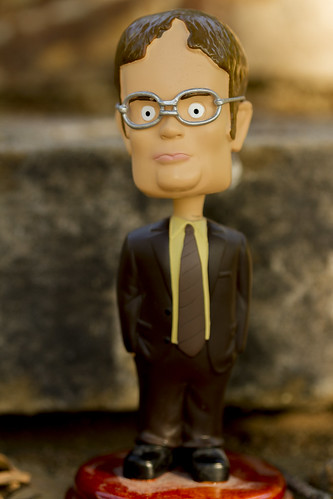
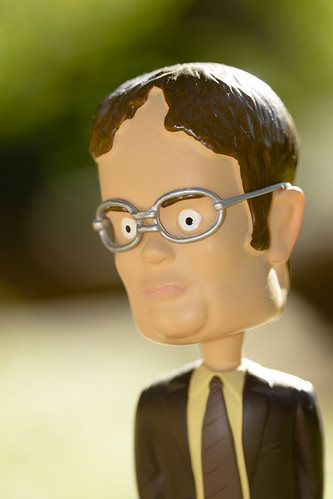
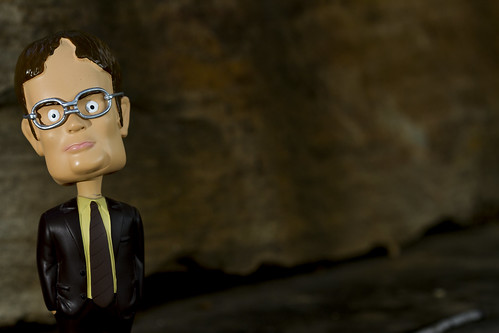
 Only thing she's not good for is catchlights; most heads have those painted in on a matte surface.