Jonas B
Online
Upload & Sell: Off
|
 Sony FE 40/2.5 G - A little darling. User review, samples and opinions welcome! Sony FE 40/2.5 G - A little darling. User review, samples and opinions welcome! | |

OK, so now the lens is mounted to the camera...
Decentering test:
Passed. All is well with this copy. "Wide" open all corners are the same.
Resolution USAF Charts, short distance:
Passed. These days I just check for even sharpness from the left border to the right border. The corners are seldom of interest. I found good resolving power across the image:
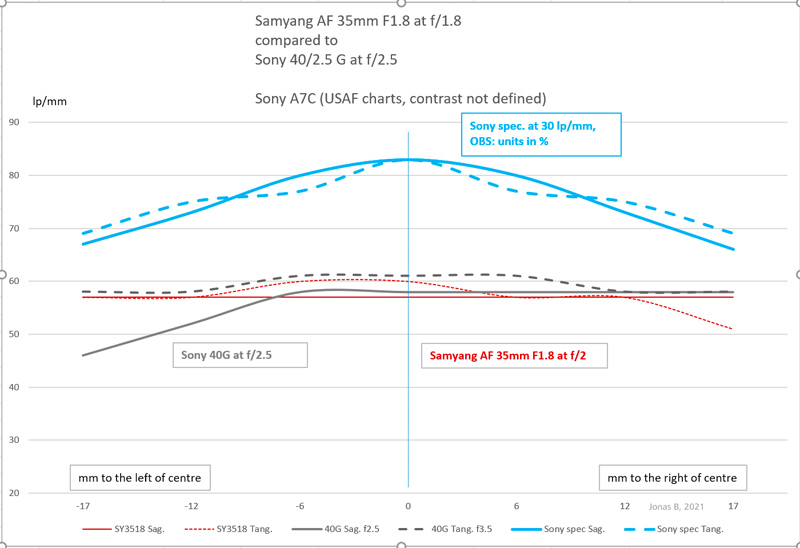
The sagittal resolution drops a bit to the left, checked and checked again. This is with a small target (width 0.82m) and at a distance of 1.02m (giving us an "effective focal length of 44.5mm at this shootong distance). If interested, the method is described here: https://www.fredmiranda.com/forum/topic/1686080/18#15577758.
The drop at the left is unfortunate but small and when critical fixed by stopping down. Checking the Sony specifications also tells me I'll have no luck if complaining about it.
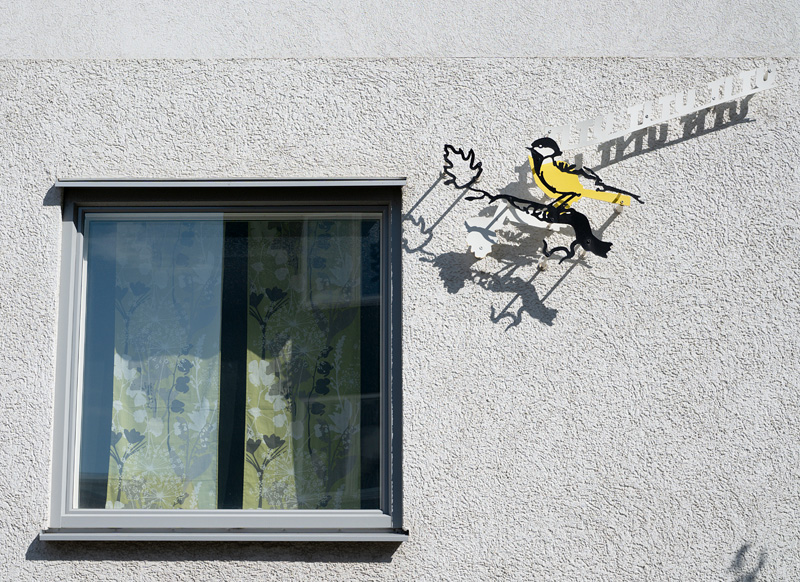
Resolution at MFD:
... is covered in the next post.
Resolution at long distance:
Short version:
The lens is excellent and sharp from border to border. When compared (downsized images for the 40G) to the 35GM the result is still very good with the 40G having the resolution power as the 35GM. Let's remember that this is with the A7C.
Long version:
It took a while to get this section ready. I allready "knew" the result from regular use but as the weather hasn't been co-operating I haven't got anything to post until now. We haven't had a clear sky for a long time but yesterday I finally got some constant light at a part of the neighbourhood. Here goes.
My favourite target couldn't be used due to the light shifting so I picked a closer piece of the world. Here is the scene:
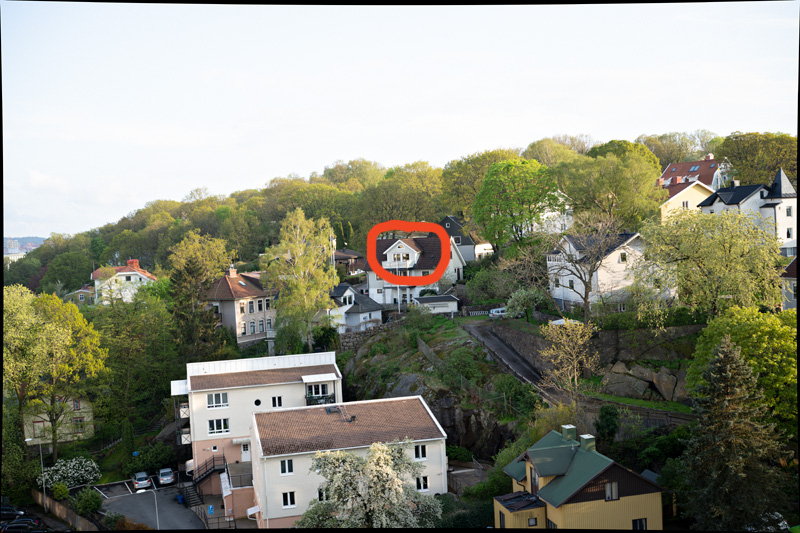
Above: red ring is the focus point, shooting distance is approximately 126 meters away.
For a 40mm lens that is a close neighbour to infinity. (Even if printed big, say 1x1.5 meters, having 20/20 vision and looking at that print from 1 meter the calculated DOF goes, easily, to infinity.)
Anyway, there was no tripod used but the exposure times were very short, I lean a little and didn't aim perfectly from one image to the another and so on. All that doesn't matter, we can safely evaluate these images.
I have no test charts of course so instead I used the 35GM as a reference. Not an exact method as the focal lengths are different. I downsized the 40G images to achieve the same magnification and the result was the same for the two lenses. (In fact a little better for the 40G but that is a focal length thing, not a "sharpness/contrast thing.)
Here we have the two images with the 40G (downsized and rotated) on top of the 35GM. Just to show the difference in focal lengths and how much of the scene the lenses covered:
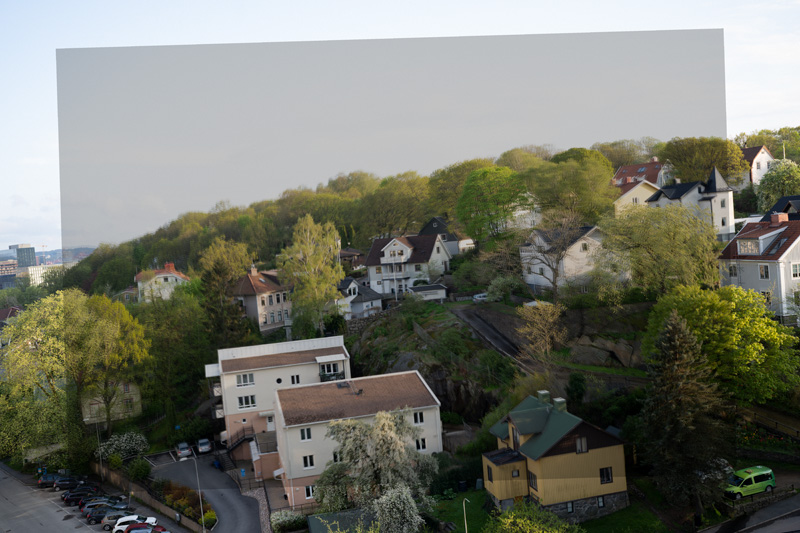
Here the 40G image is still downsized, the 35GM is original size and then I cropped them making it easier to compare:
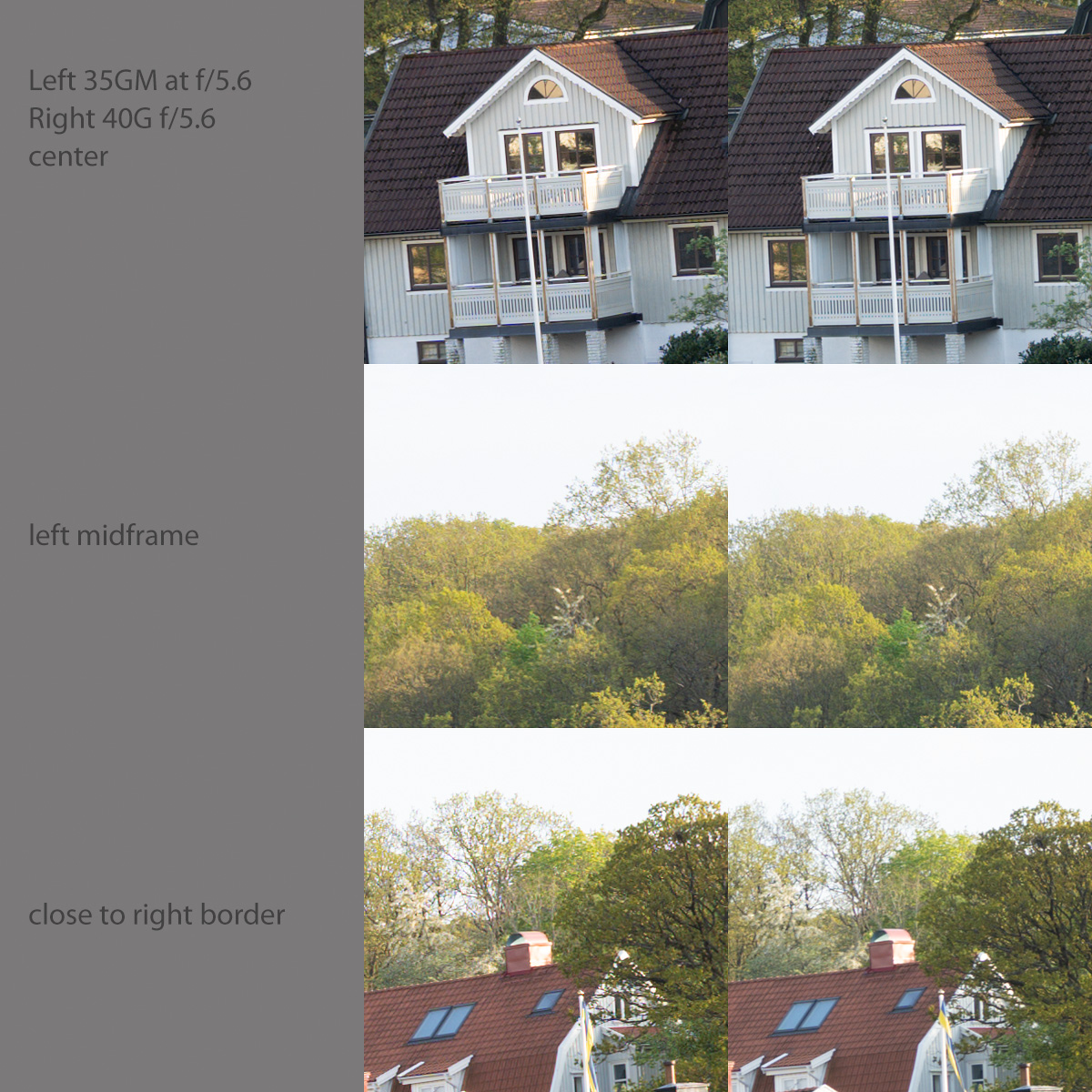
It's a little stupid - you really can't compare things carefully when downsizing or fiddling around. However, to my eyes we have images from the two lenses where one of them is a miniscule bit better at one place, the other lens the same at another place. The differences are mainly due to shifting light/wind. My guess is that the 35GM would be sharper than the 40G at the borders if using a camera with higher resolution. As a "24MP and then downsize" sort of photographer this is of little interest.
A7C, handheld, IBIS on, 35GM and 40G, both at f/5.6, ISO100 and 1/80 sec.
PP: everything neutral or zero in ACR, cropped, compiled, turned, smart sharpened (41, 0.5, 0) and then converted to sRGB and 8-bit JPG-files. Exposure, contrast and so on are left un-touched.
I have looked at all the images, from f/2.5 to f/22 (f/16 for the 35GM) and the result is all the way the same as above: there are no meaningful or significant differences. Together with all the other "real life" images I think it is safe to say you can use the lens without hesitation for land- and cityscapes.
.
|


