fredmiranda.com
Login

Moderated by: Fred Miranda
  New fredmiranda.com Mobile Site
  New Feature: SMS Notification alert
  New Feature: Buy & Sell Watchlist
  

FM Forums | Leica & Alternative Gear | Join Upload & Sell

1       2       3              92              94              138       139       end
  

which lens has the most 3D POP?


Nifty Fifty
Offline
• • •
Upload & Sell: Off
p.93 #1 · which lens has the most 3D POP?


OregonSun wrote:
Hmm, now it seems like you are saying the examples do convey some 3D effect, but you just don't like it.

No, I'm not saying I dislike it. It can suit certain subjects. I'm saying that I believe this effect (blur vignette) is something completely different from suggesting natural depth, since it actually delivers the exact opposite: a very unnatural appearance, which of course isn't necessarily a bad thing.


Nov 19, 2025 at 12:19 PM
OregonSun
Offline
• • • •
Upload & Sell: Off
p.93 #2 · which lens has the most 3D POP?


Nifty Fifty wrote:
No, I'm not saying I dislike it. It can suit certain subjects. I'm saying that I believe this effect (blur vignette) is something completely different from suggesting natural depth, since it actually delivers the exact opposite: a very unnatural appearance, which of course isn't necessarily a bad thing.


Got it. Interesting point about 'natural' vs 'unnatural' depth, yet another subjective dimension to this discussion that I hadn't explicitly considered.


Nov 19, 2025 at 12:51 PM
Nifty Fifty
Offline
• • •
Upload & Sell: Off
p.93 #3 · which lens has the most 3D POP?


What many people understand as 3D pop, that cut-and-paste look, I find not only extremely unnatural, but also ugly and repulsive. I think your blurred vignette is better.


Nov 19, 2025 at 12:58 PM
Grenache
Offline
• • • •
Upload & Sell: On
p.93 #4 · which lens has the most 3D POP?


@Fesuce
Of your images, only the gas station one looks particularly 3d to me. Some of the subjects themselves in the other images are flat (sign, tombstone), so it is hard to appreciate any depth. Ironically - relative to what people often try to do, to generate sense of depth - the gas station image does not have a blurred background. In fact, the fact that there is a lot of DoF actually is what makes it look more 3d. The light wrapping around each part of the scene likely greatly enhances the effect.

Jim


Nov 19, 2025 at 01:04 PM
Fescue
Offline
• •
Upload & Sell: Off
p.93 #5 · which lens has the most 3D POP?


Grenache wrote:
@Fesuce
Of your images, only the gas station one looks particularly 3d to me. Some of the subjects themselves in the other images are flat (sign, tombstone), so it is hard to appreciate any depth. Ironically - relative to what people often try to do, to generate sense of depth - the gas station image does not have a blurred background. In fact, the fact that there is a lot of DoF actually is what makes it look more 3d. The light wrapping around each part of the scene likely greatly enhances the effect.

Jim


That's where the "hopelessly subjective" bit comes in lol


Nov 19, 2025 at 01:46 PM
RustyBug
Offline
• • • • • • •
Upload & Sell: On
p.93 #6 · which lens has the most 3D POP?


Nifty Fifty wrote:
At first glance, it suggests something like spatial depth, but in a way that quickly becomes boring, as it's an extreme, repetitive, and immediately obvious effect that quickly loses its impact. It also only works in conjunction with appropriate image composition. In the last example (Bully), it already fails.

It's like with the Holga. It can be a lot of fun and produce great results. But in my opinion, it's better suited to a cohesive series that conveys a specific, consistent style and for which specially chosen subjects are selected. I find it rather unsuitable for general photography.


+1 that the utilization is subjective. Imo, that's a degree of discernment that folks have to assess for themselves if they are looking for the "parlor trick" projection, vs. something complementary to the subject / scene depth, et al. That, and learning the "sweet spots" for application of a given optic, to do so.

But, my entire point in this thing is that the variable optical design can generate variable influence. I think Heron has clearly provided the A : B that illustrates this (which folks have clamored for) influence from the optic. When, where, why, how folks incorporate this into their work ... their call. To wholesale dismiss the optical contribution ... imo, Heron just dismissed that dismissal.

Love it, like it, hate it, don't care ... sure, why not. But, even if the emotive response is "hate it, it ruined the picture ... you don't know how to take a good picture" ... that acknowledges its existence to produce differing visual cues in regard to human physiological response. What someone does with it is up to them ... but, for those who do aspire to embrace different optics in this regard, well you're not crazy. Thanks again, Heron.

Although, we do drive others crazy when the subject is mentioned.


Nov 19, 2025 at 02:16 PM
philip_pj
Offline
• • • • • •
Upload & Sell: On
p.93 #7 · which lens has the most 3D POP?


You can (with practice) learn to gauge small aperture image depth, even if you don't have the luxury to regularly see open vistas as 'training' for your eyesight. How easily do the foreground, midground and distance flow into each other? How closely does the scene approximate real life? Is color realistic enough? What photographic tricks do you see that act as 'hidden persuaders' to fool your visual system into thiking it is 3D?

3D is not just the absence of fast-fade fake 3D as perpetrated by Zeiss which only works with mid-FL lenses wide open or near to it - it is the recognition that two 3D models exist for fast lenses, and that stopped down images still need the vital inputs that work in such compositions, as foundations. It all starts with bokeh, however - the model is set there and flows into images created using f2.8-f4-f5.6-f8.

All image motifs must look credible to natural vision, their brightness tone values and color must look like you saw it yourself, there must be the right level of contrast at both macro and micro (and also middle spatial frequencies, which is why it is reported - 20 lpmm, or 30 lpmm as used by Cosina). Ironically enough, final micro-contrast is not vital, but it is sugar to the eyes. In particular, if your lens attenuates highlights poorly, the result is a flattening of the subject, it merely looks dreary.

Related to this phenomenon is the highlight blocking we all see in a bright sky, the appearance of which forces you to reduce exposure if you want that detail to stay inside the DR envelope. Natural vision is a subtle outcome that needs to be nurtured in natural landscapes, but our eyes do so well at compensating for what we see that we are quite easily convinced by poor 3D lenses.

The cine world, some of them and maybe most of them, are now reconciled to the fact that 3D is not going away, and it is not going anywhere in discussions of image depth as a value to final output. We must have bokeh, even if it contains identifiable motifs, as a consequence of how we pursue photography.

All people want is an understanding that it is important, worthwhile and they have the right to choose lenses on that basis. Even high 3D lenses can revert to the Zeiss 3D model simply by manipulating aperture, camera-subject distance. It's child's play to 'do a Sigma' at the work bench in the design studio, and just dish up a lot of soft blur and call that 3D. It's in fact just the opposite, they are producing photographic fog in their ART series. There is no 3D in fog. What such image makers are saying to you is that you don't deserve to get any sense of depth that might otherwise detract from the bride or groom. We call this reductionism, the erasure of all material to leave 'just the basics' on the focal plane.

Sigma's recent slow lenses are a kind of mea culpa from them, a step in the right direction, very nice and rounded. Below, notice how rapidly your vision settles on the scene and accepts it as quasi-realistic even if you sit on the other side of this fence of 3D? Your eyes are better than you are! Well, your visual cortex is better than your theories, another way to put it.

Related - guess where your visual cortex focuses first? Hint - it's not the far corners so beloved of reviews and APO enthusiasts. The photo lives or dies on its impact zones: the colorful, contrasty, bright and identifiable data in or near to the middle 'magic donut'. What is it? It's the circle that is formed with a radius of 12mm (known as the short edge).

Cooke knew this a hundred years ago, all their lenses conform to it. So do for example, the Simeras and many Chinese lenses. The fall-off in focus, contrast and muted color in corners are designed to correspond to your own vision. These are not design fails, they are design choices - hard nosed and carefully orchestrated. And they are coming to your niche of the visual arts via the process of cine-stills 'convergence'. This is going to be a kind of visual invasion from the cine world into our quaint and settled world.



Sony 55mm f1.8 at f5.6, all data is in gamut, with accurate tone values


Nov 19, 2025 at 04:00 PM
Nifty Fifty
Offline
• • •
Upload & Sell: Off
p.93 #8 · which lens has the most 3D POP?


philip_pj wrote:
You can (with practice) learn to gauge small aperture image depth, even if you don't have the luxury to regularly see open vistas as 'training' for your eyesight. How easily do the foreground, midground and distance flow into each other? How closely does the scene approximate real life? Is color realistic enough? What photographic tricks do you see that act as 'hidden persuaders' to fool your visual system into thiking it is 3D?

3D is not just the absence of fast-fade fake 3D as perpetrated by Zeiss which only works with mid-FL lenses wide open or near to it -
...Show more
https://en.wikipedia.org/wiki/Snake_oil


Nov 19, 2025 at 04:23 PM
RustyBug
Offline
• • • • • • •
Upload & Sell: On
p.93 #9 · which lens has the most 3D POP?


philip_pj wrote:
The fall-off in focus, contrast and muted color in corners are designed to correspond to your own vision.


+1 visual cues of saturation reduction and contrast reduction ... are associated with distance is a human physiological perception cue. Basically, we recognize atmospheric haze creating a reduction in acuity and saturation, which in turn infers distance.

You mention of "fog" ... in real life, we can have a bright sunny day, after a fresh rain that has "cleansed" the atmosphere. Our acuity and saturation in the distance is greater under this condition, compared to a fog, where the acuity and saturation are very low. This is a natural experience on the other end of the spectrum, which infers a very short distance. The range between these two ... and the rate of change in near to far relationships ... conveys toward our physiological response to visual cues (largely rooted in relationships of rate of change for various attributes ... i.e. focus, saturation, contrast, etc.).

There are more aspects to the physiological assessment of distance (i.e. scale, convergence / divergence, etc.), but yes there is basis in lens design that leans to emulate vision, vs. lens designs that try to offset / overcome those attributes. More than one way to skin the cat ... designers generally take a position on where they want to land things, in this regard. The Cron vs. Lux or Mandler vs. Karbe is well known for taking different positions in this regard. Cooke, cine, Sigma, Thypoch, Zeiss, etc. ... yup, different take on things.


Nov 19, 2025 at 04:25 PM
Nifty Fifty
Offline
• • •
Upload & Sell: Off
p.93 #10 · which lens has the most 3D POP?


RustyBug wrote:
+1 visual cues of saturation reduction and contrast reduction ... are associated with distance is a human physiological perception cue. Basically, we recognize atmospheric haze creating a reduction in acuity and saturation, which in turn infers distance.

This is hardly a new insight. In art, this is called aerial perspective.

RustyBug wrote:
yes there is basis in lens design that leans to emulate vision, vs. lens designs that try to offset / overcome those attributes.

You surely have a link to a reliable source that supports this statement, right? I would be very interested to know which commercially available camera lenses you're referring to.


Nov 19, 2025 at 05:08 PM


Search in Used Dept. 

j4nu
Offline
• • • • •
Upload & Sell: Off
p.93 #11 · which lens has the most 3D POP?


OregonSun wrote:
3D POP is real, here's the most reasonable definition/explanation of it I've found: https://www.theatreofnoise.com/2024/04/that-elusive-3d-pop-defined.html

Lenses can enhance the effect, some to a surprising amount.

I shot each of the pairs below with different 28mm M42 lenses a few seconds apart with the same aperture, shutter speed and focus point.

I stood in the same place for each shot. One lens is obviously wider than the other despite their both being labeled as 28mm. Other slight framing differences are due to handholding. None are cropped.

Shot on Fuji Neopan Acros II B&W film, developed by my local lab.

Some exposure adjustments during negative conversion to correct
...Show more

This is a great comparison of a pair of very different lenses.

I've been looking at these images since a few hours now and, I can't put my finger on it, but there's something that breaks the 3d-pop impression for me. Maybe it's simply too much of whatever it is that is at play there (astigmatism, field curvature, too abrupt focus fade, ?), maybe my brain is looking for color gradiations .They give me more of a smudged or tilt lens vibe, which seems a bit too unnatural for my eyes I guess. And I actually think blur is one of the most prominent factors in producing the 3d effect...
It's an interesting comparison nonetheless!

Edited on Nov 19, 2025 at 06:06 PM · View previous versions


Nov 19, 2025 at 05:55 PM
philip_pj
Offline
• • • • • •
Upload & Sell: On
p.93 #12 · which lens has the most 3D POP?


There is a reason I don't converse on this thread.
It's understandable and to be expected that many here have a rather jaundiced view of those of us who have done the hard work of researching the topic. I mean, who are these people who care about having image depth appear in their photos, when we can just listen to the lens producers themselves? Or see, or not see, with our own eyes?

“We were aware of the 3D trend, but this didn’t come up at the beginning. It came up later in the design phase when we realized that 3D was no longer a fad, but that the studios needed something else. Smaller and shorter lenses.."

'No longer a fad.' 'We were aware.'

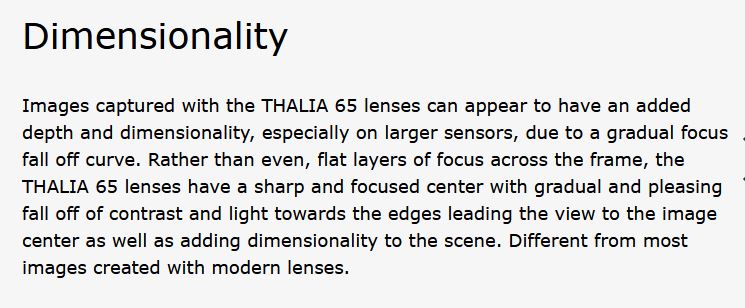
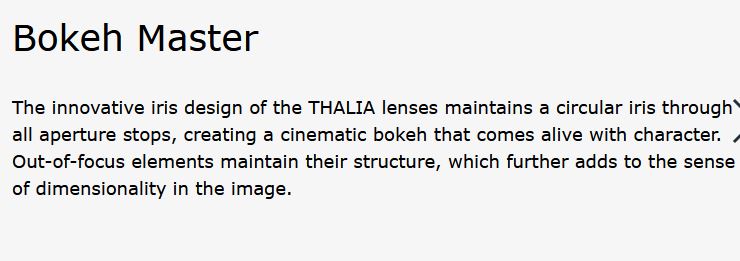
Quote from master designer Iain Neil, in 2014, one of the most decorated figures in modern cinema. Three years later, CW Sonderoptics designed and produced the Thalia series of cine lenses, lenses targeting 3D in a very special formula of inputs (see their words below). No one did this in the stills photography world, least of all Leica itself. In fact, just the opposite, they don't even design for bokeh - it's a 'byproduct' of design to Peter Karbe. The Thalias are the diametric opposites of modern Leica lenses, therefore. The irony. Which road do you reckon the Chinese are taking?


..


Nov 19, 2025 at 05:55 PM
Nifty Fifty
Offline
• • •
Upload & Sell: Off
p.93 #13 · which lens has the most 3D POP?


philip_pj wrote:
There is a reason I don't converse on this thread.

Delicious!😅😅😅


Nov 19, 2025 at 06:06 PM
chez
Offline
• • • • • • •
Upload & Sell: Off
p.93 #14 · which lens has the most 3D POP?


Nifty Fifty wrote:
Delicious!😅😅😅


Philip at least is bringing something to this topic. You…not much.


Nov 19, 2025 at 06:37 PM
OregonSun
Offline
• • • •
Upload & Sell: Off
p.93 #15 · which lens has the most 3D POP?


j4nu wrote:
This is a great comparison of a pair of very different lenses.

I've been looking at these images since a few hours now and, I can't put my finger on it, but there's something that breaks the 3d-pop impression for me. Maybe it's simply too much of whatever it is that is at play there (astigmatism, field curvature, too abrupt focus fade, ?), maybe my brain is looking for color gradiations .They give me more of a smudged or tilt lens vibe, which seems a bit too unnatural for my eyes I guess. And I actually think blur is one
...Show more

Yes, the Revuenon is a bit of an extreme example. I've been having fun figuring out how to use it effectively.

I've found that the 'unnaturalness' you and others have noted varies depending on the composition. Photos of a flat subject definitely look more like a blur vignette was slapped on it in post. Also, the effect changes with aperture, almost completely disappearing by f/16. I haven't tried it with color yet, I'll post some more examples in this thread when I do.


Nov 19, 2025 at 06:40 PM
RustyBug
Offline
• • • • • • •
Upload & Sell: On
p.93 #16 · which lens has the most 3D POP?


Nifty Fifty wrote:
You surely have a link to a reliable source that supports this statement, right? I would be very interested to know which commercially available camera lenses you're referring to.


Yes, study the history of Leica lens design.

And, yes, this perspectives of art are not new. But, they are rooted in centuries old understanding of human physiological response to spatial / depth cues. Enter the "new kid in town" (photography), and lens designs (some) seek to harness this into their optical design. Trompe' Loeil, etc. are age old ... I'm not saying anything that isn't already know, just that folks have been dismissive to the possibility that optical lens designers pay attention to this in their efforts to emulate the 3D physiological response into our 2D medium.

As to "links" ... have you already read the Irwin Puts link or watch the Peter Karbe link?

I realize that some folks genuinely are interested in the subject. Meanwhile others are largely intent / content to be dissenters. The links I've already provided are primers. They make a decent starting point (imo) ...

Given your proximity, I'd envy your opportunity to visit Leica and the annals of their optical design work. I'd venture that a trip there would reveal massive amounts of information on the subject, far beyond anything my personal experience / observation and training.

Heck, a trip to the Berlin Leica store would be a great start, I'd think. If you're earnest ... go for it.


Nov 19, 2025 at 06:54 PM
RustyBug
Offline
• • • • • • •
Upload & Sell: On
p.93 #17 · which lens has the most 3D POP?


philip_pj wrote:
There is a reason I don't converse on this thread.
It's understandable and to be expected that many here have a rather jaundiced view of those of us who have done the hard work of researching the topic. I mean, who are these people who care about having image depth appear in their photos, when we can just listen to the lens producers themselves? Or see, or not see, with our own eyes?

“We were aware of the 3D trend, but this didn’t come up at the beginning. It came up later in the design phase when we realized that
...Show more

Don't forget that while Karbe is the modern APO master for Leica (my personal, paraphrase), their overall history has given consideration to the dimensionality / spatial response rate. The debates between Leica / Zeiss have been around for decades. That, and Karbe isn't the only designer that has passed through Leica's heralded legacy of optical design. The mention (other threads) that some of the Thypoch's don't approach as much micro-contrast ... just another designer decision on where they want to land things.

As to Thalia going opposite Karbe APO designs ... yeah, I get that. I respect Karbe, but sometimes I prefer some of the non-Karbe or non-APO optics, likely for similar (yet, different) reasons. That said ... I repeat the perspective of "craft optics" presenting a wide variety of offerings in the market, wrt to how they land their choices for renderings / emulations (i.e. similar to Lux vs. Cron vs. et al).

Some folks (me, at one time) simply thought that a Summilux was a faster aperture lens than a Summicron. And, while that is true (e.g. f/1.4 vs. f/2.0) ... what I didn't understand (early on) was that the transition rates from Zones A / B / C were designed differently, for the purposes aforementioned.

I find it interesting that when some folks mention the "Leica look", others scoff and say something like, you mean that center subject thing and falloff surroundings. (Summilux oriented). Yet, some folks will say that optics don't make a difference in the falloff / transition rate, without having the benefit of working with a Summicron differentiated from the Summilux, while the other group is scoffing because it does. Go figure.


Nov 19, 2025 at 07:29 PM
Nifty Fifty
Offline
• • •
Upload & Sell: Off
p.93 #18 · which lens has the most 3D POP?


RustyBug wrote:
Yes, study the history of Leica lens design.
As to "links" ... have you already read the Irwin Puts link or watch the Peter Karbe link?

In other words: Apart from the feeling of having once read or heard something somewhere (but obviously not understood it), you have nothing, nada, rien, niente. Thank you, that's enough for me. So it's exactly the same as with Philipp. Nothing but hot air.

RustyBug wrote:
And, yes, this perspectives of art are not new. But, they are rooted in centuries old understanding of human physiological response to spatial / depth cues. Enter the "new kid in town" (photography), and lens designs (some) seek to harness this into their optical design. Trompe' Loeil, etc. are age old ... I'm not saying anything that isn't already know, just that folks have been dismissive to the possibility that optical lens designers pay attention to this in their efforts to emulate the 3D physiological response into our 2D medium.

That's all complete nonsense. Aerial perspective is a physical phenomenon that's easily explained on Wikipedia. Just name a few commercially available camera lenses that override this principle. Shouldn't be difficult if they exist, right?
https://en.wikipedia.org/wiki/Aerial_perspective

RustyBug wrote:
Given your proximity, I'd envy your opportunity to visit Leica and the annals of their optical design work. I'd venture that a trip there would reveal massive amounts of information on the subject, far beyond anything my personal experience / observation and training.
Heck, a trip to the Berlin Leica store would be a great start, I'd think. If you're earnest ... go for it.

Leica Stores make me want to vomit. You don't feel like you're in a camera shop at all, but rather in a luxury car dealership or a high-end boutique where golden calves are displayed on velvet in glass cases and sold by people who seem to have spent their lives reading brochures but taking very little photographs. Simply dreadful. Thanks, my experience with this will last until the end of my life.


Nov 20, 2025 at 03:42 AM
Nifty Fifty
Offline
• • •
Upload & Sell: Off
p.93 #19 · which lens has the most 3D POP?


RustyBug wrote:
Some folks (me, at one time) simply thought that a Summilux was a faster aperture lens than a Summicron. And, while that is true (e.g. f/1.4 vs. f/2.0) ... what I didn't understand (early on) was that the transition rates from Zones A / B / C were designed differently, for the purposes aforementioned.

Well, it's certainly amusing that someone who wants to educate others about lens design first has to consume Leica's company history and countless videos to arrive at this conclusion. Those of us who have never fallen for this misconception simply look at 1:1 comparison images and see the difference!


RustyBug wrote:
I find it interesting that when some folks mention the "Leica look", others scoff and say something like, you mean that center subject thing and falloff surroundings. (Summilux oriented). Yet, some folks will say that optics don't make a difference in the falloff / transition rate, without having the benefit of working with a Summicron differentiated from the Summilux, while the other group is scoffing because it does. Go figure.

And I find it amusing when someone in the same post talks about the significant differences in rendering between Leica lenses and simultaneously mocks those who believe that the "Leica look" therefore cannot exist. How can lenses that differ so significantly in their rendering have the same look? Don't you realize how you're contradicting yourself?


Nov 20, 2025 at 03:46 AM
Nifty Fifty
Offline
• • •
Upload & Sell: Off
p.93 #20 · which lens has the most 3D POP?


chez wrote:
Philip at least is bringing something to this topic. You…not much.

Yes, he clearly makes more untenable (because unsubstantiated) claims here than I (or anyone else) and repeats them endlessly at regular intervals instead of responding to objections. I completely agree with you there.


Nov 20, 2025 at 03:50 AM
1       2       3              92              94              138       139       end


FM Forums | Leica & Alternative Gear | Join Upload & Sell

1       2       3              92              94              138       139       end


Welcome back
Log in to your account