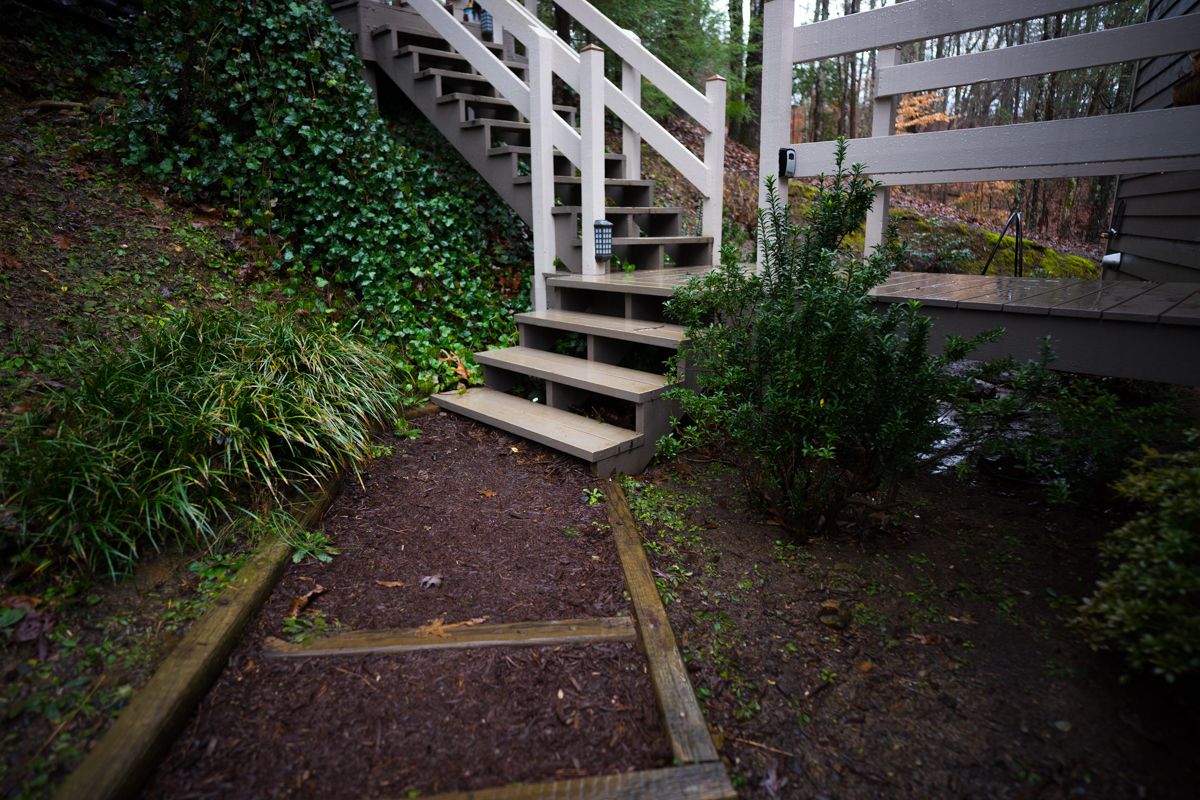
If pop is a lens property, then its extra information recorded by this lens.
You cannot add information that wasnt recorded in the first place.
Yes, I'm aware of that and I agree, hence: "It's not quite the same as a good lens with that characteristics, but it's close."
It's just a way of simulating the effect, in the same way that software-sharpening a soft image isn't as good as a photo made with a sharp lens, but it can simulate it to a certain extent and give a good illusion of sharpness to the final image.
Sr.Cordeiro wrote:
That image is probably one of the best examples of 3D effect I've seen, and it doesn't even have to rely on DOF separation to do so.
Thanks! Not only does it not rely on DOF separation, it’s actually a hand blended focus stack for maximum DOF. I think it is the fog that helps with the 3D look; a combination of de-emphasising the background and the slightly wet bark on the tree making it pop a bit.
On my Fuji setup, the lens that I think has the most 3D effect is the Fujinon 35mm f/2 WR:
I love the rendering of that little Fujicron.
Another one that I found that can surprisingly deliver some "3D-ish" photos is the Fujifilm X100F. It's interesting because that lens is the same as the one used on the original X100 I had, but the old camera never delivered images with the kind of pop the X100F has. Maybe the 24mp X-Trans sensor made that lens really shine:
Jim Schemel wrote:
Zeiss 100 f2 Makro Planar - its a legend of a lens and delivers 3D in buckets
Absolutely. Which is why despite the bundles of loca it produces I've never once considered giving it up. I don't take it out as much as I should due to its weight but when I flip through my images I always linger a little longer on ones made by this lens.
Interesting quote from that article, as one could possibly apply the same strategy to photography by looking for these patterns in the natural or man made environment or perhaps enhancing in post: “Some painters, notably Cézanne, employ "warm" pigments (red, yellow and orange) to bring features towards the viewer, and "cool" ones (blue, violet, and blue-green) to indicate the part of a form that curves away from the picture plane.”
Looking to painters and artists techniques is a good way to approach this subject, since they have been working for many centuries to perfect such visual cues and illusions.
Also see Hoffman's "push-pull" theory of contrasting colors and brightness.
anumits wrote:
Absolutely. Which is why despite the bundles of loca it produces I've never once considered giving it up. I don't take it out as much as I should due to its weight but when I flip through my images I always linger a little longer on ones made by this lens.
If you don't mind giving up the macro MFD, the Contax Zeiss C/Y 100mm f/2 is much better corrected.
I saw this in an AKC e-mail today regarding VMF (Veterans Moving Forward), a non-profit organization that helps veterans return to their everyday lives. Even without lots of resolution this shot clearly exhibits 3D pop:
Gunzorro wrote:
Looking to painters and artists techniques is a good way to approach this subject, since they have been working for many centuries to perfect such visual cues and illusions.
Also see Hoffman's "push-pull" theory of contrasting colors and brightness.
Part of the issue is the rate of change in transition (not to be confused with DOF). Lenses that have different rates of transition between zones offer an opportunity to have a subject / element placement in a location that harness that transition variance. In that regard, different lens designs can / do contribute. Some mfr's design their lenses toward variant transitions. Others design more toward uniform transitions. Ceteris paribus ... variant transition lenses afford more opportunity for the effect than uniform transitions.
Beyond the optical projection transition rates ... then the other mentioned items can make contributions as well, including some manipulation efforts to impact transitions.
A very important video. One that derails and demystifies so much of the nonsense we are living through - the flat universe dominated by out of focus to the detriment of beatifully shaped and presented subject matter. Never mind the content, feel the bokeh is the modern mantra.
Industry: wrong way, go back. What a tragedy the modern age has been to the visual arts. Some great highlights here, like the 21mm Leica is for 'shooting sheet metal' (4:30); the side by side faces (8:08) but seriously if you have an interest in top tier imaging don't miss this video.
I now see more clearly why it is so hard to like (or even use) modern lenses with the exception of the one or two makers still interested in melding the wisdom of the past with the technology of the present.
Most lens producers are sheep wandering around in the top paddock, going this way or that. All at once, lest people see the difference, and what has been lost. It's a flat earth now.