which lens has the most 3D POP?
p.147 #1which lens has the most 3D POP?
'i guess a Zeiss, but which one?'
At that time in 2011, yes - Carl Zeiss, who remained so until they capitalized themselves into 'ZEISS' not realising no one would ever inflict their brand name on each other in that textual form, was entering the 'unleaded fuel' era of substandard replacements for the magic of lead and trying to remain relevant with the impoverished glass selections left to them from the decimated Schott catalog.
So that was the upheaval's core issue. Zeiss themselves now acknowledge the superiority of the CY optics, in their release statement of the new Aatma cine lens range. When asked 'why not just reissue CY lenses', they said they were prohibited from using lead.
Zeiss also had the misfortune of losing their way in the post-Contax period, in terms of the first advanced (heavily revised) T* coatings used in both the CY and Super Speed lenses. It's been downhill ever since, as makers resorted to APD glass and hoodwinked all and sundry into believing sharpness was all that mattered. And coatings became correction entities in their own right.
Nobody in the know is fooled. The Super Speeds share glass formulae, coatings and design methodologies with the CY lenses, not what followed - CZ went a similar way in cine lenses: more sharpness! Lead was crucial in permitting such simple spherical lenses (6-8 elements in the main) to perform so well, particularly their treatment of image depth, saturation and skin tones. The cine people know all this, but it does not compute in stills land.
'Super Speeds Sets (MKII / MKIII, 5-lens set: 18, 25, 35, 50, 85mm):Very good condition sets routinely trade around $35,000 to $50,000 USD, though pristine or expanded sets with the rare 135mm T2.1 can push past $68,000 to $75,000 USD.'
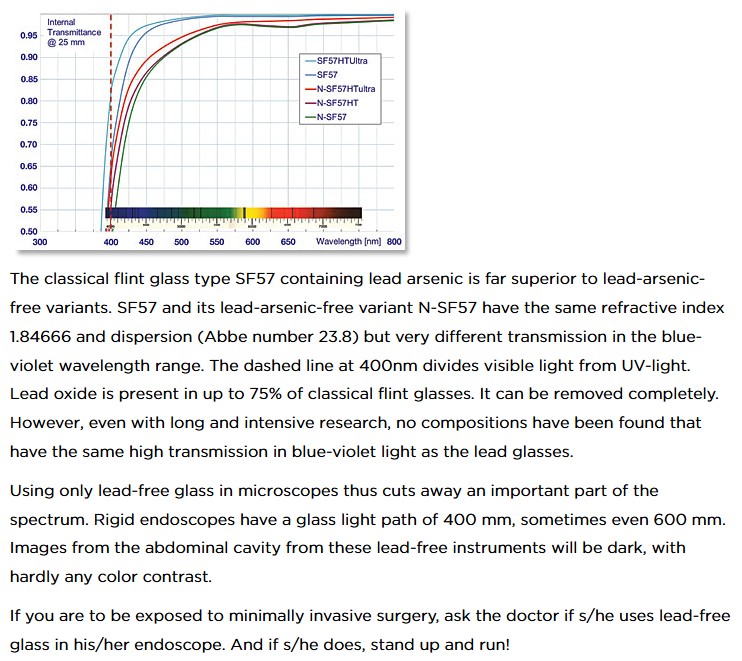
And full credit to Schott's Peter Hartmann (https://spie.org/profile/Peter.Hartmann-13859) who tried for years to convince the dopes in Brussels of the error of their ways. Besides consumer optics, there was much more at stake in very important high tech fields - it actually threatened to disable MRI machines because they lost the ability to image the blue channel.
https://www.spiedigitallibrary.org/conference-proceedings-of-spie/8065/1/Optical-glass-and-the-EU-directive-RoHS/10.1117/12.882922.full
you might find this interesting
At that time in 2011, yes - Carl Zeiss, who remained so until they capitalized themselves into 'ZEISS' not realising no one would ever inflict their brand name on each other in that textual form, was entering the 'unleaded fuel' era of substandard replacements for the magic of lead and trying to remain relevant with the impoverished glass selections left to them from the decimated Schott catalog.
So that was the upheaval's core issue. Zeiss themselves now acknowledge the superiority of the CY optics, in their release statement of the new Aatma cine lens range. When asked 'why not just reissue CY lenses', they said they were prohibited from using lead.
Zeiss also had the misfortune of losing their way in the post-Contax period, in terms of the first advanced (heavily revised) T* coatings used in both the CY and Super Speed lenses. It's been downhill ever since, as makers resorted to APD glass and hoodwinked all and sundry into believing sharpness was all that mattered. And coatings became correction entities in their own right.
Nobody in the know is fooled. The Super Speeds share glass formulae, coatings and design methodologies with the CY lenses, not what followed - CZ went a similar way in cine lenses: more sharpness! Lead was crucial in permitting such simple spherical lenses (6-8 elements in the main) to perform so well, particularly their treatment of image depth, saturation and skin tones. The cine people know all this, but it does not compute in stills land.
'Super Speeds Sets (MKII / MKIII, 5-lens set: 18, 25, 35, 50, 85mm):Very good condition sets routinely trade around $35,000 to $50,000 USD, though pristine or expanded sets with the rare 135mm T2.1 can push past $68,000 to $75,000 USD.'
And full credit to Schott's Peter Hartmann (https://spie.org/profile/Peter.Hartmann-13859) who tried for years to convince the dopes in Brussels of the error of their ways. Besides consumer optics, there was much more at stake in very important high tech fields - it actually threatened to disable MRI machines because they lost the ability to image the blue channel.
https://www.spiedigitallibrary.org/conference-proceedings-of-spie/8065/1/Optical-glass-and-the-EU-directive-RoHS/10.1117/12.882922.full
 |
||
 |
||
|
you might find this interesting
Aug 16, 2026 at 12:39 AM
p.147 #2which lens has the most 3D POP?
Having said that, here are some CY images that hopefully show their wares.
..
..
..
..
|
||
 |
||
|
..
|
||
 |
||
|
..
|
||
 |
||
|
..
|
||
 |
||
|
..
|
||
 |
||
|
Aug 16, 2026 at 01:15 AM
p.147 #3which lens has the most 3D POP?
Schwarzlicht wrote:
[...]
I've now updated my post and added the image that I probably originally posted back then (second image). To be honest, I don't think the difference is that big. The second one has slightly cooler colors, but there's a lamp post on the left that unfortunately intrudes into the frame. Today, I would just crop that out. In the current image, the colors appear more vibrant, probably due to the higher color temperature. The saturation is at 0 – unedited. Personally, I prefer the current image.
[...]
Hi Schwarzlicht,
I don't understand... you switched the images? Now I can't se much of a difference between the versions in your post at page 146 post #2.
When I wrote my comment there was one image only. This one:
image DSC08211, August 14
https://www.fredmiranda.com/forum/link.php?url=https://flic.kr/p/FMTtSg
Now the image DSC08211 is this one, August 15
https://www.fredmiranda.com/forum/link.php?url=https://flic.kr/p/2a6PaL8
One of the first times, perhaps the very first time, I saw your image was back in 2024, I think here: https://www.fredmiranda.com/forum/topic/1879326/5&year=2024#16687344
There is an obvious difference and it's that difference I discussed in my first comment.
[...]
I've now updated my post and added the image that I probably originally posted back then (second image). To be honest, I don't think the difference is that big. The second one has slightly cooler colors, but there's a lamp post on the left that unfortunately intrudes into the frame. Today, I would just crop that out. In the current image, the colors appear more vibrant, probably due to the higher color temperature. The saturation is at 0 – unedited. Personally, I prefer the current image.
[...]
Hi Schwarzlicht,
I don't understand... you switched the images? Now I can't se much of a difference between the versions in your post at page 146 post #2.
When I wrote my comment there was one image only. This one:
image DSC08211, August 14
https://www.fredmiranda.com/forum/link.php?url=https://flic.kr/p/FMTtSg
Now the image DSC08211 is this one, August 15
https://www.fredmiranda.com/forum/link.php?url=https://flic.kr/p/2a6PaL8
One of the first times, perhaps the very first time, I saw your image was back in 2024, I think here: https://www.fredmiranda.com/forum/topic/1879326/5&year=2024#16687344
There is an obvious difference and it's that difference I discussed in my first comment.
Aug 16, 2026 at 03:32 AM
p.147 #4which lens has the most 3D POP?
OK, the Forum links make a mess of my post above. I show you instead:

The image to the left was great and admired, and rightly so, when you posted it. When I saw the image to the right, posted yesterday I reacted to the difference.
Let m know if you want me to remove the image.
The image to the left was great and admired, and rightly so, when you posted it. When I saw the image to the right, posted yesterday I reacted to the difference.
Let m know if you want me to remove the image.
Aug 16, 2026 at 03:56 AM

p.147 #5which lens has the most 3D POP?
philip_pj wrote:
'i guess a Zeiss, but which one?'
At that time in 2011, yes - Carl Zeiss, who remained so until they capitalized themselves into 'ZEISS' not realising no one would ever inflict their brand name on each other in that textual form, was entering the 'unleaded fuel' era of substandard replacements for the magic of lead and trying to remain relevant with the impoverished glass selections left to them from the decimated Schott catalog.
So that was the upheaval's core issue. Zeiss themselves now acknowledge the superiority of the CY optics, in their release statement of the new Aatma cine lens...Show more →
Philip,
Is the image you shared in the post from the conference presentation you linked above it? It seems unlikely that it is. Especially the last sentence appears to be very hyperbolic and not warranted by the data in the figure and the sort of thing I would never expect at a scientific conference and it someone presented such data and such a conclusion they would be seen by almost all as highly irresponsible. It could happen. There is no peer review of presentations at conferences, just the abstract for the conference. So occasionally strange stuff gets presented, but is someone made the argument that is made in your figure or anything like that at least in my field they would be seen as an irresponsible hack.
I think your arguments about glass types are highly speculative and almost certainly wrong. We get it. You love HRI glass. You hate APD glass. You love lead added to glass. You dislike aspherical glass and think it can't be put in lenses without excessively copy variation. The evidence you present for these strong views, however, is extremely weak and poorly argued. You aren't convincing me of any of these positions and appear to be stretching almost beyond credulity for all of these points.
Aug 16, 2026 at 06:38 AM
p.147 #6which lens has the most 3D POP?
philip_pj wrote:
'i guess a Zeiss, but which one?'
At that time in 2011, yes - Carl Zeiss, who remained so until they capitalized themselves into 'ZEISS' not realising no one would ever inflict their brand name on each other in that textual form, was entering the 'unleaded fuel' era of substandard replacements for the magic of lead and trying to remain relevant with the impoverished glass selections left to them from the decimated Schott catalog.
So that was the upheaval's core issue. Zeiss themselves now acknowledge the superiority of the CY optics, in their release statement of the new Aatma cine lens...Show more →
Regarding "it actually threatened to disable MRI machines because they lost the ability to image the blue channel" - you must have confused MRI with something else. I am closely familiar with NMR - a related Magnetic Resonance (MR) technique. MRI is not an optical technology. MRI images are constructed from radiofrequency signals emitted by the nuclei of hydrogen atoms in a magnetic field, detected by RF coils, and reconstructed into grayscale images based on proton density and relaxation times. There's no lens system, no visible-light optical path, and no "blue channel" — the whole imaging chain is electromagnetic/RF, not optical.
Aug 16, 2026 at 06:47 AM
p.147 #7which lens has the most 3D POP?
Steve Spencer wrote:
At that time in 2011, yes - Carl Zeiss, who remained so until they capitalized themselves into 'ZEISS' not realising no one would ever inflict their brand name on each other in that textual form, was entering the 'unleaded fuel' era of substandard replacements for the magic of lead and trying to remain relevant with the impoverished glass selections left to them from the decimated Schott catalog.
So that was the upheaval's core issue. Zeiss themselves now acknowledge the superiority of the CY optics, in their release statement of the new Aatma cine lens range. When asked 'why not just reissue CY lenses', they said they were prohibited from using lead.
Zeiss also had the misfortune of losing their way in the post-Contax period, in terms of the first advanced (heavily revised) T* coatings used in both the CY and Super Speed lenses. It's been downhill ever since, as makers resorted to APD glass and hoodwinked all and sundry into believing sharpness was all that mattered. And coatings became correction entities in their own right.
Nobody in the know is fooled. The Super Speeds share glass formulae, coatings and design methodologies with the CY lenses, not what followed - CZ went a similar way in cine lenses: more sharpness! Lead was crucial in permitting such simple spherical lenses (6-8 elements in the main) to perform so well, particularly their treatment of image depth, saturation and skin tones. The cine people know all this, but it does not compute in stills land.
'Super Speeds Sets (MKII / MKIII, 5-lens set: 18, 25, 35, 50, 85mm):Very good condition sets routinely trade around $35,000 to $50,000 USD, though pristine or expanded sets with the rare 135mm T2.1 can push past $68,000 to $75,000 USD.'
And full credit to Schott's Peter Hartmann (https://spie.org/profile/Peter.Hartmann-13859) who tried for years to convince the dopes in Brussels of the error of their ways. Besides consumer optics, there was much more at stake in very important high tech fields - it actually threatened to disable MRI machines because they lost the ability to image the blue channel.
https://www.spiedigitallibrary.org/conference-proceedings-of-spie/8065/1/Optical-glass-and-the-EU-directive-RoHS/10.1117/12.882922.fullPhilip,
Is the image you shared in the post from the conference presentation you linked above it? It seems unlikely that it is. Especially the last sentence appears to be very hyperbolic and not warranted by the data in the figure and the sort of thing I would never expect at a scientific conference and it someone presented such data and such a conclusion they would be seen by almost all as highly irresponsible. It could happen. There is no peer review of presentations at conferences, just the abstract for the conference. So occasionally strange stuff gets presented, but is...Show more →
Amen.
The quality of actual photography done every day by excellent photographers all over the world using the gear he attacks reveals clearly the hyperbolic, obsessive, and nonsensical nature of his claims in this forlorn thread.
It is that simple.
Edited on Aug 16, 2026 at 10:12 AM · View previous versions
philip_pj wrote
'i guess a Zeiss, but which one?'At that time in 2011, yes - Carl Zeiss, who remained so until they capitalized themselves into 'ZEISS' not realising no one would ever inflict their brand name on each other in that textual form, was entering the 'unleaded fuel' era of substandard replacements for the magic of lead and trying to remain relevant with the impoverished glass selections left to them from the decimated Schott catalog.
So that was the upheaval's core issue. Zeiss themselves now acknowledge the superiority of the CY optics, in their release statement of the new Aatma cine lens range. When asked 'why not just reissue CY lenses', they said they were prohibited from using lead.
Zeiss also had the misfortune of losing their way in the post-Contax period, in terms of the first advanced (heavily revised) T* coatings used in both the CY and Super Speed lenses. It's been downhill ever since, as makers resorted to APD glass and hoodwinked all and sundry into believing sharpness was all that mattered. And coatings became correction entities in their own right.
Nobody in the know is fooled. The Super Speeds share glass formulae, coatings and design methodologies with the CY lenses, not what followed - CZ went a similar way in cine lenses: more sharpness! Lead was crucial in permitting such simple spherical lenses (6-8 elements in the main) to perform so well, particularly their treatment of image depth, saturation and skin tones. The cine people know all this, but it does not compute in stills land.
'Super Speeds Sets (MKII / MKIII, 5-lens set: 18, 25, 35, 50, 85mm):Very good condition sets routinely trade around $35,000 to $50,000 USD, though pristine or expanded sets with the rare 135mm T2.1 can push past $68,000 to $75,000 USD.'
And full credit to Schott's Peter Hartmann (https://spie.org/profile/Peter.Hartmann-13859) who tried for years to convince the dopes in Brussels of the error of their ways. Besides consumer optics, there was much more at stake in very important high tech fields - it actually threatened to disable MRI machines because they lost the ability to image the blue channel.
https://www.spiedigitallibrary.org/conference-proceedings-of-spie/8065/1/Optical-glass-and-the-EU-directive-RoHS/10.1117/12.882922.full
Is the image you shared in the post from the conference presentation you linked above it? It seems unlikely that it is. Especially the last sentence appears to be very hyperbolic and not warranted by the data in the figure and the sort of thing I would never expect at a scientific conference and it someone presented such data and such a conclusion they would be seen by almost all as highly irresponsible. It could happen. There is no peer review of presentations at conferences, just the abstract for the conference. So occasionally strange stuff gets presented, but is...Show more →
Amen.
The quality of actual photography done every day by excellent photographers all over the world using the gear he attacks reveals clearly the hyperbolic, obsessive, and nonsensical nature of his claims in this forlorn thread.
It is that simple.
Edited on Aug 16, 2026 at 10:12 AM · View previous versions
Aug 16, 2026 at 08:01 AM
p.147 #8which lens has the most 3D POP?
ruthenium wrote:
At that time in 2011, yes - Carl Zeiss, who remained so until they capitalized themselves into 'ZEISS' not realising no one would ever inflict their brand name on each other in that textual form, was entering the 'unleaded fuel' era of substandard replacements for the magic of lead and trying to remain relevant with the impoverished glass selections left to them from the decimated Schott catalog.
So that was the upheaval's core issue. Zeiss themselves now acknowledge the superiority of the CY optics, in their release statement of the new Aatma cine lens range. When asked 'why not just reissue CY lenses', they said they were prohibited from using lead.
Zeiss also had the misfortune of losing their way in the post-Contax period, in terms of the first advanced (heavily revised) T* coatings used in both the CY and Super Speed lenses. It's been downhill ever since, as makers resorted to APD glass and hoodwinked all and sundry into believing sharpness was all that mattered. And coatings became correction entities in their own right.
Nobody in the know is fooled. The Super Speeds share glass formulae, coatings and design methodologies with the CY lenses, not what followed - CZ went a similar way in cine lenses: more sharpness! Lead was crucial in permitting such simple spherical lenses (6-8 elements in the main) to perform so well, particularly their treatment of image depth, saturation and skin tones. The cine people know all this, but it does not compute in stills land.
'Super Speeds Sets (MKII / MKIII, 5-lens set: 18, 25, 35, 50, 85mm):Very good condition sets routinely trade around $35,000 to $50,000 USD, though pristine or expanded sets with the rare 135mm T2.1 can push past $68,000 to $75,000 USD.'
And full credit to Schott's Peter Hartmann (https://spie.org/profile/Peter.Hartmann-13859) who tried for years to convince the dopes in Brussels of the error of their ways. Besides consumer optics, there was much more at stake in very important high tech fields - it actually threatened to disable MRI machines because they lost the ability to image the blue channel.
https://www.spiedigitallibrary.org/conference-proceedings-of-spie/8065/1/Optical-glass-and-the-EU-directive-RoHS/10.1117/12.882922.fullRegarding "it actually threatened to disable MRI machines because they lost the ability to image the blue channel" - you must have confused MRI with something else. I am closely familiar with NMR - a related Magnetic Resonance (MR) technique. MRI is not an optical technology. MRI images are constructed from radiofrequency signals emitted by the nuclei of hydrogen atoms in a magnetic field, detected by RF coils, and reconstructed into grayscale images based on proton density and relaxation times. There's no lens system, no visible-light optical path, and no "blue channel" — the whole imaging chain is electromagnetic/RF, not...Show more →
Hold on. You’ve come to the completely wrong place in this thread to share expert knowledge and facts.
After all, far more important matters are at stake.
😇
philip_pj wrote
'i guess a Zeiss, but which one?'At that time in 2011, yes - Carl Zeiss, who remained so until they capitalized themselves into 'ZEISS' not realising no one would ever inflict their brand name on each other in that textual form, was entering the 'unleaded fuel' era of substandard replacements for the magic of lead and trying to remain relevant with the impoverished glass selections left to them from the decimated Schott catalog.
So that was the upheaval's core issue. Zeiss themselves now acknowledge the superiority of the CY optics, in their release statement of the new Aatma cine lens range. When asked 'why not just reissue CY lenses', they said they were prohibited from using lead.
Zeiss also had the misfortune of losing their way in the post-Contax period, in terms of the first advanced (heavily revised) T* coatings used in both the CY and Super Speed lenses. It's been downhill ever since, as makers resorted to APD glass and hoodwinked all and sundry into believing sharpness was all that mattered. And coatings became correction entities in their own right.
Nobody in the know is fooled. The Super Speeds share glass formulae, coatings and design methodologies with the CY lenses, not what followed - CZ went a similar way in cine lenses: more sharpness! Lead was crucial in permitting such simple spherical lenses (6-8 elements in the main) to perform so well, particularly their treatment of image depth, saturation and skin tones. The cine people know all this, but it does not compute in stills land.
'Super Speeds Sets (MKII / MKIII, 5-lens set: 18, 25, 35, 50, 85mm):Very good condition sets routinely trade around $35,000 to $50,000 USD, though pristine or expanded sets with the rare 135mm T2.1 can push past $68,000 to $75,000 USD.'
And full credit to Schott's Peter Hartmann (https://spie.org/profile/Peter.Hartmann-13859) who tried for years to convince the dopes in Brussels of the error of their ways. Besides consumer optics, there was much more at stake in very important high tech fields - it actually threatened to disable MRI machines because they lost the ability to image the blue channel.
https://www.spiedigitallibrary.org/conference-proceedings-of-spie/8065/1/Optical-glass-and-the-EU-directive-RoHS/10.1117/12.882922.full
Hold on. You’ve come to the completely wrong place in this thread to share expert knowledge and facts.
After all, far more important matters are at stake.
😇
Aug 16, 2026 at 08:09 AM
p.147 #9which lens has the most 3D POP?
philip_pj wrote:
'i guess a Zeiss, but which one?'
At that time in 2011, yes - Carl Zeiss, who remained so until they capitalized themselves into 'ZEISS' not realising no one would ever inflict their brand name on each other in that textual form, was entering the 'unleaded fuel' era of substandard replacements for the magic of lead and trying to remain relevant with the impoverished glass selections left to them from the decimated Schott catalog.
So that was the upheaval's core issue. Zeiss themselves now acknowledge the superiority of the CY optics, in their release statement of the new Aatma cine lens...Show more →
My Zeiss lenses are not even originals. I have a couple of Zeiss Touits for my A6xxx and the Zeiss Batis. Anyway I love the rendering but nowadays I mostly use them for travel except the Batis 85.

Sony Alpha α6700
1/320s f/1.8 at 32.0mm iso100
'i guess a Zeiss, but which one?'
At that time in 2011, yes - Carl Zeiss, who remained so until they capitalized themselves into 'ZEISS' not realising no one would ever inflict their brand name on each other in that textual form, was entering the 'unleaded fuel' era of substandard replacements for the magic of lead and trying to remain relevant with the impoverished glass selections left to them from the decimated Schott catalog.
So that was the upheaval's core issue. Zeiss themselves now acknowledge the superiority of the CY optics, in their release statement of the new Aatma cine lens...Show more →
My Zeiss lenses are not even originals. I have a couple of Zeiss Touits for my A6xxx and the Zeiss Batis. Anyway I love the rendering but nowadays I mostly use them for travel except the Batis 85.
Sony Alpha α6700
1/320s f/1.8 at 32.0mm iso100
Aug 16, 2026 at 08:20 AM
p.147 #10which lens has the most 3D POP?
Nifty Fifty wrote:
ruthenium wrote
philip_pj wrote
'i guess a Zeiss, but which one?'At that time in 2011, yes - Carl Zeiss, who remained so until they capitalized themselves into 'ZEISS' not realising no one would ever inflict their brand name on each other in that textual form, was entering the 'unleaded fuel' era of substandard replacements for the magic of lead and trying to remain relevant with the impoverished glass selections left to them from the decimated Schott catalog.
So that was the upheaval's core issue. Zeiss themselves now acknowledge the superiority of the CY optics, in their release statement of the new Aatma cine lens range. When asked 'why not just reissue CY lenses', they said they were prohibited from using lead.
Zeiss also had the misfortune of losing their way in the post-Contax period, in terms of the first advanced (heavily revised) T* coatings used in both the CY and Super Speed lenses. It's been downhill ever since, as makers resorted to APD glass and hoodwinked all and sundry into believing sharpness was all that mattered. And coatings became correction entities in their own right.
Nobody in the know is fooled. The Super Speeds share glass formulae, coatings and design methodologies with the CY lenses, not what followed - CZ went a similar way in cine lenses: more sharpness! Lead was crucial in permitting such simple spherical lenses (6-8 elements in the main) to perform so well, particularly their treatment of image depth, saturation and skin tones. The cine people know all this, but it does not compute in stills land.
'Super Speeds Sets (MKII / MKIII, 5-lens set: 18, 25, 35, 50, 85mm):Very good condition sets routinely trade around $35,000 to $50,000 USD, though pristine or expanded sets with the rare 135mm T2.1 can push past $68,000 to $75,000 USD.'
And full credit to Schott's Peter Hartmann (https://spie.org/profile/Peter.Hartmann-13859) who tried for years to convince the dopes in Brussels of the error of their ways. Besides consumer optics, there was much more at stake in very important high tech fields - it actually threatened to disable MRI machines because they lost the ability to image the blue channel.
https://www.spiedigitallibrary.org/conference-proceedings-of-spie/8065/1/Optical-glass-and-the-EU-directive-RoHS/10.1117/12.882922.full
After all, far more important matters are at stake.
😇
Culpa mea. That post must be a symptom of the foot-in-mouth disease.
Aug 16, 2026 at 12:10 PM
|
p.147 #11which lens has the most 3D POP?
ruthenium wrote:
Nifty Fifty wrote
ruthenium wrote
philip_pj wrote
'i guess a Zeiss, but which one?'At that time in 2011, yes - Carl Zeiss, who remained so until they capitalized themselves into 'ZEISS' not realising no one would ever inflict their brand name on each other in that textual form, was entering the 'unleaded fuel' era of substandard replacements for the magic of lead and trying to remain relevant with the impoverished glass selections left to them from the decimated Schott catalog.
So that was the upheaval's core issue. Zeiss themselves now acknowledge the superiority of the CY optics, in their release statement of the new Aatma cine lens range. When asked 'why not just reissue CY lenses', they said they were prohibited from using lead.
Zeiss also had the misfortune of losing their way in the post-Contax period, in terms of the first advanced (heavily revised) T* coatings used in both the CY and Super Speed lenses. It's been downhill ever since, as makers resorted to APD glass and hoodwinked all and sundry into believing sharpness was all that mattered. And coatings became correction entities in their own right.
Nobody in the know is fooled. The Super Speeds share glass formulae, coatings and design methodologies with the CY lenses, not what followed - CZ went a similar way in cine lenses: more sharpness! Lead was crucial in permitting such simple spherical lenses (6-8 elements in the main) to perform so well, particularly their treatment of image depth, saturation and skin tones. The cine people know all this, but it does not compute in stills land.
'Super Speeds Sets (MKII / MKIII, 5-lens set: 18, 25, 35, 50, 85mm):Very good condition sets routinely trade around $35,000 to $50,000 USD, though pristine or expanded sets with the rare 135mm T2.1 can push past $68,000 to $75,000 USD.'
And full credit to Schott's Peter Hartmann (https://spie.org/profile/Peter.Hartmann-13859) who tried for years to convince the dopes in Brussels of the error of their ways. Besides consumer optics, there was much more at stake in very important high tech fields - it actually threatened to disable MRI machines because they lost the ability to image the blue channel.
https://www.spiedigitallibrary.org/conference-proceedings-of-spie/8065/1/Optical-glass-and-the-EU-directive-RoHS/10.1117/12.882922.full
After all, far more important matters are at stake.
😇
You are forgiven!😄
Aug 16, 2026 at 03:04 PM
p.147 #12which lens has the most 3D POP?
philip_pj wrote:
'i guess a Zeiss, but which one?'
At that time in 2011, yes - Carl Zeiss, who remained so until they capitalized themselves into 'ZEISS' not realising no one would ever inflict their brand name on each other in that textual form, was entering the 'unleaded fuel' era of substandard replacements for the magic of lead and trying to remain relevant with the impoverished glass selections left to them from the decimated Schott catalog.
So that was the upheaval's core issue. Zeiss themselves now acknowledge the superiority of the CY optics, in their release statement of the new Aatma cine lens...Show more →
You mentioned eight elements. I googled the type of glass my Sonnar 24/1.8 for Sony aps-c and says eight elements in seven groups. Whatever that means I love the rendering of this lens. As I become older this lens is probably more important to me than the bokehlicious but heavy and hefty Viltrox 35/1.2.

Sony Alpha α6700
1/320s f/1.8 at 24.0mm iso100

Sony Nex-6
1/100s f/3.2 at 24.0mm iso100

Sony Alpha α6700
1/2500s f/1.8 at 24.0mm iso100
'i guess a Zeiss, but which one?'
At that time in 2011, yes - Carl Zeiss, who remained so until they capitalized themselves into 'ZEISS' not realising no one would ever inflict their brand name on each other in that textual form, was entering the 'unleaded fuel' era of substandard replacements for the magic of lead and trying to remain relevant with the impoverished glass selections left to them from the decimated Schott catalog.
So that was the upheaval's core issue. Zeiss themselves now acknowledge the superiority of the CY optics, in their release statement of the new Aatma cine lens...Show more →
You mentioned eight elements. I googled the type of glass my Sonnar 24/1.8 for Sony aps-c and says eight elements in seven groups. Whatever that means I love the rendering of this lens. As I become older this lens is probably more important to me than the bokehlicious but heavy and hefty Viltrox 35/1.2.
Sony Alpha α6700
1/320s f/1.8 at 24.0mm iso100
Sony Nex-6
1/100s f/3.2 at 24.0mm iso100
Sony Alpha α6700
1/2500s f/1.8 at 24.0mm iso100
Aug 17, 2026 at 06:05 PM
p.147 #13which lens has the most 3D POP?
philip_pj wrote:
Zeiss also had the misfortune of losing their way in the post-Contax period, in terms of the first advanced (heavily revised) T* coatings used in both the CY and Super Speed lenses.
Does "the post-Contax period" refer to C/Y-mount glass, or to lenses that were released after C/Y-mount lenses were released?
Beautiful photography. If you feel like it, can you share which lens(es) were used? Are they the lenses priced in the five digits as you described?
Aug 17, 2026 at 08:58 PM

p.147 #15which lens has the most 3D POP?
My Viltrox 35/1.2 LAB N has been singing some ballads lately.
"Bridge over Troubled Water", Simon and Garfunkel

"Wednesday in Your Garden" by the Canadian Guess Who

And I gotta get this in because the old 50L's image looks like a painting. That must be the so-called character. I wonder if the upcoming Viltrox 50/1.2 will be smoother than this.

"Bridge over Troubled Water", Simon and Garfunkel
"Wednesday in Your Garden" by the Canadian Guess Who
And I gotta get this in because the old 50L's image looks like a painting. That must be the so-called character. I wonder if the upcoming Viltrox 50/1.2 will be smoother than this.
Aug 20, 2026 at 10:45 PM
p.147 #16which lens has the most 3D POP?
All the Chinese lenses have above average to very good 3D. They choose one of the two 'models' of 3D, either the supersharp subject/fast fade to high blur background; or the smoother graduated content, with a real world vision level rendering of the subject, fading off smoothly and gradually to a still content-rich background. A slight simplification, but not by much.
Viltrox are big into the commercial lens business (pros, event, etc.) so they do the accepted 3D standard of the cutout subject/big blur approach, and they are doing a damn fine job of it. They seem primed to bite a large chunk of the market. (At the other end are Thypoch and LLL, using the other 3D model.)
All the good older lenses (except some not-so-good zooms) back in the (probably, you don't say which aperture 50mm L) days of the 50/1.2 L in 2006? We had a much higher ratio of very good 3D lenses as a 'percentage of total good lenses' - among primes/slow zoom lenses, because of lead oxide and a solid backup in lanthanum oxide. And fully leaded lenses were the reference to be aimed for, even as they were phased out.
I have to chuckle when I read about 'lanthanum-infused' or 'lead-infused' designs. That terminology tends to downplay the role of these materials - the language matters here. They should simply say: 'we used lead for its optical properties'.
What percentage of lanthanum or lead are we talking about?
'Lanthanum Flint (LaF) & Heavy Lanthanum Flint Glass: These contain the highest concentrations, typically ranging from *30% to 50% by weight*. Some formulations specifically target a range of 27% to 40%. Lanthanum Crown (LaK) Glass: These formulations generally feature concentrations between 20% and 35%. (Don't worry about the crown/flint terms, that is how achromat doublets are made.)
Lead? Even worse:
'High Refractive Index and Dispersion: Lead oxide (often 24%–36% by weight) significantly increases the refractive index'
Now that above is a move by the AI LLM to downplay lead as a glass component, they want you to 'move on'. Now read this:
'The highest lead content by weight percentage in high-end photographic or optical glass reaches roughly *55% to 60%* lead(II) oxide (PbO) *by mass*. This level is found in extreme extra-dense flint glass types (such as ZF or SF types like SF6 or SF57 variants) *historically utilized by top-tier makers like Zeiss, Leica, and Canon* for *specialized high-refractive elements.*'
55% can be argued to be a little more dramatic than a mere 'infusion' - more of a hostile takeover. We lost lead in 2004, and images have never looked the same since. (My stuff above is all lead lenses - Carl Zeiss lenses, to show readers how they look.)
The insiders know this, BTW, as you would when many key elements in your lens designs lose a third to half the glass 'ingredient', in fact the main component. The older lenses were *more lead* than anything else. cheers.
Aug 21, 2026 at 01:29 AM
p.147 #17which lens has the most 3D POP?
Hi Philip,
Thanks for your comments. I am not an engineer but googled the composition of the EF 50/1.2 L---apparently it is high-refractive, lead-free optical glass. My only concern in using this lens is in some lighting conditions it will show some purple fringing. It could be corrected on Photoshop/DXO PL 9 Elite. Also the AF performance is excellent with the R6MKII vs. DSLR. I think I'll save my money and just use this lens instead of buying that Viltrox for my Sony A7V in the future.
As to my Viltrox 35 I am not sure the type of blurring either the fast fade or the smoother gradual content you mentioned. Whatever it is---whether full body or half body shots in busy backgrounds or not so busy ones---I love it!


50/1.2L, 17 years ago in the financial district

Canon EOS-1D Mark III
1/500s f/2.0 at 50.0mm iso100
Thanks for your comments. I am not an engineer but googled the composition of the EF 50/1.2 L---apparently it is high-refractive, lead-free optical glass. My only concern in using this lens is in some lighting conditions it will show some purple fringing. It could be corrected on Photoshop/DXO PL 9 Elite. Also the AF performance is excellent with the R6MKII vs. DSLR. I think I'll save my money and just use this lens instead of buying that Viltrox for my Sony A7V in the future.
As to my Viltrox 35 I am not sure the type of blurring either the fast fade or the smoother gradual content you mentioned. Whatever it is---whether full body or half body shots in busy backgrounds or not so busy ones---I love it!
50/1.2L, 17 years ago in the financial district
Canon EOS-1D Mark III
1/500s f/2.0 at 50.0mm iso100
Aug 21, 2026 at 07:57 AM
p.147 #18which lens has the most 3D POP?
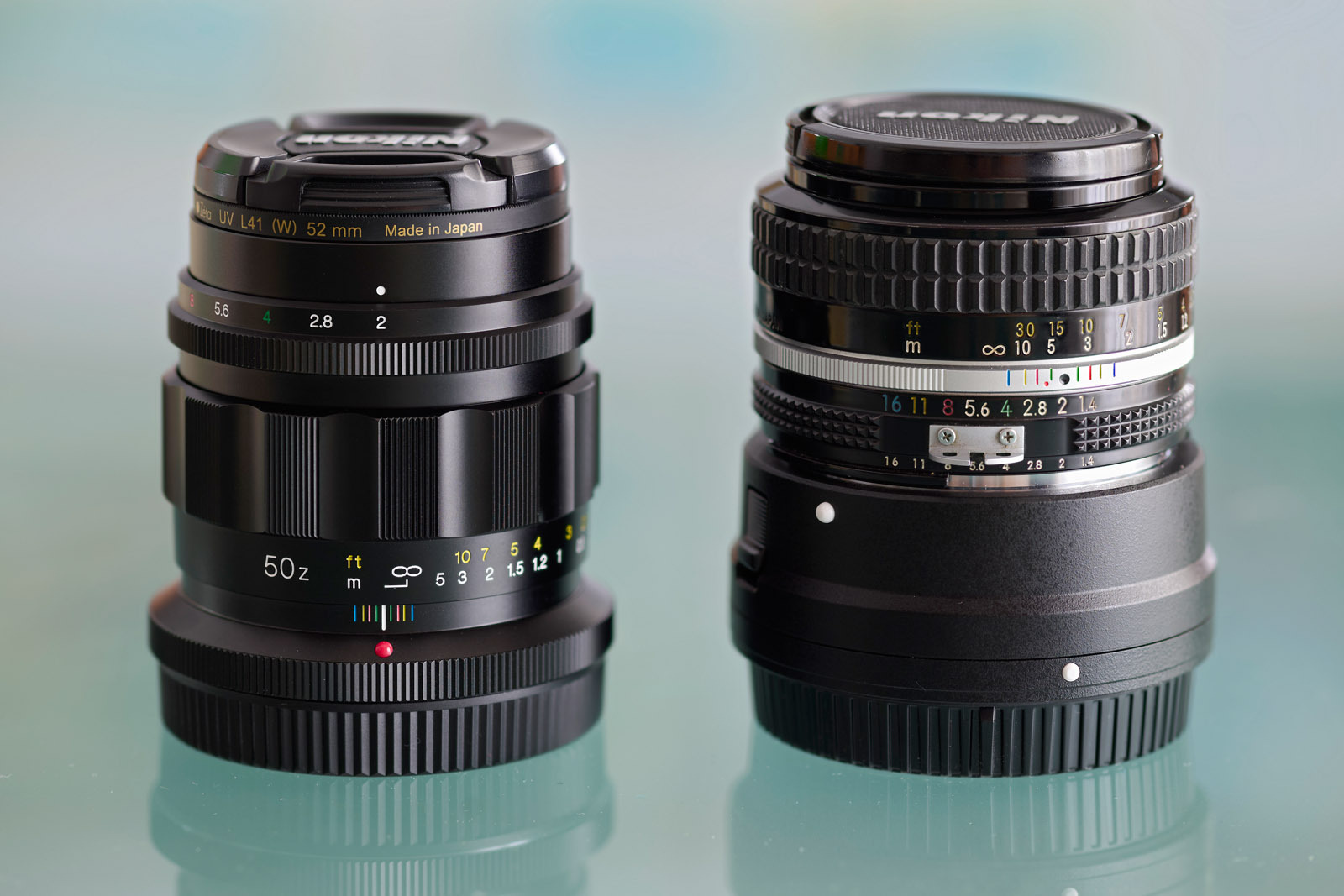
Yesterday at home, I only had these models  , so I played around with the lens that—in my opinion—produces a better 3D effect than other, more modern lenses that are perhaps even sharper.
 |
||
 |
||
|
Aug 22, 2026 at 03:25 AM
p.147 #19which lens has the most 3D POP?
There are lenses out there that are more modern and sharper than the 50 Apo Lanthar? 🤯
Ripolini wrote:
Yesterday at home, I only had these models, so I played around with the lens that—in my opinion—produces a better 3D effect than other, more modern lenses that are perhaps even sharper.
https://s1.directupload.eu/images/user/260822/ietxochs.jpg
Ripolini wrote:
Yesterday at home, I only had these models
, so I played around with the lens that—in my opinion—produces a better 3D effect than other, more modern lenses that are perhaps even sharper.https://s1.directupload.eu/images/user/260822/ietxochs.jpg
Aug 22, 2026 at 04:13 AM
p.147 #20which lens has the most 3D POP?
gammarART wrote:
There are lenses out there that are more modern and sharper than the 50 Apo Lanthar? 🤯
Probably not (I haven't used ALL modern lenses ); however, I didn't take that picture with the 50 Apo (I only have one sample ).
There are lenses out there that are more modern and sharper than the 50 Apo Lanthar? 🤯
Probably not (I haven't used ALL modern lenses
); however, I didn't take that picture with the 50 Apo (I only have one sample ).Aug 22, 2026 at 07:03 AM