I had the Zeiss C/Y 21mm for 2 years and the one thing I didn't like was the nervous bokeh in close-up photos. Looking through this thread here I see my impression - with a frew exceptions (e.g. the first shot from denoir) - somehow confirmed and wouldn't use the 21mm for images involving prominent bokeh-parts in an image. I understand that bokeh-perception is a somehow personal thing, but nevertheless: how do you evaluate the 21mm regarding bokeh?
I love the bokeh - you can get it bascially from painterly to completely nuts. I am however preferential to the European lively style of bokeh than the Japanese smooth style. Both have their places but I think the former is more interesting. There is however a thin line between lively and nervous and you can get both with the 21 but I really like the almost impressionist style of it.
denoir wrote:
I love the bokeh - you can get it bascially from painterly to completely nuts. I am however preferential to the European lively style of bokeh than the Japanese smooth style. Both have their places but I think the former is more interesting. There is however a thin line between lively and nervous and you can get both with the 21 but I really like the almost impressionist style of it.
Thanks for these pretty good examples. Maybe I gave up too early on the 21mm bokeh or had too difficult backgrounds for any lens in my few initial close up shoots. What I find special in Zeiss-Bokehs more general is the relatively high contrast. I see it for example in the 21 2.8, 35 2.0 and 100 2.0. For my liking this rendering style draws the attention more on the background then I would like. At least in many cases. I admit that in some cases it can be totally fine. I observe this difference for example in a direct comparision of my Zeiss 35 ZE and Canons 35L, where I like Canons Bokeh in more cases better (but the foreground doesn't pop out as good in the Canon, so I can't have it all with just one lens...).
My first shots on the ZE 35/2. Okay, I'm not a professional and probably not even a very good amateur; so please no bashing. I'm thinking the 35 may be a tad too long for my 40D. I have a few more days to decide whether I want to keep it. Any crop camera users liking this focal length?
BTW, the Katz screen is a life saver. I don't think I would have been able to be in focus for a quarter of the time I am now.
swolfcg wrote:
...
I'm thinking the 35 may be a tad too long for my 40D. I have a few more days to decide whether I want to keep it. Any crop camera users liking this focal length?
swolfcg,
I tried a 35mm (Nikkor at the time) as a "standard" lens on my crop camera and I hated it. Just too long for allround use for me, but obviously that's based on personal preference. I have a 25mm Distagon now and I love the focal length (as well as the lens itself) as a standard lens on a crop body. I sure would like to have the 35/2, but not as the main allround lens. Waiting for my contax 35-70 for landscape use.
Thanks David, I might just have to send it back since I'm not sure if it will ever get much practical use. I think the 21 is in my future and hopefully the 35-70. If I ever find one. I probably shouldn't look into the 25 or 28 if I'm going to end up getting the 21. However, the 25 & 28 would work for closeups and the 21 doesn't, right?. The 25 may be the perfect walk-around lens for a crop camera, but there isn't a ZE25. I'm going to check out the 28mm at my local camera shop tomorrow.
steve g wrote:
I wonder how far apart are you bracketing the exposures?
It depends; 1 2/3 if dynamic range is big - 1 1/3 if dynamic range doesn't need 1 2/3 stop bracketing. During the past years I have learned that software doesn't like 1 stop bracketing, results comes out very bland. Also if you need 2 stop bracketing that starts to be too much for the software, and also if you have 4 stop difference between dark and bright image it starts to be really difficult to map all that dynamic range to single image in tone mapping process.
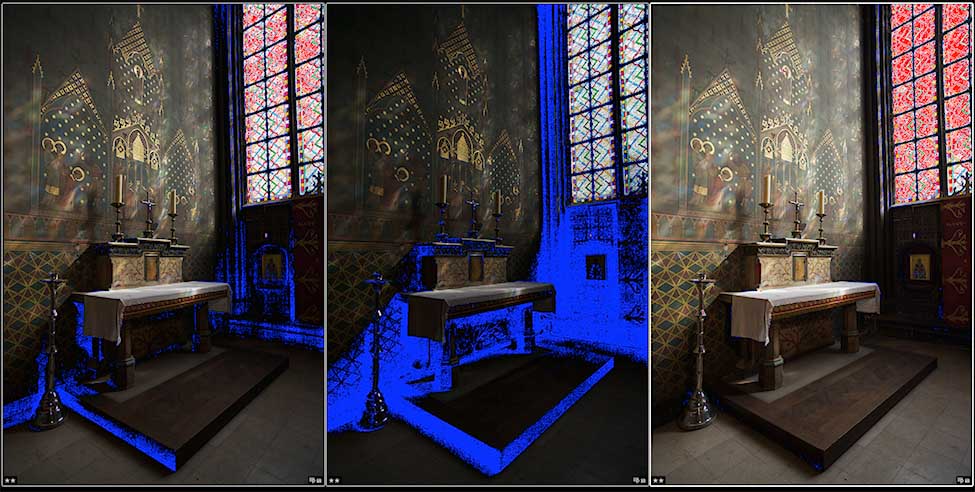
My goal is to get darkest image exposed so that there are no burned highlights AND lightest image to show all shadows, like this:
(In Apple Aperture highlight clipping indicated by red, blacks clipping by blue)
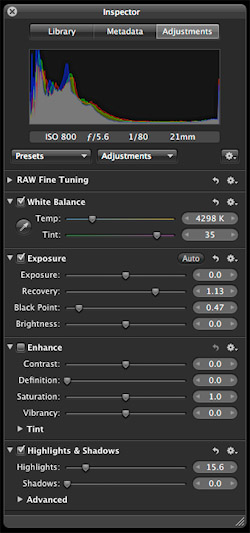
In order to achieve this I sometimes need to use recover highlights and adjust the highlights slider a little bit as well. Also my standard for exporting panorama or HDR is to set the black point so that the blacks are not clipping. All images need to have same settings applied, otherwise Photomatix confuses and doesn't work in very predictable way: