I think it comes down to subject contrast--sometimes DOF causes this, sometimes contrasting colors or shapes, lights and darks, lighting, perspective (large foreground/small background)....any of those things cause some subject isolation that makes it jump out to us.
I was browsing some 2006 images and found this image. I'm having hard time figuring this out - due to flatness of all parts in wooden stairs I'm not seeing shapes but somehow this still seems 3D. Comments? (does it appear 3D)
jcmarney wrote:
I think it comes down to subject contrast--sometimes DOF causes this, sometimes contrasting colors or shapes, lights and darks, lighting, perspective (large foreground/small background)....any of those things cause some subject isolation that makes it jump out to us.
That's my two cents.
I think if we're to include Samuli Vahonen's definition and shots like the stairs here above in the "3D-ish" category then you're right - and DOF only becomes another assisting feature attribute instead of the basis of the effect.
I so far (personally) haven't accepted that idea yet though. The mossy stairs (above) to me is a good shot that uses "perspective view" (lines and angles) as depth cues but doesn't contain any of the "3D-ish pop" that the DOF-as-depth-cue based images do.
EDIT:
BTW, The reason I haven't accepted that as part of >my< definition yet is because if I did so then 80% to 90% of the images posted here on FM would classify and I would be left judging only the degree to which it were prevalent.
Bifurcator wrote:
I think if we're to include Samuli Vahonen's definition and shots like the stairs here above in the "3D-ish" category then you're right - and DOF only becomes another assisting feature attribute instead of the basis of the effect.
I so far (personally) haven't accepted that idea yet though. The mossy stairs (above) to me is a good shot that uses "perspective view" (lines and angles) as depth cues but doesn't contain any of the "3D-ish pop" that the DOF-as-depth-cue based images do.
EDIT:
BTW, The reason I haven't accepted that as part of >my< definition yet is because if I did so then 80% to 90% of the images posted here on FM would classify and I would be left judging only the degree to which it were prevalent.
Yes, if I'm right, then that shot uses a large DOF, perspective, color and shapes to create the 3D effect--no one aspect can be tied to the effect, IMO.
Samuli Vahonen's image illustrates 3d principles in a way unusual to what we are used to seeing as examples.
If the foreground tree on the left is considered the subject, the subject has 3d. The tree has good surface micro-contrast to provide textural details to cue 3d response. The tree is isolated in dof by close proximity compared to staircase. The eye is drawn there first; the mind and body note "don't bump your head", then the eye is drawn to the rest of the scene. The 3d perception machinery is set into motion.
The perspective of the receding and rising angled staircase provides depth cues. Identical detail in construction of staircase -- the mind knows a near step has same dimensions as far step; the detail and micro-contrast in the close stairs establishes those details in the mind for all of the steps. With the repeating details in the staircase construction, the mind is able to fill in that detail using cues present in farther stairs, more detail than is present in image is imagined.
All these activities of the mind occur when looking at the real scene; is that how to achieve 3d, to engage the mind with the image the same way the mind is engaged with the real scene? That seems silly now that I see it written; of course that is what photography is all about That said, the degree to which the photographer and viewer minds, life experiences, and emotional profiles are similar determine if photographer and viewer both judge an image has 3d.
To me, the photos I find 3D-ish have two things in common: 1) A foregroud object that has very high grade of detail and micro-contrast, and 2) a very slightly OOF background. If it's too OOF, then it looses the 3D in my view. Just slightly OOF. These first two by Samuli Vahonen are 3D to me.
I'll really enjoy reading this thread, the descriptions have been very educating, specially enjoyed siriusdogstar description of stairs image above (PS. just noticed that I had left my glasses on top of the rail of stairs on the left side while I took the picture - I would have never published this but as an example of "look" in this kind of thread). I don't think we can get one opinion what is 3D in pictures and what causes it, this seems to be very subjective.
Personally I'm after that kind of 3D, where the subjects shape can be seen/felt from picture but it seems very hard to achieve.
Mortyb, regarding the 2 photos you refer I feel the 2nd one has too shallow DOF; the front branches are slightly OOF and the background (for me) is too blurred. Closing down one more stop would have made the picture but can't do that afterwards. However I don't see much 3D in form of seeing the shape in those two pictures, this is very hard to do in this kind of photo since snow is so uniform and even it has texture it doesn't work (for me at least).
One thing which has not been mentioned in this 3D-thread, but I think on some of the earlier similar threads we also mentioned this, is the quality of light, and naturally angle from which it's coming, which may have been mentioned in this thread. I have found out that in hard light I have difficulty to make subjects look 3D, so that I can see/feel the shape in the picture. However cogitech castle shot proofs hard light does not prevent 3D, it may even enhance it...
Example of soft light helping the 3D effect (?): This photo looks a little 3D (to me), but versions with same framing, aperture, focus but without soft light, either with harsh light (direct sunshine) or overcast (through thick cloud), do not look 3D at all. When this photo was shoot the edge of the photo was shading the building, softening the light but not too much - Contax Planar T* 1.7/50 @ f/2.5 (between 2 and 2.8), 1/640s, ISO 100::
I've mentioned lighting several times in this thread already. And not to be difficult, but in the above image I see no 3D-ishness of any of the kinds described so far. Almost all depth cues except the dark areas under the front shed area, are missing or understated.
jcmarney,
If you're right, it also means that the vast majority of images posted on this site have "3D" (to some degree or another). Depth cues of some kind are prevalent in just about every photograph ever taken.
Bifurcator wrote:
I've mentioned lighting several times in this thread already. And not to be difficult, but in the above image I see no 3D-ishness of any of the kinds described so far. Almost all depth cues except the dark areas under the front shed area, are missing or understated.
Bifurcator, personally I don't think that 3D comes from that the image fulfills some classifications/definitions, "cues" you call them. If that would be the case then any lens would produce as good 3D if the "cues" are there. In practice I have not seen this happening, and I have compared a lot of my own lenses for example at 50mm Canon 1.4, Contax Planar 1.7 and Leica Summicron-R. And all of then produce different character. I have never seen any 3D from Canon or Leica 50mm, but Contax produces it on right conditions.
However I don't think any of this matters since we are clearly talking about "different" 3D since on the shots you see 3D I tend to see just shallow DOF image without 3D:
1. your moth shot=no 3D, no shape; to me the subject looks very flat without shape of surface, no texture (in different light, which would have enhanced texture on the moth and it's wings==>allowing to see the shape, this subject would have potential for 3D - also it seems that the lens used has high contrast on large edges but doesn't produce micro-contrast, thou might be just bad sharpening/resizing technique, and in order to achieve 3D a lens with proper microcontrast production might have been needed)
2. your pigeon shot=no 3D, no shapes, no texture (even pigeon would have had texture which it does have in real life, either lens doesn't produce micro contrast or bad sharpening/resize technique eats texture) - the rock on foreground is separated from background but pigeon almost blends with the foreground rock
3. your Nikon F3=I do see a little shape in the camera but not enough that I really could feel it 3D, more detail/texture (=lens with more microcontrast/different sharpening/resizing technique?) on the "leather" parts of the camera body would have enhanced the 3D feeling
4. Bruce Sawle's parents swinging kid=nice lights/colors/expression on people faces, very good subject separation from background, but I fail to see any 3D since the subjects lacks shape and texture (I liked this image very much as photograph, but doesn't make me feel "being there" etc.)
And on other hand you don't see 3D on images which to me are very 3D, e.g. cogitech castle shot in which I see all the shapes of the castle and I can somehow feel the roughness of the castle walls from picture, which all relates that it feels very real and I can feel being there and the subject appears 3D.
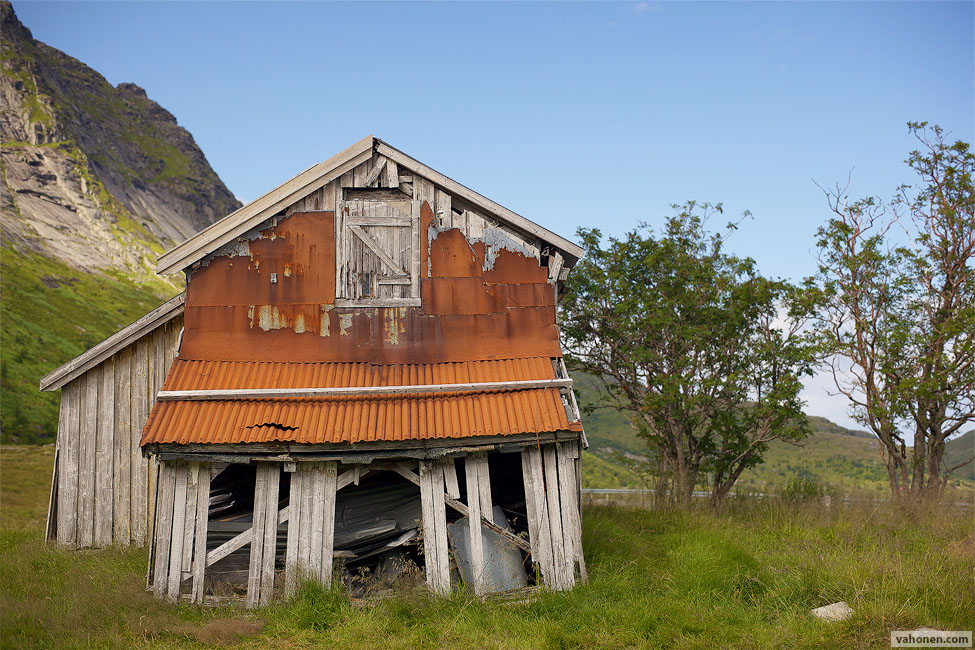
The last picture I posted appears "a little" 3D to myself, it doesn't have full effect in this small size viewer cannot see the texture on rusty metal and only some on the wood - also many surfaces are flat making it difficult to see the shape. However when I view the image I the front of the appears to "come out of screen" which makes it appear "a little 3D" to me. (sorry about not having as good "verbal skills" as many other here have to explain these things - I have really enjoyed other people descriptions of 3D but I cannot put them in English as well as some of people here)
philber wrote:
To me, it does, Samuli. But then I am one of your fans, so...
I agree with philber. Samuli, there is nothing that you have shown that *doesn't* have some stronger-than-average (an in all cases superb) sense of 3D.
Very interesting post, Samuli. It seems to me that texture, which is obviously important in your approach of 3D is closely related to micro-contrast. Am I on the right track?
StevenPA wrote:
I agree with philber. Samuli, there is nothing that you can produce that *doesn't* have some stronger-than-average (an in all cases superb) sense of 3D.
Thanks, but this is misconception - I do not publish photos * which I don't like. Criteria #1 (since summer 2009) for me to like photo is that I can "feel being there instead watching photo", which kind of requires some sort of 3D into image, of course if everything else works in image I can publish photo even it's flat. I have 65000+ images in Apple Aperture library, which do not have any 3D, most from past years when I still used Canon lenses - I'm also not gonna going to publish them anywhere...
* technical examples is different thing - the stairs image for example was technical sample, as well as the barn - composition on both sucks, on barn image the fence from road shows etc.
philber wrote:
Very interesting post, Samuli. It seems to me that texture, which is obviously important in your approach of 3D is closely related to micro-contrast. Am I on the right track?
I think on last page carstenw has the best definition of 3D I have seen. To me personally the texture is key to see the shape - if surface is without detail it's impossible to see the shape. Without shape there is no 3D. In order to see texture light needs to hit from angle which makes possible to see texture. So today's images I'm going to shoot in will not have any 3D since there is 100% overcast heavy clouding/no direction of light can be seen -kind of conditions in Finland --> I'm surprised if anything good comes out today
With texture Carsten has added a new concept (next to depth and 3d) to the discussion that helps explain certain qualities that some pictures posess hitherto for want of a better word described as 3d. It would help any discussion if we accept Carstens notion as a common approach.
The picture of the couple swingin junior shows us no texture at all. This is not very surprising, since the faces are way too compressed as an effect of the telelens and the distance of the photographer. In this case composition and the type of lens seem to play a major part.
Don't you think that a good combination of focal length and distance to the subject play a vital role in the process of adding texture to a picture?
Good point, Biotar. If you think of the compression introduced by a long lens, and if you think texture is required for 3D, then it stands to reason that short lenses should produce 3D to a greater degree than long ones. Yet I have seen 3D coming from a 100/2 makro Zeiss, and, of all Canon lenses, the one that produces the most 3D is the 135/2.0... Except of course that long lenses have a thinner DOF and thus offer more separation, which might help...what do you think?
I think you are absolutely right. Were those lenses score is usually on depth. There should be no reason for those lenses to add texture too, but I think an apropriate distance should be held to the subject for this. It is - i think - the combination of focal length and distance rather than the focal length or distance alone that might create this
-edit: for example: think of an extremely wide close up of a portrait: faces get 'distorted' and any relation to a real situation disappears
biotar wrote:
Don't you think that a good combination of focal length and distance to the subject play a vital role in the process of adding texture to a picture?
Yes I agree, focal lenght & distance = magnification does have effect on what kind of texture we see.
I think texture is a "scalable". For example the cogitech castle shot, the castle has too small magnification in order to show the texture of the rock walls of castle, but instead the rocks in the castle wall become the texture.
Some textures are not scalable, for example fabrics look single color when seen far enough and when looked closer you can see the texture in fabrik.
Hehehe, it seems like we've come full circle and we're back to "It's DOF with micro-contrast (detailed texture)" yet again.
And, yes it makes sense Samuli, as texture is a function of pixel resolution - relative to the display device and not the real world object - as demonstrated by the castle shot and dictated by common sense. Right? I mean actually there is vastly rich texture even below the molecular scale but we won't be seeing these in a DSLR shot from 30 meters away as displayed on a 30" monitor.
And please forgive me but I'm still not sure why we have to redefine what has already been defined in much more detail, scientifically, and without imaginary "feelings" or a magic ingredient. <shrug> http://www.auspiciousdragon.net/photowords/?p=304
I dunno if you will have time to read all of those as I have but my basic thinking is that anyone who does will likely never attempt to use a term like "3D" to describe a photograph again.





 That said, the degree to which the photographer and viewer minds, life experiences, and emotional profiles are similar determine if photographer and viewer both judge an image has 3d.