I assume you are trying to say that the lens has strong curvature of field which it's zf version has too.
Zeiss is changing the design of the zf right now, right?
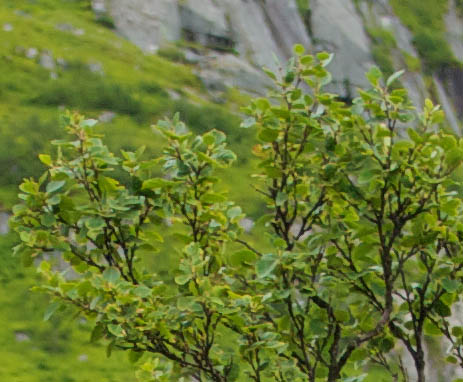
Philber, I'm not 100% sure of the shallow DOF but as you can see from center crop the three I focused at about 4 meters is much sharper than the three behing at about 7 meters. If using simple theoretical lens (the formulas used in calculators) and CoC of 0.019635 (300mm x 200mm printout, 400mm watching distance, person with typical seeing capability=2.25) the hyperfocal distance at f/8 is 3.979m. So in theory I should have got the tree on background also into focus - however theory and practice do not match and as seen from the center crop the tree behind is not in depth of field. To me the hyperfocal shooting did die when I started to print larger than 15x10 (6"x4") at 90's, and this kind of thing do not help at all...
I would not say that the lens is not sharp with faster aperture than f/8. This is 100% unsharpened crop from the f/2.8 or f/4 shot from Norway:
I hope anyone is not understanding me wrong, I'm not saying that Contax 25mm Distagon would be really good, both 21mm and 28mm are better. I'm just saying it's not soft - or better say that at least my copy of the lens is not soft...
Personally I don't use C/Y25 often since I have ZE 21 and ZF 35 (hopefully getting my ZE 35 soon), 25mm might be with me if I have big bag of lenses with me but I try to get to 4 lens setup, instead of 10+ lens setup what I have used to carry. 25mm is very difficult to use since it has something weird on how it handles DOF, I have tried to learn this lens but I don't seem to get it; today I assumed on many shots that f/8 or even f/5.6 was enough, but now seeing photos on computer it seems that I would have needed to use f/11-16 on many of the shots. Luckily ZE21 is much more easier to learn, and I almost understand how it handles in various situations even I have had it only very short time.
philip_pj wrote:
I believe the better Nikkor 28/2.8 AIS focuses to 0.2m...I have the 28/2 Nikkor AIS, also very nice rendition, but a little heavier and larger; sadly quite lot more expensive, the price is rising since the Nikon FFs appeared. The CY 28/2.8 I just bought for its stopped down performance at medium distances and the 3D look I read about here - it is reputedly very good at f8-f11, after which diffraction begins to steal from you on the large Mp cameras in any case.
I find my C/Y 28mm f2.8 to be razor sharp wide open and I virtually never use it stopped down to more than f5.6. What I do find is that it seems sharper on close up subjects than at infinity. I converted the lens to SA mount myself so it could be because the registration distance might be a fraction away from that needed for infinity. Anyway, I dont have to worry about corner sharpness as I only use mine on crop DSLR's.
Samuli Vahonen wrote:
Philber, I'm not 100% sure of the shallow DOF but as you can see from center crop the three I focused at about 4 meters is much sharper than the three behing at about 7 meters. If using simple theoretical lens (the formulas used in calculators) and CoC of 0.019635 (300mm x 200mm printout, 400mm watching distance, person with typical seeing capability=2.25) the hyperfocal distance at f/8 is 3.979m.
So in theory I should have got the tree on background also into focus - however theory and practice do not match and as seen from the center crop the tree behind is not in depth of field....Show more →
Why do you compute a DOF scenario for a 30x20-cm image viewed from a 40-cm distance, and subsequently check it by examining a blown-up portion?
Your photograph measures approximately 30x20 cm on my screen, and I think that someone with an average acuity can't find much wrong with the sharpness when he looks at it from a 40-cm distance. Granted, it's a monitor display and not a print, but then your CoC of 0.020 mm is not that critical either.
OK, here are three from my 1DsIII and 21mm ZE. Not my best but good examples I think of a wide lens giving good results when held level, etc (no mustache distortion). Thanks, Bob
Toothwalker, those were the default parameters in DOF calculator I'm using. I can change them to the failed print I have in my hands right now: 420mm x 280mm, watching from 400mm distance (I can put the print further away as long as my arms reach and the result won't change) resulting 0.014025 CoC, and the stupid formula in calculator saying that DOF should reach from 2.334m to 13.966m. However any of this doesn't matter: the point was that the calculator formulas assume simple lens (one element if I remember correctly), not real lens used for photography. However this typically works somehow with most of the lenses, specially very real results can be achieved with simple symmetrical lenses (e.g. rangefinder lenses, specially Biogon kind of design), but can be very different with lenses which are reverse telephoto design (e.g. Distagon). Also the "sharpness" is divided differently inside the "acceptable" DOF, for example Leica lenses typically have very sharp region in middle of DOF, and Zeiss has tried to spread the sharpness inside the DOF.
In the A3 print the tree at about 7m from camera appears to lack details and contrast compared to the tree on front of it. In this photo I would have preferred to have both trees in focus. I assumed that f/8 would be enough but seems that I should have used f/11 or even f/16. I have not used many lenses around this focal length except Nikon 28/3.5PC, Canon 28/1.8, Canon 17-40 and they would all have had enough DOF with f/8 on this scene.
For me personally the LCD monitor vs. print does not end to same results: I cannot see individual needles on the "tree at 4m distance" on the photo I posted above in my monitor. However on A4 printout I can see them, if I put the printout next to my monitor. Also on the A4 printout the "about 7m tree" does lack microcontrast and "punch" in the tree at 4m, where this 975px wide webthumbnail does not show much difference between the trees, but even on monitor the tree closer to "stands out" from the tree behind it, maybe due to smaller (micro)contrast on the tree behind.
bobring wrote:
OK, here are three from my 1DsIII and 21mm ZE. Not my best but good examples I think of a wide lens giving good results when held level, etc (no mustache distortion). Thanks, Bob
Wow, the first one was really great looking image, I can really feel being there (which is the most important criteria for me in photograph and 99% of the photos fail in this).
Samuli, I will try to rephrase my argument. I have ZE 21, C/Y 25 and ZE 35. Only C/Y25 has this "issue" of actual DOF not following the calculated DOF when opened wider than f:8.0. You might even call that DOF-shift...:-) Even the ZE 35 has more DOF than the 25 at wider apertures, and that is not the way things should be...
philber wrote:
Samuli, I will try to rephrase my argument. I have ZE 21, C/Y 25 and ZE 35. Ohly C/25 has this "issue" of actual DOF not following the calculated DOF when opened wider than f:8.0. You might even call that DOF-shift...:-) Even the ZE 35 has more DOF than the 25 at wider apertures, and that is nto the way things should be...
Philber, now I got it, DOF-shift ;-) Yes I agree wide open or f/4 the C/Y25 has way too shallow DOF (compared to other lenses and calculators), I have not directly compared to ZE(/F)35, but I have learned that my ZF35 provides enormous DOF at wide apertures, at least typically I get more DOF than I expected when I did press the shutter button. I think have to shoot more at f/11 with C/Y25 before completely abandoning it - I have tried to avoid f/11 due to diffraction eating my precious Zeiss micro-contrast...
About ZF35 wide DOF we discussed here earlier in FM Alternative Forum.
Also this is great reading to understand that DOF calculators are just theory based on symmetrical lens: link.
And from here one can read and understand that SLR lenses are not symmetrical: http://www.largeformatphotography.info/articles/DoFinDepth.pdf
"Most treatments of depth of field assume a symmetrical lens for which the entrance and exit pupils are the same size, and for which the pupils coincide with the object and image principal planes. Although this assumption is reasonable for most large-format lenses of short and medium focal length, it may not be appropriate for telephoto designs. For most
35 mm and medium-format single-lens reflex cameras, the only nearly symmetrical lenses are those with focal length approximately equal to the film diagonal; longer-focus lenses usually are telephoto designs, and shorter-focus lenses are retrofocus designs that allow the rear element to clear the reflex mirror."...Show more →
Samuli Vahonen wrote:
However any of this doesn't matter: the point was that the calculator formulas assume simple lens (one element if I remember correctly), not real lens used for photography. However this typically works somehow with most of the lenses, specially very real results can be achieved with simple symmetrical lenses (e.g. rangefinder lenses, specially Biogon kind of design), but can be very different with lenses which are reverse telephoto design (e.g. Distagon).
I am sorry to disappoint you, but compound lenses like a Distagon do comply with the theory, provided that the object distance is measured from the front principal plane of the lens. It is true that the importance of lens symmetry is not taken into account by the majority of calculators, but that is an issue only at close focus. If you find that your results do not match the theory, then either there is something wrong with the method of measurement or comparison, or the lens suffers from aberrations. For lens aberrations are not included in any DOF calculator.
Toothwalker, you can't disappoint me, learning more about optics doesn't bother me. Aberrations as reason make some sense, also explains Philber's "DOF-shift" as well (wide open=a lot of aberrations, closed down=some aberrations disappear). Thanks for the info, I have not yet seen this on any documentation and optics books I have read this far, do you have source? This would be interesting to explore, e.g. which aberrations effect to create more DOF and which reduce DOF etc. If I would have to guess spherical aberrations should have some sort of effect since as uncorrected they are major cause for focus shift.
For me the only thing what is meaningful is the perceived the depth of field in the end product (=for me A3 or larger print). Perceived depth of field is not always the same as mathematical depth of field. This is because detail which is smaller than CoC looks better/sharper than detail, which is exact size of CoC. Perceived depth of field is also relevant to things like differences how "sharpness" is spread inside DOF. In real life there are rarely on/off limits, but typically things move from "on" to "off" gradually.
Samuli Vahonen wrote:
Toothwalker, you can't disappoint me, learning more about optics doesn't bother me. Aberrations as reason make some sense, also explains Philber's "DOF-shift" as well (wide open=a lot of aberrations, closed down=some aberrations disappear). Thanks for the info, I have not yet seen this on any documentation and optics books I have read this far, do you have source? This would be interesting to explore, e.g. which aberrations effect to create more DOF and which reduce DOF etc. If I would have to guess spherical aberrations should have some sort of effect since as uncorrected they are major cause for focus shift....Show more →
I don't remember reading about technical details of aberrated DOF, but I have 1 meter of optics books and will see if I can find any. Many effects are possible when you think about it.
For me the only thing what is meaningful is the perceived the depth of field in the end product (=for me A3 or larger print). Perceived depth of field is not always the same as mathematical depth of field. This is because detail which is smaller than CoC looks better/sharper than detail, which is exact size of CoC. Perceived depth of field is also relevant to things like differences how "sharpness" is spread inside DOF. In real life there are rarely on/off limits, but typically things move from "on" to "off" gradually.
If there are no aberrations (or diffraction, I forgot about that earlier) the perceived DOF should correspond to the mathematical DOF of a decent calculator provided that the CoC value is set appropriately. So if you can see details smaller than the tolerated circle of confusion, that does not necessarily imply that something weird is going on. It is also possible that you should just use a more demanding CoC value.
Mirek Elsner wrote:
First thing that comes to my mind as possible explanation of anomalies you describe is field curvature.
Mirek, please explain further I don't get how field curvature could affect to that some lenses do not follow the DOF calculator results. With some lenses the edge/border softness (e.g. Canon's 14mm) can be partially explained by field curvature, but I think we are here talking about DOF not differences of sharpness in different parts of image circle when shooting planar subjects.
Toothwalker wrote:
I don't remember reading about technical details of aberrated DOF, but I have 1 meter of optics books and will see if I can find any. Many effects are possible when you think about it.
Ok, don't bother, I'm not anymore listed to Technical University and therefore have limited access to technical books. I was hoping for internet reference.
Mirek, please explain further I don't get how field curvature could affect to that some lenses do not follow the DOF calculator results.
With field curvature, the distance from the film/sensor plane to exact focus is different for center and the corners and so is the minimum and maximum sharp distance...
Mirek Elsner wrote:
With field curvature, the distance from the film/sensor plane to exact focus is different for center and the corners and so is the minimum and maximum sharp distance...
I do know what is field curvature very well - but how the hell it as anything to do with small perceived DOF compared to calculator results?
For example in this shot the tree which is 7m away is too blurred in A3 size printout, compared to tree in front which is 4 meters away into which I focused. Do you claim my lens has field curvature which is shape of the tree in front? The photo I'm talking about (see the crops on previous page):
or in this shot, where the background is way too much blurred for 25mm lens (crop can be found previous page):
So could you now please explain why you think field curvature has anything to do with this. Please do not explain what is field curvature, majority of people in this forum know what it is very well.
Seems like this discussion is entering the realm of "angels on a pin".
Me? I just enjoy the marvellous images that have been displayed and adopt the "Eric Clapton" approach to photography, not that my photographic skills remotely approach Eric's guitar skills.




 !!!!!!!!!!
