e6filmuser wrote:
A TC will give you no more than double the magnification of your lens.
It depends on the design of the TC as to whether this will work or not, but I use TCs which I can stack. With a pair of Kenko 2X TCs on a Laowa 100mm 2X macro lens I get from infinity focus to 8X magnification (with a working distance of around 72mm at 8X).
Interesting to see you stacking TCs. Blaker established that you could do this with no loss of quality. However, he found that similar TCs stacked in one sequence might give a central white disc of flare, whereas in a different sequence this did not happen:
Good luck with all that potential snagging out in the woods! I went over to RC flash years ago. I also use some freestanding, off-camera flash when working at ground level or equivalent.
e6filmuser wrote:
Interesting to see you stacking TCs. Blaker established that you could do this with no loss of quality. However, he found that similar TCs stacked in one sequence might give a central white disc of flare, whereas in a different sequence this did not happen:
Thanks Harold. I've just ordered a second hand copy.
I seem to have been very fortunate in happening upon teleconverters that are physically capable of being stacked (from pictures of them I imagine Canon, Sony, Olympus and Panasonic TCs can't be stacked, and maybe the same for Nikon TCs), and which don't give any flare issue that I've noticed.
e6filmuser wrote:
Good luck with all that potential snagging out in the woods!
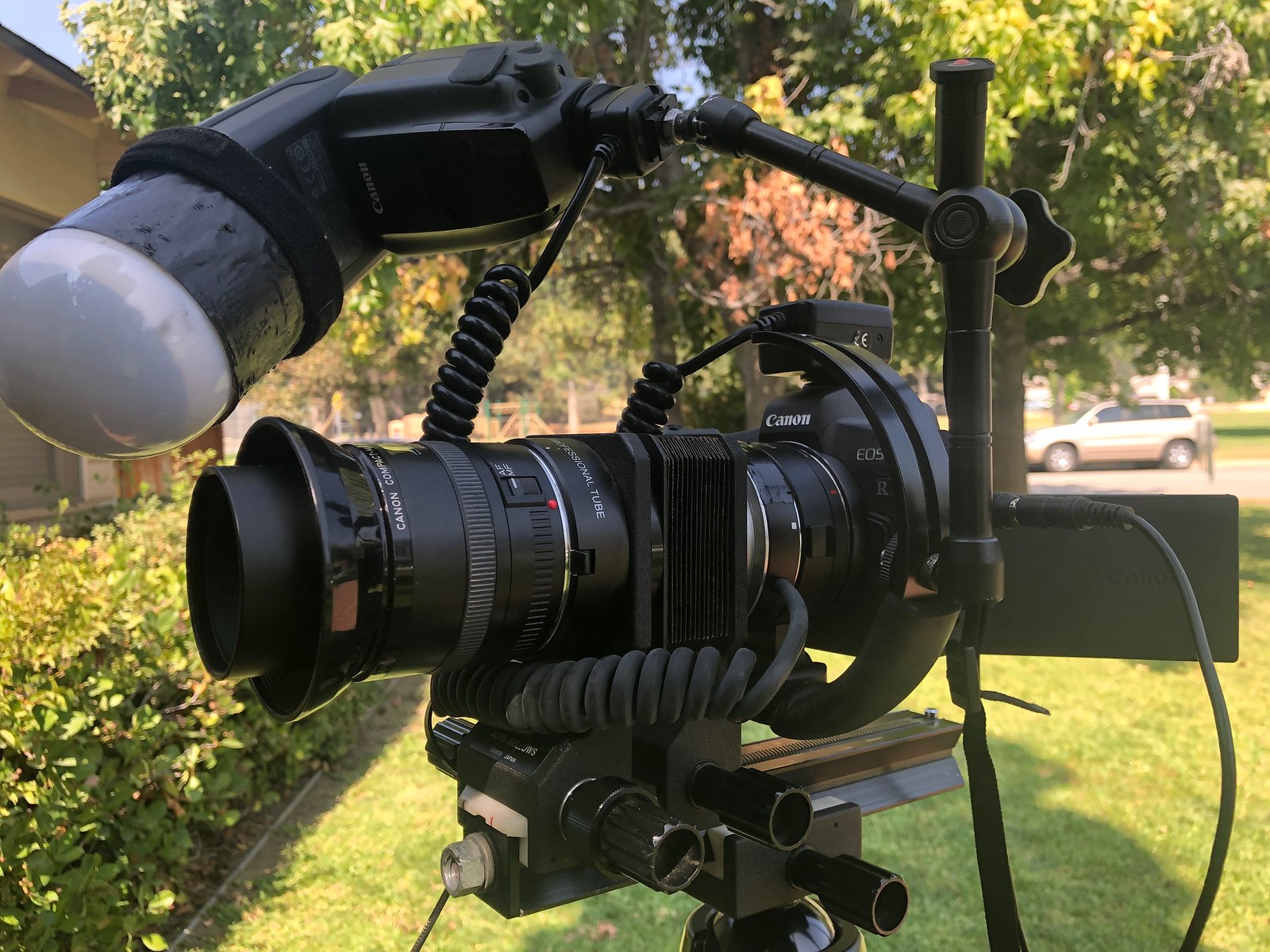
Its the setup I've been using for several years now. With this latest camera setup I tried numerous flash setups with lens-mounted flash units (Yongnuo and Meike) but despite trying lots of diffusion materials and configurations (and help from John Kimbler, @Dalantech, who is very good with flash), and also trying cross polarisation, I couldn't get illumination that I was comfortable with, particularly with reflective subjects. Out of desperation I took a KX800 setup off of one of my close-up lens on telezoom setups, stretched the arms out, and tried that. The illumination was more like I was used to. Still highly imperfect with reflective subjects, but I decided to live with that; I was burnt out with the fruitless flash configuration experiments. At least I was familiar with the operating characteristics with the KX800.
The diffusers obviously do get in the way sometimes, but the arms give a bit when I push in to an obstruction and I can usually get what I need from it. Sometimes of course it pushes away a branch connected to what the subject is on, in which case I can't get close enough, but that doesn't happen often enough to make me want to go back to a thus far frustrating search for a flash setup which provides illumination I like without getting in the way sometimes.
e6filmuser wrote:
I went over to RC flash years ago. I also use some freestanding, off-camera flash when working at ground level or equivalent.
Harold
The KX800 is fully manual and so quite crude in its controls, but they provide all I need and are very accessible (using right hand thumb, with both hands left in place) and quick to use.
I could be wrong about it (I have been wrong about plenty of other things!), but I've never felt that off-camera flash would work well for what I do (for example following subjects as they move around, in and out of view, often radically changing my angle of attack to get a line on them, and changing magnification often and a lot too).
gardenhelper wrote:
Thanks Harold. I've just ordered a second hand copy. [/quote}
When I ordered mine from America it cost £50 and the postage was as much again and then there was import duty & VAT!
e6filmuser wrote:
Good luck with all that potential snagging out in the woods!
I was referring to walking through brambles and twiggy bushes to find specimens. Less of a problem at the subject position. Depends whether you carry the components in a bag and assemble when you find subject, which I often do if there in not much around.
I could be wrong about it (I have been wrong about plenty of other things!), but I've never felt that off-camera flash would work well for what I do (for example following subjects as they move around, in and out of view, often radically changing my angle of attack to get a line on them, and changing magnification often and a lot too). ...Show more →
TTL metering (up to several guns) takes care of most of that. When tracking moving specimens my second unit on its foot is easily and quickly moved. The main unit in on an L-bracket on the camera.
gardenhelper wrote:
Thanks Harold. I've just ordered a second hand copy.
When I ordered mine from America it cost £50 and the postage was as much again and then there was import duty & VAT!
e6filmuser wrote:
Good luck with all that potential snagging out in the woods!
I was referring to walking through brambles and twiggy bushes to find specimens. Less of a problem at the subject position. Depends whether you carry the components in a bag and assemble when you find subject, which I often do if there in not much around.
I could be wrong about it (I have been wrong about plenty of other things!), but I've never felt that off-camera flash would work well for what I do (for example following subjects as they move around, in and out of view, often radically changing my angle of attack to get a line on them, and changing magnification often and a lot too).
TTL metering (up to several guns) takes care of most of that. When tracking moving specimens my second unit *on its foot is easily and quickly moved. The main unit in on an L-bracket on the camera.
Unfortunately, Olympus make the only one which can be tilted down by 45 degrees.
e6filmuser wrote:
When I ordered mine from America it cost £50 and the postage was as much again and then there was import duty & VAT!
£23.80 including postage for mine.
e6filmuser wrote:
I was referring to walking through brambles and twiggy bushes to find specimens. Less of a problem at the subject position. Depends whether you carry the components in a bag and assemble when you find subject, which I often do if there in not much around.
I carry the fully rigged setup around in my hands. I've not had problems when walking around. I often used a bag for my close-up lens on telezoom lens setups, but with this setup I haven't been using a bag. I have workman's trousers with lots of pockets for spare batteries and a folded refuse bag (in case I need to put the kit down on wet ground), and for botanical sessions, also a ColorChecker Passport and scissors.
e6filmuser wrote:
TTL metering (up to several guns) takes care of most of that. When tracking moving specimens my second unit *on its foot is easily and quickly moved. The main unit in on an L-bracket on the camera.
Unfortunately, Olympus make the only one which can be tilted down by 45 degrees.
Kneepads - I always carry at least one but I rarely bother. I would on sharp(ish) rock.
Wet knees are an occupational harzard. I mostly just accept that. I have waxed leggings for serious rain and a hooded, waxed jacket for all but warm, dry weather.
Since you mentioned Blaker's Handbook for Scientific Photography, I'll also suggest getting his other book from the 1970s: Blaker, A.A., 1976, Field Photography, Beginning and Advanced Techniques: Freeman, 449 p.
Since you mentioned Blaker's Handbook for Scientific Photography, I'll also suggest getting his other book from the 1970s: Blaker, A.A., 1976, Field Photography, Beginning and Advanced Techniques: Freeman, 449 p.
Glen
Thank, Glen, I purchased it around the same time.
The two books were being "remaindered" a few years ago at £10 or so each.
mannyfresh79 wrote:
Panasonic Lumix GX-85 with Oshiro 60mm 2:1 (Canon EF mounted with passive fotasy adapter) + Godox V1 + Pringles can hack with wax paper for diffusion
That's an excellent lens, my goto macro for my A7r3, although I don't yet do much macro with that camera.
That said, you images look soft. Noise may be contributing to this.
I have taken a closer look and the front edge of the wings seem to be the sharpest part, with the eyes reasonably good but the face OOF. This suggests too wide an aperture.
Thanks for taking a look, Harold. Most of the time I'm shooting these critters in a hurry and don't have time to review the photos. I'll work on stopping down But for the ugly (and cheap) setup, I think the pics come out great.
mannyfresh79 wrote:
Thanks for taking a look, Harold. Most of the time I'm shooting these critters in a hurry and don't have time to review the photos. I'll work on stopping down But for the ugly (and cheap) setup, I think the pics come out great.
I use a default of f11 so focus is not often an issue.
pcvrz22g wrote:
New to this and enjoying it so far.
5D MK IV
Canon MP-E 65
Meike MK-MT24 II TTL Macro Ring Flash
Not digging the rail I got. Its probably ok for a very light setup but as soon as I tilt the head on this setup, the gear slips when I try to adjust. I end up having to assist and that sometimes results in small changes that show up later.
Ran into issues with this setup immediately. The Ring Flash setup eats up about 1 inch of your working distance. At 3.5 to 5x I was having issues with the flash heads hitting the work surface before I could reach my usable working distance. I ended up mounting the ring to the backside of the screw on adapter as well as taking the head mounts apart and reversing them so when attached to the adapter they would be facing the correct direction. This worked out pretty good with the exception of losing a little bit of head angle adjustment due to the design of the case. I cannot angle them in quite as much but I will try to tackle that later....Show more →




 But for the ugly (and cheap) setup, I think the pics come out great.