Dave In La wrote:
try again when it is not a full moon....the surface will be sidlighted with splendid detailing
nice shot btw
I've been trying this (unfortunately) not with an 800. What setting(s) do you recommend? The high contrast between the lit and unlit sides are so dramatic, I've had a hard time getting the shot.
There was just a tad of post processing in EOS20's compilation - the background sky was getting way brighter than that while I was looking at it
I'm greatly impressed with Whayne's moon shot using the 500 and stacked TCs but I'm equally disappointed in my results with the 600 and stacked TCs. I thought I was using the right gear and technique but the results suck. I'll try again in a night or two with a brighter and more side-lit moon. I had a Wimberley head on a Gitzo 3540XLS with legs only partly extended and sitting on a brick path, I used mirror lockup and 10-second timer delay. Even at the faster shutter speeds the results were poor but during the eclipse there was not enough light to work with. I found the lens and TC combo too dark for successful MF with the Ec-D focus screen but I suspect my eye glasses played a big part in my failure too. That screen has a split prism but the moon filled the frame so much that I could not use it successfully.
EOS20 wrote:
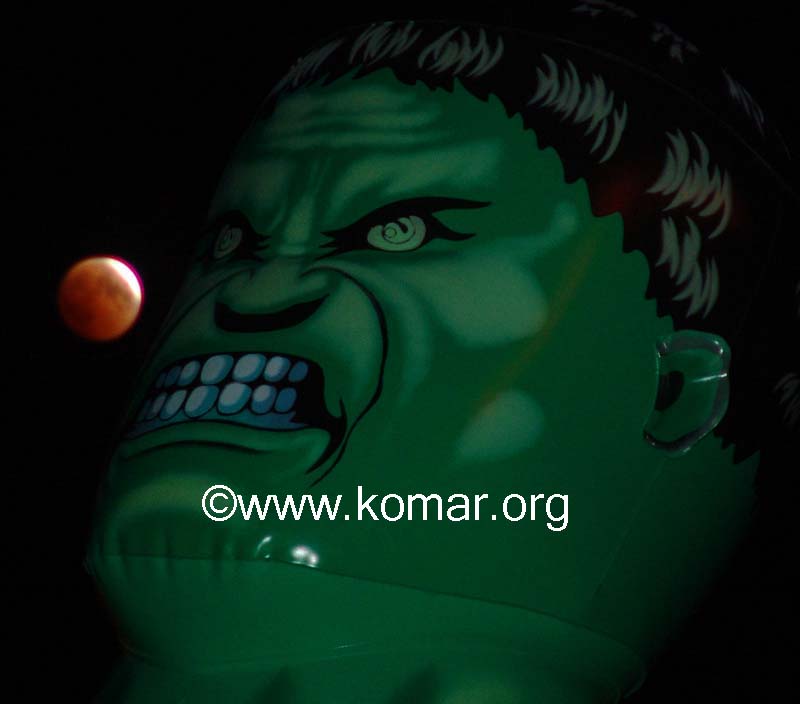
Since everyone is posting moon shots ...
OK - I'll join the party even though my lunar eclipse picture is lame compared to the rest of the great moon shots here (and ditto that Romy has some amazing ones) ... but HEY, I've got THE HULK in my shot! ;-)
This picture was taken in 2004 with a Sony F828 point-n-shoot (yes, that's an actual pic - no photoshop trickery)... would love to reshoot with my 40D and a long lens ... but lunar eclipses don't happen that often ...
burningheart wrote:
I did also take a few other shots with TC 1.4, TC 2.0 and both TC 1.4 and 2.0 mounted together (that shot was at ISO 3200). I'm not overly pleased with my 2.0. The 1.4 wasn't too bad,
I'm curious to see crops from the 800L + 2x TC. Here's a crop from my 800 zoom + 2x TC:
The biggest factor in moon sharpness is not the focal length- it's atmospheric stability! ("seeing" is the term astronomers use).
Romy is in Manila. Some of the worlds best amateur planetary and lunar photographers are in Manila-- because the Philipines (and the tropics in general) have two very serious advantages:
- no jet stream overhead
- solar system objects (when opposite the sun) are always within 20 degrees of zenith (directly overhead)- less atmosphere to look through, less blurring and distortion.
Shooting from the Northeastern US, you'll be lucky to get air half as stable as Manila. Florida and Bahamas are the nearest decent to good places you can go in the US.
Andrew Welsh wrote:
The biggest factor in moon sharpness is not the focal length- it's atmospheric stability! ("seeing" is the term astronomers use).
Romy is in Manila. Some of the worlds best amateur planetary and lunar photographers are in Manila-- because the Philipines (and the tropics in general) have two very serious advantages:
- no jet stream overhead
- solar system objects (when opposite the sun) are always within 20 degrees of zenith (directly overhead)- less atmosphere to look through, less blurring and distortion.
Shooting from the Northeastern US, you'll be lucky to get air half as stable as Manila. Florida and Bahamas are the nearest decent to good places you can go in the US....Show more →
Andrew Welsh wrote:
The biggest factor in moon sharpness is not the focal length- it's atmospheric stability! ("seeing" is the term astronomers use).
Romy is in Manila. Some of the worlds best amateur planetary and lunar photographers are in Manila-- because the Philipines (and the tropics in general) have two very serious advantages:
- no jet stream overhead
- solar system objects (when opposite the sun) are always within 20 degrees of zenith (directly overhead)- less atmosphere to look through, less blurring and distortion.
Shooting from the Northeastern US, you'll be lucky to get air half as stable as Manila. Florida and Bahamas are the nearest decent to good places you can go in the US....Show more →
This is also why a $60 webcam can image circles around an $8000 DSLR- because the webcam can record video at 15 fps and collect hundreds of frames of those brief still moments. You can then stack them together getting an average of it all, canceling out the horrible digital noise a $60 webcam produces. Of course the FOV is a limiting factor... but still...
ghozer wrote:
Hilarious post. I wonder how San Diego is. Seems like it would be as good as Florida?
I'd have thought that thick steamy air of Manila would suck for astrophotography. All the big optical telescopes are at the top of mountains with thin cold air for a good reason. Cold still nights are the best for good moon shots and it doesn't get cold in Manila.
Pixel Perfect wrote:
I'd have thought that thick steamy air of Manila would suck for astrophotography. All the big optical telescopes are at the top of mountains with thin cold air for a good reason. Cold still nights are the best for good moon shots and it doesn't get cold in Manila.
Thick steamy air does suck if you're trying to image faint fuzzies like the big scopes atop cold, dark, distant mountaintops do. But for solar, planetary and lunar imaging, you can do it from downtown Manila no problem. There is an amateur photographer who, through his own discovery of a weather system on Jupiter, ended up getting telescope time at Keck (the world's largest scope, on Mauna Kea in Hawaii) and Hubble. His name is Christopher Go, and images from his balcony in Cebu City, Philipines.. google his name and you'll see.
The planets and moon are bright enough that humidity, dense air, pollution and city light pollution don't affect the result much, if at all. The key factor is air stability. Of course really hazy skies will have an effect, but there is some latitude.