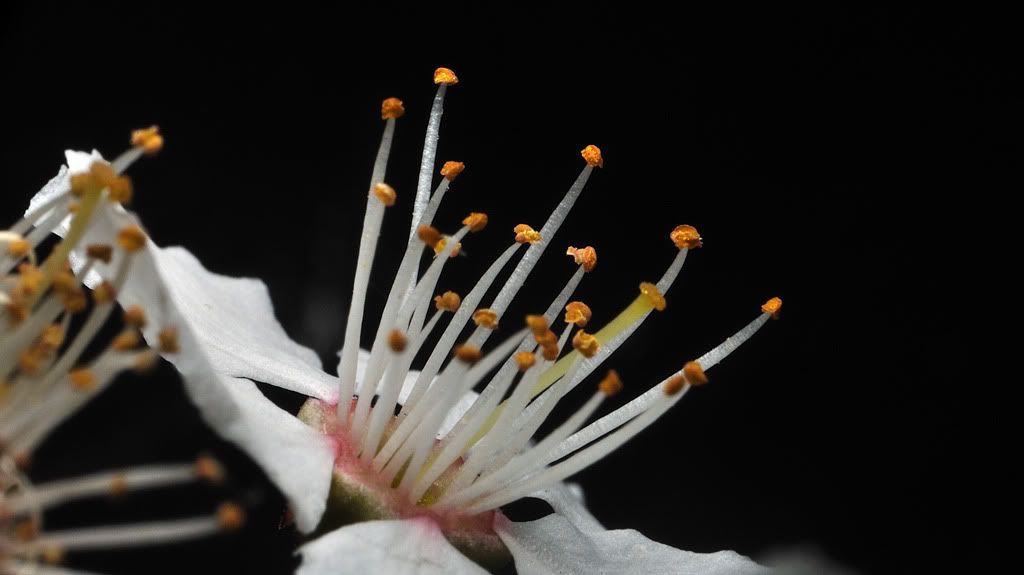
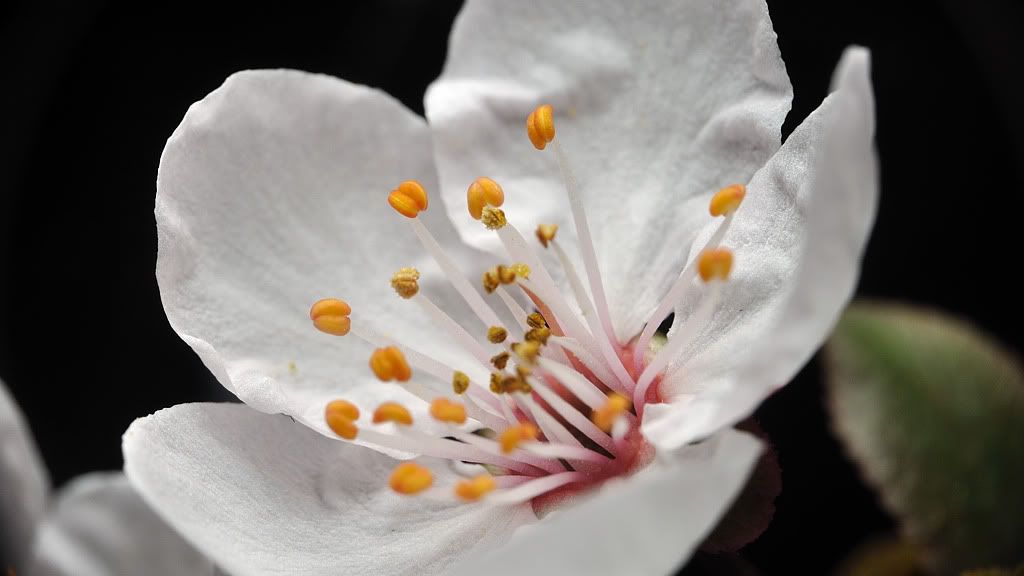
Quick (and probably dumb) question - is it more advantageous to do this lens reversal on a crop sensor camera? Is it going to give you slightly more magnification?
And when looking for a 28mm - am I correct in thinking that it doesn't have to be the best, highest performing one you can find. Reason I ask is with the last pic posted above - all the reviews I could find spoke of the Nikon Series E as vastly inferior to the AIS version with CRC - yet that photo above using the "cheap" Series E Nikkor is pretty damm amazing.
In this field I guess its more about technique and perseverance rather than the equipment?
Lastly, if people are hand holding these rigs - how do you manage operation of the aperture, especially if you're shooting at f/8-f/16, and with tubes - I'd imagine it would be really dark. Do hold the aperture wide open with a finger, and let if snap closed just before you release the shutter?
Anyway here my newbie attempt from this afternoon hand holding a 35mm reversed again my camera. (waiting for my reverse adapter and flash bracket to arrive.)
Don't know what these little fellas are called -perhaps someone can make an ID for me?
Still need to work on getting the eyes in focus -heaps of fun tho!
The Series E are less regarded because of coating, plasticky build and reduced number of elements. In normal shooting, the lack of a multicoated front element introduces flare and loss of contrast in your images
However, since you're gonna reverse mount it, that makes the front element coating to be redundant for your usage.
There's plenty of 28mm lenses. CRC, Close Range Correction allows for better optimization at close-up distances - again for when the lens is mounted the normal way. http://www.photosynthesis.co.nz/nikon/specs.html
For information on MF Nikon lenses, Curtis (CGrindahl) has an excellent thread going on in the Nikon subforum.
(I don't quite subscribe to the Series E lenses being inferior; there are plenty of gems in the Series E lenses: the negative is beneficial for bargain hunters. Makes them light, cheap and good if you are MF inclined. The 75-150mm E is one that comes to mind, the 50mm E makes a great pancake lens)
With the reversal ring method Am I correct that you will get bigger magnification with a wide angle lens (35mm) than a medium (50mm) or a reversed telephoto (100+mm)?
Thanks in advance,
The 50 rev, straight to camera body will give you approx 1to1 or more depending on the 50mm lens used . The 50 on the 100 will give you 2 to1 , you get that by dividing 50 into 100 if you use a 24mm you get 4to1 . When using the lens straight to cam you have to set the lens at the f stop you intend to use and you will be looking thru that f stop the image can be dark depending on the light. attached to to 100 you would set the rev lens to the widest opening or f stop and the 100 would control the f stop used . the image you see thru the came will be brighter. That in a nut shell is the only difference.
Tom Hicks wrote:
The 50 rev, straight to camera body will give you approx 1to1 or more depending on the 50mm lens used . The 50 on the 100 will give you 2 to1 , you get that by dividing 50 into 100 if you use a 24mm you get 4to1 . When using the lens straight to cam you have to set the lens at the f stop you intend to use and you will be looking thru that f stop the image can be dark depending on the light. attached to to 100 you would set the rev lens to the widest opening or f stop and the 100 would control the f stop used . the image you see thru the came will be brighter. That in a nut shell is the only difference....Show more →
Thanks, that makes sense. Can I expect a lot of vignetting?
Tom Hicks wrote:
Sometimes, it depends on the lens , you may have to put a tube between the camera body and the 100 ,12mm tube will usually fix the vignetting.
I've just ordered a reversing ring so I can get into some reversed macro shots.
I currently have a 50mm lens that I plan to reverse straight onto the camera body. I also have some tubes.
What is the difference between using a reversed 50mm attached to some tubes or using a shorter focal length without tubes (eg 28mm).... Am I able to get similar magnifications using a reversed 50 and some tubes compared to a straight reversed 28mm?
For a given focal length, the farther the lens is from the focal plane, the more magnification.
For a given distance (extension) the shorter focal length lens gives more magnification.
One of the thing it depends on is lens construction. The "optical center" of a lens that you
want to measure to depends on lens construction.
As a concrete example, I am working with an older (FD mount) 50mm/f3.5 canon macro lens.
Built into the lens (as is the case with many macro lenses) is a fairly substantial "hood", and
when the lens is reversed, this actually places the optical elements at a fair bit of extension
from the camera -- sort of like a built in extension tube -- so this lens reversed might give
similar magnification as a 28mm reversed and mounted directly on the camera.
But I never mount them directly on the camera -- in my case I am using a nice old FD series
belows as an infinitely variable "extension tube" which I like a lot.
But the thing to do is .... try things out !! It isn't all about magnification though, at least it
certainly isn't once you find out ways to get the amount of magnification you want.
I am in the midst of trying all the different lenses I have to see which give me the best results
in terms of resolution, lack of flare, color saturation, contrast, overall image quality.
The main things is to experiment and try things, expect to be surprised.