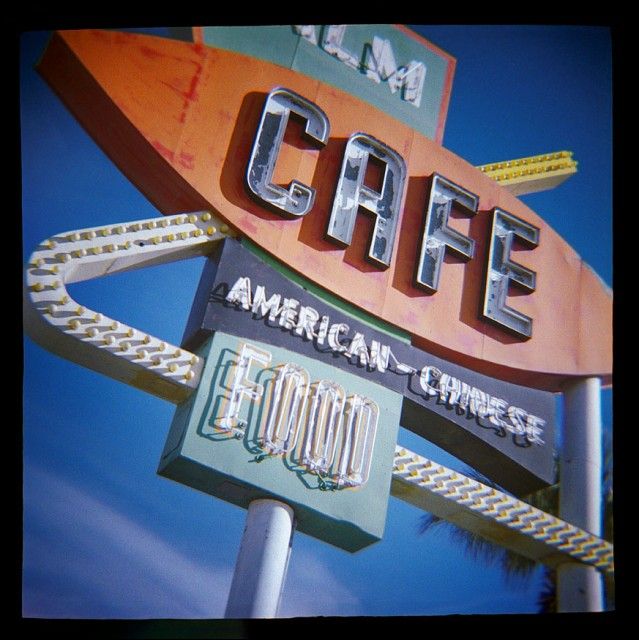
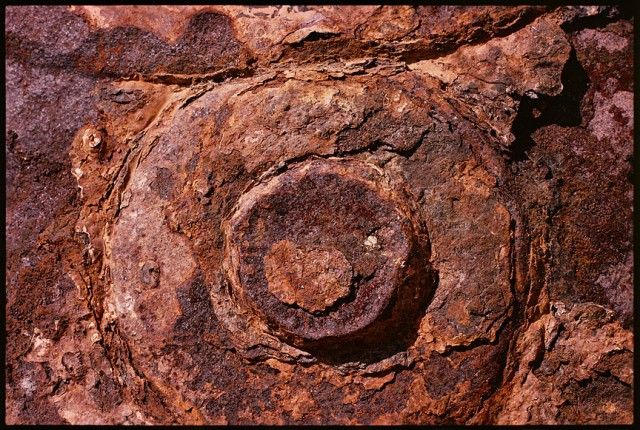
Here's a Portra 160 Holga shot from Barstow, Ca. along old Route 66. And a second shot - a Kodachrome 64 shot of rust on a old buoy sitting near the end of the commercial wharf in Monterey, Ca.
There are still some of us around. I need to start posting some occasional shots here too.
FM2, various Nikkors, TriX400. I really need to figure out what is going on with the grain I'm getting. It seems very excessive for ISO400 film, and is robbing shots of sharpness.
huddy wrote:
FM2, various Nikkors, TriX400. I really need to figure out what is going on with the grain I'm getting. It seems very excessive for ISO400 film, and is robbing shots of sharpness.
are you processing yourself or is a lab doing it. my first thought would be that the camera is not exposing correctly and the lab is compensating (if you send to the lab). another possibility would be low contrast lenses (which will show the grain more). tri-x isn't exactly a fine grain film, but those shots do show more than i'm used to.
I got the 135 Macro back for the Pentax 67II, and wanted to also get some new shots for the relatively new Canon T90 with FD 28-85/4 lens. All shots hand held.
Here are a couple for rough comparison of frame size and overall "look". 35mm shot on Fuji Superia 100, 6x7 shot on Fujicolor NPS 160.
35mm
6x7
35mm
6x7
I'm not sure if the 135 Macro will be a keeper -- the original problem was fixed, but a new one has surfaced with auto-aperture (probably put together wrong after repair). Otherwise, it's a great lens and very sharp.
The 35mm images are disappointing compared to the 6x7 -- no surprise there!
sebboh wrote:
are you processing yourself or is a lab doing it. my first thought would be that the camera is not exposing correctly and the lab is compensating (if you send to the lab). another possibility would be low contrast lenses (which will show the grain more). tri-x isn't exactly a fine grain film, but those shots do show more than i'm used to.
I processed these myself. It is possible that I'm not getting good exposures due to poor metering. The lenses would have been 105/2.5, 50/1.2 or 35/1.4, all of which should have sufficient contrast. I need to pull out my loupe tonight and compare a set of HP5+ negatives that went through an F100 with similar lenses. They have some grain too, but much more sharpness.
Perhaps I just need to take out a few rolls of film and my lightmeter and do some test shooting in more controlled environment and see how things turn out then.
sebboh wrote:
are you processing yourself or is a lab doing it. my first thought would be that the camera is not exposing correctly and the lab is compensating (if you send to the lab). another possibility would be low contrast lenses (which will show the grain more). tri-x isn't exactly a fine grain film, but those shots do show more than i'm used to.
I believe that Tri-X is also quite sensitive to scanning methodology. I am not sure I know why, but perhaps searching around a bit would reveal something?
carstenw wrote:
I believe that Tri-X is also quite sensitive to scanning methodology. I am not sure I know why, but perhaps searching around a bit would reveal something?
Carsten, thanks for the tip. Its been a rough week so I hope to have some progress next week.
There are specific films which are known to scan much better than others, and they aren't necessarily the films we liked best in the film days, so it might be good to try a few different films.
I have tried scanning Tri-X but find it excessively grainy, although it looks nice. T-MAX might be better. I can heartily recommend Adox/Efke CHS 25, but this is an ISO 25 film, so probably only for tripod work.
wfrank wrote:
Jim, I'd say you squeezed out an impressive amount of details there. Impressive!
Thanks Wilhelm! I was happy with these from the local lab. Even though they were jpg, I was able to do some effective PP on them. These were some of the best this lab has done for me, and to sweeten the deal further, they were the cheap scans.
Just dropped off another 35mm roll, this time from the Canon 1N body and EF lenses. But the scans definitely loom better from the bigger film.
FWIW, I have looked at my HP5+ right next to the Tri-X under my loupe and the grain size looks to be pretty similar. The HP5+ scans great so at least I have that option at ISO400.
Well, recent Tri-X is certainly better than Tri-X from the 60's but none of it is hard to scan. I remember doing some test drum scans a few years ago from a friend's 35mm Tri-X neg. I ended up scanning it at 4000 ppi/6.35 micron aperture, but also did a test scan at 8000 and the 3 micron aperture. I was amazed to see that there was actually more visible detail on screen in the 8000 scan - not a lot, and since the drum scanner jumps from 4000 to 8000 in one leap, there's no way to know exactly where the cutoff is, but scanning Tri-X at 4000 - a real 4000, not an Epson or Nikon 4000, is quite viable.
I've done thousands of drum scans over the years of almost every film imaginable (no Efke yet though) and I can't honestly say that one is more difficult than the other. Tri-X, Plus-X, Verichrome Pan, Panatomic-X, every E-6 and K-14 process emulsion.
Kodachromes usually are the most difficult but that's only because they have a different color response and higher d-max than other films. Wish they still made Tech Pan. The few pieces of that are mind blowing for detail.
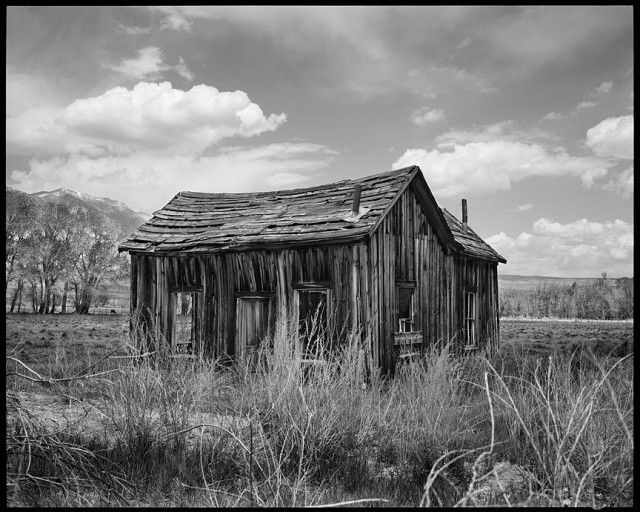
I think overall, my two favorite black and white films for scanning are T-Max100 and Plus-X, but that's just me. I love the way they look. Here's a T-Max 100 from just north of Bishop, Ca. on U.S 395. Mamiya 7, T-Max100, 25A Filter, developed in T-Max Developer and drum scanned on a Howtek.