This image probably is a longer exposure than all of the other WA entries put together.
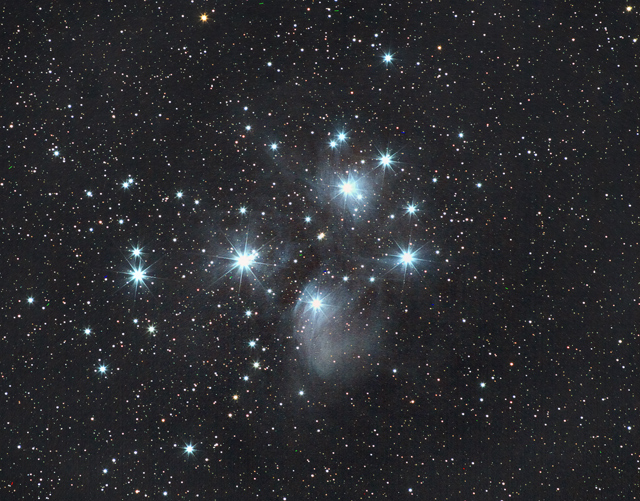
This is the Pleiades, the seven sisters, Subaru, Messier Catalog #45. It is known since antiquity because it is the easiest open cluster to see in the fall/winter night sky with the naked eye. All major cultures around the world recognize this cluster and it is even mentioned in the Bible multiple times.
The Pleiades is in the constellation Taurus, and is roughly west of Orion's belt (if you follow the line of Orion's 3-star belt to your right, if in the northern hemisphere), and looks like a clump of stars by themselves when viewed naked eye. Subaru the car company bases their logo after this cluster.
This is a collection of exposures over several nights, including last night (had a few sucker holes in the clouds), for a total of 3 hours, 28 minutes. This picutre was taken with a Canon 400mm f/5.6 L lens (at f/6.3) mounted piggyback on a LX200 scope from my suburban backyard.
Edited by Andrew Welsh on Oct 16, 2007 at 09:45 PM GMT
Andrew,
Is this cropped a lot? I'm amazed at the clarity...you have a nebulae, the color of the stars (yellow, red, blue) - I just wouldn't have thought a 400mm lens could fill the frame very well on the Pleiades + plus it's resolving power. I also have a couple questions. Which Meade scope do you have in the LX200 series....14"...16"? I quess I'm wondering if you shoot through it as well, or is that problematic? Which Canon body did you use? Stacking software? I love the shot! Perfect entry, and spot on topic!
Hi Andrew,
That's a great shot!! I'm glad the skies cleared enough for you to capture this. I like it a lot but think I would like even more w/o the star effect. These can't be diffraction spikes from a secondary spider, or can they be? The nebulosity you've captured is great. This is a perfect WA entry. Well done.
-Nick
1_of_9 wrote:
Andrew,
Is this cropped a lot? I'm amazed at the clarity...you have a nebulae, the color of the stars (yellow, red, blue) - I just wouldn't have thought a 400mm lens could fill the frame very well on the Pleiades + plus it's resolving power.
I cropped maybe about half of the frame. I was using a Rebel XT. A closer fit would've been 600mm but I can't afford a 600/4 nor a mount to support it.
1_of_9 wrote:
I also have a couple questions. Which Meade scope do you have in the LX200 series....14"...16"? I quess I'm wondering if you shoot through it as well, or is that problematic? Which Canon body did you use? Stacking software? I love the shot! Perfect entry, and spot on topic!
Jim
My equipment is in my profile. I do shoot through the scope directly but this target is too big for it. I can get maybe 2-3 stars of the cluster in the frame. Plus, it's F/10 so exposures would be long to do a mosaic.
This was stacked with Iris + processed in Photoshop.
nlamendo wrote:
Hi Andrew,
That's a great shot!! I'm glad the skies cleared enough for you to capture this. I like it a lot but think I would like even more w/o the star effect. These can't be diffraction spikes from a secondary spider, or can they be? The nebulosity you've captured is great. This is a perfect WA entry. Well done.
-Nick
Nick:
These are diffraction spikes from the aperature blades in the lens. Unavoidable.. but I like the effect. Thanks for the kind words. There was some clear skies early Tuesday morning.
Bill Sutherland wrote:
Magnificent image. I guess you have some kind of tracking device to stay on target
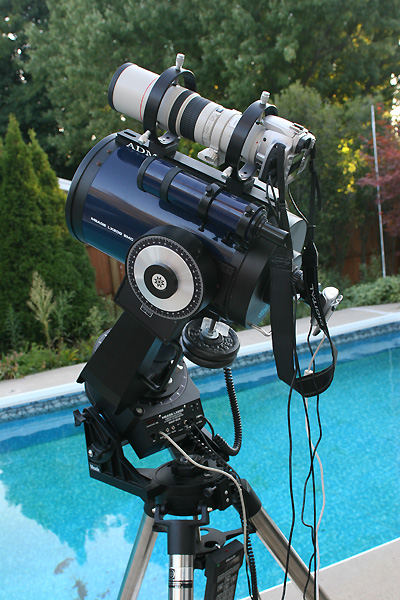
Yes, the Meade LX200 telescope has a clock drive installed on it, and the camera and lens was mounted on top of the telescope with rings.. similar to a rifle scope. Here's what it looks like:
These are diffraction spikes from the aperature blades in the lens. Unavoidable.. but I like the effect. Thanks for the kind words. There was some clear skies early Tuesday morning.
Thanks Adrew,
I didn't know the blades in the lens did this, makes sense though. It's really a lovely shot. Super.
-Nick
It's a great Pleiadies shot Andrew! and I like the star shapes in it....adds alot of visual interest and contrasts with the smooth nebulas (nebulae?).....
It is perfect for the assignment, and you were working hard to get enough clear sky time around here for this image. Great job...It's a winner!
now......please move your equipment away from the swimming pool area. Earthquakes in NY are rare....but hey, you never know
Andrew
There is a thread in the Forums section called Canon Gear At Work. The shot of your camera mounted on the scope should be posted there. Great stuff !!
Klaus Priebe wrote:
I would think there would be a bit more nebulosity in there with that long of exposure time.
Nice pic though.
Klaus: (Meisterman on CN)
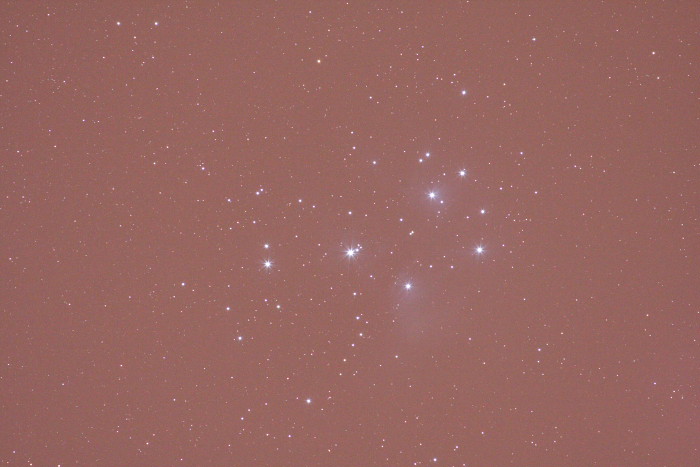
I am shooting from mag 4.5ish skies. Here's what one of the 2 min exposures looked like:
For 3.5 hours of exposure at a reasonably dark site, yes I would have tons more nebulosity. I probably would take much longer exposures too. But city lights limit what I can do
Philly Rains wrote:
Andrew! This image is stunning! I'm sorry I didn't get here sooner to post, but had to tell you! I'm so green with envy at your equipment, too!
Just amazing!!
Philly:
Thanks for the kind words. No need to be green with envy-- a used 5D costs more than the scope, and the whole setup (lens, camera, telescope) is less than a 1DMk3 body! You should talk to the guys with the 7" Taks and 20" dobs, and the birders who use the 600/f4 lens
Overall I didn't think this would make it to the finals, there's no 'human element' or connection to the surroundings in the photo like the milky way shot or the star trails, but at least I had a chance to show off an astrophoto