Measuring the focal length of a lens is not so easy because the definition of the focal length is for a lens focused at infinity. If the lens is focused closer than infinity, the measured focal length will generally be less than the focal length when focused at infinity. A well-designed lens will have a constant field of view (FOV) as the focus distance moves from infinity to closer distances, not a constant focal length. The focal length of a lens can be measured to a high degree of accuracy by focusing on an object that is very far away and that has a known angular subtense. Star constellations, such as The Orion Constellation, are sometimes used. The Moon is far enough away to produce focal length measurements accurate to about 1 part in a million.
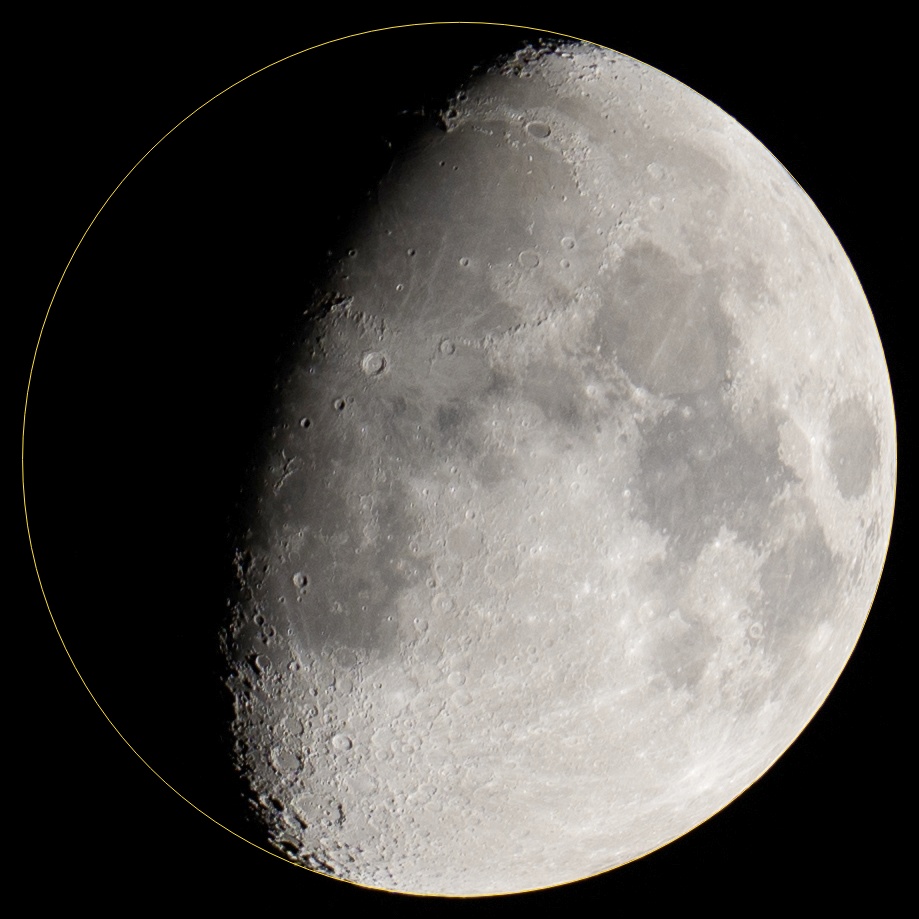
I have measured the focal lengths of six longer focal length Sony lenses that I have. My curiosity was in part stimulated by the recent 400/4.5 and 600/6.3 lenses I acquired. They share many of their optical elements, and there is interest in their relative performance, with and without TC’s. I set up to photograph the Moon, measure the Moon’s diameter in the images, and convert those measurements into accurate measurements of the lens focal lengths. Photographing the Moon is easy, but accurately measuring the diameter of the Moon’s image on the sensor can be somewhat tricky since the Moon is usually not a full Moon and consequently not a full circle. Also, it’s important to photograph the Moon when it is at a high altitude above the horizon to avoid that distortion of the Moon’s shape by the Earth’s atmosphere. To make accurate measurements I used Claude to write a program to fit a circle to the Moon’s image to extract an accurate measurement of the diameter in pixels. The photo below shows the circle that was fit to the partial Moon’s image to measure the diameter in pixels. The Moon’s diameter in pixels can be converted to a length if the sensor pixel size is known. The Moon’s diameter, D, is related to the lens focal length, fl, by the following formula:
D = 2*fl*tan(theta/2)
where theta is the angular subtense of the Moon. Measuring D in pixels is very accurate, but the conversion to mm depends on the precision of the dimensions of the sensor. The sensor is nominally 24x36mm, but Sony spec is 24x35.9mm. I take that to mean it rounds up to 24 and rounds to 35.9. As a result, I used 23.96x35.94, which is exactly 2:3. If this is off, the focal lengths scale proportionally to the sensor size.
The problem with using the Moon is that its angular subtense varies as the Earth rotates and the Earth and Moon move in their orbits, and depends on the location of the observer on the Earth’s surface. NASA provides extremely accurate data on the angular subtense of the Moon at any date or time, but the angular subtense is for an observer at the center of the Earth. In order to use that data, the user needs to correct the data to the observer’s position on the surface of the Earth.
The program that measures the Moon’s diameter also extracts the date/time and GPS coordinates from the photo’s metadata, and extracts from NASA’s web site the Moon’s angular subtense for an observer at the center of the Earth and corrects it for the actual observer’s position on the surface. With that information the focal length and the FOV of the lens can be calculated.
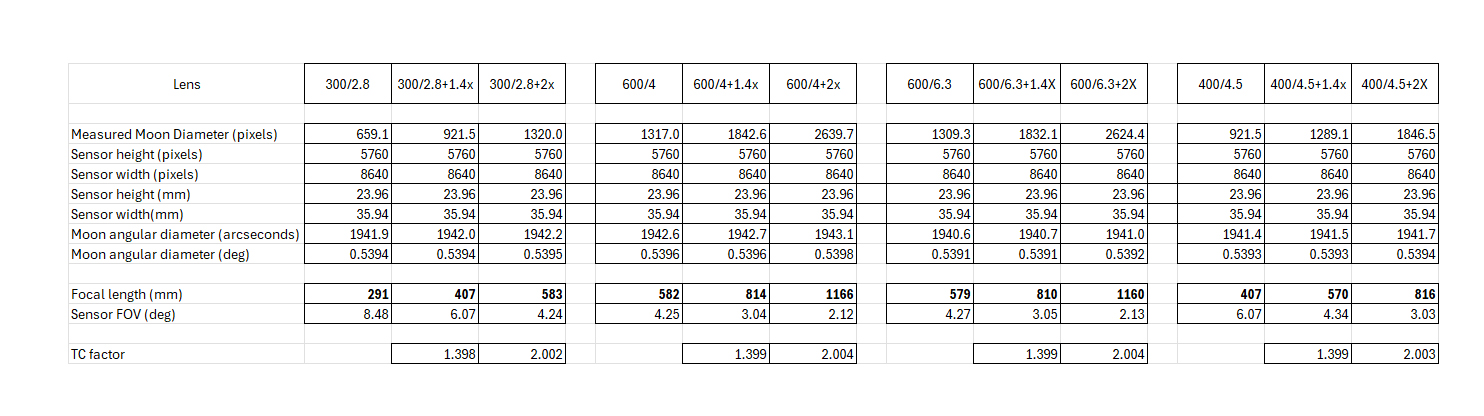
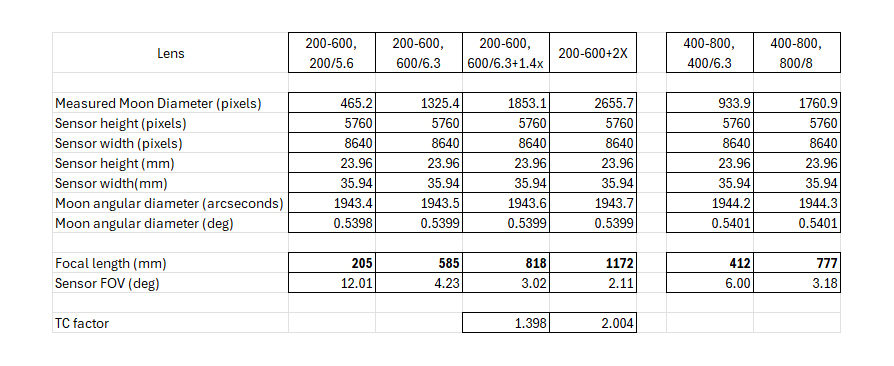
The tables below show the results for some Sony prime and zoom lenses. The accuracy of the focal lengths depends on the accuracy of the measurement of the diameter of the moon’s image on the sensor, the size of the sensor, and the angular subtense of the moon. All these factors have been assessed, and the error in the measured focal lengths is estimated to be less than 0.5 mm.
We see that the nominal 600mm lenses are 582mm and 572mm for the primes and 585mm for the zoom. These are all short but within the nominal 10% accuracy Sony claims for their lenses. The 300/2.8+2x is 583mm which is very close to the two primes, and the 400/4.5+1.4X is at 570mm, which is longer than the nominal 560mm and just 1.5% short of the 600/6.3 at 579mm. Effectively all the 600mm lenses are short of 600mm but for most purposes essentially equal.
Yellow circle shows the fit to the diameter of the Moon.
Focal Length Measurements - Prime Telephoto Lenses
The comparison of the 400/4.5 and 600/6.3 is an interesting comparison since they share most of their optical elements, including the entrance aperture. Interest in that comparison is what stimulated my interest in accurately measuring the focal lengths. The 600/6.3 and the 400/4.5+1.4X nominally are 600/6.3 and 560/6.3. We see they are considerably closer in focal length at 579mm and 570mm than their nominal 600mm and 560mm. If we take their nominal specs, their entrance apertures should be 600/sqrt(40) = 94.9mm and 400/sqrt(20) = 89.4mm. If we use instead the measured focal lengths, we get 579/sqrt(40) = 91.5mm and 407/sqrt(20) = 91.0. Much closer but not equal.
How can we measure the entrance aperture? An obvious way is to measure the diameter of the first element of the lens, which is the same for these lenses. It’s difficult to get an accurate measurement, but using a caliper I conclude it is smaller than 90mm. This method may not be correct since the maximum aperture is probably determined by the iris inside the lens. A better way is to observe the aperture by looking back down the lens and focus on the lens aperture from several meters away. I set up the two lenses with a white background to give a strong contrast at the edge of the aperture and then set up about 30 meters away with the 600/4+2X and photographed the aperture along with a measuring rule. Using this method I measured about 86mm for the 600/6.3 and 88mm for the 400/4.5. I estimate there is a possible error of as much as 2mm, so I use 87mm for both. Using 87mm for the aperture I computed the f/# for the 600/6.3 is 6.66 and the f/# for the 400/4.5 is 4.69. So, I conclude the 600/6.3 is 579/6.66, and the 400/4.5 is 407/4.69 and with the 1.4X TC it is 570/6.55.
dclark wrote:
The comparison of the 400/4.5 and 600/6.3 is an interesting comparison since they share most of their optical elements, including the entrance aperture. Interest in that comparison is what stimulated my interest in accurately measuring the focal lengths. The 600/6.3 and the 400/4.5+1.4X nominally are 600/6.3 and 560/6.3. We see they are considerably closer in focal length at 579mm and 570mm than their nominal 600mm and 560mm. If we take their nominal specs, their entrance apertures should be 600/sqrt(40) = 94.9mm and 400/sqrt(20) = 89.4mm. If we use instead the measured focal lengths, we get 579/sqrt(40) = 91.5mm and 407/sqrt(20) = 91.0. Much closer but not equal.
How can we measure the entrance aperture? An obvious way is to measure the diameter of the first element of the lens, which is the same for these lenses. It’s difficult to get an accurate measurement, but using a caliper I conclude it is smaller than 90mm. This method may not be correct since the maximum aperture is probably determined by the iris inside the lens. A better way is to observe the aperture by looking back down the lens and focus on the lens aperture from several meters away. I set up the two lenses with a white background to give a strong contrast at the edge of the aperture and then set up about 30 meters away with the 600/4+2X and photographed the aperture along with a measuring rule. Using this method I measured about 86mm for the 600/6.3 and 88mm for the 400/4.5. I estimate there is a possible error of as much as 2mm, so I use 87mm for both. Using 87mm for the aperture I computed the f/# for the 600/6.3 is 6.66 and the f/# for the 400/4.5 is 4.69. So, I conclude the 600/6.3 is 579/6.66, and the 400/4.5 is 407/4.69 and with the 1.4X TC it is 570/6.55. ...Show more →
This is incorrect. The entrance pupil is the apparent diameter of the aperture stop (usually the iris diaphragm) as viewed through the front optical elements, not the physical diameter of the front element.
A magnified image of the iris can extend beyond the front element, this isn't an issue when the subject is not at infinity, but when focusing at infinity the front element would clip the incoming beam
dclark wrote:
The comparison of the 400/4.5 and 600/6.3 is an interesting comparison since they share most of their optical elements, including the entrance aperture. Interest in that comparison is what stimulated my interest in accurately measuring the focal lengths. The 600/6.3 and the 400/4.5+1.4X nominally are 600/6.3 and 560/6.3. We see they are considerably closer in focal length at 579mm and 570mm than their nominal 600mm and 560mm. If we take their nominal specs, their entrance apertures should be 600/sqrt(40) = 94.9mm and 400/sqrt(20) = 89.4mm. If we use instead the measured focal lengths, we get 579/sqrt(40) = 91.5mm and 407/sqrt(20) = 91.0. Much closer but not equal.
How can we measure the entrance aperture? An obvious way is to measure the diameter of the first element of the lens, which is the same for these lenses. It’s difficult to get an accurate measurement, but using a caliper I conclude it is smaller than 90mm. This method may not be correct since the maximum aperture is probably determined by the iris inside the lens. A better way is to observe the aperture by looking back down the lens and focus on the lens aperture from several meters away. I set up the two lenses with a white background to give a strong contrast at the edge of the aperture and then set up about 30 meters away with the 600/4+2X and photographed the aperture along with a measuring rule. Using this method I measured about 86mm for the 600/6.3 and 88mm for the 400/4.5. I estimate there is a possible error of as much as 2mm, so I use 87mm for both. Using 87mm for the aperture I computed the f/# for the 600/6.3 is 6.66 and the f/# for the 400/4.5 is 4.69. So, I conclude the 600/6.3 is 579/6.66, and the 400/4.5 is 407/4.69 and with the 1.4X TC it is 570/6.55. ...Show more →
Interesting how the 400mm, and it’s TC iterations, are longer than their stated focal length. While the 600mm is shorter than the stated focal length in all it’s configurations. I would have thought they would behave similarly seeing how they share so many components
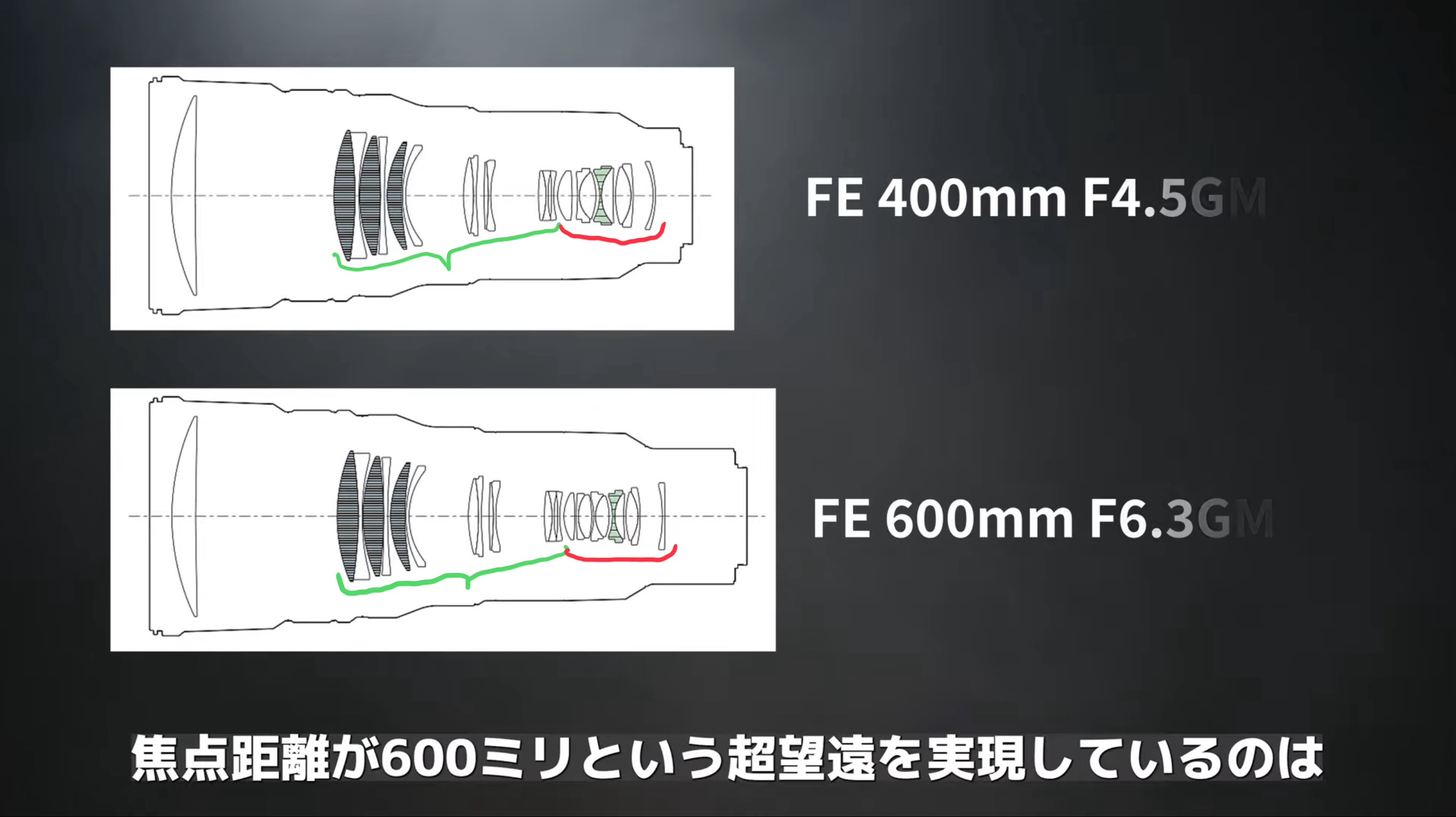
I posted this screen grab in another thread (the front element should be included in the shared elements). And I have no idea how accurate the diagrams are. But while the two lenses seemingly share a majority of the elements (the front dozen or so elements). The back third of the elements (the ones closest to the camera) appear to be unique to each lens. Although, I don’t think those come into play in your calculations.
I know nothing about lens design. I just thought the lens diagrams side by side was interesting
aCuria wrote:
This is incorrect. The entrance pupil is the apparent diameter of the aperture stop (usually the iris diaphragm) as viewed through the front optical elements, not the physical diameter of the front element.
A magnified image of the iris can extend beyond the front element, this isn't an issue when the subject is not at infinity, but when focusing at infinity the front element would clip the incoming beam
I am not clear what you are disagreeing with.
I believe I stated that the aperture cannot be larger than than the size of the entrance optic. Do disagree with that?
I also stated that the better way is to observe and measure the image of the aperture, which is most likely determined by the iris, from a long distance. The reason I say most likely is that we are making a measurement with the iris fully open. I believe it's possible that the aperture may be determined by the size of the entrance optic, or some other stop in the lens, if the iris is fully open. I consider that to be a design error but it happens. It was clear to me that in this case I was focused on the iris and measuring its apparent diameter. That was the 87mm I used.
dclark wrote:
I am not clear what you are disagreeing with.
I believe I stated that the aperture cannot be larger than than the size of the entrance optic. Do disagree with that?
I also stated that the better way is to observe and measure the image of the aperture, which is most likely determined by the iris, from a long distance. The reason I say most likely is that we are making a measurement with the iris fully open. I believe it's possible that the aperture may be determined by the size of the entrance optic, or some other stop in the lens, if the iris is fully open. I consider that to be a design error but it happens. It was clear to me that in this case I was focused on the iris and measuring its apparent diameter. That was the 87mm I used. ...Show more →
The entrance pupil (which is the apparent diameter of the aperture stop as viewed from the front of the lens) CAN be larger than the diameter of the front element.