GGEIS
Offline
• •
Upload & Sell: Off
|
 p.1 #1 · A9III: Taking global shutter flash to the next level with exact timing for any shutter speed on any strobe brand | |
The potential of the global shutter for flash can’t be overstated. Being able to shoot at 3 to 5 stops lower power than on a conventional camera changes everything about what you carry and how fast you can work.
Think about it this way. What would you pay for a new version of the flash you already own that had 16 times the battery life? Or 4 times the output? Or did the same job at a fraction of the size? However you want to multiply it, that’s what 4 stops gets you. And you don’t have to buy a new flash to get it. The upgrade applies to every flash you already own.
But there’s one huge caveat, especially for professional work. The timing has to be synced correctly so the shutter captures your flash perfectly. Once you combine multiple strobes, that becomes the Achilles heel. In a professional environment, I have to know my flashes will respond the way I expect them to. So I knew I had to find a better way to map them.
I built a guided way to map exactly when each flash hits its peak output against the global shutter, across every shutter speed and power level. A few things I didn’t expect. First, how differently certain flashes behave in terms of flash duration. At 1/10,000s I can shoot my AD100 2 stops higher than my AD600BM. That effectively gives me the output of a 400 in those conditions. And that’s comparing global shutter to global shutter. If you took that 600 into HSS on a conventional camera, the AD100 would put out more light while set 4 stops lower in power. That’s 16 times the shot count.
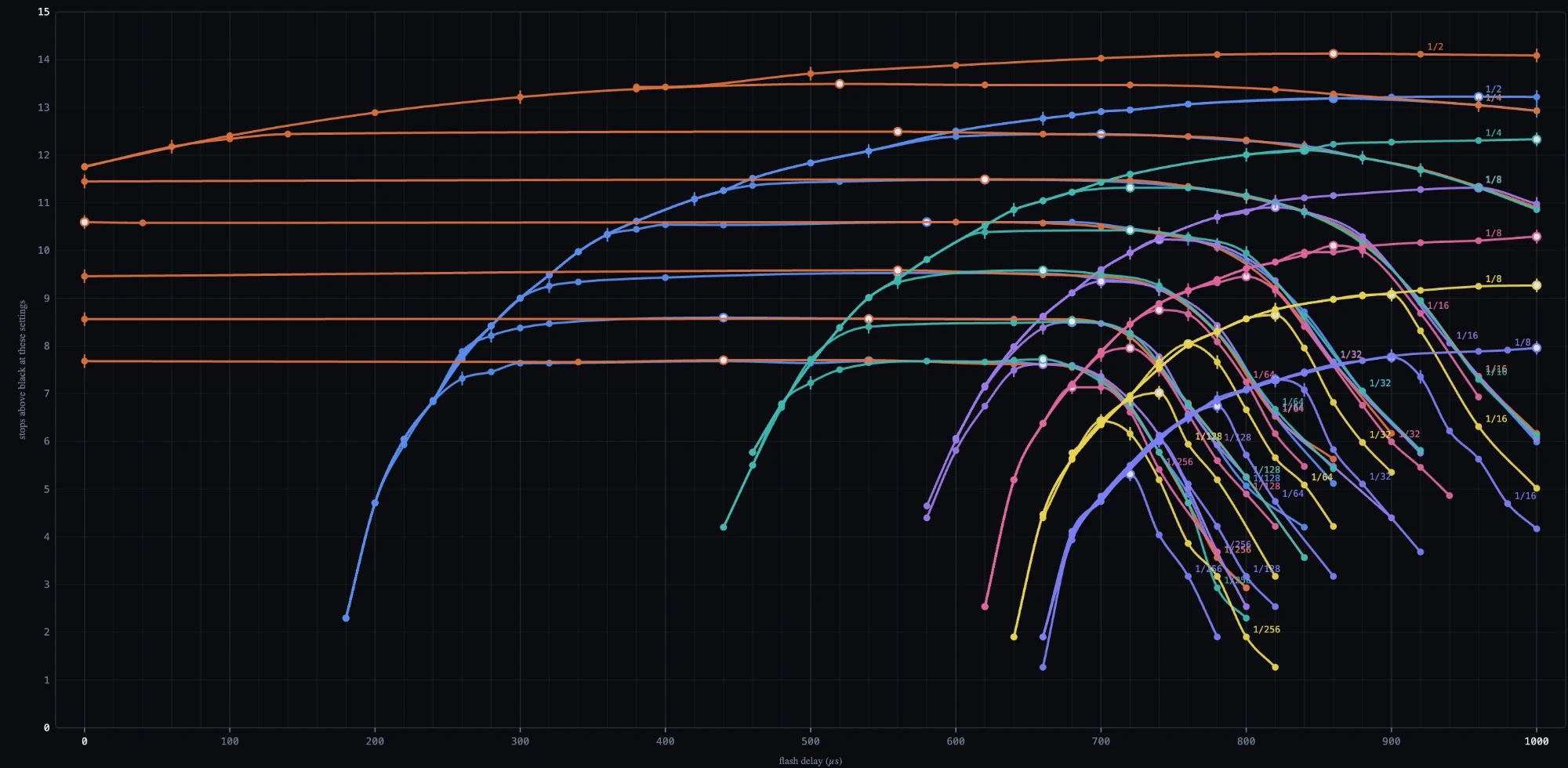
This is one flash mapped on the A9III. Each line is one power level at one shutter speed. Higher means more light hit the sensor. Look how narrow the peaks get at low power. You have to know where your flash bands are forgiving and where they get tight. You can do some really cool photography when you push the shutter speed up, but the timing has to be right. You’ll also see where higher power settings stop adding any exposure at the top end. On my flashes, that point is 2 stops different between the 600s and the 100s. There’s no way to find that without ridiculously meticulous manual testing, and even if you did, you couldn’t remember it and use it on a shoot. I tried, and wasted a lot of time doing it.
Then I turned all of that into a field app you use on set. It runs on your phone. Pick your flash, your power, and your shutter speed, and it tells you the delay to dial in. No guessing, no test firing, and no fully automated trigger needed.
Published timing charts help, but a single setting per cell isn’t enough. You can’t reset your timing on every small change, especially with multiple strobes. You need to know the window. And that doesn’t even cover the range of power settings you should never use at a given shutter speed, because the flash is still firing after the shutter closes.
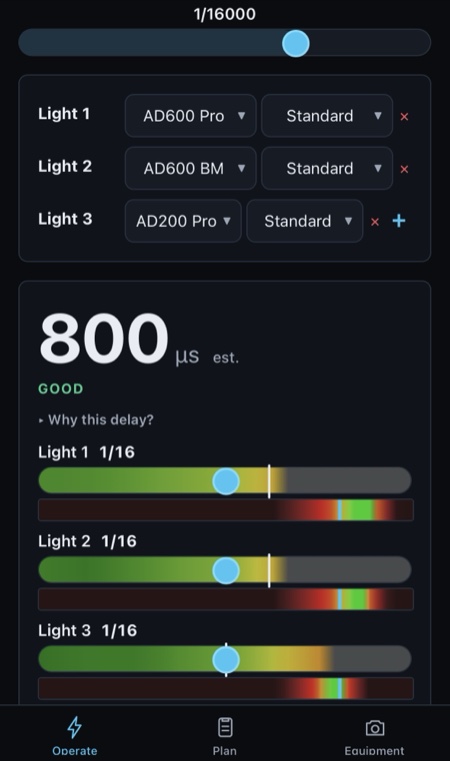
Three lights at 1/16 power, shot at 1/16000. The app says 800 µs and shows where that delay lands in each light’s window. Green is where you want to be.
Here’s a short video showing how it works:
https://youtu.be/CgqaujqYMtU
Here’s where I’m at. It works great for me, because it covers my flashes. To be useful for everyone else, it needs to cover a lot more strobes, and mapping each one takes real time and money on top of what I’ve already put into building it. Before I take that on, I want to know there are enough people who would actually use it.
That’s what the wait list is for. If you’d use this, sign up at https://flash-waitlist.vercel.app and tell me which flashes you shoot. That tells me which ones to map first.
I’d love to hear your feedback on the app and any way I can make it better. I have some more advanced features I didn’t cover, but first I need to show people it’s easy to use and why they need it.
I could also use help getting the message to more people so they understand the need.
The program I used to map the flashes could also be used by manufacturers to program their flash triggers directly and auto sync with the Sony. Any contacts at Westcott, Godox, or Neewer would be really appreciated.
|


