Clip-in Filter Thickness & Kolari Converted Cameras
p.1 #1Clip-in Filter Thickness & Kolari Converted Cameras
One thing I've kept an interested eye on for a while has been the thin filter conversions of digital mirrorless cameras, but been acutely aware of the pros and cons, one of them being reduced compatibility with native mount lenses. It occurred to me that clip-in filters might actually 'improve' the native performance on native lenses depending on how thick they are. Has anyone ever tested this? I'm very curious.
Sep 12, 2026 at 09:16 AM
p.1 #2Clip-in Filter Thickness & Kolari Converted Cameras
I haven't. I have a unmodded body for that, but the UT-modded rII doesn't play poorly with every lens. It really depends on focal length (none of my teles suffer) and the lens design itself. The Zony 50/1.4, for example, has less of an FC issue on the mod.
Sep 12, 2026 at 10:04 AM

p.1 #3Clip-in Filter Thickness & Kolari Converted Cameras
I have and it’s been long enough I dont recall specifics but you will see differences. Reviews included Sony (2.5mm) Nikon Z (2.3mm if I recall) a naked sensor w/ and w/o a clip in filter and front end option sigma filter or color correcting filter. One data point I do remember, the Loxia 35mm on Nikon vs Sony, corners improved as the field flattened, but it was a wavy field to begin with so midfield degraded. Implications is 0.2mm of variance can change default behavior.
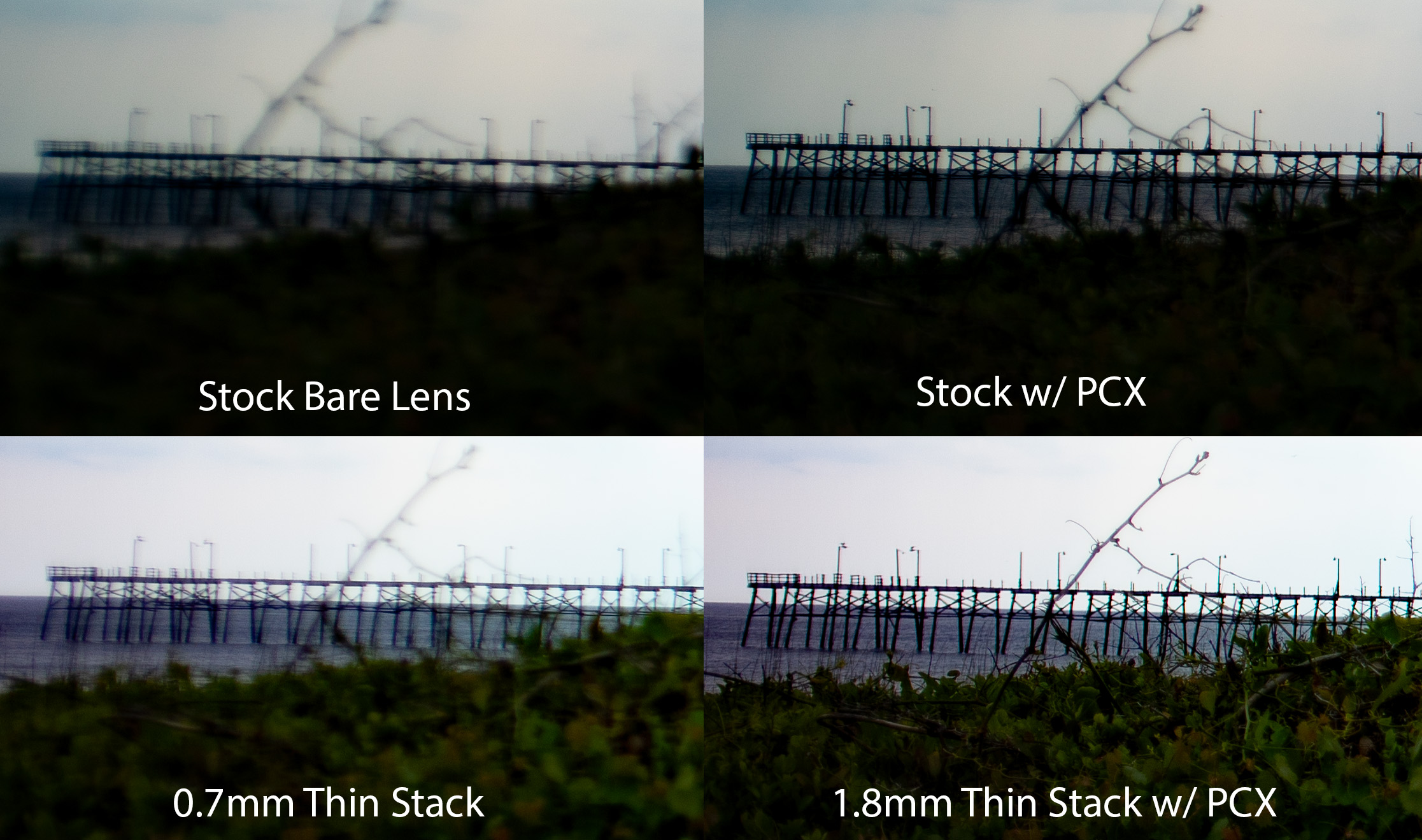
Edit fortunately I’ve saved this comp with a Contax G28. 0.7mm is “bare” sensor which still have thin cover glass but no hot mirror (full spectrum). 1.8 adds a clip in filter. Also had a standard Sony sensor at the time. Gives some idea of how things change with a challenging lens.
Edit fortunately I’ve saved this comp with a Contax G28. 0.7mm is “bare” sensor which still have thin cover glass but no hot mirror (full spectrum). 1.8 adds a clip in filter. Also had a standard Sony sensor at the time. Gives some idea of how things change with a challenging lens.
Sep 14, 2026 at 03:11 PM