p.1 #1 · Recommended full frame platform for adapting vintage glass?
Hey all,
I’ve avoided GAS pretty well for the last many years by not visiting this forum. But it may be time to re-evaluate the full frame mirrorless platform for adapting the vintage lenses I like. Hence my question.
I have been using an A7II for a long time and found it to work really well. I have a set of Canon FD/FDn lenses, a C-Sonnar M-mount, a Leica R/leitaxed to F-mount, and ZF 25/2.8. I use all of this quite interchangeably (including sports/nature photos with telephotos) on the Sony. Other than some recent quirks (the camera just shutting down somewhat regularly for some reason, so having to be turned on and off frequently), the Sony A7II works reasonably well for me.
Given the notion of moving to a newer full frame camera for these lenses, should I stick with a Sony, or are there other platforms that work better for the lenses I have? I only use MF and alternate between A and M settings depending on context. So manual use is a priority and I don’t care about digital/tech features that are unrelated (no video, no eye-tracking, etc.). I prefer a camera that gets out of the way. And I split evenly between color and monochrome.
p.1 #3 · Recommended full frame platform for adapting vintage glass?
I personally use digital-M bodies (M10R / M10M) for adapting vintage M42-mount lenses (plenty of classic soviet lenses, and other classics like Takumars, etc. go really well. The flange distance makes the M-mount pretty versatile for accepting older SLR lenses, or helicoid-adapted enlarger lenses (with interesting aperture shapes) like the Meopta Belar, etc
To match the mounts, I use a SHOTEN M42-LM helicoid-adapter - which has the advantage that for 50mm lenses, it also provides the correct rangefinder coupling! (hence, can also use with your film-M cameras if you please)
And for the rest, you'd need a visoflex. Not as cool as using the TechArt adapter on a Sony but serves the purpose without adding a new camera system
p.1 #4 · Recommended full frame platform for adapting vintage glass?
expwmbat wrote:
Hey all,
I’ve avoided GAS pretty well for the last many years by not visiting this forum. But it may be time to re-evaluate the full frame mirrorless platform for adapting the vintage lenses I like. Hence my question.
I have been using an A7II for a long time and found it to work really well. I have a set of Canon FD/FDn lenses, a C-Sonnar M-mount, a Leica R/leitaxed to F-mount, and ZF 25/2.8. I use all of this quite interchangeably (including sports/nature photos with telephotos) on the Sony. Other than some recent quirks (the camera just shutting down somewhat regularly for some reason, so having to be turned on and off frequently), the Sony A7II works reasonably well for me.
Given the notion of moving to a newer full frame camera for these lenses, should I stick with a Sony, or are there other platforms that work better for the lenses I have? I only use MF and alternate between A and M settings depending on context. So manual use is a priority and I don’t care about digital/tech features that are unrelated (no video, no eye-tracking, etc.). I prefer a camera that gets out of the way. And I split evenly between color and monochrome.
If you like the Sony I think it's fine to stick with Sony. There's an entire thread about the Nikon Zf as a platform for adapted lenses and I think people really enjoy the focus aids that the Nikon Z has (though they may not be as useful to you). What are your priorities with this next camera? Image quality/ease of use/weight/price/looks?
p.1 #5 · Recommended full frame platform for adapting vintage glass?
If you're not planning to get any other lenses, sticking with Sony should indeed be fine. You might get some improvements with your C-Sonnar if you switch to Nikon Z, especially at longer distances (I doubt you'd see any improvement at portrait distance), But I don't think you'd see much benefit for your other lenses. The main advantages to Nikon Z over Sony are the thinner sensor stack and the manual-focus aids...which work best with electronically chipped lenses but there are workarounds (as explained in Bastian's article that I linked to above).
p.1 #6 · Recommended full frame platform for adapting vintage glass?
bjhurley wrote:
If you're not planning to get any other lenses, sticking with Sony should indeed be fine. You might get some improvements with your C-Sonnar if you switch to Nikon Z, especially at longer distances (I doubt you'd see any improvement at portrait distance), But I don't think you'd see much benefit for your other lenses. The main advantages to Nikon Z over Sony are the thinner sensor stack and the manual-focus aids...which work best with electronically chipped lenses but there are workarounds (as explained in Bastian's article that I linked to above).
The Bastian's article should be updated by including the Nikon Z5II, which is even cheaper than Zf, has better ergonomics and has two full-size UHS-II SD card slots
Steve Spencer Offline • • • • • • • Upload & Sell: Off
p.1 #8 · Recommended full frame platform for adapting vintage glass?
I think because you shoot almost exclusively manual focus lenses, that you have to begin by considering whether you are happy with magnification and peaking for focussing or if you want focus aids. If you want focus aids then you can get them with Nikon or Canon. I think they are a big help and I switched from Sony to Canon largely because I too shoot manual focus a lot and I prefer shooting with focus aids most of the time.
If you can live without focus aids and are happy with magnification and peaking, then Sony can be a great system for manual focus shooting. Personally, I wanted the focus aids and from there I wanted a camera with a very good EVF and blackout free shooting, because for me the EVF experience is very important for manual focus shooting. I also wanted a medium sized camera and I wanted to be able to shoot silently if I needed to for most of my shooting. That led me to the Canon R5 II, which is a 45 MP BSI stacked sensor camera with a very fast sensor scan speed that allows shooting almost everything in silent electronic shutter mode, has excellent focus aids, and a very good blackout free EVF. There is some downside in that there are only a few MF lenses made for Canon RF mount, but you can adapt Canon EF mount lenses (and the Zeiss ZE/ZF/Milvus lenses are among my favorites) easily and Leica M mount lenses easily. I was able to put together an excellent kit of manual focuses lenses for the camera. I am happy with my choice, but I realize it may not be for everyone.
You will have more selection of manual focus lenses made for the Z mount, but you will not get the stacked sensor with blackout EVF shooting unless you go to a bigger camera. Nikon is definitely a solid choice, but I am happy with Canon.
p.1 #9 · Recommended full frame platform for adapting vintage glass?
If you want to stay with 24mp, Sony's a7III:
'The Sony Alpha A7 III released in February 2018 is widely considered Sony's breakthrough 24MP camera. While not the first 24MP sensor they made, the Sony Alpha A7 III redefined the industry standard for full-frame mirrorless cameras by combining a 24.2MP back-illuminated sensor with pro-level battery life, incredible low-light performance, and game-changing autofocus tracking that forced competitors to completely rethink their mirrorless lineups.'
All the nonsense came with the a7IV - for birds, video, etc.
If you wish to get more from your lenses, Sony a7rIII - or to stay with early batteries, Sony a7rII. The a7rII was the breakthrough camera - better IBIS, and it made history as the world's first full-frame mirrorless camera with a backside-illuminated (BSI) CMOS sensor.
The later models are computers disguised as cameras. Like the new cars that people are abandoning..
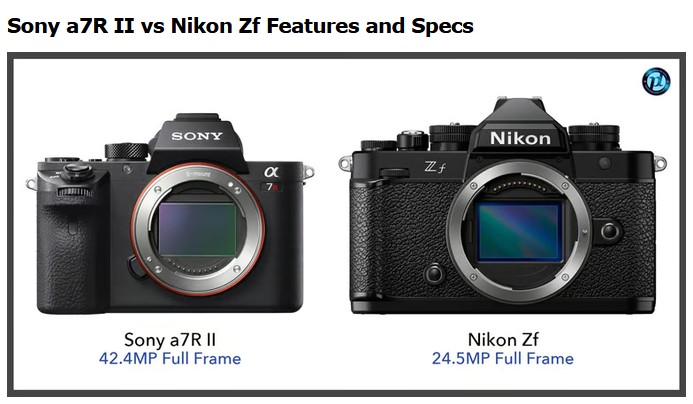
The Nikon Zf is a cultist camera for unreconstructed DSLR shooters. Take a look at the thing below, a 24mp camera that is 100g heavier than the 42mp a7rII, with a huge outlandish body, but just a vestigial grip.
Not good for street, travel or anything that needs discretion. And you'd need to retrain your muscle memory. The Sonys are great with legacy (D)SLR lenses, I've used them for 13 years now. I also use a bunch of M-mount lenses, no problemo. But it's a gear forum as you rightly point out, and many will have bought into the latest and greatest, to be expected. Maybe 85% of my thousands of images here were shot on MF lenses (all on Sony), many using M-mount lenses, see for yourself. cheers, and good luck going forward.
p.1 #10 · Recommended full frame platform for adapting vintage glass?
I use a Sony A1 for adapting lots vintage lenses.
The main advantage for me is the amazingly clear high-mp EVF for manual focusing. It makes a huge difference compared to lower mp EVF systems found on my other cameras.
Also I find the adapters for vintage lenses are the easiest to find for Sony ( just a minor advantage, but anything helps...)
Some lenses dont perform well on Sony bodies, I guess due to the thicker sensor stack. I stay mostly with 50mm and longer focal lengths, that works well for me...some wider lenses can get a bit funky.
p.1 #12 · Recommended full frame platform for adapting vintage glass?
Thanks to everyone who replied—very helpful perspectives.
It seems like the Sony remains the best choice given the options—I have no need for the extra computer work, so I’ll fish around for the a7rIII (actually the a7rii looks like a better choice). I like IBIS and a good EVF, but the extra focus aids seem to require electronic adapters. And the size difference compared with the Nikon is very unappealing (even if I like the vintage design).
p.1 #13 · Recommended full frame platform for adapting vintage glass?
I went with the Nikon ZF. Early tests have been positive. The thicker sensor stack of the Sony’s put me off and the SL cameras were too big and pricey. They also don’t have the Nikon focus aids or the ability to use something like the Techart adapter, which I really dig.
p.1 #14 · Recommended full frame platform for adapting vintage glass?
Nikon is better than Sony for this use case by every single metric including focus aids and sensor stack thickness among others. How someone comes to the conclusion that Sony is the best option is...interesting at its most generous.
It really comes down to your savviness and expectation of quality. If adapting to Sony looks ok to you, no need to reinvest. It seems like that's where we've landed for OP, but let's not muddy the waters for others finding this thread later.
p.1 #16 · Recommended full frame platform for adapting vintage glass?
My current set up is M11, Nikon ZF, a7cr.
manual focus confirmation via the Nikon is a really great shooting experience. Accurate, fast, not need to magnify to focus. BUT as mentioned above, the ZF is a bulky body and it takes away from the lifestyle aspect of compact M mount lenses mounted to a compact full frame body. a7cr seems to be more similar to the lifestyle experience of the M body.
I need to sell either the Zf or the a7cr but enjoy them both for different reasons tbh. If I did not have the M11, I would probably just use the a7cr personally. In my day to day shooting, I prefer smaller set-ups. I keep the ZF around because the focus confirmation is nice but tbh I don't find myself reaching for it as much because of the size of the camera.
p.1 #17 · Recommended full frame platform for adapting vintage glass?
While I prefer my M11 for M lenses I do often adapt a Nikon Z7II, using either the Voigtlander close focus, or the Techart autofocus adapter. The Z7II gives me a backup camera for the M11 and it works very well, and at 46 mp is for my use a better than a Zf since I shoot mostly outdoors and want more mp. The techart works fairly well, it is no rapid focus of native Z lenses but it is quite good for lighter not too challenging autofocus circumstances. the close focus adapter works well to get a M lens close. Note the techart is limited to 500 gm lenses, so no monster M lenses like nocts. For a vast majority of the time the Z7II and adapter is a good choice to use small modest sized M lenses, I like it with the LLL elcan, Voigtlander colorskopers etc.... the techart cannot be used with an infinity lock ruling a few of my lens out, but otherwise it with the Z7II is a nice combo especially if AF is a good idea, like when I am fishing and photography is not the primary goal of the day and I want to hand the camera to someone with no experience. I can keep it all nice and dry with an Osprey 2 L bag and put everything in on bag and then a backpack. It is a good-enough choice sometimes.
p.1 #19 · Recommended full frame platform for adapting vintage glass?
RoamingScott wrote:
Nikon is better than Sony for this use case by every single metric including focus aids and sensor stack thickness among others. How someone comes to the conclusion that Sony is the best option is...interesting at its most generous.
It really comes down to your savviness and expectation of quality. If adapting to Sony looks ok to you, no need to reinvest. It seems like that's where we've landed for OP, but let's not muddy the waters for others finding this thread later.
Thanks for the reply—can you say more? The sensor stack matters for M-mount lenses, but isn’t an issue for the 50mm I have. My other lenses are SLR. From what I have read, it seems like the focus assist on the Nikon requires electronic adapters (I would need three different sets of Z-mount adapters), and/or is variable in how well/which focus assist works for a particular adapter/lens combo.
Am I wrong? What else should I be considering, given my particular use case (which is certainly not typical)?
Cheers,
Daniel
Aug 18, 2026 at 05:24 PM
Steve Spencer Offline • • • • • • • Upload & Sell: Off
p.1 #20 · Recommended full frame platform for adapting vintage glass?
expwmbat wrote:
Thanks for the reply—can you say more? The sensor stack matters for M-mount lenses, but isn’t an issue for the 50mm I have. My other lenses are SLR. From what I have read, it seems like the focus assist on the Nikon requires electronic adapters (I would need three different sets of Z-mount adapters), and/or is variable in how well/which focus assist works for a particular adapter/lens combo.
Am I wrong? What else should I be considering, given my particular use case (which is certainly not typical)?
Cheers,
Daniel
Let me try to answer this question. You do not need three sets of electronic adapters. You could buy one, two, or three electronic adapters in the following way:
1 adapter - you would want to get an M-mount electronic adapter. Shoten makes a nice one that includes a short built-in extension and can be programmed for up to ten lenses. If you went this route you would directly adapt your Leica M mount lens to this electronic adapter, but then adapt your F mount lenses and your FD lenses to M mount with a plain non electronic adapter and then mount the lens on the M-mount electronic adapter. This works reasonably well and the focus aids will work well. I do this with my Minolta Rocker 58 f/1.2, which is Leitaxed to Canon EF mount, then has an EF mount to M mount adapter which I then mount on my M mount to Canon RF mount electronic adapter (you could do the same thing with a an M mount to Nikon Z mount electronic adapter with a Nikon camera). In practice it works for me.
2 adapters - you could get an M-mount electronic adapter and use it for your M mount lens, then adapt your FD lens to M mount and add them to the M-mount adapter as described above, but then add the Nikon F to Z adapter for your Nikon F mount lenses. I think the F mount lenses would have to be chipped if they are not already and it may not be easy to do that at this point, but you could do that.
3 adapters - you can get electronic adapters for Nikzon Z mount for pretty much any lens, and they aren't too expensive. You would just need one for each type or mount. Here is one place to get them:
The Leica M adapter is $169.
The Nikon F adapter is $57
The Canon FD adapter is $57
Not a huge expenditure for these adapters but only you can decide if it is worth it. You can save a bit of money and only have one electronic adapter, but for $100 I would be buying multiple adapters. That is just me, however, YMMV.