I honestly think it's more likely we will be seeing the FF market in 5 years even more split between Sony, Canon, Nikon, and L mount.
Nikon has some strong momentum going, and seems to be cooking up something special between its second gen S lenses, Silky Swift Voice Coil Motors for AF, and Red video Technology.
Panasonic's latest L mount cameras are much improved, and If Sigma pulls off Foveon, L mount might have the best studio / landscape FF camera.
shadow9d9 wrote:
Olympus sold out of the camera business years ago...to a liquidator that is throwing out what was left in the pipeline. So, no, Olympus is not still alive.
Olympus / OM is in a strange position. When Olympus sold to JIP I thought it would be over for them within a few years. But OM seems to be doing well enough that JIP is no longer its primary owner:
@DWOfPaul the market is not big enough for all of them now, look at the CIPA numbers. Dedicated camera sales are 30% of their 2012 peak. Talking to young people I notice that they're already treat a large dedicated camera as an attribute of an old weird creep, unless he is a hired pro. Is anyone here on FM younger than 40?
The logos you listed are not great businesses. Look up their numbers, they are public. They'll get only worse when the Chinese inevitably show up. As usual, they will be state-funded and margin-insensitive. I see extinction and consolidation, not expansion, in the future. I question the Nikon's long-term survival as a photographic brand. Only the futures of Sony and Canon seem secure, due to their size and vertical integration. Panasonic and Nikon are likely seeing video as greener pastures even today. The odd duck here is Fuji. They have the resources to be like Canon and Sony. Historically they've been very business-savvy, look at their margins! But something tells me they will bail out of imaging when the margins collapse. They've done it with film, full-frame digital, and will happily do it again because they have so many other sectors to redirect investment.
DWOfPaul wrote:
Olympus / OM is in a strange position. When Olympus sold to JIP I thought it would be over for them within a few years. But OM seems to be doing well enough that JIP is no longer its primary owner:
The photography industry is interesting, no doubt. I'm fascinated by how cooperative an industry it's forced to be from a manufacturing perspective.
That said, who designed what and put what brand on it doesn't matter when the lens is on the camera. Then it's all about how well that lens works for you.
old-gregg wrote:
@DWOfPaul@ the market is not big enough for all of them now, look at the CIPA numbers. Dedicated camera sales are 30% of their 2012 peak. Talking to young people I notice that they're already treat a large dedicated camera as an attribute of an old weird creep, unless he is a hired pro. Is anyone here on FM younger than 40?
I am still under 40 but getting close. What this means for the market as a whole, it's hard to say, but I know people, not from online, who are in there 30's that are into photography, and I know more who would like to get more into photography if it was not so expensive. There also seems to be quite a few people in their 20s and 30s who are into photography on platforms like IG, and Threads. Traditional photograph forms and sites like Flickr do seem to have mostly an older user group, though.
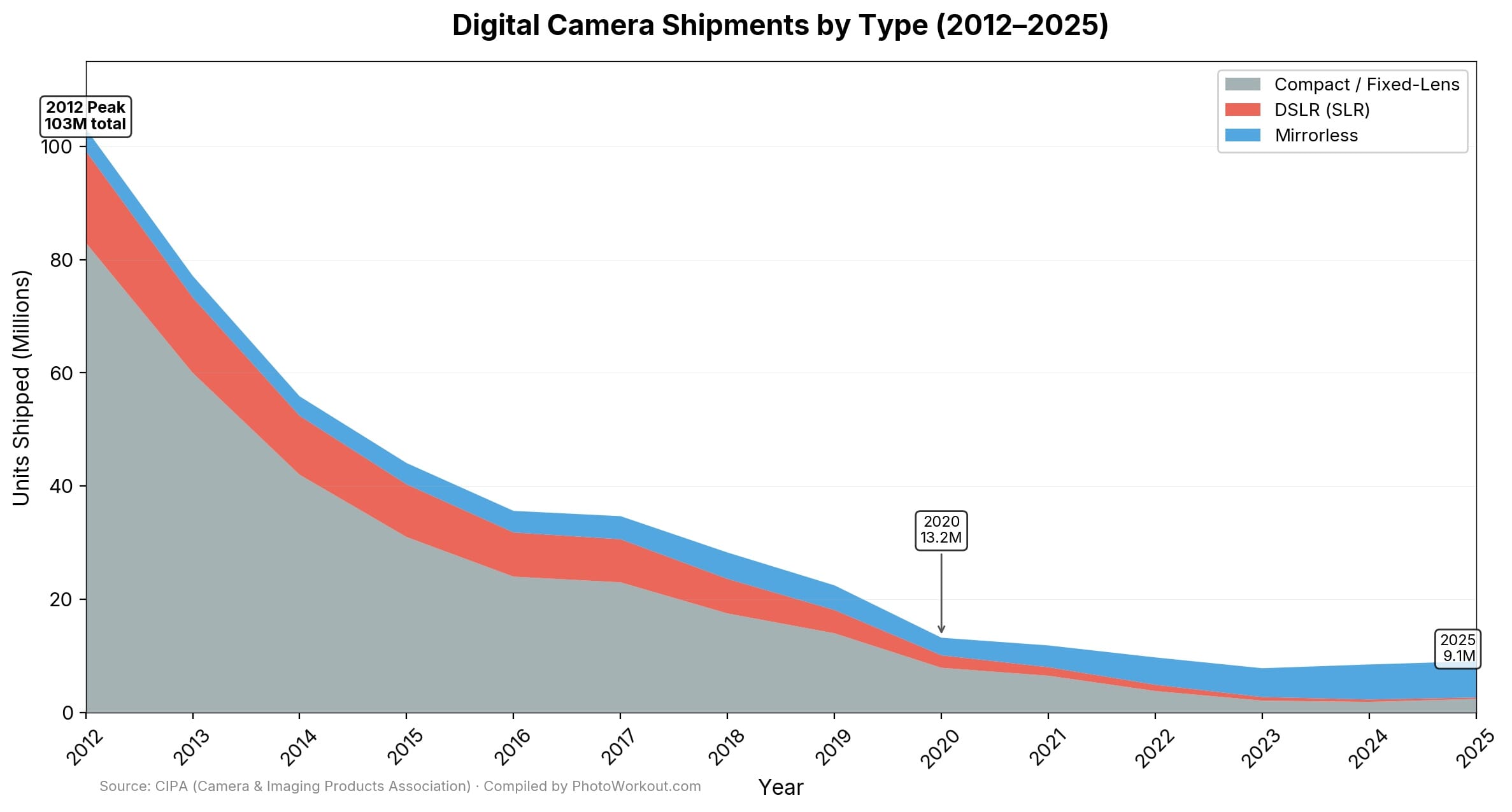
IDK if the CIPA numbers are really that bad. Let's take a look at a chart by year:
The majority of the dedicated cameras were fixed lens. This growth was definitely killed by smart phones, but historically this section wasn't there in the film days, and fixed lens digital cameras are actually starting to come back. Sure DSLR + Mirorless was bigger at the time too, but my guess is a lot of the dedicated cameras sold in 2012 were entry level cameras like the D3000 series that people were picking up at places like Best Buy and Costco. It would be interesting to know how many people who bought an entry level DSLR moved up to FF eventually, but I have met very few. Mirrorless + DSLR sales have bassically been stedy now since around 2019.
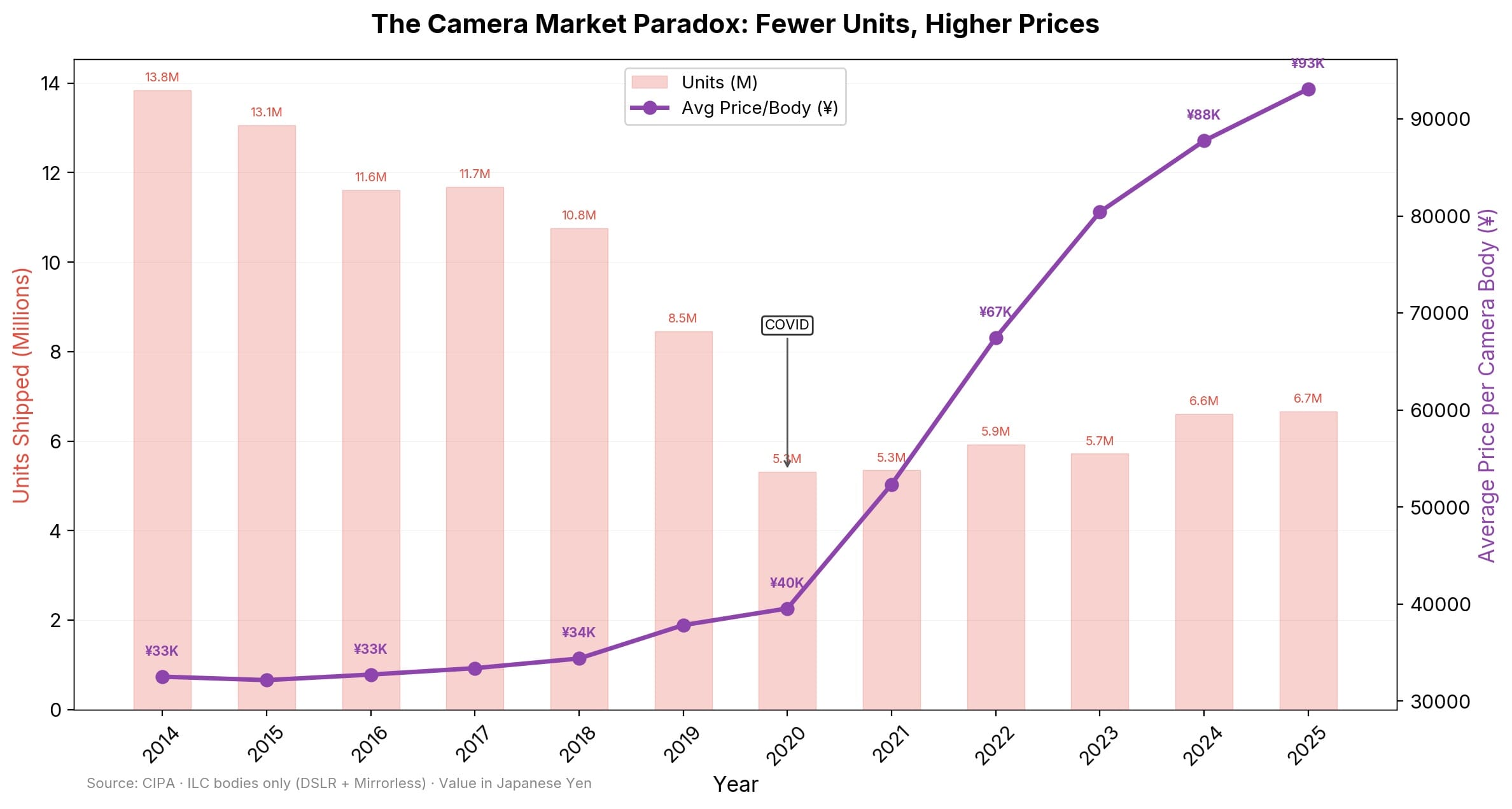
Also, while the total number of units has gone down, the value of each unit has gone up:
DWOfPaul wrote:
I honestly think it's more likely we will be seeing the FF market in 5 years even more split between Sony, Canon, Nikon, and L mount.
Nikon has some strong momentum going, and seems to be cooking up something special between its second gen S lenses, Silky Swift Voice Coil Motors for AF, and Red video Technology.
Panasonic's latest L mount cameras are much improved, and If Sigma pulls off Foveon, L mount might have the best studio / landscape FF camera.
Looking at what Sony has been doing with their latest offering, I agree. I know a lot of younger people who are into photography, both film and digital. What they are not into is paying almost $3k for the lowest end model, and over $4k for the next step up. Or having 50000 settings that need navigating. Not that the latest Sony models are not marvels of technology and arguably the "best" cameras. But most of their advances are entirely useless/overkill for much of what people take photos off (BIF enthusiasts excepted).
A $1500 Nikon is more than good enough for most people's needs, and Sony has a very noticeable gap in this price range.
It’s going to happen. Look at the numbers. You can’t run a camera company only making 800,000ish cameras a year.
The only thing keeping any of them alive is sports and birders. Families don’t own cameras anymore. Even Leica is on the bubble. Who pays that much other than celebrities?
The only two big enough to survive longterm are canon and Sony. It’s just math.
Newenglandrocks wrote:
I seriously doubt that we will be down to two companies. Olympus / OM system is still alive. There seems to be a market for a few "larger than full frame" camera systems. As long as companies can charge premium prices, which enables healthy margins and don't get to mixed up in private equity debt loading (totally orthogonal to their actual businesses, unfortunately) I could see the landscape looking the same as it does now in a few years. With the exception of Chinese companies getting bigger. Nikon's smartest move was acquiring Red. That should keep them from getting killed off.
To be more specific, do we really see Fuji, Leica AND Nikon disappearing in 4-5 years? I don't. ...Show more →
jwolfe wrote:
It’s going to happen. Look at the numbers. You can’t run a camera company only making 800,000ish cameras a year.
The only thing keeping any of them alive is sports and birders. Families don’t own cameras anymore. Even Leica is on the bubble. Who pays that much other than celebrities?
The only two big enough to survive longterm are canon and Sony. It’s just math.
I agree with the caveat that luxury brands might survive longer. Hasselblad and Leica being some of them.
Sony, just like Apple, is going for vertical integration from sensor to lens, from consumer to cinema. Canon is similar but does not have the cash cow that is Sony's sensor manufacturing but it is also a very diversified company.
Nikon can survive a bit longer with the acquisition of Red.I think they should step up their lithography business. They are in danger of becoming more and more like Olympus. An assembler of off-shelf parts and adding their name on it and releasing the same model over and over again just in different housing. It's already the case with some models.
scoundrel wrote:
This sure is a lot of armchair speculation. Maybe time to go out and take some more photos with the gear we already own?
What does your comment have to do with the topic of Sony acquiring Tamron? Wasn't that the thread title you clicked on? If you prefer going out and taking some photos with the gear you already own, instead of discussing industry news, why are you posting here then?
Besides, do you relalize how offensive your comment is to poor children in Africa who don't own any gear? Armchair speculations is all they have! I bet you haven't even thought about this, Mr. Scoundrel.
Good grief..
it's mostly speculation on if/how/when Nikon can survive. Or Fuji. Or OM. etc.
According the recent news, Nikon has/is in the process of building two new lens facilities for production of mirrorless lenses and other products in Japan.
So, the Tamron ownership issue is not a 'fatal' loss IMO.
The 'future of photography' as we know it has been in question - ' literally' forever . Since the 1970's for me.. I thought digital would be a disaster.. & I was wrong.
I now shoot Sony and have and really like a couple Tamron zooms, so it’s a win for me. I suspect Tamron had something Sony liked enough to want to onboard the brand. Probably the design team as well as manufacturing. Add those to Sony’s marketing team, and it looks like a win-win acquisition for both companies. It also aligns with the Japanese business ethos. Other Asian companies like Viltrox and Samyang are making great inroads on optical performance at attractive price points. In that light this merger seems like a logical defensive move for both companies. But what do I know 🤷🏼
jwolfe wrote:
It’s going to happen. Look at the numbers. You can’t run a camera company only making 800,000ish cameras a year.
The only thing keeping any of them alive is sports and birders. Families don’t own cameras anymore. Even Leica is on the bubble. Who pays that much other than celebrities?
The only two big enough to survive longterm are canon and Sony. It’s just math.
800,000 cameras at even an average price of 1,500 (could very well be low), works out to 1.2 billion a year. Without counting lens or accessory sales. While we are not talking a masive consume market like cell phones, we are not exactly talking about a niche market selling a couple of million in products a year either.
Leica is so much its own world that I didn't even mention them before when I was mentioning L mount. There bassically the super car of the photography world. People pay for them because of their premium build quality, reputation, and rarity. They could end up being the first FF manufacturer to leave the market or the last one standing. It's almost impossible to say.
Look I’m a lifelong Nikon shooter but I’m coming close to a choice. If I go back to mirrorless do I go Sony or stay with Nikon? It’s a tough choice because the A1 is amazing.
Personally I want to see Nikon flourish but I just don’t see it happening. Sure $1.2 billion sounds like a lot, but when you consider the overhead and R&D required it’s pennies.
Even luxury brands like Porsche are struggling. Inflation and the market are making it very hard for people to afford the things they used to. I make good money and I struggle to afford a Z8. There just aren’t enough rich guys who like birds to keep so many companies going.
DWOfPaul wrote:
800,000 cameras at even an average price of 1,500 (could very well be low), works out to 1.2 billion a year. Without counting lens or accessory sales. While we are not talking a masive consume market like cell phones, we are not exactly talking about a niche market selling a couple of million in products a year either.
Leica is so much its own world that I didn't even mention them before when I was mentioning L mount. There bassically the super car of the photography world. People pay for them because of their premium build quality, reputation, and rarity. They could end up being the first FF manufacturer to leave the market or the last one standing. It's almost impossible to say....Show more →
jwolfe wrote:
Look I’m a lifelong Nikon shooter but I’m coming close to a choice. If I go back to mirrorless do I go Sony or stay with Nikon? It’s a tough choice because the A1 is amazing.
Personally I want to see Nikon flourish but I just don’t see it happening. Sure $1.2 billion sounds like a lot, but when you consider the overhead and R&D required it’s pennies.
Even luxury brands like Porsche are struggling. Inflation and the market are making it very hard for people to afford the things they used to. I make good money and I struggle to afford a Z8. There just aren’t enough rich guys who like birds to keep so many companies going.
The world wide market for nail polish was $18.5 billion in 2025. We are lucky to have one, or two companies serving such a small market. Film stock sales for both still and motion picture was about $613 Million. These photographic related industries are small niche markets.
Not really. Sony has an ecosystem of third party lenses that completely embarrasses Nikon, at reasonable prices and a massive focal length range. The lenses matter more than the camera since you buy much more of them. And of course, sony has many cameras, at many prices, and so many options that their used prices are extremely cheap.
mranger211 wrote:
Looking at what Sony has been doing with their latest offering, I agree. I know a lot of younger people who are into photography, both film and digital. What they are not into is paying almost $3k for the lowest end model, and over $4k for the next step up. Or having 50000 settings that need navigating. Not that the latest Sony models are not marvels of technology and arguably the "best" cameras. But most of their advances are entirely useless/overkill for much of what people take photos off (BIF enthusiasts excepted).
A $1500 Nikon is more than good enough for most people's needs, and Sony has a very noticeable gap in this price range.
Exactly. I could trade from dslr into Sony mirrorless for hardly anything because of how cheap used gear is.
shadow9d9 wrote:
Not really. Sony has an ecosystem of third party lenses that completely embarrasses Nikon, at reasonable prices and a massive focal length range. The lenses matter more than the camera since you buy much more of them. And of course, sony has many cameras, at many prices, and so many options that their used prices are extremely cheap.
jwolfe wrote:
Look I’m a lifelong Nikon shooter but I’m coming close to a choice. If I go back to mirrorless do I go Sony or stay with Nikon? It’s a tough choice because the A1 is amazing.
....
I make good money and I struggle to afford a Z8.
A bit of a side note, but I would recommend trying an A1 and a Z8 and making your decision from there. I was a Nikon DSLR user, then got into Sony Mirrorless, and now I am migrating more and more into Nikon Mirrorless. Both are great cameras, but it does bring up the price point.
The a1 still goes for about 6k new and 4k used. You can pick up a Z8 currently for 3.4k new and about 3k used. You would really need an a1II to have some advantages over the Z8, such as pre capture raw, which is about 7k new and 6k used. Even then, the Z8 still has some features the a1ii does not, such as raw video.
Then, if you spring for an a1 or a1ii and try to recoup the difference on lenses, you are stuck with 15fps and no TC support. Take those same third party lenses and add a Megadap ETZ21 Pro+, and you get no FPS limitations on Nikon. 5 years ago I definitely felt Sony had a price advantage, but I am not sure anymore.