My point is 1,3,5 is just as blinding as symmetry of 2. There is nothing inherently wrong with either and nothing inherently right. The 1,3,5 convention was created as a counter to neoclassicism. There is nothing scientific about it. It was created by early modernists to dismiss the past.
Kevner wrote:
My point is 1,3,5 is just as blinding as symmetry of 2. There is nothing inherently wrong with either and nothing inherently right. The 1,3,5 convention was created as a counter to neoclassicism. There is nothing scientific about it. It was created by early modernists to dismiss the past.
I agree with you. I don't think art should follow any rules, when you or I compose an image the way others suggest or follow rules made by orhers it is no longer our personal work. When I see where the rules may benefit an image I may use them, but it is very rare. I think learning to see is what the rules were for. I believe some photographers think the rules are cut and dried and should be followed at all costs.
I don't want someone to feel bad over an image, I am just trying to promote growth. You don't know what you can do till you try!
grandmas wrote:
the other thing I see is the background and text, that adds up to two.
Do you see the rhythm, symmetry, leading lines or patterns ... or anything else, other than "text" and "background"?
The other thing that comes to mind is that you continue to decry the use of rules ... yet, advocate for using odd numbers as a preferred rule over even.
I'm not a fan of blind, rote, indiscriminate use of rules. However, the use of rules are often times "cheat sheets" that precede the development of actual understanding, and can / may be helpful to budding persons, as they build / grow their understanding. Presently, you seem to present your level of understanding as a choice between "rules" of odds vs. evens (of sorts).
Your association of preference for odds vs. evens ... (imo) is just a different form of advocating for rules (those ones you like) ... moreover than fostering an understanding of movement (not the same as motion, btw), as it pertains to utilization of compositional elements, to achieve an emotive in the viewer.
Movement can range from dynamic to harmonic to static, and (imo) should be aligned to the overall goals. That (imo) is vastly greater level of understanding than simply decrying "two" ... in favor of 1 / 3 / 5 ... or decrying asymmetry as an ongoing mantra against it.
RustyBug wrote:
However, the use of rules are often times "cheat sheets" that precede the development of actual understanding, and can / may be helpful to budding persons, as they build / grow their understanding. .
I don't mind quotes, but I would like them to be accurate.
I did say this: I think you missed this, the other thing I see is the background and text, that adds up to two. The number two in art is not considered as interesting as 1, 3, or 5, unless you have a pair of something.
,,,and I also said this:
That was kind of a starter to get people away from using 2 in their images, kind of a path to grow into. 1,3,5 can be used in lots of different ways, and might require some thinking.
Anything else you think I said or didn't see, you made up, quit it, please!
You (long history) continue to advocate for a "rule" of "don't use two" (and skip over 4, via 1/3/5, etc.) with a long advocacy for the "Rule of Odds" (nearly a decade's worth, now.).
Juxtaposition (e.g.) ... umm, kinda is (base) rooted IN the compositional use of two. But, the salient point is that the use of "Rule of Odds" is still a "rule". So, when advocating / decrying against (different) rules, but advocating for a preferred rule, it is a bit antithetical to do so (imo).
The "might require some thinking" is pertinent to the use of all aspects of composition and the cadre of compositional elements in concert / orchestration with each other ... not just the "count" of objects in an image.
RustyBug wrote:
You (long history) continue to advocate for a "rule" of "don't use two" (and skip over 4, via 1/3/5, etc.) with a long advocacy for the "Rule of Odds" (nearly a decade's worth, now.).
Juxtaposition (e.g.) ... umm, kinda is (base) rooted IN the compositional use of two. But, the salient point is that the use of "Rule of Odds" is still a "rule". So, when advocating / decrying against (different) rules, but advocating for a preferred rule, it is a bit antithetical to do so (imo).
The "might require some thinking" is pertinent to the use of all aspects of composition and the cadre of compositional elements in concert / orchestration with each other ... not just the "count" of objects in an image....Show more →
You don't have a clue what I think feel or see and you make stuff up that was never said. I'm asking one more time would you please quit it.
grandmas wrote:
You don't have a clue what I think feel or see and you make stuff up that was never said. I'm asking one more time would you please quit it.
A) I didn't "make up" what you said you saw. I ASKED if you saw more than you stated, regarding the TWO. To which you never answered the question.
B) You have advocated for the "Rule of Odds" for many years. That is historical, documented fact.
You may not have stated the term "Rule of Odds" in your written text in this thread, but it is the "rule" you've been purporting alongside decrying that others are followers of different things. If you can't recognize your own historical explanations as being the embodiment of "Rule of Odds" that you have strongly advocated to others ... I'm not sure what folks are supposed to take from that. My input was that when you have called out others regarding their apparent (your perspective / perception) adherence to different rules, you seemingly were remiss to the point that you have been advocating for a different set of rules for them to follow ... thus, antithetical (imo).
If you don't want to explain or acknowledge your position regarding this apparent incongruity ... your prerogative.
RustyBug wrote:
A) I didn't "make up" what you said you saw. I ASKED if you saw more than you stated, regarding the TWO. To which you never answered the question.
B) You have advocated for the "Rule of Odds" for many years. That is historical, documented fact.
You may not have stated the term "Rule of Odds" in your written text in this thread, but it is the "rule" you've been purporting alongside decrying that others are followers of different things. If you can't recognize your own historical explanations as being the embodiment of "Rule of Odds" that you have strongly advocated to others ... I'm not sure what folks are supposed to take from that. My input was that when you have called out others regarding their apparent (your perspective / perception) adherence to different rules, you seemingly were remiss to the point that you have been advocating for a different set of rules for them to follow ... thus, antithetical (imo).
If you don't want to explain or acknowledge your position regarding this apparent incongruity ... your prerogative.
I have never pushed for using the rule of thirds, and have clearly stated that I don't play by the rules, I don't understand why you make this stuff up. Does the flower at the top of the forum page look like rule of thirds? I have clearly advised folks to simply balance the visual weight in the photo. If you think I have pushed for the rule of thirds, why does everyone make comments about my subjects being too centered, and you have been one of those. You clearly never understand anything I say, we have a failure to communicate. I am done trying to explain anything to you, you just do not get it.
Read the link I posted earlier.
You are so inspiring I think I'll take my camera out tomorrow and sneak up on some puddle people and take some snaps!
I did take the time to read the essay that you linked in your first post. To be honest, I don't believe it is relevant to the image that RWNphoto posted. All of the examples used in the essay are either impressionist or romanticist painters with the exception of Escher who never strays from classical composition. The image that was posted is clearly a modernist image in the vein of Bourke White and others who observed the beauty of the machine made in non-classical compositions. The celebration of the repetition of parts and the precision of the manufactured was a direct refute of the impressionist celebration of craft over composition. RWNphoto's image has far more to do with a lineage that passes through the B&W art/architecture photography of someone like Ezra Stoller that seeks to abstract the building through observation of the detail and celebration of construction. If I were looking to see contemporary photography that extended the mission of the impressionists as shown in your essay, I would probably look at someone like the Starns twins or maybe a singular project like Sally Mann's Mother Land which forefronts the craft of representation as an overlay over fairly classical composition.
Recognizing the building as a limitation as to what could be captured, I stand by my earlier comment that the basic positive qualities of the image could be enhanced if the diagonal/vertical/horizontal geometries in inherent in the screen were more apparent. To my eye, the image is very close. In the words of one of my mentors, Peter Eisenman, minimalism is the hardest thing to do. RWNphoto may not have captured enough of the screen or the building may not make it possible to rework the crop but I think it would be worth doing so.
grandmas, based on the thread of your comments I believe the general approach of your critique has been to dismiss this image and propose a different composition entirely. This is not a form of critique I practice.
grandmas wrote:
I have never pushed for using the rule of thirds, and have clearly stated that I don't play by the rules, I don't understand why you make this stuff up. Does the flower at the top of the forum page look like rule of thirds? I have clearly advised folks to simply balance the visual weight in the photo. If you think I have pushed for the rule of thirds, why does everyone make comments about my subjects being too centered, and you have been one of those. You clearly never understand anything I say, we have a failure to communicate. I am done trying to explain anything to you, you just do not get it.
Read the link I posted earlier.
You are so inspiring I think I'll take my camera out tomorrow and sneak up on some puddle people and take some snaps!
I did take the time to read the essay that you linked in your first post. To be honest, I don't believe it is relevant to the image that RWNphoto posted. All of the examples used in the essay are either impressionist or romanticist painters with the exception of Escher who never strays from classical composition. The image that was posted is clearly a modernist image in the vein of Bourke White and others who observed the beauty of the machine made in non-classical compositions. The celebration of the repetition of parts and the precision of the manufactured was a direct refute of the impressionist celebration of craft over composition. RWNphoto's image has far more to do with a lineage that passes through the B&W art/architecture photography of someone like Ezra Stoller that seeks to abstract the building through observation of the detail and celebration of construction. If I were looking to see contemporary photography that extended the mission of the impressionists as shown in your essay, I would probably look at someone like the Starns twins or maybe a singular project like Sally Mann's Mother Land which forefronts the craft of representation as an overlay over fairly classical composition.
Recognizing the building as a limitation as to what could be captured, I stand by my earlier comment that the basic positive qualities of the image could be enhanced if the diagonal/vertical/horizontal geometries in inherent in the screen were more apparent. To my eye, the image is very close. In the words of one of my mentors, Peter Eisenman, minimalism is the hardest thing to do. RWNphoto may not have captured enough of the screen or the building may not make it possible to rework the crop but I think it would be worth doing so.
grandmas, based on the thread of your comments I believe the general approach of your critique has been to dismiss this image and propose a different composition entirely. This is not a form of critique I practice. ...Show more →
I do understand your point and agree. Yes my link is simply to let folks know that there are other ways to organize an image. I think folks get caught up in the OP’s kind of presentation and that is all they have on their plate. Also as you mentioned size matters for this kind of presentation, and many do not see or understand that. I happen to think the image would be better without the text, and that is only an idea. It is up to the poster to take whatever direction he wants. Sometimes looking at something a different way can get creative juices going.
I say composition is easy, however finding an interesting subject is what is hard.
I had not seen any of your work till I clicked on your flickr link. You have some very interesting and creative pieces presented, very nice work!
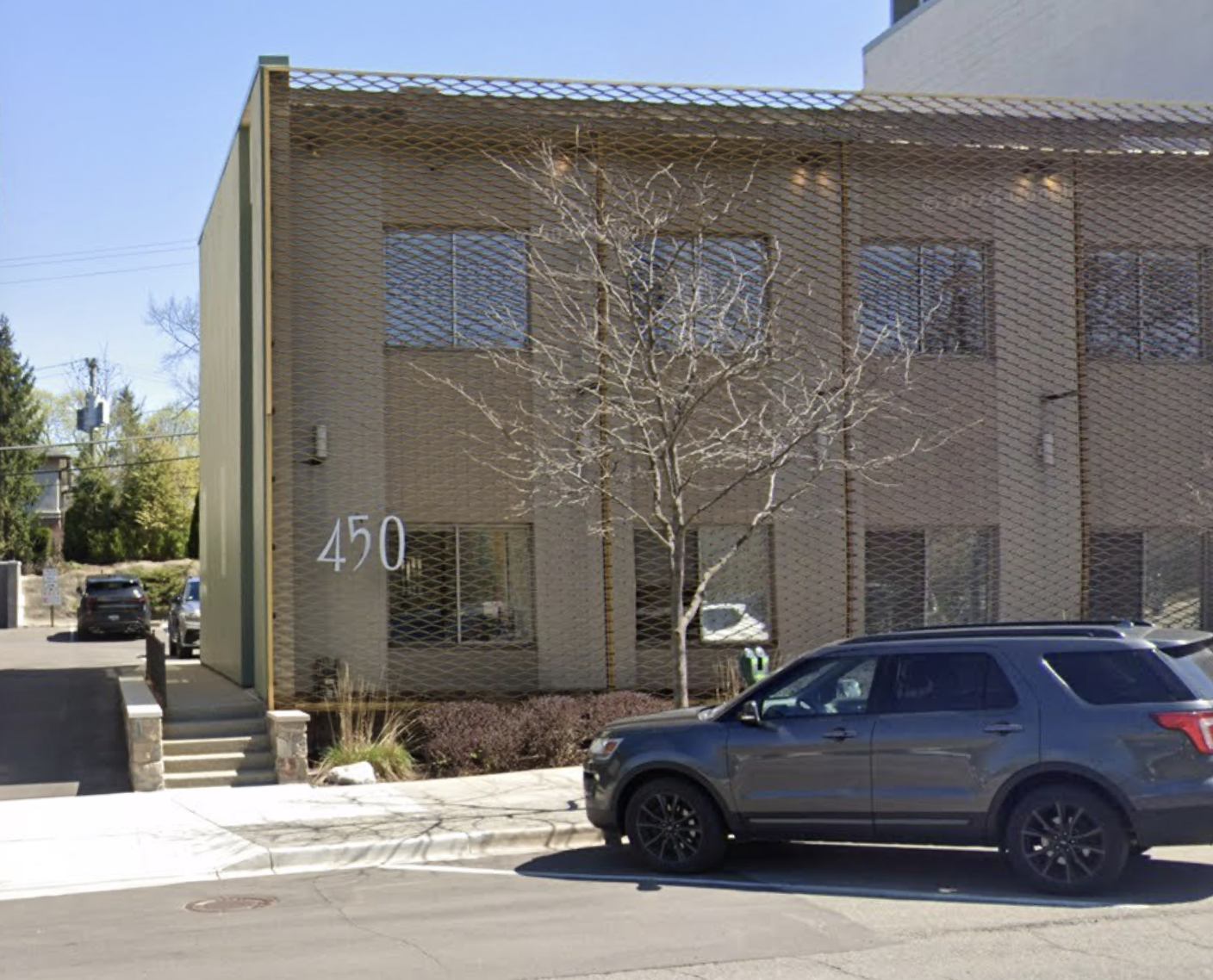
Also, to close a book because some may not like the rule of thirds placement of the 450 here, below is the actual building, from Google Maps street view. Yes, it is straight on, not here for critique, just a back story of how the 450 is probably not going to work centered (not much on the left side), or anywhere else in the image, and if straight on, the wavy metal artwork covering (and it IS in this image) is more of a moot point, to me anyway.
RWNPhoto wrote:
To be fair, RustyBug mentioned "Rule of Odds" on 3 occasions in his last post.
You claimed to never pushed for using rule of thirds.
Those are not the same. He is saying you like to "advise" having 1, 3, 5, etc things, instead of saying you saying a subject on the 1/3 lines/points.
Rusty and I have a failure to communicate and it goes back a few years.
There is more to art than numbers. I think when someone plays by the numbers their work looks like the work of others who also play by the numbers. My opinion. For someone learning to see, the numbers can be a starting place, at some point they should strike out on their own and make the images for themselves and not to please others. I assume that when someone posts in the critique forum they are not happy with the photo, so to me the critique forum is more of an idea forum, a place to stir the pot, because their is never any right or wrong, only different ways of seeing.
Kudos for seeing the image you shared. That building definitely lacks inspirational qualities. Having lived around Detroit in the past, I'm pretty sure I have seen this building, or at least its twin.
Thank you for sharing what it is and what you saw.
Kudos for seeing the image you shared. That building definitely lacks inspirational qualities. Having lived around Detroit in the past, I'm pretty sure I have seen this building, or at least its twin.
Thank you for sharing what it is and what you saw.
Best,
- Kk
+1
I think that seeing the "recorded" view of the scene ... it gives clear perspective that the OP had an INTENT that he had something he wanted to show us. Thus, the presentation of the OP image, complete with its various aspects of compositional elements, is available for us to visually digest.