p.3 #1 · Cosina Voigtländer APO-Lanthar 90/4 VM officially announced for August release
dan98 wrote:
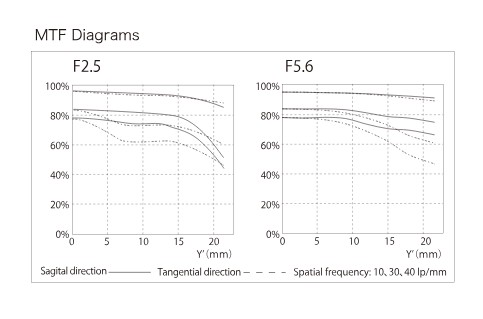
Those MTF curves resemble the performance of my Voigtlander SL 90/3.5 APO-Lanthar, specifically in terms of the pronounced mid-zone dip. I am not suggesting that the new 90/4 has the same optical design--it clearly does not--but based on the MTF curves it would seem to have the same primary flaw. If this proves to be true then it would be a disappointment. The 90/3.5 is by far the weakest of the SL APO-Lanthars and is quite an old design, so I would have expected the latest Voigtlander offering to avoid this issue.
The 90/3.5 is also the weakest of the series in terms of control of various aberrations (especially LoCA and purple fringing), and at least here I am confident that the new lens will offer improvements. I believe that the old 90/3.5 is the least APO of all of their APO-designated lenses. Based on the few sample images I have seen, the new 90 produces very little fringing. ...Show more →
To my knowledge, Cosina never published an official MTF chart for the original LTM (M39) 90mm f/3.5 APO-Lanthar from the early 2000s. I've tested this lens myself in the past and was also disappointed by its performance, especially wide open. It wasn't until f/6.3 or smaller that it matched other 85mm/90mm lenses, even ones that weren't APO-corrected at all. https://www.fredmiranda.com/forum/topic/1626686/
Having said that, I believe an MTF graph for the old 90mm f/3.5 APO-Lanthar (LTM) would show much worse performance. There's a lot of astigmatism with this lens, along with color error, so it's "APO" by the standards of another time.
I'm hopeful the new 90mm f/4 APO-Lanthar will perform similarly to the 50mm f/3.5 APO-Lanthar, which I consider outstanding based on my tests, regardless of what the graph says. It's on par with the 50mm f/2 APO-Lanthar at f/3.5, if you check the review. These are real-world tests, which is what matters most to us.
The lack of astigmatism is the key to that crisp off-axis performance, and I believe the new 90mm f/4 APO will deliver that too.
Jul 16, 2026 at 12:27 PM
Steve Spencer Offline • • • • • • • Upload & Sell: On
p.3 #2 · Cosina Voigtländer APO-Lanthar 90/4 VM officially announced for August release
dan98 wrote:
Those MTF curves resemble the performance of my Voigtlander SL 90/3.5 APO-Lanthar, specifically in terms of the pronounced mid-zone dip. I am not suggesting that the new 90/4 has the same optical design--it clearly does not--but based on the MTF curves it would seem to have the same primary flaw. If this proves to be true then it would be a disappointment. The 90/3.5 is by far the weakest of the SL APO-Lanthars and is quite an old design, so I would have expected the latest Voigtlander offering to avoid this issue.
The 90/3.5 is also the weakest of the series in terms of control of various aberrations (especially LoCA and purple fringing), and at least here I am confident that the new lens will offer improvements. I believe that the old 90/3.5 is the least APO of all of their APO-designated lenses. Based on the few sample images I have seen, the new 90 produces very little fringing. ...Show more →
Dan, I had the old 90 f/3.5 APO Lanthar and I totally agree with your assessment of it. It is one of the few Voigtlander lenses I have owned in which I was pretty disappointed. I noticed with my copy the same things you mentioned and I do believe it had a pretty substantial mid-zone dip.
That said, the MTF's of this 90 f/4 APO Lanthar do not show a mid zone dip. A mid zone dip is indicated by worse performance (i.e. lower percentage contrast) from 12-18mm from the center than you see in the center *and* than you see in the outer part of the frame (i.e. 18-22mm from the center). When there is a mid zone dip as the name implies performance doesn't just go down in the midfield it comes back up toward the corners.
A gradual decrease in performance from the center to the corners in not a mid-zone dip and that is what we see in the MTF curve for this new 90 f/4 APO Lanthar. This gradual decrease is a pattern that I find I typically associate with a lens that performs in ways I like. Like Fred alluded to the Voigtlander M mount 50 f/3.5 APO has this pattern too. As does the 110 f/2.5 and 65 f/2 APO Lanthar Macros for Sony E mount. As does the relatively new Voigtlander 28 f/2 APO Lanthar for M, E, and Z mounts. The pattern does suggest performance will be better in the center than in the edges and corners, but as long as the change is gradual and the performance at the edges and corners is good enough it is not a pattern that I think indicates a problem.
I totally agree with Fred, however, that the real way to evaluate this lens, and really every lens, is the sort of rigorous testing that Fred does in his reviewers. I would bet this lens is going to perform well in those tests, but of course we won't know until the tests are actually done. The few real world shots we have seen (From Juha at CP+) also seem to suggest strong performance from the lens, but his testing was necessarily limited by the venue and only a short time with the lens. It will be great to see how the lens performs when people have it for a lot longer and can thoroughly test it out.
p.3 #3 · Cosina Voigtländer APO-Lanthar 90/4 VM officially announced for August release
Fred Miranda wrote:
To my knowledge, Cosina never published an official MTF chart for the original LTM (M39) 90mm f/3.5 APO-Lanthar from the early 2000s. I've tested this lens myself in the past and was also disappointed by its performance, especially wide open. It wasn't until f/6.3 or smaller that it matched other 85mm/90mm lenses, even ones that weren't APO-corrected at all. https://www.fredmiranda.com/forum/topic/1626686/
Having said that, I believe an MTF graph for the old 90mm f/3.5 APO-Lanthar (LTM) would show much worse performance. There's a lot of astigmatism with this lens, along with color error, so it's "APO" by the standards of another time.
I'm hopeful the new 90mm f/4 APO-Lanthar will perform similarly to the 50mm f/3.5 APO-Lanthar, which I consider outstanding based on my tests, regardless of what the graph says. It's on par with the 50mm f/2 APO-Lanthar at f/3.5, if you check the review. These are real-world tests, which is what matters most to us.
The lack of astigmatism is the key to that crisp off-axis performance, and I believe the new 90mm f/4 APO will deliver that too....Show more →
There is an official MTF chart for the 90/3.5, and it can be found in the thread you linked above (p.1, #9). It is quite consistent with the performance that I have observed with the lens, showing the mid-frame dip.
In terms of sharpness, various tests and user reports of the 90/3.5 are all over the map. While to some extent this reflects variation among users, it also likely reflects sample variation. For example, Klaus at Photozone found that the SL version was significantly better than the LTM version that you tested (a point made in the thread you linked). Since the optics are supposedly the same, and since the testing methodology was the same, this is surely a sign of sample variation. With my copy the corners are very sharp (just a tiny bit worse than the center), but there is a mid zone that is soft. Others report soft corners. Of course it would not be the only CV lens to be plagued by sample variation. The one area where there seems to be a solid consensus is that the 90/3.5 is not really apochromatic; not by the standards of any era.
I hope that you are right about the new lens being sharp across the frame, although I am a tad skeptical based on the MTF graph. I agree that real-world tests are more important than MTF graphs, so it would be foolish to rush to judgment. I also agree that correction of aberrations is important, and it is all but certain that the new lens will be much improved in that regard.
p.3 #4 · Cosina Voigtländer APO-Lanthar 90/4 VM officially announced for August release
dan98 wrote:
There is an official MTF chart for the 90/3.5, and it can be found in the thread you linked above (p.1, #9). It is quite consistent with the performance that I have observed with the lens, showing the mid-frame dip.
I was referring to the M39 mount version. I believe the MTF chart shared in that thread (with no known source) is for the SL version and appears to be computer-generated rather than based on actual measurements, even though the optical design is the same. My guess is that it originated from Nikon rather than Cosina.
After shooting extensively with the LTM (M39) version, I simply don't trust that MTF chart. In my experience, it does not accurately represent my copy of this lens's real-world performance.
p.3 #5 · Cosina Voigtländer APO-Lanthar 90/4 VM officially announced for August release
Steve Spencer wrote:
Dan, I had the old 90 f/3.5 APO Lanthar and I totally agree with your assessment of it. It is one of the few Voigtlander lenses I have owned in which I was pretty disappointed. I noticed with my copy the same things you mentioned and I do believe it had a pretty substantial mid-zone dip.
That said, the MTF's of this 90 f/4 APO Lanthar do not show a mid zone dip. A mid zone dip is indicated by worse performance (i.e. lower percentage contrast) from 12-18mm from the center than you see in the center *and* than you see in the outer part of the frame (i.e. 18-22mm from the center). When there is a mid zone dip as the name implies performance doesn't just go down in the midfield it comes back up toward the corners.
A gradual decrease in performance from the center to the corners in not a mid-zone dip and that is what we see in the MTF curve for this new 90 f/4 APO Lanthar. ...
.......Show more →
While there is just a gradual decrease from the center to the corners at 10 lp/mm (which is not a mid-zone dip), there is a pronounced dip at 30 lp/mm and 40 lp/mm in the sagital direction. This is most pronounced at 30 lp/mm and f/5.6, where the value hits a trough at about 12-13mm, and then rises steadily as we move out to 18%, but only for the sagital. This is exactly the same pattern as the MTF curve for the 90/3.5 at f/3.5. In the sagital direction a trough occurs at 12-13%, with the value rising steadily as we move out to 18mm. With both lenses the dip in the MTF curve only occurs in the sagital direction. Regarding the magnitude of the dip, it is is slightly more pronounced with the new lens, although they are really quite similar. It is this similarity that has me concerned, but I agree that the real-world results are what matters.
p.3 #6 · Cosina Voigtländer APO-Lanthar 90/4 VM officially announced for August release
Fred Miranda wrote:
I was referring to the M39 mount version. I think that MTF shared on that thread is for the SL version and is computer generated rather than based on actual measurements, even though the optical design is the same. My guess is that it came from Nikon, not Cosina. After shooting extensively with the LTM (M39) version, I simply don't trust that MTF chart. In my experience, it does not accurately represent my copy of this lens's real-world performance.
I assume you mean that it does not reflect the real world performance of your copy of the lens. It matches up pretty well with my copy. Either there is sample variation or there are some unreported differences between the LTM and SL versions. My copy is sharp wide open in the center and near the edge of the frame, but that mid-zone dip spoils the party. It's not that the sharpness is terrible in mid zone, but the drop in relative sharpness is very annoying. And of course the LoCA and purple fringing are inexcusable.
p.3 #7 · Cosina Voigtländer APO-Lanthar 90/4 VM officially announced for August release
Steve Spencer wrote:
I'm not sure what you were expecting, .
given the uncritical focal length and the very modest aperture I expected the MTF curves to be quite flat, but they aren't;
especially since wide open they're not, I expected some improvement on stopping down, which there isn't.
p.3 #8 · Cosina Voigtländer APO-Lanthar 90/4 VM officially announced for August release
A host of design tradeoffs are involved here to deliver, among other things, reduced VF blockage, close focus, market considerations like RRP and size, weight. The best guide to the actual imaging to be expected comes from the 50/3.5 because it is quite recent (August 2024) and of a similar mix of glass types. Slow lenses of this class are designed to deliver the goods straight from wide open.
Glass development is proceeding apace in the background, which is why the recent Cosina offerings have a different look to their images, with improved color/contrast balance (my opinion). Slow lenses are associated with more settled imaging, I believe. As Zeiss has stated, most small scale fluctuations in MTF (esp. at 40lpmm) can be largely ignored because the test is an approximate technical guide and so many inputs can affect the results (mild curvature, residual color error, etc). You need image verification, always.
In terms of on-axis lens contrast, designers face the choice of providing flat cross-frames, or an elevated on-axis MTF followed by gradual fade into the corners. This gradation is what the most popular cine lenses do, as well.
The first model we see in Leica's 90/2 M-APO, Zeiss 100MP, APO-Telyt 135/3.4 etc.;
The second model is the more recently popular model of a very high center (80%) falling to around 60% in outer frames, exemplified by great lenses like APO-Lanthar 65/2, Batis 135/2.8, Otus 85/1.4, Milvus 135/2 etc.
The exceptions that give flat MTF at 40lpmm are very heavy and very expensive - Otus 100mm and the SL primes, not many of this ilk around in the short telephoto space.
Below see the MTF of their fine 14/12 macro, to see the regular pattern of cross-frame fade. Cosina engineers probably aim for 80% on-axis and they achieved that level here in the 90/4.
MTF for Voigtlander 110mm f2.5 macro (E-mount)
Jul 16, 2026 at 04:50 PM
Steve Spencer Offline • • • • • • • Upload & Sell: On
p.3 #9 · Cosina Voigtländer APO-Lanthar 90/4 VM officially announced for August release
dan98 wrote:
While there is just a gradual decrease from the center to the corners at 10 lp/mm (which is not a mid-zone dip), there is a pronounced dip at 30 lp/mm and 40 lp/mm in the sagital direction. This is most pronounced at 30 lp/mm and f/5.6, where the value hits a trough at about 12-13mm, and then rises steadily as we move out to 18%, but only for the sagital. This is exactly the same pattern as the MTF curve for the 90/3.5 at f/3.5. In the sagital direction a trough occurs at 12-13%, with the value rising steadily as we move out to 18mm. With both lenses the dip in the MTF curve only occurs in the sagital direction. Regarding the magnitude of the dip, it is is slightly more pronounced with the new lens, although they are really quite similar. It is this similarity that has me concerned, but I agree that the real-world results are what matters....Show more →
Where have you seen the MTF curves for the Voigtlander SL 90 f/3.5 APO Lanthar? Please provide a link I would love to see them.
I would not call what we see in the 90 f/4 APO MTF curves a dip. Yes, the values for 30 lp/mm and 40 lp/mm are slightly lower between 10 and 15mm from and rebound slightly at 17mm we are talking less than 5 percent contrast difference. In my view that is not relevant and I certainly wouldn't call this lower contrast a dip given the it is less than 5%. Many s
lenses (see the Leica 35 Summilux FLE here: https://leica-camera.com/sites/default/files/pm-56063-Summilux-M35-TechnicalData.pdf?srsltid=AfmBOorxAAH7mYdXcZL2fUkppJTvbjC2G93F9j50fjH_YjD1QxdoqCwK) have substantial drops and recovery. That Leica lens, which is not the worst Leica M lens--at f/5.6 loses 25% contrast between 8cm and 14cm from the center and then recovers 20%.contrast from 14mm to 19mm, and that mid zone dip is about twice as big at f/2.8.
Ultimately it is a matter of semantics, but I wouldn't call anything in the 5% contrast range as being field relevant, YMMV.
Edit:
I see now your reference to the MTF curve for the old 90 f/3.5 APO Lanthar in that other thread. I don't think we can use that MTF chart. Even the person who posted it did not know how it was computed and suspected that it wasn't measured but was theoretical. That is very different from the MTF Charts Voigtlander is publishing these days that seem to be measured performance.The tell is that the MTF curve in that old thread is implausibly high. If true they would suggest that old lens, that as we have discussed was not a great performer has an MTF curve substantially higher than the current MTF champs like the Leica L mount 90 f/2 APO. It makes the chart implausible as a representation of measured MTF. That MTF curve in that old thread is not at all consistent with my experience of that lens. It would suggest exceptional performance, when my experience was a lens that was quite mediocre.
Steve Spencer Offline • • • • • • • Upload & Sell: On
p.3 #10 · Cosina Voigtländer APO-Lanthar 90/4 VM officially announced for August release
Maximilian wrote:
given the uncritical focal length and the very modest aperture I expected the MTF curves to be quite flat, but they aren't;
especially since wide open they're not, I expected some improvement on stopping down, which there isn't.
There is some improvement on stopping down, but not a lot -- just over 5% at the edges and corners. As far as being flat, I won't reiterate what I said earlier, but I think flat is overrated. Gradual changes to my eyes looks fine as long as contrast doesn't drop too far, but of course YMMV.
p.3 #11 · Cosina Voigtländer APO-Lanthar 90/4 VM officially announced for August release
Steve Spencer wrote:
Where have you seen the MTF curves for the Voigtlander SL 90 f/3.5 APO Lanthar? Please provide a link I would love to see them.
I would not call what we see in the 90 f/4 APO MTF curves a dip. Yes, the values for 30 lp/mm and 40 lp/mm are slightly lower between 10 and 15mm from and rebound slightly at 17mm we are talking less than 5 percent contrast difference. In my view that is not relevant and I certainly wouldn't call this lower contrast a dip given the it is less than 5%. Many sense (see the Leica 35 Summilux FLE here: https://leica-camera.com/sites/default/files/pm-56063-Summilux-M35-TechnicalData.pdf?srsltid=AfmBOorxAAH7mYdXcZL2fUkppJTvbjC2G93F9j50fjH_YjD1QxdoqCwK) have substantial drops and recovery. That Leica lens, which is not the worst Leica M lens--at f/5.6 loses 25% contrast between 8cm and 14cm from the center and then recovers 20%.contrast from 14mm to 19mm, and that mid zone dip is about twice as big at f/2.8.
Ultimately it is a matter of semantics, but I wouldn't call anything in the 5% contrast range and being field relevant, YMMV....Show more →
As with the 90/4, the magnitude of the dip is not very large, and is only in the sagital direction. In my experience lenses with noticeable real-world mid-zone dips usually have some sort of corresponding dip in the MTF chart, even if sometimes the dip doesn't look like much in the chart. On the other hand, this doesn't work reliably in the other direction: not all lenses that exhibit dips in the charts show a dip in real world images. In general, I don't find MTF charts to be a very reliable predictor of real-world performance. The mid-zone dip I see in the MTF chart of the 90/4 might be something, or it might be nothing--or at least nothing that is photographically relevant. We will just have to wait and see.
p.3 #12 · Cosina Voigtländer APO-Lanthar 90/4 VM officially announced for August release
Steve Spencer wrote:
Edit:
I see now your reference to the MTF curve for the old 90 f/3.5 APO Lanthar in that other thread. I don't think we can use that MTF chart. Even the person who posted it did not know how it was computed and suspected that it wasn't measured but was theoretical. That is very different from the MTF Charts Voigtlander is publishing these days that seem to be measured performance.The tell is that the MTF curve in that old thread is implausibly high. If true they would suggest that old lens, that as we have discussed was not a great performer has an MTF curve substantially higher than the current MTF champs like the Leica L mount 90 f/2 APO. It makes the chart implausible as a representation of measured MTF. That MTF curve in that old thread is not at all consistent with my experience of that lens. It would suggest exceptional performance, when my experience was a lens that was quite mediocre....Show more →
Whether the MTF curve is theoretical or measured it still shows a dip. Different manufacturers use different methods to compute MTF, and these change over time, so you cannot reliably compare the MTF levels across manufacturers or across time. But that is not what I am doing. I am focusing on the basic shape of the curves, not the levels. Inflating (or deflating) the MTF numbers will not cause a dip to appear or disappear. The basic shape of the curve should not change.
You may be right, and the dip in the 90/4 MTF curves may not signal a meaningful dip in real world performance. We won't know until we see some real world images with detail across the frame.
Jul 16, 2026 at 05:47 PM
Steve Spencer Offline • • • • • • • Upload & Sell: On
p.3 #13 · Cosina Voigtländer APO-Lanthar 90/4 VM officially announced for August release
As with the 90/4, the magnitude of the dip is not very large, and is only in the sagital direction. In my experience lenses with noticeable real-world mid-zone dips usually have some sort of corresponding dip in the MTF chart, even if sometimes the dip doesn't look like much in the chart. On the other hand, this doesn't work reliably in the other direction: not all lenses that exhibit dips in the charts show a dip in real world images. In general, I don't find MTF charts to be a very reliable predictor of real-world performance. The mid-zone dip I see in the MTF chart of the 90/4 might be something, or it might be nothing--or at least nothing that is photographically relevant. We will just have to wait and see. ...Show more →
I agree we will have to wait to see when the lens is tested, and yes there are reasons (different performance at different focus distances-most MTF measurements at at infinity focus but not all, field curvature, etc.) that MTF curves don't always predict performance. Theoretical MTFs like that one in the old thread are notorious for glossing over weaknesses in lenses and in my view are more marketing than accurate information abut the lenses. So, although we can speculate now we won't really know until the testing is done. We won't have to wait too long now.
p.3 #14 · Cosina Voigtländer APO-Lanthar 90/4 VM officially announced for August release
I owned both the 90AA and 90/4 Macro-Elmar for quite a long period. Those are both high performing lenses but with some MTF differences.
To my eyes, 90AA images have a calm, settled feeling to them that are generally very 'transparent' in that the lens for the most part isn't injecting aberrations/character into images. IOW, a 'sterile' modern rendering (from a lens released in 1998).
The 90/4 I found to be sharp but sometimes fine details could feel a little unsettled. It's difficult to describe and really put a finger on what the cause for this could be. But I suspect it's at least somewhat related to how tangential and sagittal performance diverges off-axis, whereas that's generally not the case with the 90AA (stopped down a little).
The VM 90/4 looks to be closer to the 90AA's characteristics.
Here's a roughly rule of thirds crop from one of Juha's 90/4 photos that shows focus transition and how the OOF area remains very neutral. This suggests to me that the MTF divergence in the mid zone area likely won't have significant character/rendering implications.
I think with greater MTF divergence you'd see a more edgy bokeh in the OOF text that would 'smear' in one direction or the other.
One caveat about the example above is that it was shot at near distance and lens performance can vary depending on the focus distance. It's possible the lens's MTF improves or changes for the better at nearer distances.
p.3 #15 · Cosina Voigtländer APO-Lanthar 90/4 VM officially announced for August release
For me this lens impressed with great sharpness on the focus plane + surprisingly narrow plane of focus (even though it's f4), and nice fall-of in the out-of-focus areas in relatively close distance shooting when I tried it out at CP+. I didn't try it much at all at longer distances yet since the CP+ hall was not really suitable environment for long distance shooting, but I'm confident it will also be performing very nicely there, even when adapted on Sony.
I've previously owned CV 90/3.5 LTM and 90/2.8 Apo-Skopar and neither of those lenses had a similar impact. I liked Apo-Skopar well enough, but I decided to trade it away since I also have Sigma 90/2.8 natively in E-mount and it can focus closer (0.5m). Sigma is not an MF lens though and it has a non-linear focus-by-wire implementation (unchangeable to linear in E-mount version).
Currently my 90mm lens collection includes Sigma 90/2.8 DG DN, Sony 90/2.8 G Macro, Minolta M-Rokkor 90/4, Konica M-Hexanon 90/2.8 and Topcor 90/3.5 LTM (1955 release). I feel like there's room for this 90/4 Apo-Lanthar as it would be a smaller option with high IQ and sufficiently different from the Sigma. I'm not using any of the 3 adapted oldies very much these days, and the Macro gets use mostly only for very occasional product shots. Overall 90mm is not my go-to focal length but I think this 90/4 could become a personal favorite. I also used to have Apo-Lanthar 110/2.5 which I traded away since it's quite big/heavy and since I didn't utilize its macro capabilities that much. This could also be a nice substitute for that lens for my purposes.
I wonder if Cosina will decide to release this fairly early in August (before Obon holiday week), or in late August. If lucky, they might release it already on 7th.
p.3 #16 · Cosina Voigtländer APO-Lanthar 90/4 VM officially announced for August release
rscheffler wrote:
I owned both the 90AA and 90/4 Macro-Elmar for quite a long period. Those are both high performing lenses but with some MTF differences.
To my eyes, 90AA images have a calm, settled feeling to them that are generally very 'transparent' in that the lens for the most part isn't injecting aberrations/character into images. IOW, a 'sterile' modern rendering (from a lens released in 1998).
The 90/4 I found to be sharp but sometimes fine details could feel a little unsettled. It's difficult to describe and really put a finger on what the cause for this could be. But I suspect it's at least somewhat related to how tangential and sagittal performance diverges off-axis, whereas that's generally not the case with the 90AA (stopped down a little).
The VM 90/4 looks to be closer to the 90AA's characteristics.
Here's a roughly rule of thirds crop from one of Juha's 90/4 photos that shows focus transition and how the OOF area remains very neutral. This suggests to me that the MTF divergence in the mid zone area likely won't have significant character/rendering implications.
I think with greater MTF divergence you'd see a more edgy bokeh in the OOF text that would 'smear' in one direction or the other.
One caveat about the example above is that it was shot at near distance and lens performance can vary depending on the focus distance. It's possible the lens's MTF improves or changes for the better at nearer distances. ...Show more →
Yes, great point, at this distance it's hard to really evaluate focus transition, since the blur masks it to some degree. We can only properly analyze rendering and focus transition with a bit more distance, especially on a tele lens. I think MTF doesn't say much about rendering either, it's really more about characteristics like resolution, contrast, astigmatism, and field curvature.
p.3 #17 · Cosina Voigtländer APO-Lanthar 90/4 VM officially announced for August release
Juha Kannisto wrote:
For me this lens impressed with great sharpness on the focus plane + surprisingly narrow plane of focus (even though it's f4), and nice fall-of in the out-of-focus areas in relatively close distance shooting when I tried it out at CP+. I didn't try it much at all at longer distances yet since the CP+ hall was not really suitable environment for long distance shooting, but I'm confident it will also be performing very nicely there, even when adapted on Sony.
I've previously owned CV 90/3.5 LTM and 90/2.8 Apo-Skopar and neither of those lenses had a similar impact. I liked Apo-Skopar well enough, but I decided to trade it away since I also have Sigma 90/2.8 natively in E-mount and it can focus closer (0.5m). Sigma is not an MF lens though and it has a non-linear focus-by-wire implementation (unchangeable to linear in E-mount version).
Currently my 90mm lens collection includes Sigma 90/2.8 DG DN, Sony 90/2.8 G Macro, Minolta M-Rokkor 90/4, Konica M-Hexanon 90/2.8 and Topcor 90/3.5 LTM (1955 release). I feel like there's room for this 90/4 Apo-Lanthar as it would be a smaller option with high IQ and sufficiently different from the Sigma. I'm not using any of the 3 adapted oldies very much these days, and the Macro gets use mostly only for very occasional product shots. Overall 90mm is not my go-to focal length but I think this 90/4 could become a personal favorite. I also used to have Apo-Lanthar 110/2.5 which I traded away since it's quite big/heavy and since I didn't utilize its macro capabilities that much. This could also be a nice substitute for that lens for my purposes.
I wonder if Cosina will decide to release this fairly early in August (before Obon holiday week), or in late August. If lucky, they might release it already on 7th....Show more →
I'm very interested to see how the CV 90mm f/4 APO-Lanthar compares to the CV 90mm f/2 APO-Ultron. Both are APO lenses, but with different design priorities. I'd especially love to compare them at f/4 and f/5.6. I expect the APO-Ultron to perform better, particularly since it would be stopped down two stops from wide open.
I am not too concerned about the MTF graph. In fact, I don't even include MTF charts in my reviews because, to me, what really matters is real-world performance, which I will show at the pixel level. Take the CV 65mm f/2 and 110mm f/2.5 APO-Lanthars, for example. Their MTF charts suggest a noticeable drop-off away from the center, yet in practice both lenses are superbly sharp from the center all the way to the extreme corners of the frame.
p.3 #18 · Cosina Voigtländer APO-Lanthar 90/4 VM officially announced for August release
I don't understand MTF curves and I don't care. I really like the Apo Skopar 90mm 2.8, but compared to the Lanthar 50mm 3.5 it loses a bit. Lanthar 50mm f3.5 completely changed my perception of lenses. I no longer desire fast lenses with an aperture of f1.2 or lower. The Lanthar excels in the smooth transition from sharpness to bokeh. Amazing colors. I expect similar performance from Lanthar 90mm f4. Compact dimensions and 0.5m minimum focusing distance are other strong arguments. Cosina, now suggest another compact Lanthar to the line. Ideally 35mm .
Jul 17, 2026 at 01:41 PM
Steve Spencer Offline • • • • • • • Upload & Sell: On
p.3 #19 · Cosina Voigtländer APO-Lanthar 90/4 VM officially announced for August release
If people haven't looked at a lot of MTF charts, a good place to start in this page from the Lens Rentals blog:
come very close in almost all cases to the MTF charts Zeiss provides. That is important because Cosina made all those Zeiss lenses in the same factory that they make the Voigtlander lenses, and as the Zeiss lens' MTF provided by Zeiss are claimed to be actual lenses tested in the factory, the Voigtlander lenses may well be similarly tested.
If you look at those Zeiss lenses and all the Sony FE lenses they tested reported on this page:
How many of the 36 lenses tested had a smaller drop from their center performance to their outer performance? The answer is 3 and it is notable what these three lenses are: the ZEISS Milvus 35 f/1.4, the Zeiss 100 f/2 Makro, and the Zeiss Otus 28 f/1.4. All are very large and expensive lenses. None of the 22 Sony FE mount lenses tested at that point had less of a drop of center to edge performance.
You might ask what lens' MTF charts look most like the one Voigtlander posted for the 90 f/4 APO Lanthar? Check it out but it is the Sony FE 135 f/2, the Zeiss Batis 135 f/2.8 APO, the Zeiss Otus 85 f/1.4 (although it has a larger mid zone dip), and the Zeiss 85 f/2.4 Loxia (although the Voigtlander is a bit higher performance everywhere). That is some pretty good company for this new lens to keep.
p.3 #20 · Cosina Voigtländer APO-Lanthar 90/4 VM officially announced for August release
Plzenaak wrote:
I don't understand MTF curves and I don't care. I really like the Apo Skopar 90mm 2.8, but compared to the Lanthar 50mm 3.5 it loses a bit. Lanthar 50mm f3.5 completely changed my perception of lenses. I no longer desire fast lenses with an aperture of f1.2 or lower. The Lanthar excels in the smooth transition from sharpness to bokeh. Amazing colors. I expect similar performance from Lanthar 90mm f4. Compact dimensions and 0.5m minimum focusing distance are other strong arguments. Cosina, now suggest another compact Lanthar to the line. Ideally 35mm .
The current Voigtlander 35mm f/3.5 Color-Skopar isn't marketed as an APO lens, yet I couldn’t find any trace of chromatic aberration during my review. So, if excellent color correction is a priority and you don't mind a slower lens, it's an outstanding option. Not only does it deliver excellent performance wide open, but it’s also one of the smallest 35mm lenses ever made. At just 14mm in length, this lens is exceptionally compact, even shorter than the ultra-compact Voigtlander 40mm f/2.8 Heliar and a full 4mm shorter than the tiny Leica 28mm f/5.6 Summaron.