I stopped bothering with the Canon app when it started asking me to create an account to use it...
Often when I'm using my 'real' cameras I'm also taking at least some photos with my phone, which tags photos with GPS coordinates. Later, I'll sync those coordinates manually to the real camera files and fill in the gaps as needed. But yes, it would be nice to have on-camera GPS in more cameras other than just the top one or two models.
Jeff Nolten wrote:
I just have to say that using my iPhone and Camera Connect App for GPS has been very reliable these last few years. It used to drop out regularly but now it easily connects to my Rs and G1X3 without problem. Just remember to put the camera in airplane mode when you put it away after a trip or the battery will drain over a month or two.
INPUT EB-1´s first sentence here. I´m a stubborn old fart still on a dumb-phone and apps are the problems of others. Should have gathered more GP-E2 mushrooms while they grew. Who would have thought that tech would evolve backwards.
Jeff Nolten wrote:
I just have to say that using my iPhone and Camera Connect App for GPS has been very reliable these last few years. It used to drop out regularly but now it easily connects to my Rs and G1X3 without problem. Just remember to put the camera in airplane mode when you put it away after a trip or the battery will drain over a month or two.
Maybe it's good on Apple, but the Android version was abysmal last year in September when I used it. I don't understand why the camera cannot employ some heartbeat checking and simply open big red text that GPS position updates had dropped out.
In many cases I had no GPS position at all, or one from morning stuck to all afternoon photos in a completely different location. And few maybe protocol bugs, showing my position once 10km and twice over 800km north (always direct north!) from the place I shot the pictures.
I just bought additional two second hand GP-E2s for one I lost.
Sorry for all your woes! I used to rely on my GP-E2 as well but the app is much more convenient since I always have it with me anyway. I recently learned that the app will update the camera's time and time zone as well. Something I always forget to do and then try to fix in post. Recent iPhones take pretty good images too if you use Adobe's Indigo app. Oh, sorry - another app.
GP-E2 can also update time. Personally I'd prefer the app if it worked well, even though it would have meant an increased battery consumption, since it would leave the hot shoe free and a mobile phone can in some cases use an additional positional info to nail the geographical position better... But GP-E2 seems to be more reliable so far, so it still wins...
It would be nice if Canon at least made a new small version to draw power from the new hot shoe, in the ST-E10 style.
MintMar wrote:
It would be nice if Canon at least made a new small version to draw power from the new hot shoe, in the ST-E10 style.
That might have some use, but would probably only work for one camera. If it had a rechargeable battery that allowed it to work off camera and record tracks I'd be interested.
EB-1 wrote:
That might have some use, but would probably only work for one camera. If it had a rechargeable battery that allowed it to work off camera and record tracks I'd be interested.
EBH
Ummm, you're right, I forgot about this feature, although in case of built-in GPS modules you can't take them off camera either. I primarily thought of size reduction, GP-E2 isn't particularly small, it's size is dictated at least partially by the AA battery.
---------------------------------------------
Jeff Nolten wrote:
It also indicates the direction of the photo which the iPhone can't.
I think this is camera dependent. So a GP-E2 will show you direction on 1D-X cameras, but not e.g. on Rebels, or on my R6/2. The "internal GP-E2" in 6D doesn't show the direction either.
That AA is quite annoying as you have to carry a small charger all over the world for longer trips.
It does make the GP-E2 viable practically forever. I have some Garamins trail GPS like 15 YO that still work since they use AAs.
The best analysis on the subject comes from Fstoppers. The period 2013-2018 were the Rip van Winkle years for Canon and Nikon management.
'In the autumn of 2013, if you walked into any professional photography studio, sporting event, or wedding venue, you'd see a sea of black cameras with red rings and gold badges.
Canon's 5D Mark III and Nikon's D800 weren't just cameras, they were symbols of serious photography. Their size, their weight, their distinctive mirror slap, these were the sounds and feels of professional work. The camera industry had a natural order, and everyone knew their place in it.'
'Then Sony dropped a bomb. It would take five years for Canon and Nikon to realize they weren't watching a cute experiment. They were watching their entire business model become obsolete.
By the time they scrambled to respond in 2018, Sony had built a commanding early lead that reshaped the market (one Canon and Nikon are only now beginning to reclaim). This is the story of how two of the most dominant companies in photography slept through a revolution happening right in front of them.'
Sony is the everyman's champion. Canon had provided 100% OVFs in pro cameras since 2002, but Sony included this fundamental feature in its a900 six years later, in 2008 - the first to bring a true 100% optical pentaprism viewfinder to the more accessible high-resolution, non-flagship full-frame market.
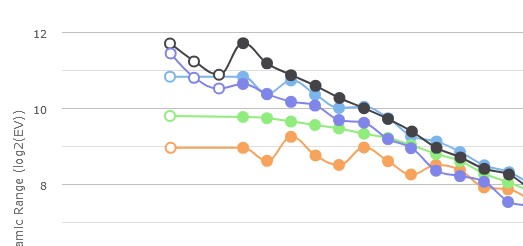
Sony's first general release mirrorless camera, the a7r, gave its users a full 30% more dynamic range than Canon's contemporaneous 5DIII, almost three stops extra. Below, the chart shows the huge divergence of DR as follows:
black - Sony a7r
blue - Canon 5DIV
purple - Sony a99v (SLT)
green - Canon 5DS R
orange - Canon 5DIII
The diminutive a7r weighed 465 grams, the Canon 5DIII was 950 grams. It changed everything for so many photographers, and the trend towards miniaturisation continues today. A travel photographer could carry three bodies in place of two DSLRs, one example among many.
I've gone into some detail here because the years are passing by and new entrants will not know the history. So we have this story as a 'Young Person's Guide to the Birth of Mirrorless Photography', because very few know it, and even fewer want to talk about it.
PDR for selected Sony and Canon cameras : ISO 1600 to base ISO
MintMar wrote:
I think this is camera dependent. So a GP-E2 will show you direction on 1D-X cameras, but not e.g. on Rebels, or on my R6/2. The "internal GP-E2" in 6D doesn't show the direction either.
philip_pj wrote:
Sony is the everyman's champion. Canon had provided 100% OVFs in pro cameras since 2002, but Sony included this fundamental feature in its a900 six years later, in 2008 - the first to bring a true 100% optical pentaprism viewfinder to the more accessible high-resolution, non-flagship full-frame market.
Sony's first general release mirrorless camera, the a7r, gave its users a full 30% more dynamic range than Canon's contemporaneous 5DIII, almost three stops extra. Below, the chart shows the huge divergence of DR as follows:
black - Sony a7r
blue - Canon 5DIV
purple - Sony a99v (SLT)
green - Canon 5DS R
orange - Canon 5DIII
The diminutive a7r weighed 465 grams, the Canon 5DIII was 950 grams. It changed everything for so many photographers, and the trend towards miniaturisation continues today. A travel photographer could carry three bodies in place of two DSLRs, one example among many.
I've gone into some detail here because the years are passing by and new entrants will not know the history. So we have this story as a 'Young Person's Guide to the Birth of Mirrorless Photography', because very few know it, and even fewer want to talk about it. ...Show more →
As a victim of the a7R I have experience with it being a rather crappy camera if you wanted performance or to capture action. Maybe the sensor was good for wideangle or some teles in backlight and relatively static conditions, but the Sony lens lineup was lame back in 2013-2015 when it was original so adapted lenses were commonly used. Regardless of adapter the sensor shake was terrible at slow shutter speeds typically used for landscapes at low ISO. So I could not get much useful of it for tele landscapes or tele action. And it had such tiny batteries that you could go through 4-5 of them in a long day. By June 15th 2015, the 5DsR was here and no need for the slow Sony or shaky adapted lenses for Canon users. The Sony users often trolled the Canon forums showing images shot into the sun or something. It was a weird kind of mental thing that I thought was in the past.
I was handed an a7R by my friend working at Sony over the Christmas holidays of 2013. I went out and shot the aftermath of an ice storm with it and my Leica M9. The Sony's battery died pretty quickly due to the cold (I'd only been given one). Ironically, the M9 kept working even though it used tiny batteries and was a power hog. It had the tendency to suddenly quit in the cold. But it didn't. I mean, I got nice photos with the a7R while it lasted, but it wasn't fun to work with in the cold with gloves and the crammed UI. I kept pressing buttons on the rear D-pad whenever I rotated the dial around it and ended up diving into random menus and accidentally changing settings. Very annoying! Also annoying were the animations that appeared when changing settings like shutter speed and aperture, IIRC. Sooo distracting and laggy. Just slowed things down and got in the way. I don't like being distracted by the camera while trying to concentrate on what's in front of it.
Hey, we all know that Canon's sensors lagged Sony's for DR in the early 2010s and it wasn't really until ~2016 with cameras like the 1DXII and 5DIV that they narrowed the gap. But during that time, cameras like the 1DX and 5DIII just worked and weren't annoying to use, if you actually needed to do something relatively quickly. Or had a moving subject. Surprisingly, there are photographers, like me, who don't put dynamic range in first position on the list of must-have priorities for a camera. It wasn't the case for me in 2013 and it isn't the case for me today. It's nice to have, but the camera, and system on the whole, has to meet other performance standards first.
I’ve shot a lot of mirrorless gear and overall do think they are superior cameras in most ways. And I’ve shot cameras with 8 stops of DR and cameras with 12. But I have also found that once you reach a certain threshold with DR (in the 9-10 stop range), the tonality looks incredible and any extra is just a bonus for tough lighting situations but even then if you do your job even in those tough situations you’ll get incredible images. At that point it’s just about what you want to use.
I feel your pain. I let go my 5D III and IV, plus the EF lenses, to get the R5 and R6 III, the 28-70mm f/2, 24-105mm f/4, plus the 35mm and 50mm 1.8. The kit I've lusted over for years (as a Sony shooter). Now I'm selling off all of it and wishing I had kept my 5D III and EF lenses. Sharp, rich colors, great images, and tank-like gear I didn't have to baby. Plus, whenever I wanted to add to that collection it was super affordable.
When I sell off all the Canon gear I'll end up with a 5D iii again.
What possible advantage did the 5D III have over the 5D IV for you? I have two 5D III and one 5DIV plus rented about 6-8 additional 5D IVs, so I used them quite a lot.
I would have suggested renting RF first, but it is too late now.
He mentioned the colors. I can understand where he's coming from because I had lengthy discussions about this with the guy I shot weddings for ~10 years ago. At the time, he had the 5DIII and really liked the final image quality (colors) from it. But he didn't like how slow it was. So he added a 1DX. That was fine because it was a similar sensor generation with similar color/tonality qualities. I also shot with a 1DX. In 2016 we both upgraded to the 1DXII. He also added a 5DIV as a more discrete option for certain wedding situations. Both of those cameras had 'next generation' sensors relative to the 5DIII/1DX. More DR, but the additional tonality meant a different color response and the need to tweak post production workflows to regain what was pretty easy to achieve with the 5DIII/1DX.
I can appreciate why someone may be nostalgic about these cameras, but for me, there's no way I would return to DSLRs. AF is one major reason, but just being able to review images in the viewfinder is a MASSIVE advantage over DSLRs since the onset of presbyopia strong enough to make image review from the rear screen uncomfortable without glasses. ~20 years ago I remember older colleagues flipping reading glasses on/off when reviewing images during their shoots and I am trying to hold off the need to do the same now myself.
I don't recall anything special about the 5D III color, but I tended to the use the 1Ds III at low ISO back then.
The 1DX was better for retaining a level of decent color quality at higher ISOs than the other old-school Canons prior to the 2016 sensors.
I had never considered the EVF for viewing settings, but I was able to eliminate the readers for constantly checking sharpness on the rear LCD.


 Should have gathered more GP-E2 mushrooms while they grew. Who would have thought that tech would evolve backwards.