johnvanr wrote:
Yep, but the difference in shape is what makes the XT5 'large' and keeps the XE5 'small.'
I have the XE5 but I'm selling it, since I don't see the point of having Fuji APSc when I already have MFT and FF. I do like the film simulations and especially bracketing them, but in reality I never end up printing those versions and just start from scratch in Lightroom anyway from the RAW file.
I can’t address your thoughts about the value of having a APS-C camera. (I do have a APS-C system and a FF system, for reasons…)
About size: I had the XPro2 before I had the XT5. By some measurements the XPro is smaller than the XT5 — the XT5 “bump” makes it taller and the more substantial key piece (along with the moveable rear screen) make it thicker. But in the hand the XT5 feels smaller and tighter to me.
There’s matter of comfort for long bouts of shooting, too. I have used both XE and XPro bodies (and briefly a X100 series body), and their squared off shape, while small, is not comfortable for lengthy shooting. (In my case, for street I carry the camera, typically with a small prime, in my hand with a wrist strap attached, sometimes for hours at a time.) I actually get numb finders and hand cramps with the XE and XPro bodies, but I have far less of an issue with that using the XT5.
If you are more of a “pull that camera out of the bag to shoot it” photographer, that probably isn’t as big of a deal as if you are a “camera is always out and ready to shoot” photographer.
While the XE is the “smallest” here, the XT5 is still quite small, especially when outfitted with a pancake prime.
joychris wrote:
I don't use BBAF because its a clunky and outdated method of focusing on Sony's AI bodies, and most of the time I don't even use the joystick - I take advantage of the AI capabilities. I use the expand flexible box with lock on activated by a back button stab to engage tracking on whatever I put the focus box on. I also have tap to track on the LCD. Point, hit the button or tap the screen, and fire away at will. It tracks everything until you disengage or plant the focus box on something else and hit the button again. It's really amazing. Accuracy is almost perfect, and more importantly in video the tracking is just unbeatable. It's so sticky, makes it painless to chase a small child or kingfishers zooming around. I've owned the R5II and rented a XH2s to see if the other's are close - they aren't. Neither is my Nikon.
But that's ok since I already have those bases covered.
The XPro4 rumors have been around for years, and given Fuji's current prices it'll probably be well over $2000 and hard to find since they don't have the foresight to slow production of the other 428 bodies they sell in order to ramp up production of anything before releasing creating artificial shortages. I may have exaggerated the number of X Mount bodies by 5 or 6 though !
The XE5 seems to fit the bill nicely. Again appreciate the time.
Well Chris I like my focusing method, been using it with my first DSLR since 2001 and with film bodies long before that since my first AF camera in the early 80's.
Not interested in AI anything, AI to me means Artificial IDIOT, probably a result of watching too many SciFi flicks where the robots took over and tried to kill everyone. Even touch screens are turned off on my cameras..... OK, I am set in my ways, I want to be in full control of my photos, but have never been called Clunky and Outdated before, not even by my 1 generation younger, beautiful Thai wife….ha ha. Suppose you like self-drive cars too... me I will keep my 4WD off-road Jeep for backcountry travel and 6 speed manual shift Boxster for roadside fun, for as long as I can. To each their own...
Actually tried the A7CR tracking method, but I found is a bit slow and not always focusing on what I wanted, and with no joystick it was ineffective for me at times. OK, you can press the center button on the 4-way pad and then hit the outer rings to move the focus, but what a time delay and PITA, just give us a joystick next to the af-on button instead Sony.
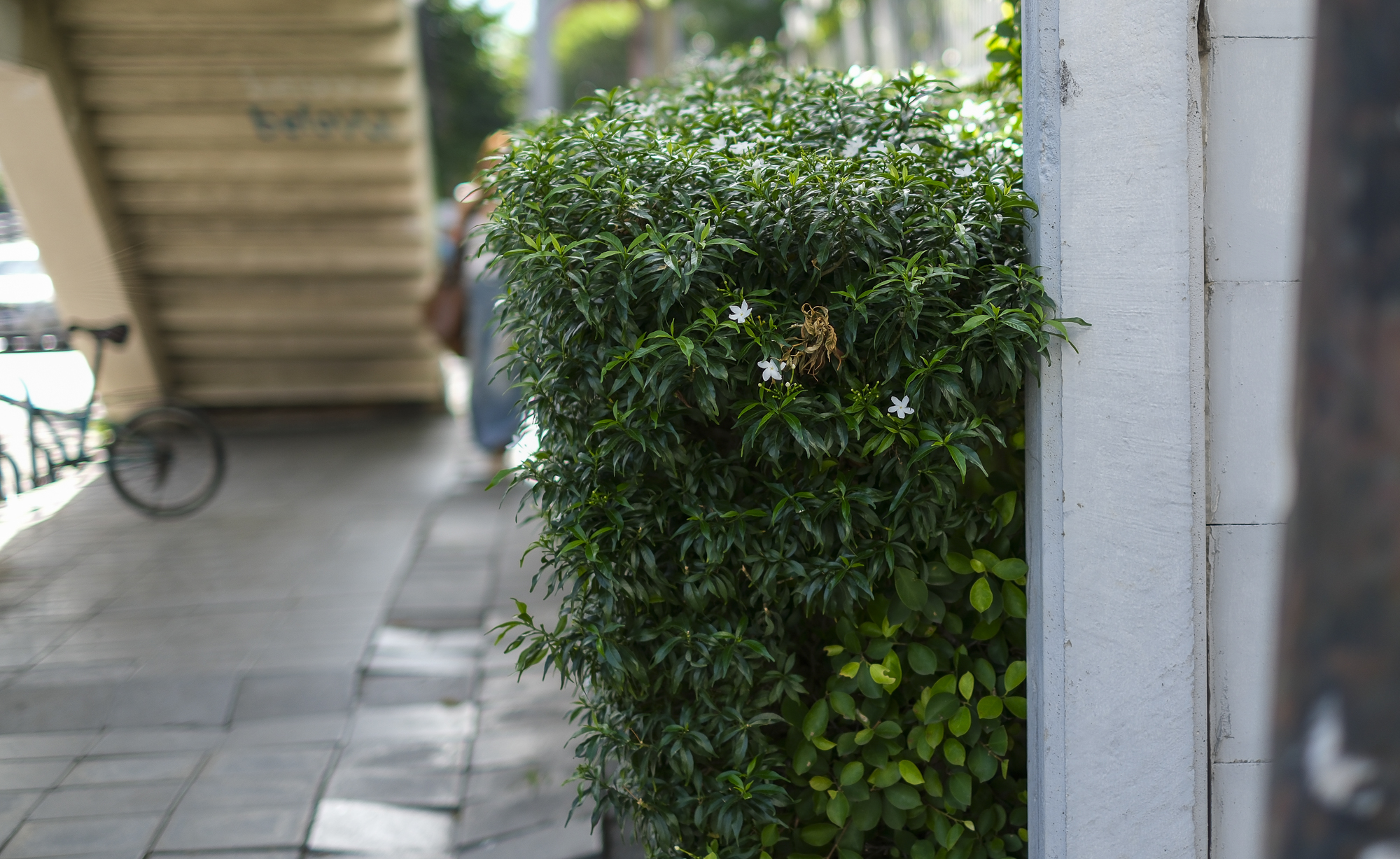
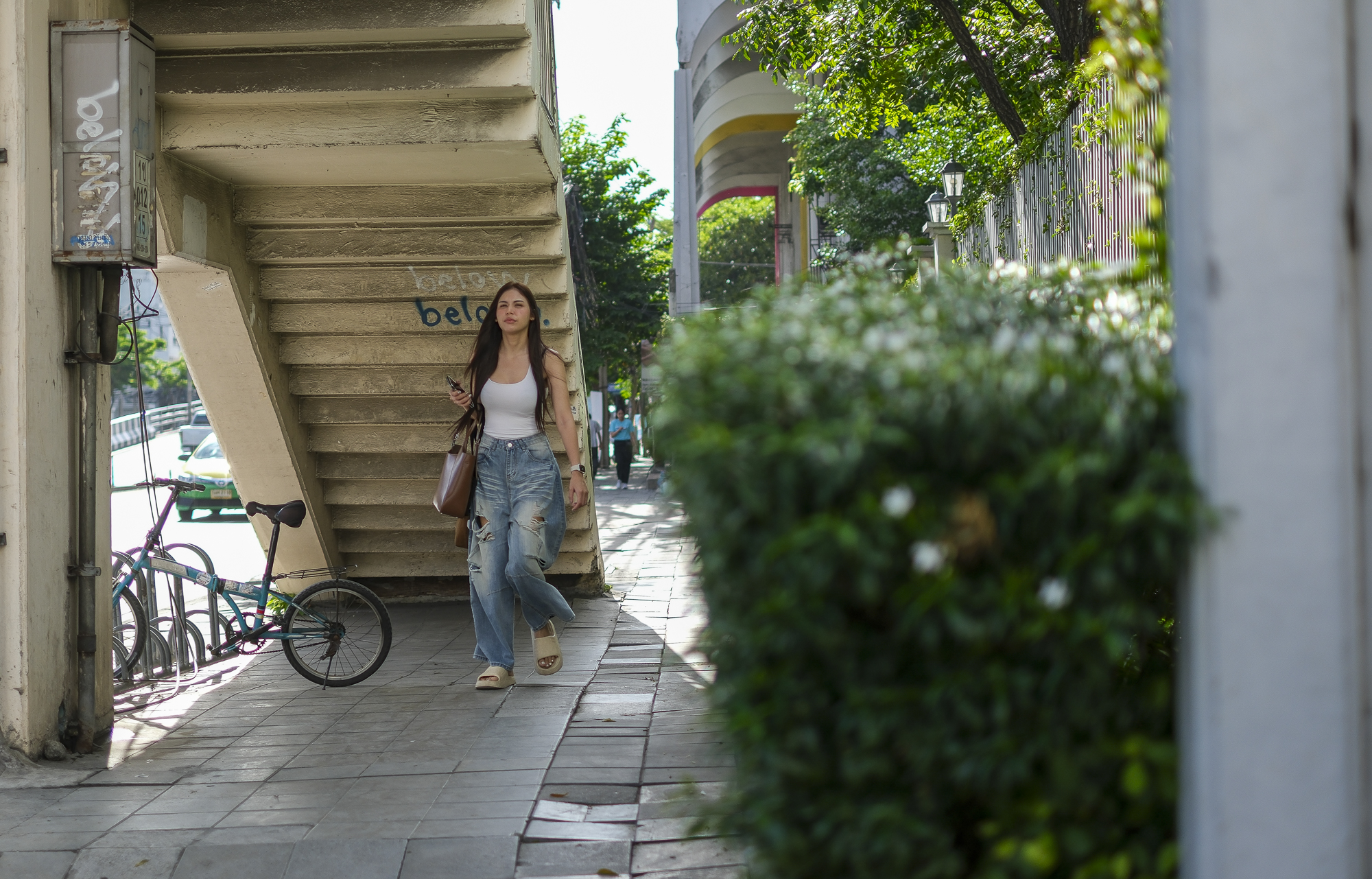
Below is a 2 shot sequence, 1 second apart, I took 2 days ago that I captured because by moving the XT5 joystick it was possible to quickly grab AF in a moving situation. Was focusing on the long row of tiny flowers up close with my XF 35 f1.4 lens (the classic, slow focusing one ) when she walked into the distant view, I panned the camera while moving the AF point to 30 feet away, got the shot and went back to shooting the flowers without her ever knowing. My A7CR most likely yes, but my XE5 with no joystick or 4-way pad it's highly unlikely it would have got this in focus in the time allotted, imho. Just saying the XT5 works better for me then you give it credit for, with really no downsides.
X-T5XF35mmF1.4 R lens35mmf/1.61/1500s125 ISO0.0 EV
X-T5XF35mmF1.4 R lens35mmf/1.61/2400s125 ISO0.0 EV
gdanmitchell wrote:
I can’t address your thoughts about the value of having a APS-C camera. (I do have a APS-C system and a FF system, for reasons…)
About size: I had the XPro2 before I had the XT5. By some measurements the XPro is smaller than the XT5 — the XT5 “bump” makes it taller and the more substantial key piece (along with the moveable rear screen) make it thicker. But in the hand the XT5 feels smaller and tighter to me.
There’s matter of comfort for long bouts of shooting, too. I have used both XE and XPro bodies (and briefly a X100 series body), and their squared off shape, while small, is not comfortable for lengthy shooting. (In my case, for street I carry the camera, typically with a small prime, in my hand with a wrist strap attached, sometimes for hours at a time.) I actually get numb finders and hand cramps with the XE and XPro bodies, but I have far less of an issue with that using the XT5.
If you are more of a “pull that camera out of the bag to shoot it” photographer, that probably isn’t as big of a deal as if you are a “camera is always out and ready to shoot” photographer.
While the XE is the “smallest” here, the XT5 is still quite small, especially when outfitted with a pancake prime.
- what APSc seems to do for you, MFT does for me.
- other than the GFX cameras, I have never found a Fuji body comfortable without a grip, be it the XT, the X-pro, the X100 or the XE lines. I assume the XH cameras would be fine, but never tried those.
- I find the X-pro cameras very large and bulky for what they are and offer; hence, I’m not a fan at all;
- I generally don’t carry a bag at all when I’m out shooting, so I’m very much a guy with one or two cameras over my shoulders ready to go
I do like the X-E5 actually (with a grip) but the only reason to keep it over MFT as my small system would be the resolution. But then I may as well stick with my Leica M11, which has even more MP and is also small. And I’m selling that and ‘replacing’ it with the Canon R8, which is resolution-wise close to my MFT cameras.
gdanmitchell wrote:
There’s matter of comfort for long bouts of shooting, too. I have used both XE and XPro bodies (and briefly a X100 series body), and their squared off shape, while small, is not comfortable for lengthy shooting. (In my case, for street I carry the camera, typically with a small prime, in my hand with a wrist strap attached, sometimes for hours at a time.) I actually get numb finders and hand cramps with the XE and XPro bodies, but I have far less of an issue with that using the XT5.
YMMV.
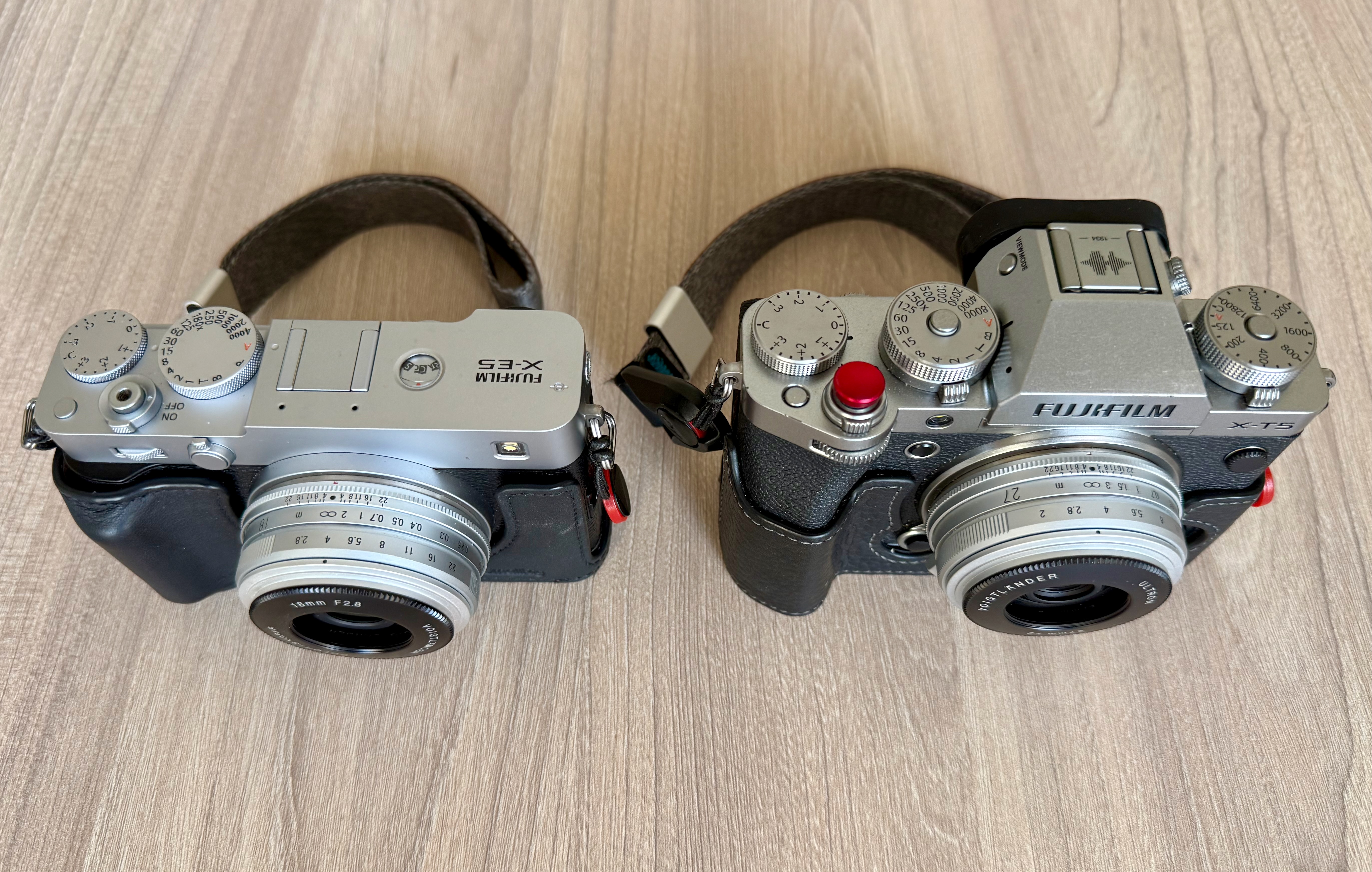
Dan, I use a PD wrist strap on almost all my camera bodies, including the XE5 and XT5. To make them both more comfortable I added a SmallRig 1/2 Leather case to both, see below. The grip has a full bottom with tripod threaded receptor, access doors for the bottom and side slots, plus a partial grip improvement for both bodies-more so for the XE5. All works well with no issues so far. I routinely carry these for 3 to 4 hours without discomfort with my primes (OK not the XF 90mm f2), the grips do help. Both were in the $40 range.
XE5 left with Voigtlander 18mm f2.8 Color Skopar and XT5 right with Voigtlander 27mm f2 Ultron. OK... I am partial, but a dang good looking setup
joychris wrote:
Thanks for the info. Nothing is a dealbreaker for me, just getting facts straight. It would have been nice if Fuji allowed everything to be customized and it would certainly be possible via FW updates. But it is what it is. The XE5 is still looking like a winner for my EDC cam and something new to tinker with over the summer haha. I looked hard at the x100's, but as much as I like the 35mm focal length, I'll eventually want something wider or with more reach.
Cheers
Chris
The FS settings are designed for film recipes, so Fuji is probably not going to push a firmware update to permit you to change things like aspect ratio, metering mode, etc.
mdude85 wrote:
The FS settings are designed for film recipes, so Fuji is probably not going to push a firmware update to permit you to change things like aspect ratio, metering mode, etc.
They could allow custom recipes for each of the Film Simulations on the dial - but they probably won't - its complicated enough as it is.
AZ Photo wrote:
They could allow custom recipes for each of the Film Simulations on the dial - but they probably won't - its complicated enough as it is.
You mean aside from the FS1-FS3 settings? Yes, Fuji would not do that.
So, how DOES the dial work then? I select classic chrome with clarity at -2 and set WB to 5600K, I put the aspect ratio on 4:5, i change the dial to acros...are those settings consistent and flow between film sims? That would be a pretty radical shift away from how all of their other (non RF100) cameras work.
I reached out to Fuji and asked for a loaner unit because I have a lot of questions
RoamingScott wrote:
So, how DOES the dial work then? I select classic chrome with clarity at -2 and set WB to 5600K, I put the aspect ratio on 4:5, i change the dial to acros...are those settings consistent and flow between film sims? That would be a pretty radical shift away from how all of their other (non RF100) cameras work.
I reached out to Fuji and asked for a loaner unit because I have a lot of questions
With the exception of the FS1-FS3 positions, changing the dial does exactly the same thing as changing the film simulations in the IQ menu. Changing the film simulation does not change any other menu settings. That is the same as any other Fuji camera.
The FS1-FS3 dial positions permit the following custom settings to be changed/stored:
Film simulation
Grain Effect
Color Chrome Effect (+FX Blue)
Smooth Skin Effect
WB
DR
D Range Priority
Tone Curve
Color
Sharpness
High ISO NR
Clarity
RoamingScott wrote:
So, how DOES the dial work then? I select classic chrome with clarity at -2 and set WB to 5600K, I put the aspect ratio on 4:5, i change the dial to acros...are those settings consistent and flow between film sims? That would be a pretty radical shift away from how all of their other (non RF100) cameras work.
This is partly why they shouldn't make it any more complicated - its not obvious even to those with lots of experience with FujiFilm cameras that when you set a Film Simulation on the dial all you are doing is setting the Film Simulation - nothing else.
Unless you are using the FS1 - FS3 settings in which case you may or may not be setting a recipe in addition to the film simulation.
Or when you use the C setting which does something else.
It doesn't work the same way as the Custom Settings that we are familiar with (which the X-E5 also has).
AZ Photo wrote:
This is partly why they shouldn't make it any more complicated - its not obvious even to those with lots of experience with FujiFilm cameras that when you set a Film Simulation on the dial all you are doing is setting the Film Simulation - nothing else.
Unless you are using the FS1 - FS3 settings in which case you may or may not be setting a recipe in addition to the film simulation.
Or when you use the C setting which does something else.
It doesn't work the same way as the Custom Settings that we are familiar with (which the X-E5 also has)....Show more →
The C setting just lets you choose one of the available film simulations, as not all of the available simulations are on the dial.
I do agree that the C, FS1-FS3, and then C1-C7 settings could be confusing; but if you are already prone to using custom settings, you're probably also someone who is willing to sort out those differences.
For all other Fuji cameras that lack a film sim dial/FS1-FS3, you don't have a choice but to sort out those differences, and that change alone caused me to sell my Fujis off. It's a STUPID STUPID STUPID system that clearly no one at Fuji thought about, given that their entire brand rests on the laurels of community recipes.
RoamingScott wrote:
For all other Fuji cameras that lack a film sim dial/FS1-FS3, you don't have a choice but to sort out those differences, and that change alone caused me to sell my Fujis off. It's a STUPID STUPID STUPID system that clearly no one at Fuji thought about, given that their entire brand rests on the laurels of community recipes.
On the cameras without a dedicated film sim dial, FS1–FS3 slots do not exist; you would only use C1-C7, so I'm not sure what has to be sorted?
A subset of users love those recipes and tend to discuss them online, perhaps conveying a false impression that they are more widely used by customers than they really are.
mdude85 wrote:
The cameras without a film sim dial only have C1 through C7, so I don't know what needs to be sorted?
Too many settings "stick" or don't "stick" to C settings to make them coherent and useful as banks for film sims. They exist more as "use case" banks, which, for some middling Fujis with few strong suits, are not needed.
There is no easy way on those cameras to move between custom film sims without changing a bunch of other things every time if you've made some basic changes. I've talked about this in depth, Fred has, Richie at FXW has...this isn't new info.
RoamingScott wrote:
So, how DOES the dial work then? I select classic chrome with clarity at -2 and set WB to 5600K, I put the aspect ratio on 4:5, i change the dial to acros...are those settings consistent and flow between film sims? That would be a pretty radical shift away from how all of their other (non RF100) cameras work.
Yes. Except FS1-3, which retain their own settings as below.
mdude85 wrote:
.
The FS1-FS3 dial positions permit the following custom settings to be changed/stored:
Film simulation
Grain Effect
Color Chrome Effect (+FX Blue)
Smooth Skin Effect
WB
DR
D Range Priority
Tone Curve
Color
Sharpness
High ISO NR
Clarity
RoamingScott wrote:
Too many settings "stick" or don't "stick" to C settings to make them coherent and useful as banks for film sims. They exist more as "use case" banks, which, for some middling Fujis with few strong suits, are not needed.
There is no easy way on those cameras to move between custom film sims without changing a bunch of other things every time if you've made some basic changes. I've talked about this in depth, Fred has, Richie at FXW has...this isn't new info.
Oh, hmm. I haven't encountered that confusion personally (and I'm not really part of the recipe blogs or whatnot). I just know that all the settings stick to each custom mode C1-C7 (except for the ones that are greyed out, which are not editable anyway).
johnvanr wrote:
- what APSc seems to do for you, MFT does for me.
MFT bodies can be a fine option for a small camera system. I don’t use one, but a good friend and fellow photographer (with whom I’ve exhibited) uses one — along with other gear — and does some very nice work with it.
- I generally don’t carry a bag at all when I’m out shooting, so I’m very much a guy with one or two cameras over my shoulders ready to go
FWIW, that’s one way we are different. I almost never hang cameras around my shoulders, especially for street photography. I keep the thing in my hand… and may move it to a small bag when I need to get from one place to another quickly.
RoamingScott wrote:
Too many settings "stick" or don't "stick" to C settings to make them coherent and useful as banks for film sims. They exist more as "use case" banks, which, for some middling Fujis with few strong suits, are not needed.
There is no easy way on those cameras to move between custom film sims without changing a bunch of other things every time if you've made some basic changes. I've talked about this in depth, Fred has, Richie at FXW has...this isn't new info.
It's not that complicated. You can think of it as C1-7 change global settings including recipes, Fs1-3 change recipes but not global settings, and other positions on the film sim dial just change the film sim.
I actually find it pretty useful.
As for wanting to change other things, the front lever is really useful. I have it set to change C1-7 settings pulling left, aspect ratio toggling right, then ISO, and further film sims with the long pull.
RoamingScott wrote:
For all other Fuji cameras that lack a film sim dial/FS1-FS3, you don't have a choice but to sort out those differences, and that change alone caused me to sell my Fujis off. It's a STUPID STUPID STUPID system that clearly no one at Fuji thought about, given that their entire brand rests on the laurels of community recipes.
Now that you have so wisely sold off all your Fuji gear you won't have any reason to roam this Forum and disparage the STUPID STUPID STUPID Fuji brand anymore, will you?
Geoff D F wrote:
It's not that complicated. You can think of it as C1-7 change global settings including recipes, Fs1-3 change recipes but not global settings, and other positions on the film sim dial just change the film sim.
I actually find it pretty useful.
As for wanting to change other things, the front lever is really useful. I have it set to change C1-7 settings pulling left, aspect ratio toggling right, then ISO, and further film sims with the long pull.
Yeah --while I agree with Scott that it takes a bit of work to learn the system, if one's hobby is to tinker with cameras and use custom settings and multiple brands, and even use film (!), I'm not sure why Fuji's system is insurmountably difficult. Maybe it's just that the benefits do not outweigh the effort for some, which is perfectly fine. It doesn't mean that it's Fuji's problem to solve.


 !
!