Light Lens Lab 75mm f/2 "SPII" Review
p.4 #1Light Lens Lab 75mm f/2 "SPII" Review
tunisia wrote:
OleAndre,
How special these pictures are. And what you say is as beautiful. This is more than the lens which I have and love, this is the art of the photographer shooting what he loves.
Well done!
Joe D
Thank you Joe. Coming from someone who shoots that lens, that means a lot!
All the best,
Ole
OleAndre,
How special these pictures are. And what you say is as beautiful. This is more than the lens which I have and love, this is the art of the photographer shooting what he loves.
Well done!
Joe D
Thank you Joe. Coming from someone who shoots that lens, that means a lot!
All the best,
Ole
Sep 02, 2026 at 02:17 PM
p.4 #2Light Lens Lab 75mm f/2 "SPII" Review
Knew this lens would capture boobs well.
Sep 06, 2026 at 08:09 PM
p.4 #3Light Lens Lab 75mm f/2 "SPII" Review
Reading lens reviews, I'm always wanting to know how the lens perform on a medium format sensor like the GFX or Hasselblad.
So for anyone interested, the Light Lens Lab 75mm SPII works really well on my Hasselblad 907X's medium format sensor (43.8 x 32.9 mm). The only hard vignetting in the corners occurs with very small apertures and close range, otherwise the sensor is covered. At large apertures there's surprisingly little soft vignetting, with less darkening of the corners than my XCD75 (even after standard Phocus software correction). And the bokeh balls stay round over the entire frame except in the very extreme corners, which is really impressive - much better than the Hasselblad lenses! For all practical purposes this is a great manual lens on my 907X.
I've also got a Light Lens Lab 75mm Z21. This has some hard or soft vignetting in the corners of all photos, so it's easy to tell which of the two lenses I'm using. If you don't mind this, or are prepared to crop a little, it's very useable. The Typoch Simera 75mm has corners somewhere in between the two LLL lenses, sometimes noticeable and sometimes not (but very different rendering).
Hope that helps someone out there.
Oct 01, 2026 at 07:45 AM
p.4 #4Light Lens Lab 75mm f/2 "SPII" Review
Fred Miranda wrote:
while the SP II is inspired by the Cooke Speed Panchro Series II cine look from the 1940s.
The LLL 50mm SPII is a clone of the Cooke Speed Panchro Series II.
But LLL 75mm SPII is a independent design, totally different to Speed Panchro Series II 75mm. One is double-Gauss type, another is Ernostar type.
Oct 15, 2026 at 03:53 PM
p.4 #5Light Lens Lab 75mm f/2 "SPII" Review
DIXI 50 wrote:
The LLL 50mm SPII is a clone of the Cooke Speed Panchro Series II.
But LLL 75mm SPII is a independent design, totally different to Speed Panchro Series II 75mm. One is double-Gauss type, another is Ernostar type.
Thanks, DIXI. I think my sentence was taken out of context. My point was about design goals: the Leica 75mm APO is built for technical perfection, while the SP II is built to reproduce a classic rendering, and that doesn't change whichever way the optical layouts compare.
On the design itself, LLL describes the 75mm as an "homage to a historically significant 1940s Double-Gaussian optical design, forming part of the SP-II lineage", with 8 elements in 5 groups. I haven't found a source showing the original was an Ernostar type, so if you have one, I would be glad to read it.
Fred Miranda wrote
while the SP II is inspired by the Cooke Speed Panchro Series II cine look from the 1940s.But LLL 75mm SPII is a independent design, totally different to Speed Panchro Series II 75mm. One is double-Gauss type, another is Ernostar type.
Thanks, DIXI. I think my sentence was taken out of context. My point was about design goals: the Leica 75mm APO is built for technical perfection, while the SP II is built to reproduce a classic rendering, and that doesn't change whichever way the optical layouts compare.
On the design itself, LLL describes the 75mm as an "homage to a historically significant 1940s Double-Gaussian optical design, forming part of the SP-II lineage", with 8 elements in 5 groups. I haven't found a source showing the original was an Ernostar type, so if you have one, I would be glad to read it.
Oct 15, 2026 at 04:54 PM
p.4 #6Light Lens Lab 75mm f/2 "SPII" Review
Fred Miranda wrote:
On the design itself, LLL describes the 75mm as an "homage to a historically significant 1940s Double-Gaussian optical design, forming part of the SP-II lineage", with 8 elements in 5 groups. I haven't found a source showing the original was an Ernostar type, so if you have one, I would be glad to read it.
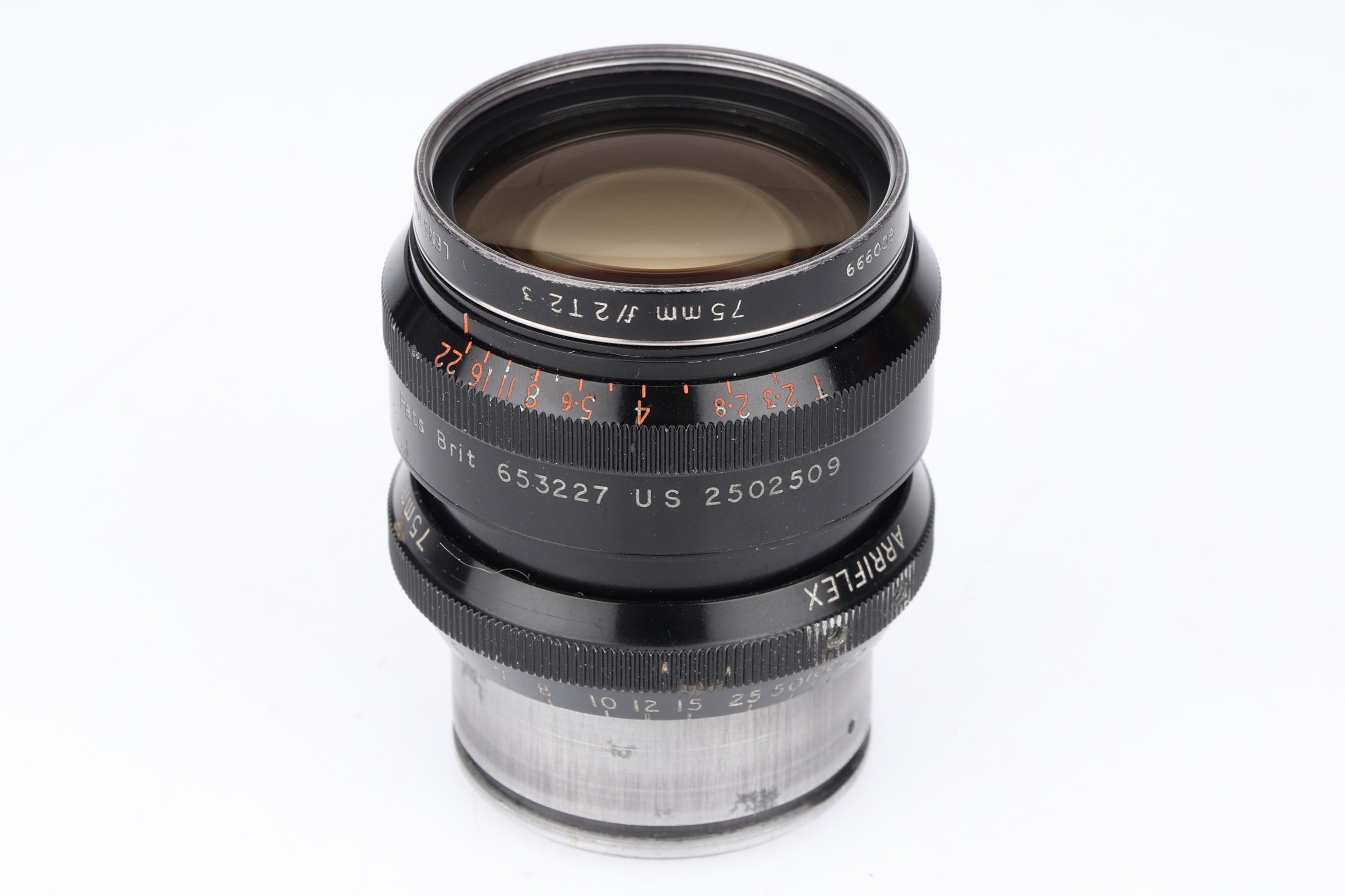
A real Cooke Speed Panchro SerII 75mm, for example, engraved with British patent 653227 & US patent 2502509.
?v=63921946729907
In US patent 2502509, it described an asymmetrical Ernostar type lens.
https://patents.google.com/patent/US2502509A
On the design itself, LLL describes the 75mm as an "homage to a historically significant 1940s Double-Gaussian optical design, forming part of the SP-II lineage", with 8 elements in 5 groups. I haven't found a source showing the original was an Ernostar type, so if you have one, I would be glad to read it.
A real Cooke Speed Panchro SerII 75mm, for example, engraved with British patent 653227 & US patent 2502509.
?v=63921946729907
In US patent 2502509, it described an asymmetrical Ernostar type lens.
https://patents.google.com/patent/US2502509A
Oct 16, 2026 at 09:00 AM
|
p.4 #7Light Lens Lab 75mm f/2 "SPII" Review
DIXI 50 wrote:
A real Cooke Speed Panchro SerII 75mm, for example, engraved with British patent 653227 & US patent 2502509.
https://flints.goauction.co.uk/stock/48068-0.jpg?v=63921946729907
In US patent 2502509, it described an asymmetrical Ernostar type lens.
https://patents.google.com/patent/US2502509A
Thanks, DIXI, that's a useful source. Gordon Cook's patent describes a different, asymmetrical layout from LLL's double-Gauss formula, so you are right that the LLL 75mm is its own design and not a copy of the original. That doesn't change what I was saying, though: the Leica 75mm APO is built for technical perfection, while the SP II is built to reproduce a classic rendering, so they aren't trying to do the same thing.
Fred Miranda wrote
On the design itself, LLL describes the 75mm as an "homage to a historically significant 1940s Double-Gaussian optical design, forming part of the SP-II lineage", with 8 elements in 5 groups. I haven't found a source showing the original was an Ernostar type, so if you have one, I would be glad to read it.https://flints.goauction.co.uk/stock/48068-0.jpg?v=63921946729907
In US patent 2502509, it described an asymmetrical Ernostar type lens.
https://patents.google.com/patent/US2502509A
Thanks, DIXI, that's a useful source. Gordon Cook's patent describes a different, asymmetrical layout from LLL's double-Gauss formula, so you are right that the LLL 75mm is its own design and not a copy of the original. That doesn't change what I was saying, though: the Leica 75mm APO is built for technical perfection, while the SP II is built to reproduce a classic rendering, so they aren't trying to do the same thing.
Oct 16, 2026 at 10:45 AM
p.4 #8Light Lens Lab 75mm f/2 "SPII" Review
Just got this lens yesterday. Initially very impressive, but there is something odd when it comes to focusing with rangefinder near the close end of the range at full aperture -- challenging situation to be sure, but nothing I haven't seen before (I have the 7a 75mm f1.25 II for example).... it is hit and miss, when i get it, it looks great, but quite often the focus is way way off. This cannot be a rangefinder calibration issue, shutter speeds are also in the hundredths of a second, stationary subject...
I will keep at it. Just wondering out aloud, can things like spherical aberration really bite this hard at some specific combinations of aperture and focus distance?
....i do think i am getting more predictable results with liveview (and EVF, but my EVF got smashed and the useless insurance company is nowhere to be seen.)
Nov 11, 2026 at 02:53 PM
p.4 #9Light Lens Lab 75mm f/2 "SPII" Review
Toni Nikkanen wrote:
Just got this lens yesterday. Initially very impressive, but there is something odd when it comes to focusing with rangefinder near the close end of the range at full aperture -- challenging situation to be sure, but nothing I haven't seen before (I have the 7a 75mm f1.25 II for example).... it is hit and miss, when i get it, it looks great, but quite often the focus is way way off. This cannot be a rangefinder calibration issue, shutter speeds are also in the hundredths of a second, stationary subject...
I will keep at it. Just wondering out aloud,...Show more →
I don't have the same lens but yes, with my 75 f2 Leica focusing at close to MFD is a real challenge. I totally rely on the Visoflex for these situations and forgo the rangefinder.
Nov 11, 2026 at 04:45 PM
p.4 #10Light Lens Lab 75mm f/2 "SPII" Review
Yeah could be the actual problem is I don't have the EVF in working condition anymore. I shot the 75mm 1.25 (and 50mm 1.0 etc.) with it quite successfully. I will keep chasing the deadbeat insurance company.
Nov 12, 2026 at 01:57 PM
p.4 #11Light Lens Lab 75mm f/2 "SPII" Review
Getting better at it, now that I had more time and better light.
 L1009799-2 by Toni Nikkanen, on Flickr
 L1009808-2 by Toni Nikkanen, on Flickr
 L1009810-2 by Toni Nikkanen, on Flickr
 L1009841-2 by Toni Nikkanen, on Flickr
 L1009842 by Toni Nikkanen, on Flickr
L1009799-2 by Toni Nikkanen, on FlickrL1009808-2 by Toni Nikkanen, on FlickrL1009810-2 by Toni Nikkanen, on FlickrL1009841-2 by Toni Nikkanen, on FlickrL1009842 by Toni Nikkanen, on FlickrNov 14, 2026 at 02:07 PM