CharleyL
Offline
• • •
Upload & Sell: On
|
A few tips about indoor table top shooting -
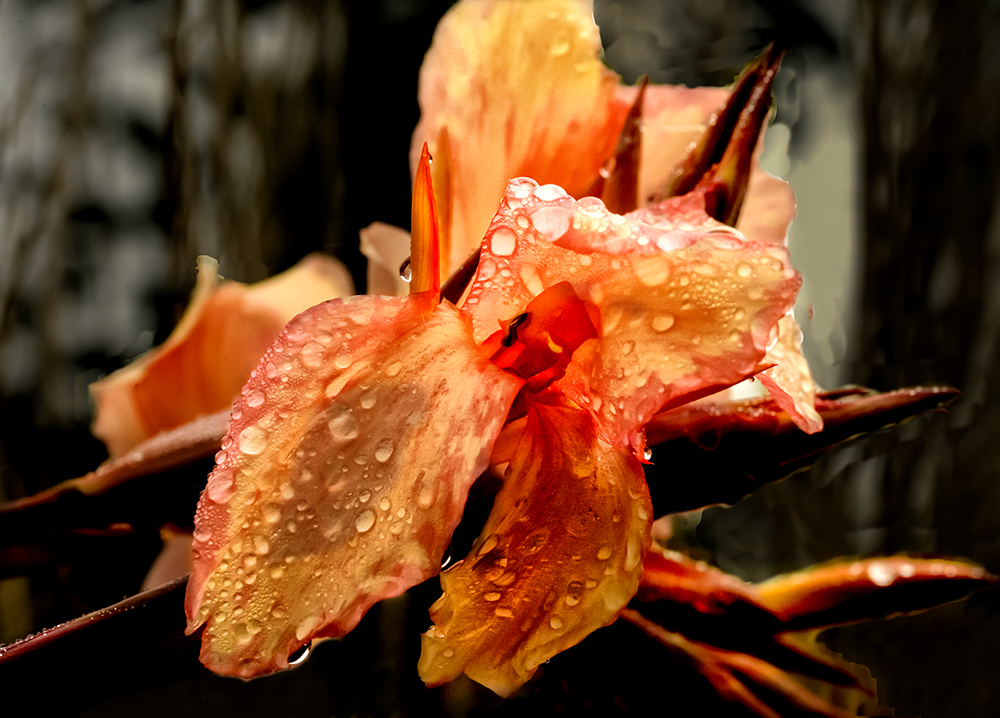
I use a spray bottle of water when I want rain indoors.
Glycerin in an eye dropper can be used to apply moisture drop by drop to the outside of glasses and leaves when I want to simulate condensation or rain and want the drops to remain in place for an extended shoot. It takes time, but can be worth it for a long shoot. The glycerin drops don't run off as easily and stay mostly where you put them for the shoot duration. When shooting food or anything related, I always throw the food out after the shoot and run the dishes, glasses, and silverware through the dishwasher before using them for anything again. I've been keeping several complete place settings of different styles in my props lately, so they never come into contact with anything that a human or animal might consume.
Setting up for an indoor table top shoot is slow, the first couple of times. Then, when you get comfortable with what you are doing, it becomes quite easy to create the setup on the table that was in your mind. When I do one shoot and I'm happy with the result, I frequently think up other similar shoot plans in my head that will work with the same lor nearly the same lighting setup, and just change the props, using nearly the same setup for additional similar shoots. I can sometimes stay busy and happy all day this way.
The way that I learned this is very close to the way that the Youtube show "Camera Club Live" uses. He is a great teacher and much can be learned from watching his shows. He always shows the final image, and then starts his setup completely over, building everything back up again and explaining every step as he does it, right up until the final edit in Photoshop. Each Wednesday he posts a new video in about mid afternoon, for us on the East Coast of the USA. He is in England somewhere.
You don't need his expensive camera or gear for this either. Any adjustable camera can be used, but it is easier if it's digital. Most often I use one of my Canon DSLR cameras with a 24-70 mm lens, but a 50 mm will work for most of his shoots too. He has a few shows where he uses a tilt-shift 24 mm lens. I have one of these, but most photographers don't, and they are quite expensive, so best to skip trying to recreate this. My lights and speedlites are all Godox and Flashpoint, so clearly no where near the level and cost of the gear that he uses, but I can get the same results with what I have. If you don't have a soft box, a light or speedlite with a piece of diffusion paper suspended in front of it will make a soft box with no sides, but it will work to evenly light the subject when the right spacings, light to diffuser and diffuser to subject are used. Experimenting will find the ideal position.
Before I start a shoot in my studio, I set my ISO, usually to 100 and my shutter speed, usually to the sync speed of my cameras (1/250 sec) for most shoots, and I vary the power level of my lights to achieve the correct exposure. I always set my F-Stop high enough so my house light on the ceiling above doesn't affect the shot, tested by a test shot with no flash, but with the house light on. If the test shot is totally black, I'm good and any light that I add with flash will be the only light seen by the camera and I can leave the ceiling light on during my shoot. If, for some reason this F-Stop setting is too high for what I am shooting, then I have wireless control of the ceiling house light with a switch on each camera stand, one at my computer desk, one on my tool cart where I frequently park my camera when shooting hand held, and the original switch at the room entrance, so I can turn the light off, take the shot, then turn the light back on without moving. This is for safety reasons.
These wireless controls are available from Amazon at reasonable prices. A receiver needs to be wired into the light wiring, then each switch needs to be "taught" into this receiver. I think you can add up to 8 wireless switches to one light receiver. Teaching is easy. Press a button on the receiver, and while the LED is flashing, activate the switch. From then on, that switch will operate the light, both on and off. Repeat the teach process for the additional switches desired.
In my studio, my usual camera setting is F-8, unless something that I will be shooting has significant glare, then I might need to go to a higher setting. It has to be high enough to keep the ceiling house light from being seen in a reflection by the camera. A higher setting might be needed if I want a greater depth of field, but for me and my studio F-8 is usually what is needed. Once I have this setting and a completely dark test shot I can power up the flashes one by one and take test shots to see if each light is doing what I want and adjust it while taking additional test shots to get it perfect. Then turn it off and go to the next light and repeat the process. Once all lights have been tested and adjusted for the desired effect, a last test shot with all of the lights switched on may be my first keeper shot, or it may show that I haven't done something right and I go back and fix it, probably taking more test shots before beginning the real part of the shoot.
It's a great way to use your camera when Mother Nature isn't cooperating, or you just don't feel good enough to go out and about, looking for something to shoot. Most any space in your home or apartment can be used. Only buy what you need, when you need it and the funds are available. Many things, like reflectors, subjects, backgrounds, etc. can be DIY, borrowed and returned later, etc. Years ago when my kids were young and money was tight, my studio was my living room with the furniture pushed aside. My light stands were non folding wooden posts with plywood bases, and I clamped my lights to them at the height needed and moved them closer or farther away or changed the bulb wattage for brightness adjustment. The backdrop was a bed sheet tacked to the wall to cover the French Doors to the porch. It can be done with very little, and the results can be quite impressive. Nobody but you knows what was behind or to either side of the camera, or where you took the photos. Only what you place in front of the camera ever gets seen in the photos.
Charley
|