Actually I realize I had missed the R50V and 14-30mm PZ combo, not paying attention really, but at it's lower weight (20 oz total), size and price ($799) it could be an honorable replacement for the G7 mk2. Admittedly bigger but a full APS-C camera for video and interchangeable lenses would allow occasional use of e.g. the bright, compact 50mm f:1.8 or 45mm f:1.2, some telephoto with whatever RF lens is handy, sound interface in the flash shoe, etc..
Gochugogi wrote:
The R6 V is 2499 USD. If a titling EVF is available I'd buy one with the new 20-50L kit lens. Using the flip screen only won't work for me. It's too darn sunny here on Oahu to shoot without an EVF.
Considering the multi-function interface shoe on the latest R bodies, a clip-on tilting EVF would be an interesting possibility, if Canon was foresighted enough to consider feeding an EVF through this interface.
I would certainly be interested in such an option just for the tilt capability on my R5II and R6II. It's a major reason I use a tilt clip-on EVF with another system I own. And would be a great way IMO to expand the usefulness of cameras without built-in EVFs.
While I could and occasionally do use the flip out rear display for this purpose, I find it more difficult to line up my shots with it, in part because it's off-center from the camera. And sometimes the ambient light level is too high to clearly see what I'm doing.
rscheffler wrote:
While I could and occasionally do use the flip out rear display for this purpose, I find it more difficult to line up my shots with it, in part because it's off-center from the camera. And sometimes the ambient light level is too high to clearly see what I'm doing.
Yeah, same. I do wish Canon had a multi-axis tilt screen similar to the Nikon Z8.
I get why they have the articulated hinge, so you can flip it around and view it from the front for video, but as a stills shooter, waist-level tilting on-axis with the lens would be much more useful to me.
garyvot wrote:
Yeah, same. I do wish Canon had a multi-axis tilt screen similar to the Nikon Z8.
I get why they have the articulated hinge, so you can flip it around and view it from the front for video, but as a stills shooter, waist-level tilting on-axis with the lens would be much more useful to me.
I can’t empathise just how much I dislike the tilt/articulated rear screens. Probably explains why I’m so reluctant to move away from the R100 and why the R50 sits unused in a box.
Given a choice I would much prefer a top lcd with a flip up cover like TLR’s used.
I find the rear screens a real ballache !! More often than not totally unusable in broad daylight. They are the single biggest weakness (fragile) on modern cameras
Perfectly fine as fixed menu/touch screens - 5div springs to mind!! May yet still buy one tbh!!
It’s the reason why my 6D is still in use and the 6dii never sees use.
I always fancied the R3, but the stupid articulated rear screen instantly killed it for me. Not paying that kind of money to still be compromised.
Maybe canon should offer a R9 - R8 but with fixed compactive screen ??
EB-1 wrote:
Just don't move the screen out and around. I almost never do so articulation is moot.
It's like the video or some other features that I don't need.
EBH
Actually I’ll just pass.
Cameras are expensive these days. I’ll just keep my money and use what I have.
I’m done with accepting what I don’t want nor need.
I use the articulating screen when shooting off my platypod, hand held down near ground level, hand held near water's level on the edge of water bodies and when camera is placed on the ground. I find it invaluable when composing shots being that low to the ground.
In my opinion the 20-50 would pair nicely with the 14-35.
Pixelpuffin wrote:
Maybe canon should offer a R9 - R8 but with fixed compactive screen ??
The lower end of the market is probably more hybrid stills/video and they would balk at a fixed rear screen. Canon would have to go more Leica-like by releasing a niche higher end, high-priced, stripped down 'pure' stills-centric model. They could go full bore Leica and entirely remove the rear display. There's still be an EVF, or if Canon were to release a phone app as functional as Leica's, we'd be able to change all the menu settings and review images from the phone. That Canon now requires us to set up an account to control a camera via their control app really annoys me!
johnctharp wrote:
None of these are as wide as the 20-50/4L though; that's a big part of the appeal here. The 20-50/4L is also absurdly compact and relatively lightweight for being an internal zoom.
As much as Sony has other PZ lenses, they don't really have an alternative for the 20-50/4L.
Well, you have the FE PZ 16–35 mm F4 G, which is wider at the wide end, but not as long of a focal range.
But I guess my point was that Canon has really lagged Sony for power zoom lenses. I don't know if that was them not acknowledging this was important for the DSLR video/low end cinema camera market, or trying to keep a point of differentiation from their camcorder and ENG lens line?
Whatever it was, I guess Canon's big push this year is video, video, and more video for casual video users (er, hand held video cameras which look like DSLRs but are held in front of you) with this lens, the RF-S 14-30mm, the R6V and last year's R50V.
tsangc wrote:
Well, you have the FE PZ 16–35 mm F4 G, which is wider at the wide end, but not as long of a focal range.
Just looked that one up - it looks great! It is even lighter than the Canon (which is already light really), and still maintains internal zooming. I did see that it has a 72mm filter thread so it may end up larger overall, and it lacks OIS, which the Canon has, and that gives the Canon the edge for working with camera bodies that have unstabilized / locked sensors (R50V or R8 on the low end, R5C or C50 moving up). A lot of folks tend to prefer having OIS in the loop for stabilization which comes across more natural for video, and then IBIS only if it backs up OIS to deal with jittery movements, but prefer not to use IBIS alone as it can lead to an unnatural look.
tsangc wrote:
But I guess my point was that Canon has really lagged Sony for power zoom lenses. I don't know if that was them not acknowledging this was important for the DSLR video/low end cinema camera market, or trying to keep a point of differentiation from their camcorder and ENG lens line?
Really just coming down to priorities. From a product management standpoint, Canon can only really develop so many lens designs (of which they have no shortage), set up so many new production lines, and service so many new SKUs at once. If they go too fast they can easily blow capital budgets without drawing the revenue to cover them.
So it's a business decision IMO. I think holding the 20-50/4L until the C50 and R6V both hit makes a lot of sense. It's really the zoom lens you want to use on those cameras for any kind of lightweight gimbaled or ENG rigging.
tsangc wrote:
Whatever it was, I guess Canon's big push this year is video, video, and more video for casual video users (er, hand held video cameras which look like DSLRs but are held in front of you) with this lens, the RF-S 14-30mm, the R6V and last year's R50V.
It's a big market. I've been looking at these - not that I'd get spousal approval, of course - to upgrade our M6 II + 11-22 setup that we use on a gimbal on vacations. The R6V retains enough stills DNA (and my family couldn't use a viewfinder to save their lives....) that it could credibly stand in as a second stills camera.
But what I'd really wait for is for Canon to put out an APS-C 'V' camera with a faster sensor. The rumored specs for the R7 II sensor seem to make a potential R7V somewhat likely too.
tsangc wrote:
Well, you have the FE PZ 16–35 mm F4 G, which is wider at the wide end, but not as long of a focal range.
But I guess my point was that Canon has really lagged Sony for power zoom lenses. I don't know if that was them not acknowledging this was important for the DSLR video/low end cinema camera market, or trying to keep a point of differentiation from their camcorder and ENG lens line?
Whatever it was, I guess Canon's big push this year is video, video, and more video for casual video users (er, hand held video cameras which look like DSLRs but are held in front of you) with this lens, the RF-S 14-30mm, the R6V and last year's R50V. ...Show more →
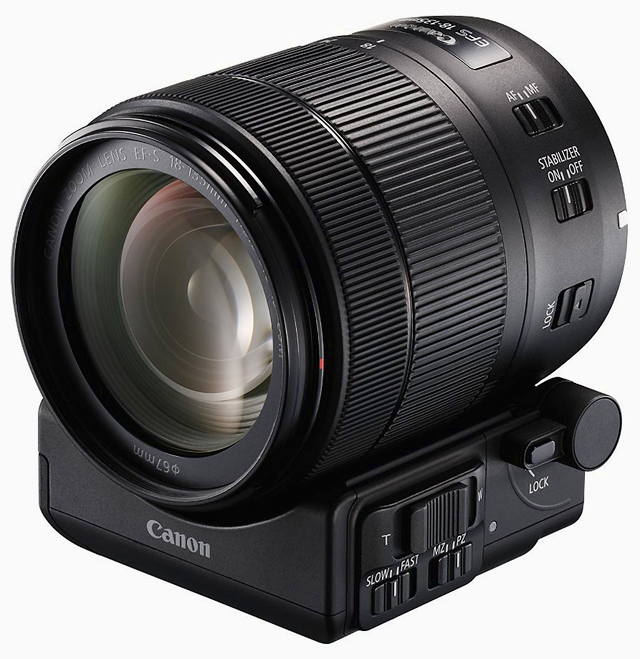
Canon product development is on the slow and conservative side. With that said, Canon did dip its toes into the DSLR power zoom market in 2016 with the 80D, EF-S 18-135 3.5-5.6 IS USM, and Power Zoom Adapter PZ-E1. I owned the whole setup and used it for shooting music videos. The 4 AA batteries made it rather heavy, but it was smooth and could be triggered via Canon Connect. I'm guessing Canon was testing the market with the PZ-E1, but it took until recently for them to develop RF lenses with power zoom attachments or built-in. I found having the zoom switch on the adapter less subject to bumps and jiggles than having it on the lens barrel. Here's Canon's first power zoom setup for DSLRs, circa 2016: