CharleyL
Offline
• • •
Upload & Sell: Off
|
 p.1 #4 · Godox flash for Sony recommendation? p.1 #4 · Godox flash for Sony recommendation? | |
Yes, in my studio I most frequently use 300 or 400 w/s lights in my studio, but have Godox 800 and 1000 w/s lights too. The Godox MS300 and MS400 are a bit shorter than an SK300 or 400, a bit cheaper, but they don't feel as well made as the SK series and just slightly more money, but I have both, and both have their benefits.
The MS300 is my choice when I need a light placed up against my 8' ceiling and pointed straight down with a soft box on it. My ceiling lighting support grid is 4" down from the ceiling, so the MS300 can be attached to the grid and fits under the ceiling. The SK300, being longer, won't attach directly to the ceiling grid and needs a bit of gaffing to be used this way, as the back of the SK series light is long enough that it won't fit directly to the ceiling grid. I probably could have lowered the ceiling grid, but I was trying to keep it as high as possible, so I could still use the space below with light stands, big soft boxes, etc for portrait shooting. It works for me in this position, with this constraint being the only time that I've wished that the grid was lower. The SK300 and 400 tend to get used more often mounted on C-Stands with soft boxes or reflectors. When I need to light a vase or similar from behind I had been using a TT600 speedlite, but recently started using one of the AD200 Pro II for this, if it is small enough not to be seen by the camera. I also like to use the AD200 with the head extension when on a tripod, so I can attach the heavy part of the AD200 low on the light stand, while the head of choice is mounted in an S2 bracket on the top of the light stand. Again, this is to keep the weight of the light lower on the light stand for more stability.
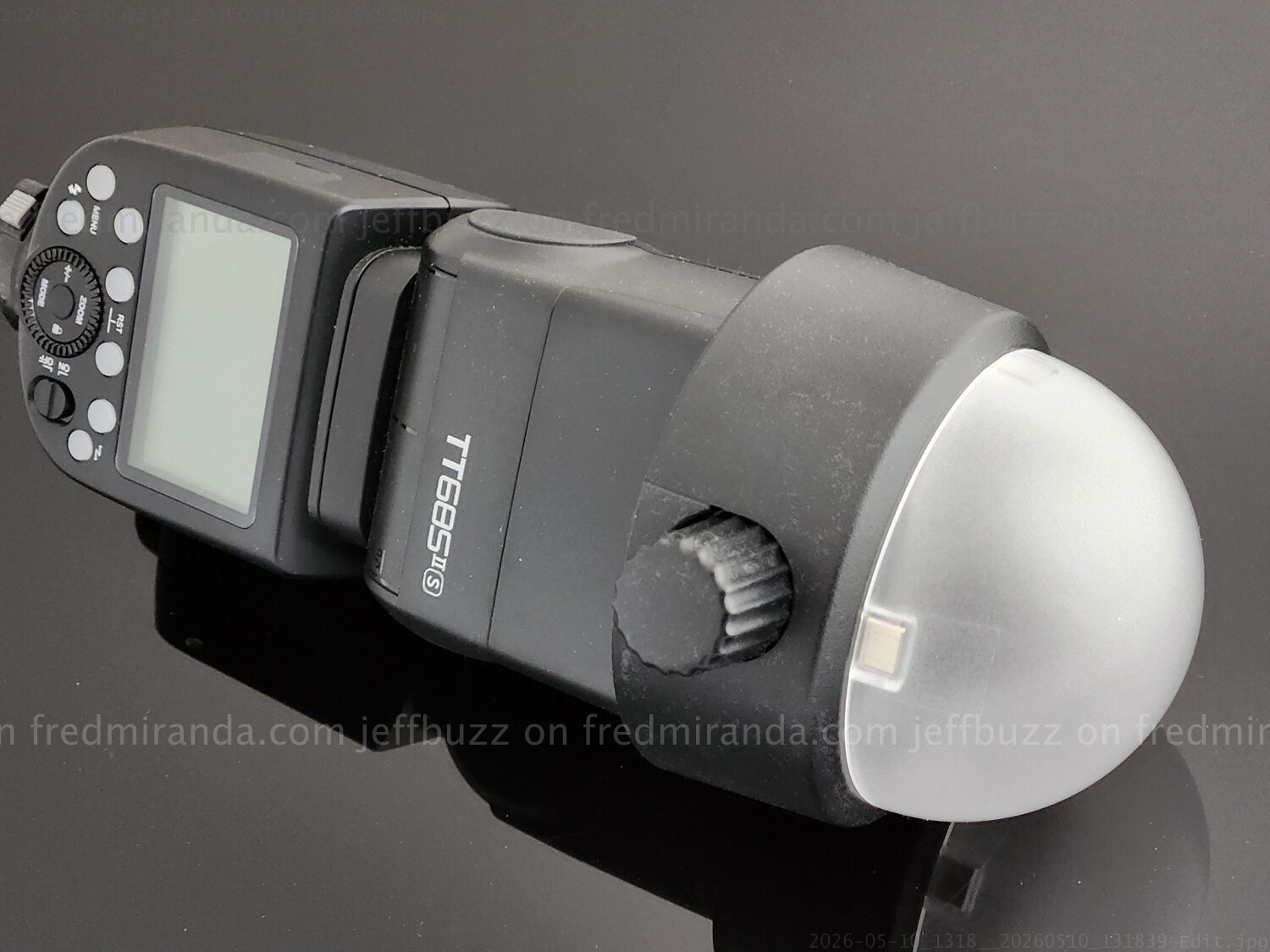
The Godox or Flashpoint speedlites can be set to work as transmitters or receivers or with no I/O capability, so one can be attached to the hot shoe of the camera and used as a transmitter to control other lights and even itself. I do my best to avoid lights on my camera hot shoe, but it does work and can save the day if you have a transmitter failure. I still carry two of the TT600 in my field kit along with the three AD200 Pro II, so one could become my control transmitter, if I needed it.
The AD200's are kind-of a half step above speedlites, not fully studio light level, but significantly above speedlites and you can't attach them to the camera hot shoe, but they are sure flexible in how you can use them. They have 1/4-20 attachment points at 90 degrees to each other in the body, so they can be turned for tall or wide light orientation. The round head also has a 1/4-20 attachment point, but I usually just use an S2 bracket so I can add a soft box, 7" reflector, snoot, etc. Each AD200 Pro II comes with a light stand to 1/4-20 male adapter bracket, something like the bracket on the bottom of studio lights, that swivels up and down and locks, with an umbrella hole and locking knob, so you can use the AD200 in this configuration when only using umbrellas.
No other light control system on the market that I know of is as flexible as the Godox "X" lighting control system. Service availability has been a bit questionable, but now there are several "Authorized" service centers. To me, if a $130 light gives me several years of good service, but then has a problem, I'll just buy a replacement and save time waiting for my light to be returned at likely more than 50% of the light purchase price. I'll just save it as spare parts for the others.
I buy mostly from Amazon, because I'm a very long way away from the big camera stores now, but still buy things from Adorama and B&H in NYC. Adorama sells Flashpoint, a rebrand of Godox, and I know that they service Flashpoint. They may now also service Godoox, but since I haven't needed service I haven't kept up with this knowledge. Flashpoint is Adorama's own brand name of the Godox products. In most cases, same products and same prices.
Charley
|