Falling in love with Sony 28-70 f2 GM again !
p.2 #1Falling in love with Sony 28-70 f2 GM again !
Xysterz wrote:
Have you compared this to a 2.8?
Compare to 2470GM2? The only real advantage is lighter which I personally don't mind anything less than 1kg. The 24 is wider yes, but 2870GM is ess blurry with the same ISO (higher shutter speed) or same shitter speed (lower ISO)
gordonyz wrote
You don't shoot small kids running indoor I do, there is no better alternativeCompare to 2470GM2? The only real advantage is lighter which I personally don't mind anything less than 1kg. The 24 is wider yes, but 2870GM is ess blurry with the same ISO (higher shutter speed) or same shitter speed (lower ISO)
Apr 09, 2026 at 11:07 AM
p.2 #2Falling in love with Sony 28-70 f2 GM again !
gordonyz wrote:
Have you compared this to a 2.8?Compare to 2470GM2? The only real advantage is lighter which I personally don't mind anything less than 1kg. The 24 is wider yes, but 2870GM is ess blurry with the same ISO (higher shutter speed) or same shitter speed (lower ISO)
How different are the lenses at various focal lengths as far as ability to capture light? Has anyone tested your theory?
Xysterz wrote
gordonyz wrote
You don't shoot small kids running indoor I do, there is no better alternativeHow different are the lenses at various focal lengths as far as ability to capture light? Has anyone tested your theory?
Apr 09, 2026 at 11:58 AM
p.2 #3Falling in love with Sony 28-70 f2 GM again !
chez wrote:
Have you compared this to a 2.8?Compare to 2470GM2? The only real advantage is lighter which I personally don't mind anything less than 1kg. The 24 is wider yes, but 2870GM is ess blurry with the same ISO (higher shutter speed) or same shitter speed (lower ISO)How different are the lenses at various focal lengths as far as ability to capture light? Has anyone tested your theory?
You mean the T stops. I never touched a 2470GM II
There is at least 2/3 difference. I tested against Tamron 17-28mm f/2.8 and the same brightness the 2870GM is a full stop brighter.
gordonyz wrote
Xysterz wrote
gordonyz wrote
You don't shoot small kids running indoor I do, there is no better alternativeYou mean the T stops. I never touched a 2470GM II
There is at least 2/3 difference. I tested against Tamron 17-28mm f/2.8 and the same brightness the 2870GM is a full stop brighter.
Apr 09, 2026 at 02:43 PM
p.2 #4Falling in love with Sony 28-70 f2 GM again !
How Sony buried the telecentricity argument in lens design:
I came to this fast mid-zoom lens genre while researching telecentricity - the ability of lenses to deliver light rays that are perpendicular to the sensor's outer reaches. You may recall the promotion of wide lens mounts at the beginning of Z and RF mounts. AI listed Canon's 28-70/2 as an example lens of the advantages of wide mount throats. Nikon Z is 55.0mm and Canon RF is 54.0mm, while Sony E is 46.1mm.
"Canon RF 28-70mm f/2L USM: A constant f/2 zoom for full-frame is historically impossible on tighter mounts like Sony E or Leica M. The wide 54 mm RF throat allows a huge rear nodal footprint, creating an oversized image circle that forces light rays down perpendicularly across the frame. (from G/AI)"
I had believed that telecentricity was highly desirable and valuable - it just seems logical that if you can fill sensor photosites at 90 degrees you will be delivered a demonstrably better image.
Sony's entrant is obviously a response to the earlier released Canon of the same configuration. Before a closer examination, the main advantages touted for telecentricity (and wide mount throats as the enabler of it) are: low to no focus breathing and low outer frame shading or vignette. Other claims are made but in sotto voce, rather quietly. Such as smaller physical size, better bokeh.
But Canon's lens is, to put it bluntly, a lemon. And this is why you don't hear much about the superiority of the wide mounts any more. There is virtually no evidence for it in the years since RF/Z first appeared, in the form of great new C/N lenses that were clearly better than the Sony equivalents, let alone being impossible for Sony to emulate.
Here, the Sony 28-70/2 is smaller, takes 86mm filters (not 95mm); has better AF, is sharper, and is a massive 500 grams lighter. And to cap it all off, it has very low vignette and extremely well-controlled focus breathing. Regarding the Canon, technical reviewers were shocked at its severe focus breathing, and aggressive vignette (2.5-3 stops). It seems telecentricity is a feature we can well do without! So that is a victory for optical science over long-established beliefs.
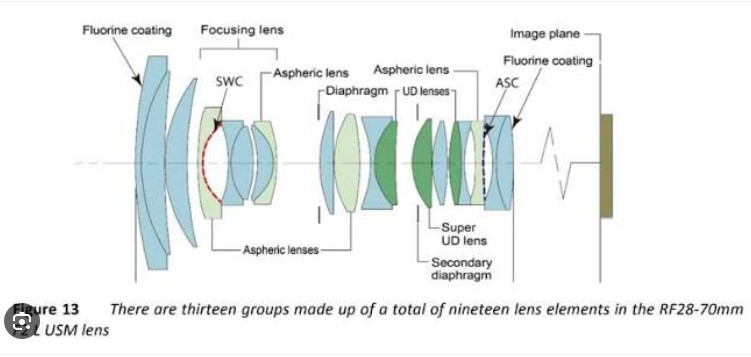
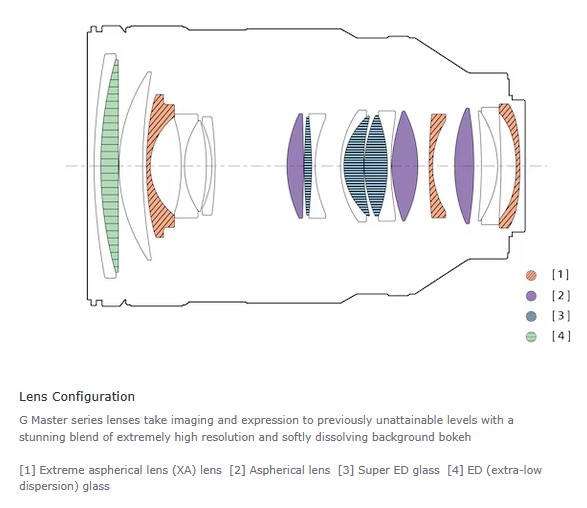
Sony's 28-70/2 is a fabulous lens, a genuine technological achievement. Below are lens block diagrams of the 19/13 Canon lens and the 20/14 Sony lens. How did they trounce Canon so completely, against all odds, against all expectations?
High tech, in a nutshell. Superb matching of six aspheres - three of highly variable centre-edge thickness; and four ED elements with ten regular optical elements. Canon used four aspheres and three ED elements, along with a dependence on their coatings. I sympathise with their users.
..
I came to this fast mid-zoom lens genre while researching telecentricity - the ability of lenses to deliver light rays that are perpendicular to the sensor's outer reaches. You may recall the promotion of wide lens mounts at the beginning of Z and RF mounts. AI listed Canon's 28-70/2 as an example lens of the advantages of wide mount throats. Nikon Z is 55.0mm and Canon RF is 54.0mm, while Sony E is 46.1mm.
"Canon RF 28-70mm f/2L USM: A constant f/2 zoom for full-frame is historically impossible on tighter mounts like Sony E or Leica M. The wide 54 mm RF throat allows a huge rear nodal footprint, creating an oversized image circle that forces light rays down perpendicularly across the frame. (from G/AI)"
I had believed that telecentricity was highly desirable and valuable - it just seems logical that if you can fill sensor photosites at 90 degrees you will be delivered a demonstrably better image.
Sony's entrant is obviously a response to the earlier released Canon of the same configuration. Before a closer examination, the main advantages touted for telecentricity (and wide mount throats as the enabler of it) are: low to no focus breathing and low outer frame shading or vignette. Other claims are made but in sotto voce, rather quietly. Such as smaller physical size, better bokeh.
But Canon's lens is, to put it bluntly, a lemon. And this is why you don't hear much about the superiority of the wide mounts any more. There is virtually no evidence for it in the years since RF/Z first appeared, in the form of great new C/N lenses that were clearly better than the Sony equivalents, let alone being impossible for Sony to emulate.
Here, the Sony 28-70/2 is smaller, takes 86mm filters (not 95mm); has better AF, is sharper, and is a massive 500 grams lighter. And to cap it all off, it has very low vignette and extremely well-controlled focus breathing. Regarding the Canon, technical reviewers were shocked at its severe focus breathing, and aggressive vignette (2.5-3 stops). It seems telecentricity is a feature we can well do without! So that is a victory for optical science over long-established beliefs.
Sony's 28-70/2 is a fabulous lens, a genuine technological achievement. Below are lens block diagrams of the 19/13 Canon lens and the 20/14 Sony lens. How did they trounce Canon so completely, against all odds, against all expectations?
High tech, in a nutshell. Superb matching of six aspheres - three of highly variable centre-edge thickness; and four ED elements with ten regular optical elements. Canon used four aspheres and three ED elements, along with a dependence on their coatings. I sympathise with their users.
 |
||
 |
||
|
..
|
||
 |
||
|
Aug 22, 2026 at 11:57 PM
p.2 #5Falling in love with Sony 28-70 f2 GM again !
Here is a fine explanation of the focus breathing phenomenon. It's not only an issue with video in a lens designed for event work and portraiture, where close focus distances are common.
Used at close range (MFD) the Canon 28-70mm f2 is actually a *25-54mm lens*..let that sink in. At 2m or so, the shift to wider angles of view will be not so dramatic but still very serious. It's not a landscape lens top be used at infinity, is it?
70mm is already a little short for people photography. Close focus headshots will be strange. It's amazing they would release it, and it's equally surprising it is not roundly condemned. This is a $3400 lens. The horror show banner says it all. At least it will work well for large group shots, I guess.
Aug 23, 2026 at 12:19 AM
p.2 #6Falling in love with Sony 28-70 f2 GM again !
28mm is not nearly wide enough.
Aug 23, 2026 at 12:56 AM
p.2 #7Falling in love with Sony 28-70 f2 GM again !
howard wrote:
28mm is not nearly wide enough.
For what? Why isn’t it wide enough? Is f/2.8 bright enough?
Aug 23, 2026 at 03:29 AM
p.2 #8Falling in love with Sony 28-70 f2 GM again !
Great lens it is. Too many of the same images here.
Aug 23, 2026 at 03:16 PM

p.2 #9Falling in love with Sony 28-70 f2 GM again !
There is an image thread of this lens posted earlier although it didn't start out that way: https://www.fredmiranda.com/forum/topic/1928366/. Some images posted there are truly amazing, making me droll 😜.
Aug 23, 2026 at 03:47 PM
|
p.2 #10Falling in love with Sony 28-70 f2 GM again !
I never truly understood the use case of a wide aperture lens for low light landscape; it’s almost an oxymoron. With the exception of isolating architectural details or targeted landmarks, in general, true landscape shots call for deep depth of field. And without doing any stacking and other techniques you need to stop down quite a bit thereby negating the wide aperture advantage and capabilities of such a lens.
Btw I do own this amazing lens.
DWOfPaul wrote:
If you already have the 24-70 f2.8 GM II, the 28-70mm f2 is probably a hard sell.
There is a very good chance I will pick up the 28-70mm f2 within the next few months. I am looking to pair it with my Sony 24-105mm f4 or Nikon 24-120mm f4, depending on the kit I am using. As you mentioned in good light, I agree there are other, less restrictive zooms that will work better, even if you give up a bit of peek IQ. When the light falls f2 is a big advantage, and with IBIS I feel like it could handle almost all my low light needs in a single lens.
Currently, the 28-70mm f2 is $3,300 and weighs 2 lbs. The Sony 35mm f1.4 GM is currently $1,500 and weighs 1.2 lbs. The Sony 50mm f1.4 GM is currently $1,400 and weighs 1.1 lbs. So, for a 1 f stop advantage, the two GM primes are already heavier and are within $400 of the zoom. The only prime that I am still thinking about instead of the zoom is the Sigma 35mm f1.2 II, which is currently $1,550 and weighs 1.6 lbs. That would gain me a 1.5 f stop advantage over the 28-70mm f2, but I would lose the entire zoom range for a lens that is not much lighter, and fairly similar in size: https://camerasize.com/compact/#898.1227,898.1183,ha,t
Hope this helps anyone thinking about the 28-70mm f2.Help me understand this bit "When the light falls f2 is a big advantage, and with IBIS I feel like it could handle almost all my low light needs in a single lens"
What is this use case? Is it handheld landscape or cityscape? Is it theater? Is it natural light portrait or still life? I have a bit of GAS for this lens, but I am really struggling to figure out my use case for it. I was thrilled with the Nikon Z 24-120 for most of what I do since I don't do people. Couldn't do astro, but otherwise pretty great. If I don't need the f2 aspect of the lens (and from an ISO standpoint I don't) is there something magical about the IQ compared to the 24-70 GM II or even the Tamron 28-75?
I would love to love this lens, but My main use case for f2 is handheld cityscapes in low light, since often tripods are not really an option. I would also occasionally use it for landscapes in low light. It would also make a good lowlight travel lens for dark interiors or even non dedecated astro photography outings (I don't see it competing with my Sigma 14mm f1.4 for dedicated astro photography). The f2 aperture can also allow for some creative shallow depth of field photography, which admittedly I have not been playing with as much with the 24-120mm f4 since it requires switching lenses.
This video has a...Show more →
Btw I do own this amazing lens.
DWOfPaul wrote:
billsnature wrote
DWOfPaul wrote
billsnature wrote
To those who own and love this lens, I’d like to ask why? Is it the sharpness and contrast or is it the f2? The images here look like they could have been shot by the 24-70 GM II and would look similar. Please help me understand what I am missing in the other than f2 portrait and isolation capabilities provided by f2.There is a very good chance I will pick up the 28-70mm f2 within the next few months. I am looking to pair it with my Sony 24-105mm f4 or Nikon 24-120mm f4, depending on the kit I am using. As you mentioned in good light, I agree there are other, less restrictive zooms that will work better, even if you give up a bit of peek IQ. When the light falls f2 is a big advantage, and with IBIS I feel like it could handle almost all my low light needs in a single lens.
Currently, the 28-70mm f2 is $3,300 and weighs 2 lbs. The Sony 35mm f1.4 GM is currently $1,500 and weighs 1.2 lbs. The Sony 50mm f1.4 GM is currently $1,400 and weighs 1.1 lbs. So, for a 1 f stop advantage, the two GM primes are already heavier and are within $400 of the zoom. The only prime that I am still thinking about instead of the zoom is the Sigma 35mm f1.2 II, which is currently $1,550 and weighs 1.6 lbs. That would gain me a 1.5 f stop advantage over the 28-70mm f2, but I would lose the entire zoom range for a lens that is not much lighter, and fairly similar in size: https://camerasize.com/compact/#898.1227,898.1183,ha,t
Hope this helps anyone thinking about the 28-70mm f2.
What is this use case? Is it handheld landscape or cityscape? Is it theater? Is it natural light portrait or still life? I have a bit of GAS for this lens, but I am really struggling to figure out my use case for it. I was thrilled with the Nikon Z 24-120 for most of what I do since I don't do people. Couldn't do astro, but otherwise pretty great. If I don't need the f2 aspect of the lens (and from an ISO standpoint I don't) is there something magical about the IQ compared to the 24-70 GM II or even the Tamron 28-75?
I would love to love this lens, but
This video has a...Show more →
Aug 23, 2026 at 04:08 PM
p.2 #11Falling in love with Sony 28-70 f2 GM again !
I'm really hoping that Sony comes out with a 16-35mm F2. I'd be fine with a zoom range of 16-35 and 50-150 at F2. I have a feeling Sony will do something to change shorten the range but I'll probably still buy it.
Aug 26, 2026 at 04:06 PM
p.2 #12Falling in love with Sony 28-70 f2 GM again !
It would be great, and I have to admit to underestimating Sony's design expertise. I would not count them out of anything, after they humbled Canon (and Nikon) so comprehensively with the 28-70/2. Have you had a look at its bokeh? Very good as well. And a 16-35 would be mostly landscape so the size is less critical.
Aug 26, 2026 at 06:23 PM
p.2 #13Falling in love with Sony 28-70 f2 GM again !
philip_pj wrote:
It would be great, and I have to admit to underestimating Sony's design expertise. I would not count them out of anything, after they humbled Canon (and Nikon) so comprehensively with the 28-70/2. Have you had a look at its bokeh? Very good as well. And a 16-35 would be mostly landscape so the size is less critical.
A 16-35 and 50-150 combo would be amazing for photojournalist and event photographers, especially with the higher mp cameras.
Aug 26, 2026 at 06:44 PM
p.2 #14Falling in love with Sony 28-70 f2 GM again !
From my research, I read this lens is flare prone. For those who own it, how bad is it shooting at night into brighter city lights? This would be one fairly typical use case for me.
Aug 27, 2026 at 08:22 AM
p.2 #15Falling in love with Sony 28-70 f2 GM again !
philip_pj wrote:
It would be great, and I have to admit to underestimating Sony's design expertise. I would not count them out of anything, after they humbled Canon (and Nikon) so comprehensively with the 28-70/2. Have you had a look at its bokeh? Very good as well. And a 16-35 would be mostly landscape so the size is less critical.
Would be great if they humbled Nikon with a better 24-120 f4 or Canon with a better 24-105 f4. This is the biggest weakness in the Sony line up right now.
Aug 28, 2026 at 09:00 AM
p.2 #16Falling in love with Sony 28-70 f2 GM again !
billsnature wrote:
Would be great if they humbled Nikon with a better 24-120 f4 or Canon with a better 24-105 f4. This is the biggest weakness in the Sony line up right now.
Between you, me and the fence post, I prefer getting 4mm extra on the wide end of the 20-70mm f/4 lens over the 50mm of the long end. That 20-70mm lens would qualify as a truly 1-lens-does-it-all in my book since I believe the 24mm is still too narrow to be qualified as such. But I realize, to each his/her own.
The Sony 24-105mm f/4 is a great performer, for sure, it doesn't do worse than that of the Canon of the same specs. Is it due for a replacement since it is an older lens design? Yes, like any other lenses in the line-up, of course...
philip_pj wrote
It would be great, and I have to admit to underestimating Sony's design expertise. I would not count them out of anything, after they humbled Canon (and Nikon) so comprehensively with the 28-70/2. Have you had a look at its bokeh? Very good as well. And a 16-35 would be mostly landscape so the size is less critical.Between you, me and the fence post, I prefer getting 4mm extra on the wide end of the 20-70mm f/4 lens over the 50mm of the long end. That 20-70mm lens would qualify as a truly 1-lens-does-it-all in my book since I believe the 24mm is still too narrow to be qualified as such. But I realize, to each his/her own.
The Sony 24-105mm f/4 is a great performer, for sure, it doesn't do worse than that of the Canon of the same specs. Is it due for a replacement since it is an older lens design? Yes, like any other lenses in the line-up, of course...
Aug 28, 2026 at 10:06 AM
p.2 #17Falling in love with Sony 28-70 f2 GM again !
I only have the 50-150mm f/2, but if they share the same characteristics, the 28-70mm must be a phenomenal lens. Great pair for travel when you leave your family behind and take a pack mule. More seriously, I understand the draw of f/2 in this zoom range.
Aug 28, 2026 at 10:26 AM