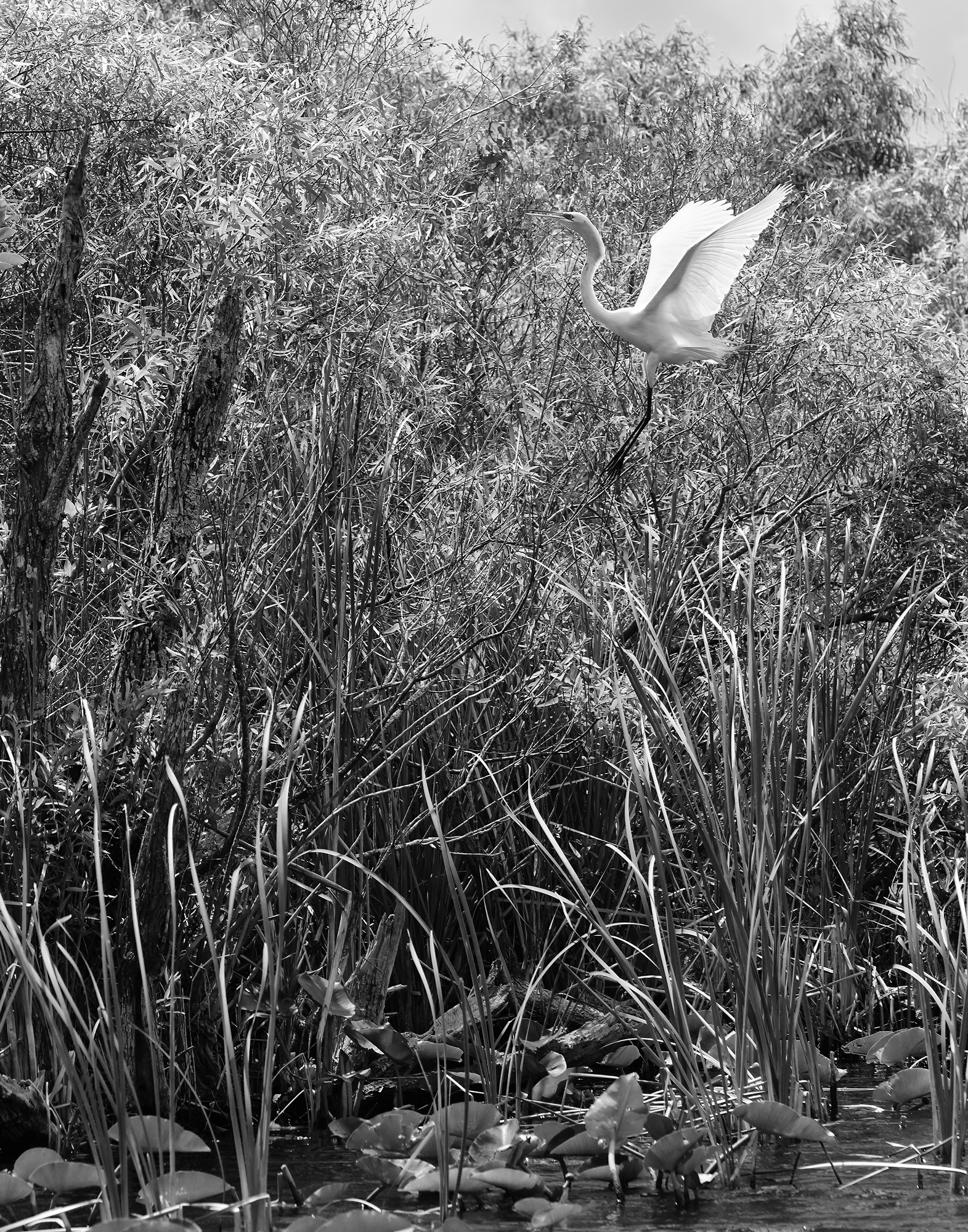
The title refers not to the bird's predicament, but to mine.
Sometimes (well, often) I work up an image, and then sit back and say no, this has all kinds of problems, into the trash it goes. (Here, that would be lack of object separation, no strong bones to provide structure for the image, etc.)
But then, the next day, I think "actually, that's exactly what it should be." In this case, I think it conveys *exactly* what so much of the Everglades is like - dense walls of lush vegetation, just bursting with birds of all kinds, no real anchor points for conventional compositions but something everywhere you look. So, I think this might actually work as a large print, big enough that you can get your nose right in it and see the density of life that is there.
And then the next day I think "no" again.
Not sure where I land on this today, but posting it anyway.
It's difficult for all the reasons you enumerate. But, also consistent with your intent, this captures the sense of place well. The darker areas below balance the image. The capture and processing of the egret is spot on with protecting the highlights and preserving detail.
It's a keeper!
sbeme wrote:
It's difficult for all the reasons you enumerate. But, also consistent with your intent, this captures the sense of place well. The darker areas below balance the image. The capture and processing of the egret is spot on with protecting the highlights and preserving detail.
It's a keeper!
I'm with you on the issues with this shot, but I quite like it for the story it tells. I often look back at shots I really liked, that captured the feeling of a day, but are too busy to stand the test of time as pure "photo art".
Jim Dockery wrote:
I'm with you on the issues with this shot, but I quite like it for the story it tells. I often look back at shots I really liked, that captured the feeling of a day, but are too busy to stand the test of time as pure "photo art".