p.1 #1 · Sony, I command you to release a 8,075 × 8,075 pixel square sensor!
This message is for Sony, in the slim chance that their bored product managers are lurking here.
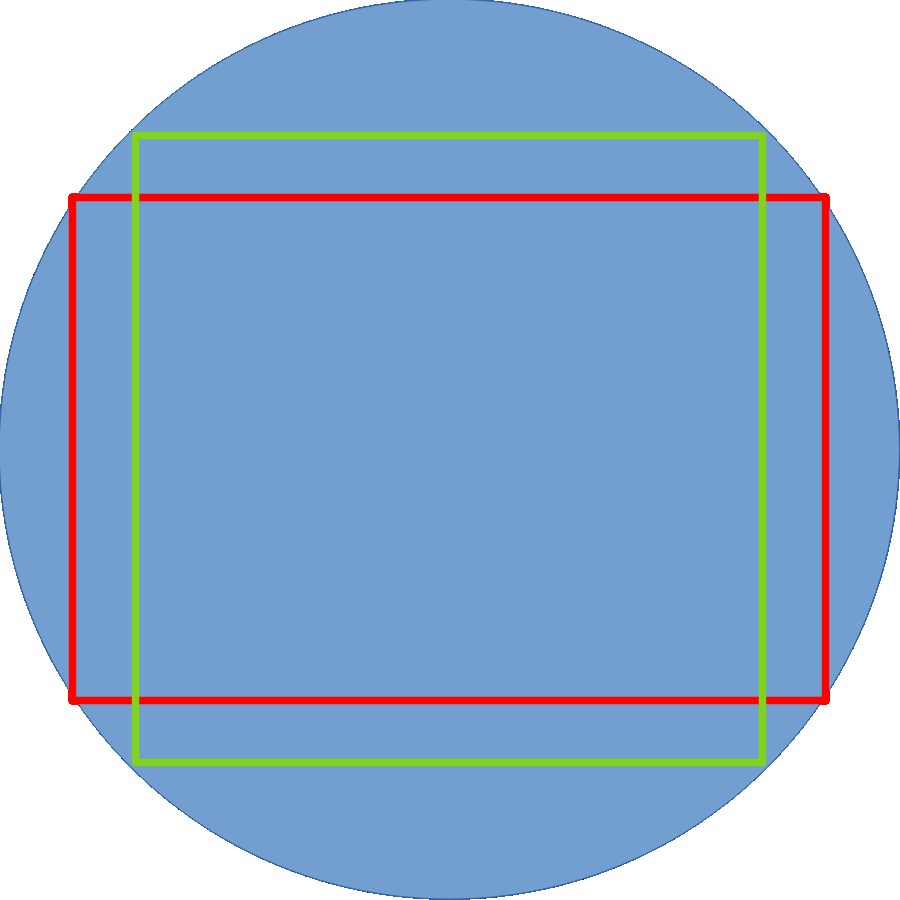
Rolleiflex and then Hasselblad figured out something obvious a century ago: non-square aspect ratios are moronic. The image circle is round, therefore the most optimal rectangular shape to capture the maximum percentage of light from a given image circle is a square. Not a rectangle, not a triangle. The square. It also happens that the square format is the most flexible format because you can crop to any ratio you want. The square is also an ergonomic king: no need to rotate the camera.
Back in the film days, cropping was problematic because film was expensive, so having smaller pre-cropped formats was economically justifiable to save money.
But why the hell are we still using pre-cropped formats in 2026? And what's worse, full-frame sensors are emulating the most idiotic film format, one that only existed because Barnack needed the cheapest possible medium for what was essentially a toy camera at the time. A whopping 33% of the image is chopped off, just because someone needed to save money in 1913!
See how silly you are, still producing this abdomination?
Listen up. We're going to fix it together. Next year, you can go ahead and produce a 8,075 × 8,075 pixel square sensor based on exactly the same tech and pixel pitch as your existing 61MP sensor. You will also announce the 1st camera to use it, with an elegant implementation of a flexible crop ratio + framelines. You'll reap a ton of benefits:
1. 64MP number for your marketing team.
2. Massive differentiator vs competition.
3. My personal respect.
p.1 #6 · Sony, I command you to release a 8,075 × 8,075 pixel square sensor!
dclark wrote:
Yes, of course. And that is the reason that if you want non-square aspect ratios you want a non-square sensor.
Even if we put aside personal preferences (although it's soooo tempting to make an argument that outside of reusing cine film, all dedicated photographic formats have been much narrower), you have to agree that the primary reason we have 3:2 is historical compatibility. Leica wanted to reuse cine film, then the early DSLRs were built reusing the existing bodies, and now we've dragged this relict into the world of mirrorless. As a result, anyone who finds 3:2 too wide is forced to crop and not getting the 60MP either.
p.1 #7 · Sony, I command you to release a 8,075 × 8,075 pixel square sensor!
I made this same argument in the 180mp GFX thread. A massive open gate sensor would be INCREDIBLE.
Feb 26, 2026 at 08:19 PM
Steve Spencer Offline • • • • • • • Upload & Sell: On
p.1 #8 · Sony, I command you to release a 8,075 × 8,075 pixel square sensor!
dclark wrote:
Yes, of course. And that is the reason that if you want non-square aspect ratios you want a non-square sensor.
I know it won't happen, but I think a 10,000 X 7,500 pixel 4 X 3 aspect ratio with a 43.3mm diameter would make sense. No new lenses would be needed and the 4 X 3 aspect ratio certainly works for both bigger and smaller sized sensors and is in between 3 X 2 and square; it is more moderate. I would be all for that as I prefer 4 X 3 aspect ratio, but like I said I don't think it is ever going to happen. That isn't a crazy pixel density and it would give you 67 MP in 3 X 2 and 56 MP in square format, and obviously 75 MP in 4 X 3.
p.1 #9 · Sony, I command you to release a 8,075 × 8,075 pixel square sensor!
old-gregg wrote:
Even if we put aside personal preferences (although it's soooo tempting to make an argument that outside of reusing cine film, all dedicated photographic formats have been much narrower), you have to agree that the primary reason we have 3:2 is historical compatibility. Leica wanted to reuse cine film, then the early DSLRs were built reusing the existing bodies, and now we've dragged this relict into the world of mirrorless. As a result, anyone who finds 3:2 too wide is forced to crop and not getting the 60MP either.
Would Sony sell more A7R5's if it had a 64MP square sensor that cropped 3:2 to 43MP?
p.1 #12 · Sony, I command you to release a 8,075 × 8,075 pixel square sensor!
I would love a Hasselblad with a large format square sensor. The OP is right about the square being the most efficient shape for a lens. Consider how many different image formats that exist, TV is 16:9 while cinema has two at 1.85:1 and 2.39:1, and 16:10 for many computer screens.
Digital images are 3x2, 4x3, and 4x5.
A huge square sensor gathers more of the information from the lens than any rectangular format giving far more options for cropping. It also removes the need to rotate the camera and provide additional controls on the grip for shooting in that position.
p.1 #13 · Sony, I command you to release a 8,075 × 8,075 pixel square sensor!
old-gregg wrote:
This message is for Sony, in the slim chance that their bored product managers are lurking here.
Rolleiflex and then Hasselblad figured out something obvious a century ago: non-square aspect ratios are moronic. The image circle is round, therefore the most optimal rectangular shape to capture the maximum percentage of light from a given image circle is a square. Not a rectangle, not a triangle. The square. It also happens that the square format is the most flexible format because you can crop to any ratio you want. The square is also an ergonomic king: no need to rotate the camera.
Back in the film days, cropping was problematic because film was expensive, so having smaller pre-cropped formats was economically justifiable to save money.
But why the hell are we still using pre-cropped formats in 2026? And what's worse, full-frame sensors are emulating the most idiotic film format, one that only existed because Barnack needed the cheapest possible medium for what was essentially a toy camera at the time. A whopping 33% of the image is chopped off, just because someone needed to save money in 1913!
See how silly you are, still producing this abdomination?
Listen up. We're going to fix it together. Next year, you can go ahead and produce a 8,075 × 8,075 pixel square sensor based on exactly the same tech and pixel pitch as your existing 61MP sensor. You will also announce the 1st camera to use it, with an elegant implementation of a flexible crop ratio + framelines. You'll reap a ton of benefits:
1. 64MP number for your marketing team.
2. Massive differentiator vs competition.
3. My personal respect.
Square is archaic. It's a rectangular computer/smartphone/tablet world. 3:2 is still a good enough compromise for the various formats. Today we don't use primitive finders that don't easily switch between vertical and horizontal. Even the wimpy folks today can switch orientation easily enough.
p.1 #14 · Sony, I command you to release a 8,075 × 8,075 pixel square sensor!
This is what we call a complete failure of understanding
EB-1 wrote:
Square is archaic. It's a rectangular computer/smartphone/tablet world. 3:2 is still a good enough compromise for the various formats. Today we don't use primitive finders that don't easily switch between vertical and horizontal. Even the wimpy folks today can switch orientation easily enough.
p.1 #15 · Sony, I command you to release a 8,075 × 8,075 pixel square sensor!
old-gregg wrote:
This message is for Sony, in the slim chance that their bored product managers are lurking here.
Yes, it will bring some laugh to those bored people.
old-gregg wrote:
Rolleiflex and then Hasselblad figured out something obvious a century ago: non-square aspect ratios are moronic.
Rolleiflex is out of business, and Hasselblad's latest sensors are no longer square. Maybe the correct interpretation is the other way around?
old-gregg wrote:
The image circle is round, therefore the most optimal rectangular shape to capture the maximum percentage of light from a given image circle is a square. Not a rectangle, not a triangle. The square.
Since you mentioned triangle, if you asked for a circular sensor, maybe you have at least better logic to stand on.
old-gregg wrote:
It also happens that the square format is the most flexible format because you can crop to any ratio you want.
Who says so? If I want 33% of pictures to be 2:3, 33% to be 3:2, and 33% to be 1:1, which sensor aspect ratio should I start with to retain the maximum number of pixels? If you are capable of going through the math, you will realize the answer is not the square sensor.
That's why no sane manufacturers of general purpose cameras will use a square sensor.
p.1 #16 · Sony, I command you to release a 8,075 × 8,075 pixel square sensor!
EB-1 wrote:
Square is archaic. It's a rectangular computer/smartphone/tablet world. 3:2 is still a good enough compromise for the various formats.
Consider this: not a single native digital format is as wide as 2:3. Larger medium format sensors are 4:3. Smartphones are mostly 4:3. But the killer is the iPhone front camera whish uses the "archaic" square and crops on the fly, like I was proposing above. Even cooler, actually, it's an octagon.
When it comes to photographic aspect ratios, 3:2 is the very definition of archaic: it's inefficient, hardly suitable for vertical orientation, too wide for normal photography and not wide enough for panaramas.
p.1 #18 · Sony, I command you to release a 8,075 × 8,075 pixel square sensor!
3:2 is closest to the Golden Ratio which makes more naturally appealing compositions. How often does anyone present their finished image in square format?
The 3:2 rectangle captures 96% of the same image circle compared to a square. So there's no real advantage to a square sensor from a material standpoint.
p.1 #19 · Sony, I command you to release a 8,075 × 8,075 pixel square sensor!
jeffbuzz wrote:
3:2 is closest to the Golden Ratio which makes more naturally appealing compositions.
Is that why 99% of all painters have used 5:4 and 4:3 over the last 500 years or so? Or why virtually every photographic system except "full frame" uses 5:4 or 4:3 or 1:1?
Edit: Or panoramic formats, of course. But 3:2? Nope, very few have used that. Personally I hate it.


 Sony, I command you to release a 8,075 × 8,075 pixel square sensor!