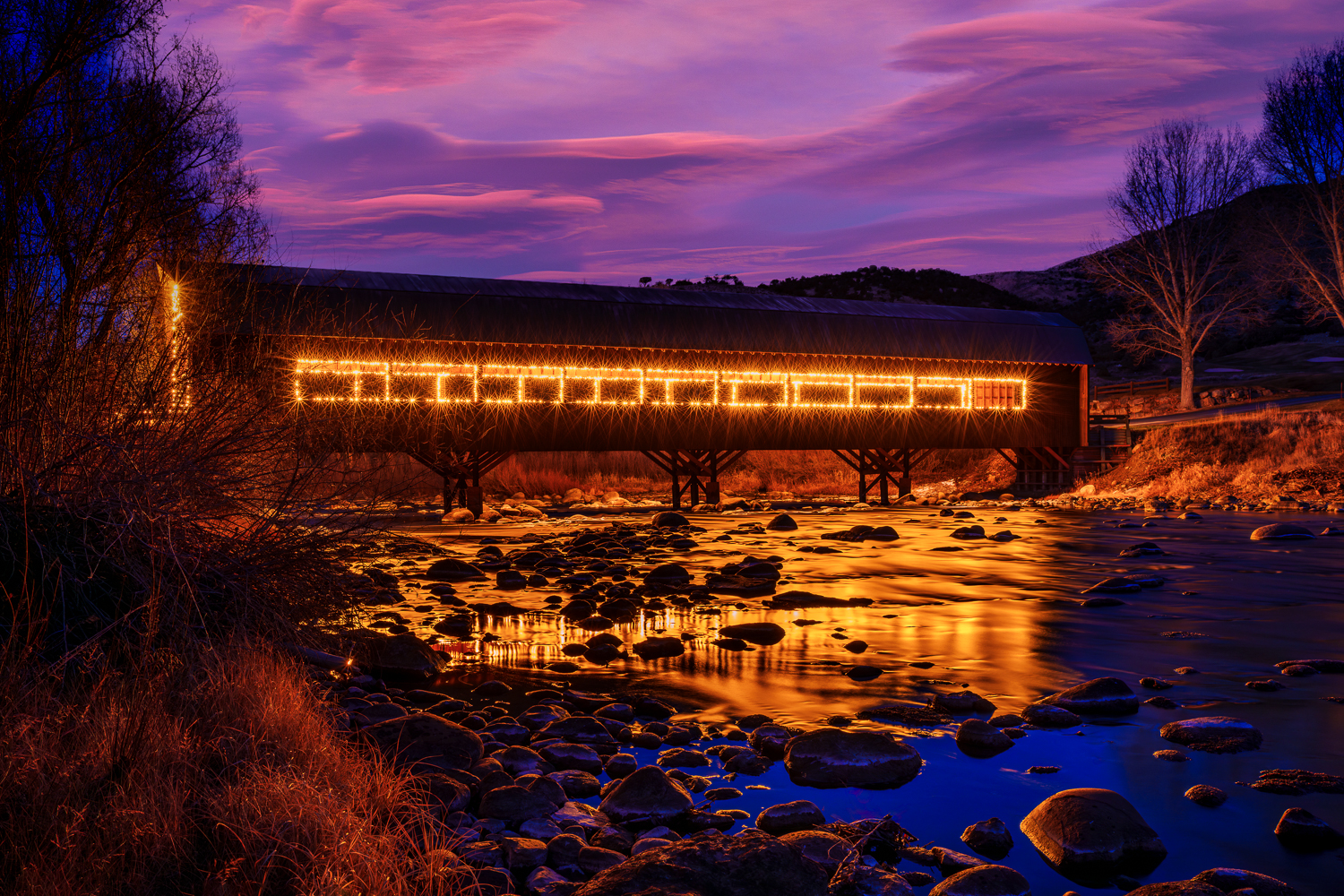
The soft glow of a covered bridge at blue hour reflects across a rocky river, set beneath textured twilight clouds. A quiet moment where structure and landscape meet.
ILCE-7CRVoigtlander NOKTON 28mm F1.5 Aspherical lens28mmf/9.081s100 ISO0.0 EV
douter wrote:
Festive looking, Scott, I keep wanting to turn down the brightness just a bit, though, just to soften it a bit more.
Douglas
Thanks Douglas — the lights were actually quite bright in person, so it was a bit of a balancing act trying to keep them from overpowering the scene while still letting them glow. Ultimately I ended up favoring a little extra luminosity for contrast against the blue hour ambient light. Totally fair observation though!
Thanks Dan for the feedback just wanted to know more what you meant? Wondering if you could elaborate more? Do you mean you feel the exposure is overexposed technically or more aesthetically To me the lights seem exposed properly but they were really bright and the reflection too. I did capture a few earlier at the beginning of blue hour but the lights still seemed also bright. What would be your suggestion for approaching this kind of image in the future? I appreciate your input.
Dan Cross wrote:
I love this image, but I tend to agree with Douglas, the lighting in the bridge is a little overpowering for the scene. The composition is fantastic!
Blue hour can be tricky to balance with artificial light. I would bring down the luminance by selecting the color of the orange bridge lighting. I would only bring this down a little. I don’t believe the image is over exposed, I think the bridge lighting commands a lot of attention in the overall image and detracts from the awesome sky, IMHO.
Dan Cross wrote:
Blue hour can be tricky to balance with artificial light. I would bring down the luminance by selecting the color of the orange bridge lighting. I would only bring this down a little. I don’t believe the image is over exposed, I think the bridge lighting commands a lot of attention in the overall image and detracts from the awesome sky, IMHO.
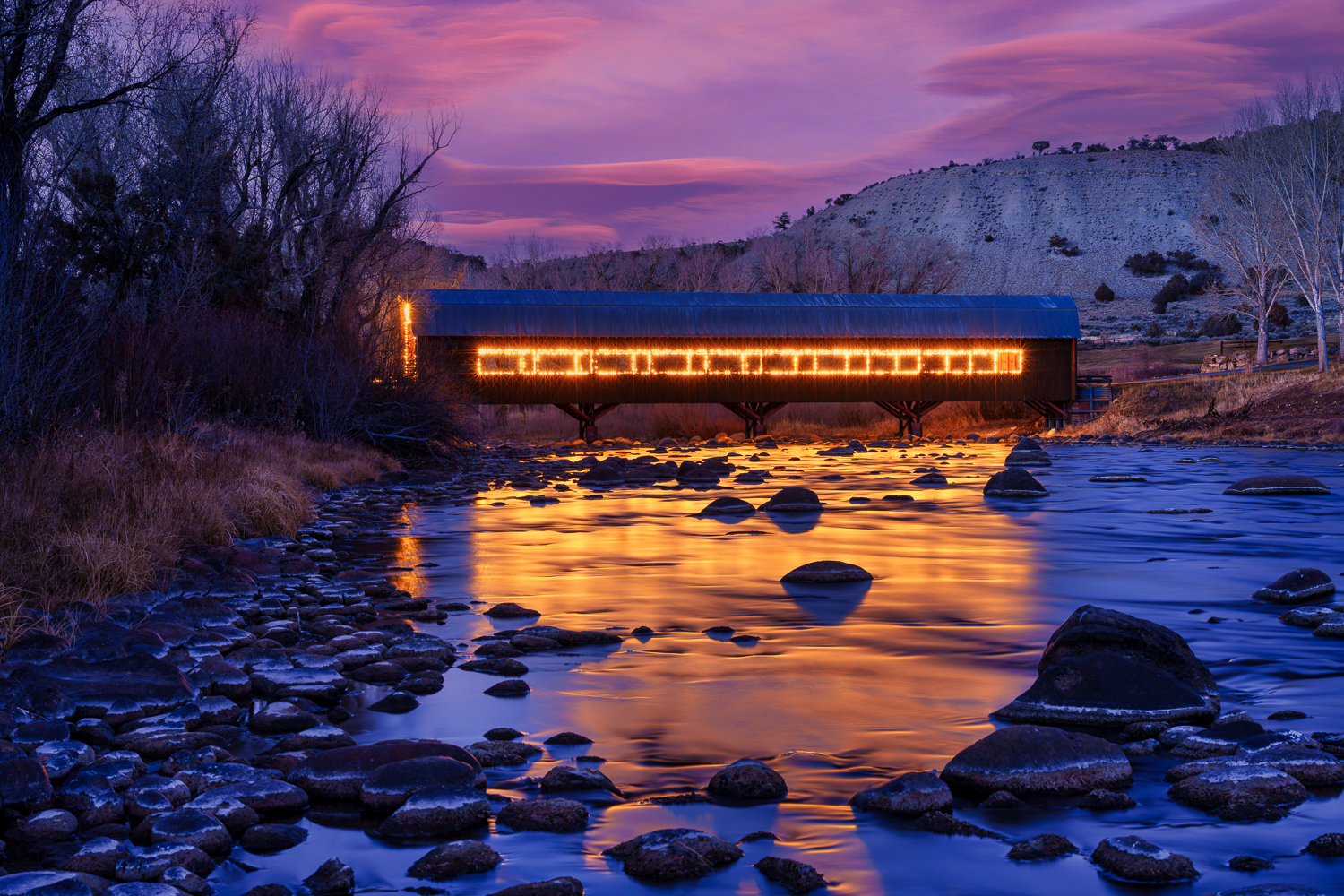
I appreciate that Joel! Thank you! There's something about blue hour shots that I really like to capture and always on the lookout for subjects. I was driving by this bridge the day before and saw the interesting reflections in the water. Came back the next day and tried to time it with blue hour. Here's another one captured a few minutes earlier - maybe this one is more balanced with the lighting?
ILCE-7CRVoigtlander APO-LANTHAR 50mm F2 Aspherical lens50mmf/10.061s100 ISO0.0 EV
adventure_photo wrote:
I appreciate that Joel! Thank you! There's something about blue hour shots that I really like to capture and always on the lookout for subjects. I was driving by this bridge the day before and saw the interesting reflections in the water. Came back the next day and tried to time it with blue hour. Here's another one captured a few minutes earlier - maybe this one is more balanced with the lighting?
You know....Im a sucker for color. I like them both TBH. Chad Hites (who is on this forum) and I go back and forth on color. He likes it a bit more muted and I like it a bit more saturated. I love the drama of the first however I like the softness of the second. This is why I love photography....There is no really perfect way to photograph. I love your "style". If I had to pick which I like best I would gravitate towards the first...Just me though.
J. Pow wrote:
You know....Im a sucker for color. I like them both TBH. Chad Hites (who is on this forum) and I go back and forth on color. He likes it a bit more muted and I like it a bit more saturated. I love the drama of the first however I like the softness of the second. This is why I love photography....There is no really perfect way to photograph. I love your "style". If I had to pick which I like best I would gravitate towards the first...Just me though.
Cheers, Joel
Thank Joel, I'm with you, I prefer saturated colors too as long as they are bold but not excessive where everything looks nuclear. I feel like I tend to "perceive" colors when I'm out there as saturated also. I appreciate your feedback and kind words!
adventure_photo wrote:
Thank Joel, I'm with you, I prefer saturated colors too as long as they are bold but not excessive where everything looks nuclear. I feel like I tend to "perceive" colors when I'm out there as saturated also. I appreciate your feedback and kind words!
Yes I would say thats a great assessment of what I feel like as well. I find color to be what makes photography enjoyable to me. I have tried B&W but I tend "not to get it"
Orphoto wrote:
yes, the one a few minutes earlier is much bettter. colors are less "nuclear" and the sky color on both edges in the trees is far more believable.
This is a fascinating scene, and it is complex enough to make photographing it a big challenge. Color and luminosity in night and near-night photographs that include artificial lighting are tricky. The natural light can be somewhere between muted daylight (if the full moon is out) and quite intensely blue. Because our eyes are less sensitive to color in very low light, we aren’t aware of the intensity of the blue when we look at the scene, but the camera works differently and it is possible to end up with something quite intensely blue. I think that happened here.
So what should we do with the blue? There’s no right answer. I’ve seen work in which the photographer “went blue” and did not try to compensate for this difference between what our eyes and the camera see at night, and some of them work really well. I’ve seen others in which the photographer toned down the intensity of the blue to create something closer to what we recall seeing, and that can work, too.
I don’t know what the “right” approach is here, and more than one are possible. If I were working this scene, I think I’d tone down the blue of the water for a more natural effect and to avoid having the extremely intense blue distraction a viewer from the sky and the bridge, which I think are more important elements of the scene. I’d probably also let the water go darker ‚ if it is as bright as other important elements in the scene, things become pretty complicated. You certainly can feel differently though.
I’d also consider darkening the light face of that hill on the far right side. It isn’t that important of an element, and it is off to the side — it can be deemphasized.
As to the bridge lights and their reflection… my impression is that the bridge lights in the second image are probably OK. We’re they actually that yellow in person? If not, I might consider shifting them a bit toward blue. The reflection in the water is interesting, but not as interesting as the bridge itself, but because of its brightness and intensely warm color, it seems to me like maybe in overpowers the bridge itself… with the latter feeling like it should be the main subject.
gdanmitchell wrote:
This is a fascinating scene, and it is complex enough to make photographing it a big challenge. Color and luminosity in night and near-night photographs that include artificial lighting are tricky. The natural light can be somewhere between muted daylight (if the full moon is out) and quite intensely blue. Because our eyes are less sensitive to color in very low light, we aren’t aware of the intensity of the blue when we look at the scene, but the camera works differently and it is possible to end up with something quite intensely blue. I think that happened here.
So what should we do with the blue? There’s no right answer. I’ve seen work in which the photographer “went blue” and did not try to compensate for this difference between what our eyes and the camera see at night, and some of them work really well. I’ve seen others in which the photographer toned down the intensity of the blue to create something closer to what we recall seeing, and that can work, too.
I don’t know what the “right” approach is here, and more than one are possible. If I were working this scene, I think I’d tone down the blue of the water for a more natural effect and to avoid having the extremely intense blue distraction a viewer from the sky and the bridge, which I think are more important elements of the scene. I’d probably also let the water go darker ‚ if it is as bright as other important elements in the scene, things become pretty complicated. You certainly can feel differently though.
I’d also consider darkening the light face of that hill on the far right side. It isn’t that important of an element, and it is off to the side — it can be deemphasized.
As to the bridge lights and their reflection… my impression is that the bridge lights in the second image are probably OK. We’re they actually that yellow in person? If not, I might consider shifting them a bit toward blue. The reflection in the water is interesting, but not as interesting as the bridge itself, but because of its brightness and intensely warm color, it seems to me like maybe in overpowers the bridge itself… with the latter feeling like it should be the main subject.
Thanks for your thoughtful response Dan. You really articulated the challenge of mixed natural and artificial light at night and I think in hindsight you are right, the blues are a bit too blue and the lights a bit too warm. I ultimately leaned into the blue rather than fully neutralizing it, knowing it was a stylistic choice rather than a strictly “natural” one. Whether that works or not is definitely open to interpretation. And yes those lights were warmer than most, far warmer than 3200 Kelvin. I think in the future I would approach it with more selective masking of color tones and bring each to an acceptable and believable level. I also appreciate your comments about the relative brightness of the water and the reflections versus the bridge itself — that’s a really good point about hierarchy and where the viewer’s attention settles. And you’re probably right about the hillside on the far right; it’s not doing much narrative work and could be pushed back. Challenging scene indeed — and exactly the kind that makes this sort of discussion so valuable. Thanks again for taking the time to dig into it.