fredmiranda.com
Login

Moderated by: Fred Miranda
  New fredmiranda.com Mobile Site
  New Feature: SMS Notification alert
  New Feature: Buy & Sell Watchlist
  

FM Forums | Canon Forum | Join Upload & Sell

1              3       end
  

AI for advice on choosing lens or camera


AmbientMike
Offline
• • • • • •
[X]
p.2 #1 · AI for advice on choosing lens or camera


I religiously avoided f/16, for years, bcause the very credible MTF test based photodo.com said it doesn't matter, all lenses more or less equally bad at 16.

Of course I got to testing eventually actually shot photos and looked at 100%, it wasn't true.

Even at f/32 lenses can be better than others. I doubt any are best sharpness stopped down that far, but its not necessarly too far behind f/8 either if you get a good usually older one that can perform good there. You certainly can't tell just on the lcd, without looking close.


Dec 13, 2025 at 01:29 PM
cpe1991
Offline
• • •
Upload & Sell: Off
p.2 #2 · AI for advice on choosing lens or camera


I did some searching on ChatGPT and it cited some of my own reviews on canonrumors. So, don't take it too seriously for camera stuff though it is excellent for well-established areas and where there is extensive codified material.


Dec 13, 2025 at 03:13 PM
Scott Stoness
Offline
• • • • • •
Upload & Sell: On
p.2 #3 · AI for advice on choosing lens or camera


Z250SA wrote:
Oh, this is interesting in som many ways and on so many levels! Yes, the Asimov novel on Multivac when humans had forgot how to add... YMMW!!

Firstly, the Airy disc, Rayleigh criterion, Nyquist frequency etc are science facts and used within the context of diffraction.

The DLA uses some measure of diffraction and adds the "pixel size" for our pleasure and enlightenment, yes, to a degree. The first problem is the measure of diffraction e.g. the Airy disc. Its size is dependent on the wavelength of the light. Short waves as in blue, smaller disc, reds larger. Which to use?
...Show more

I agree with your points. DLA is a binary measurement where the reality is linear. But it still matters a lot when it is the limiting factor. eg when you have perfect technique, great light, and a very good lens.

DLA is just the fstop point where defraction does not enable the entire use of the glass, presuming the glass is perfect. Shooting at fstop greater than R7/ff5.2 by one stop (f8) is likely going to be okay but at f11 cropping or magnifying will yield results that are not great at very large print. I have accidentally shot at very high fstop (3 stop eg f16 on apsc) and then had to back up to find out what went wrong - it was noticeable. But then when I want perfect sun stars, the composition matters more. So your points are valid but the DLA number does matter too, in telling you to not push it very far.


Dec 13, 2025 at 04:38 PM
gdanmitchell
Offline
• • • • • • •
Upload & Sell: Off
p.2 #4 · AI for advice on choosing lens or camera


Scott Stoness wrote:
I agree with your points. DLA is a binary measurement where the reality is linear. But it still matters a lot when it is the limiting factor. eg when you have perfect technique, great light, and a very good lens.

DLA is just the fstop point where defraction does not enable the entire use of the glass, presuming the glass is perfect. Shooting at fstop greater than R7/ff5.2 by one stop (f8) is likely going to be okay but at f11 cropping or magnifying will yield results that are not great at very large print. I have accidentally shot at
...Show more

I think it can be useful to know the (approximate) diffraction limited aperture (DLA) of your lenses on your camera, but it is also possible to get too wrapped up in that as a "holy number" that must be obeyed.

Let's say that I figure out that f/5.6 or thereabouts is the DLA for my camera, In most cases where I don't need a larger or smaller aperture, I'll probably just shoot about about that aperture. Why not?

But if the need of more light or more DOF (or a different shutter speed) suggests a somewhat different aperture, I'm not going to sweat it since the alternative apertures will also produce a very sharp photograph.

Of course, one has to think of this in relationship to other aspects of the lens' performance. Let's say that you are using a lens that doesn't really sharpen up in the corners until f/8. You'd have to decide on the relative importance of corner versus center sharpness, and it might (or might not) be reasonable to argue that the best overall sharpness is at f/8.

Finally, if you shoot from the tripod, rather than relying on calculations (of DLR or DOF, etc.) I think it is better to just zoom in on the rear screen view, then look at different parts of the frame that concern you with the DOF preview button pressed.

- - -

As to the whole "let AI pick my camera" thing, I can see some value in it but I can also see some problems. If it were easy and simply objective to determine the "best" camera, then we would not see so many brands and options. In reality, there are so many dimensions to the choice and they are so individual and personal, that in the end you can probably choose a range of gear and be happy... or not.


Dec 13, 2025 at 04:46 PM
AmbientMike
Offline
• • • • • •
[X]
p.2 #5 · AI for advice on choosing lens or camera


On the old modern photography tests you'd see 63 lp/mm at ~f/8 on a very good lens, might drop to 54-58 lp/mm at f/16. Good luck seeing much difference between 63 lp/mm and 54-58 lp/mm real world. The ones that did well at f/32 still 50 lp/mm, which is possibly 24-105 land, so pretty usable.

Tamron 17 had its best center performance at f/4....and f/16. The old FD 20-35 L had its best performance at f/11 & 16, not too surprisingly for a lens designed for serious amateur and professional use for landsape on a tripod before focus stacking using <125 ISO slide film

I just get pretty skeptical about newer equations telling me i need to shoot at a more open aperture to get sharp results. Contradicts a lot of other things I've seen


Dec 13, 2025 at 10:37 PM
garyvot
Offline
• • • • •
Upload & Sell: On
p.2 #6 · AI for advice on choosing lens or camera


Good discussion about DLA.

I very rarely shoot stopped down, and so do not encounter this issue much. But, one of the things that I've always been curious about with Canon's Digital Lens Optimizer tech is the practical effect of its diffraction correction.

If you are not familiar with DLO, it is a lens+camera body-specific set of corrections for aberrations beyond basic CA, distortion and vignetting and has long been a part of the DPP workflow. It is also now included in recent cameras.

Here's what Canon's documentation says:

The Digital Lens Optimizer function enables the resolution of images to be increased by removing any remaining aberration related to image-forming capability or any deterioration of resolution resulting from diffraction phenomena. These optical phenomena cannot be corrected under Lens aberration correction. Correction is achieved using the designed value of each lens. The images that can be corrected are RAW images shot using any of the compatible lenses and cameras.

Apparently the corrections take into account the characteristics of the lens plus the specific low pass filter implementation in each supported camera.

I have used this and I can tell you that it really does optimize the results from various Canon lenses, improving sharpness and reducing color blur. I find it is particularly helpful with consumer-grade lenses.

But again, most of my shooting occurs at or near maximum aperture, so I haven't had much experience with the diffraction correction.

For people who shoot stopped down, I am wondering if you have explored this technology and whether it improves the quality of your results?


Dec 14, 2025 at 03:03 AM
rscheffler
Offline
• • • • • •
Upload & Sell: Off
p.2 #7 · AI for advice on choosing lens or camera


Gary, I think the problem with DLO is you have to use DPP to realize the benefits and likely the vast majority do not. You might have to answer this one for us.

Maybe the closest non-Canon software in terms of careful image tuning for a given camera and lens is DxO, but I have not tried it. I did buy a license but never got around to it...

Mike, a quick and dirty way to determine when your landscape images are no longer recording more detail as you stop down is to shoot an aperture sequence of the scene and then compare the compressed (jpeg) file sizes. On stopping down, once the file sizes start to go down again, those images are more compressible, which suggests they contain less unique information (less sharpness).

To some degree there is leeway in post to offset diffraction with careful sharpening. Sharpening can potentially also slightly increase apparent depth of field. IOW there's probably a bit of a gray zone where things overlap.


Dec 14, 2025 at 03:25 AM
Scott Stoness
Offline
• • • • • •
Upload & Sell: On
p.2 #8 · AI for advice on choosing lens or camera


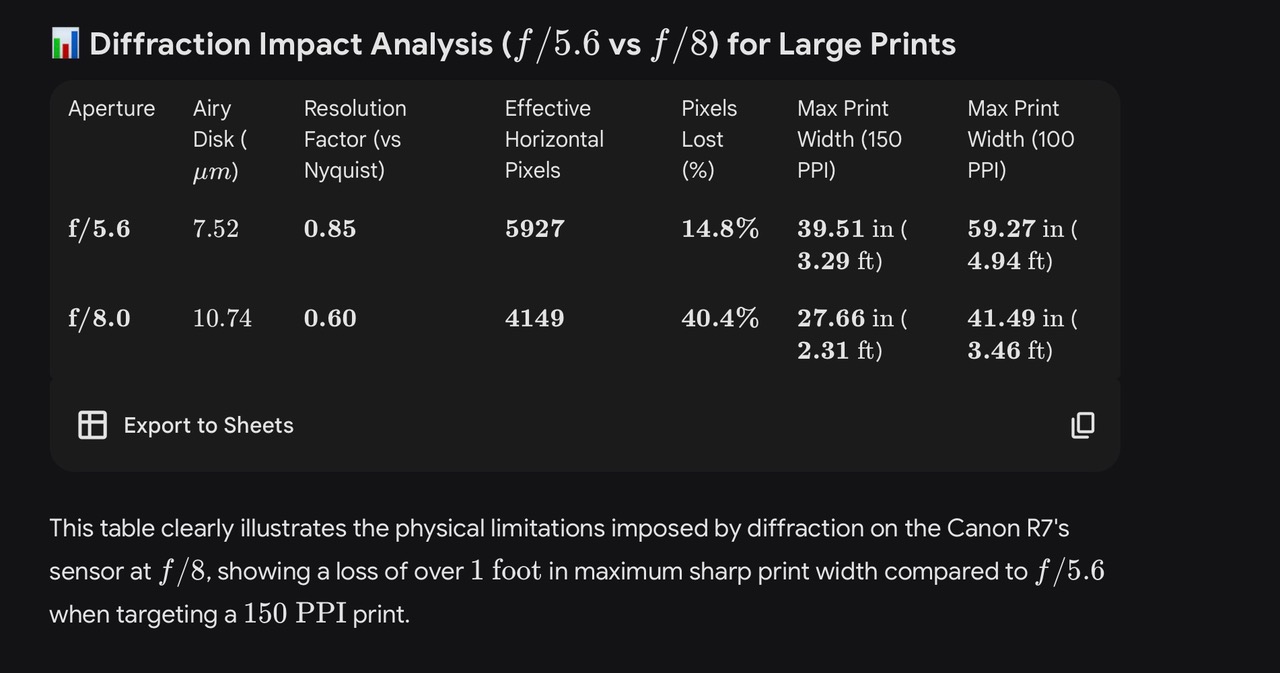
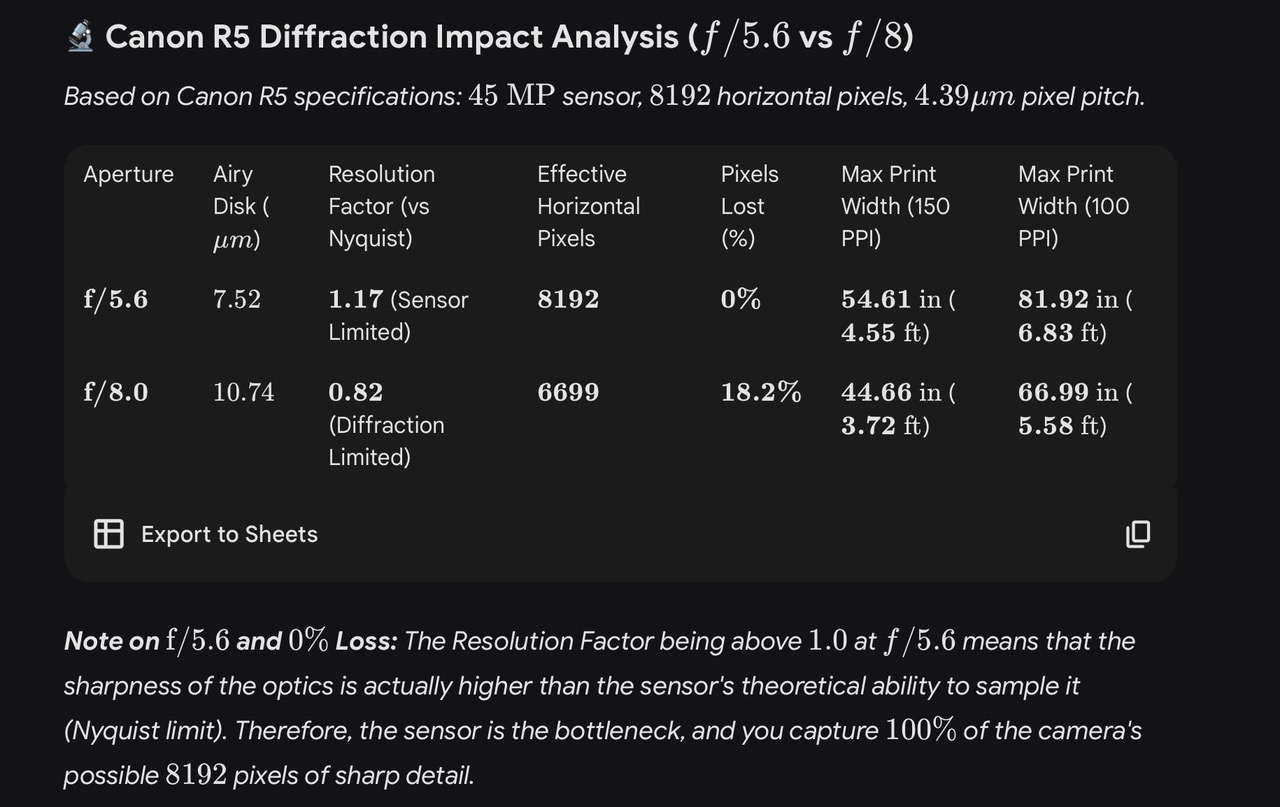
This is a good discussion but to take it back to AI theme, here is what Gemini says about f5.6 vs f8 on R7/200-800 with internal 1.4x (f5.6 ~900mm) vs external 2x (f8 ~ 1280mm). [this ignores the additional distortion that would come from adding 2x vs 1.4x]

Gemini was able to create this table calculated with credible math into a practical answer within 15 minutes. It would have been faster but I had to tune to 100ppi (it initially suggested 200 minimum) and it mistakenly assumed I wanted to use 2x and 1.4x interns (my query was not clear. And if I was faster at typing and thinking, it would have been seconds). Impressive!

Cropping more would reduce the print size even more.

[I then asked it to redo the math based on R5. It did this in less than a second - it is presented at bottom]

Thus defraction does matter at large print size or normal large cropping.


R7 ---- Diffraction affects with R7 200-400 1.4x vs 2x


R5 ---- Diffraction affects with R7 200-400 1.4x vs 2x


Dec 14, 2025 at 10:01 AM
Scott Stoness
Offline
• • • • • •
Upload & Sell: On
p.2 #9 · AI for advice on choosing lens or camera


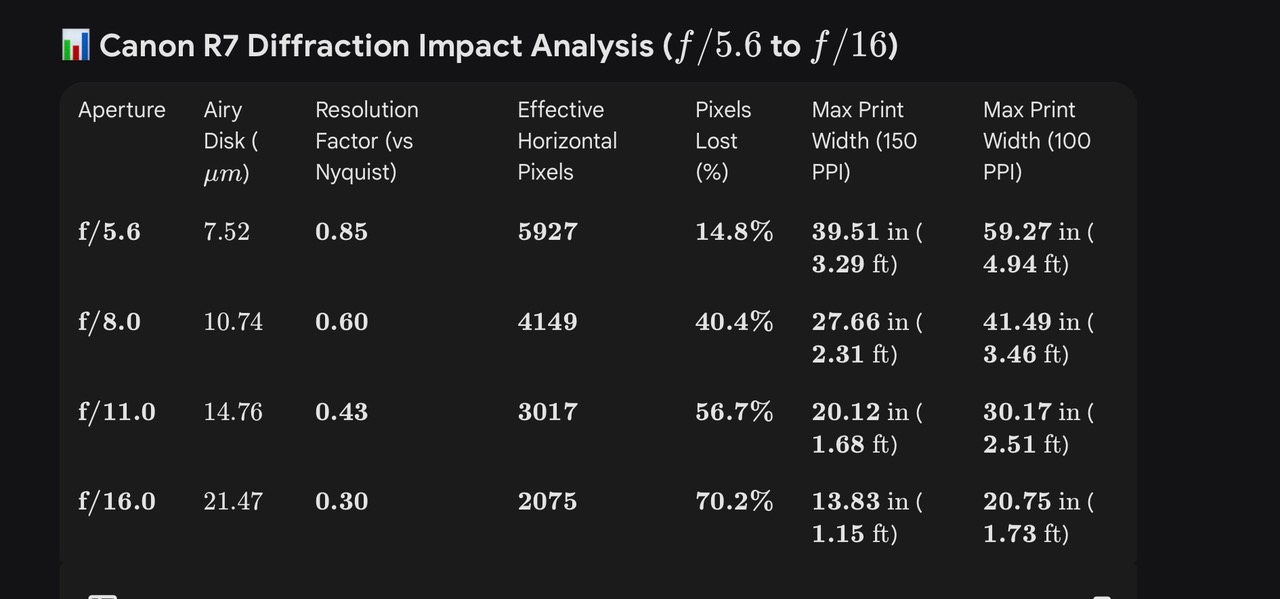
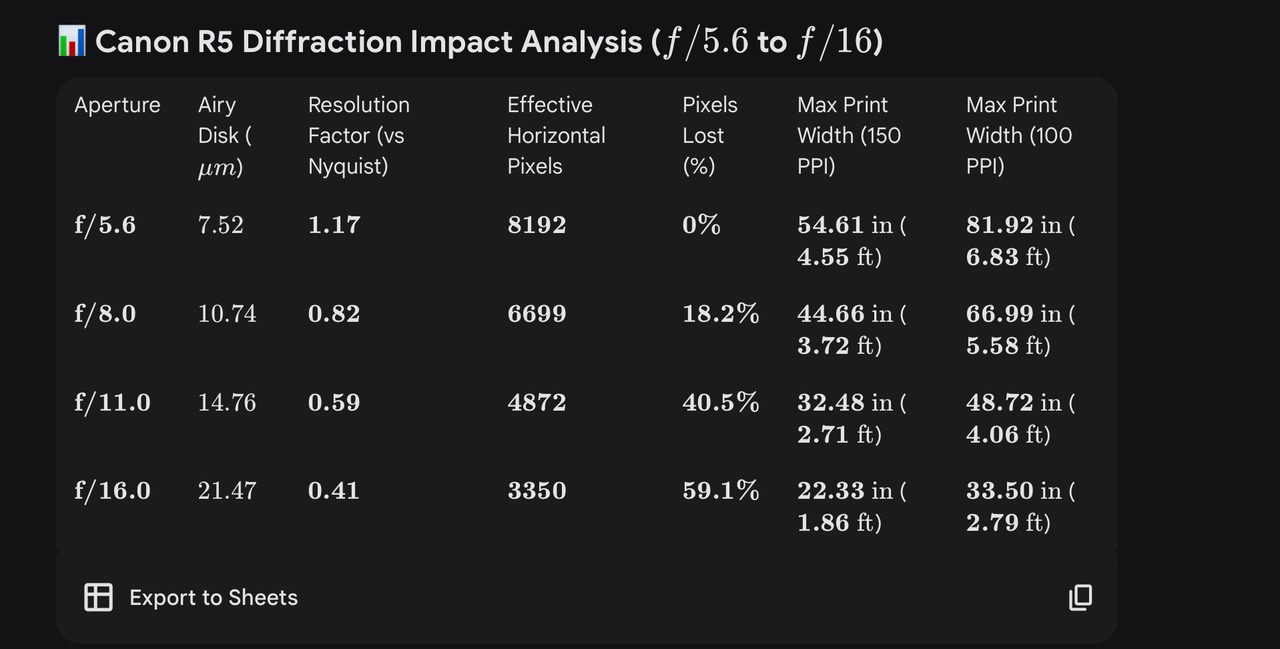
And then to complete the discussion here is r7 and r5 print size impacts for defraction:


Dec 14, 2025 at 10:25 AM
Scott Stoness
Offline
• • • • • •
Upload & Sell: On
p.2 #10 · AI for advice on choosing lens or camera


The other thing that I realize in the tables above is that my 200-800 which is f9 at 800mm is likely okay, for printing at 48x32, as long as I don't crop more than 50% width on r5 and am happy with 100ppi print.

Whereas on the R7, I really should not expect great beyond about 32" when using 800mm on the r7, with 200-800 at 800.

[I note that I have printed 48x32 of a wolf on canvas [canvas limits resolution anyway] with my 7d2 and it's okay as long as I don't stick my noise up close or employ some dxo magic. So these conclusions are relative and subjective to the photographer/artist. The wolf picture was still quite good as an artistic expression and I am proud to hang it.]

[And as a further note, if you are posting here at 1080 pixels wide, you would be happy with f16 on either camera with the 200-800 at f9]


Dec 14, 2025 at 10:39 AM


Search in Used Dept. 

gdanmitchell
Offline
• • • • • • •
Upload & Sell: Off
p.2 #11 · AI for advice on choosing lens or camera


Scott Stoness wrote:
This is a good discussion but to take it back to AI theme, here is what Gemini says about f5.6 vs f8 on R7/200-800 with internal 1.4x (f5.6 ~900mm) vs external 2x (f8 ~ 1280mm). [this ignores the additional distortion that would come from adding 2x vs 1.4x]

Gemini was able to create this table calculated with credible math into a practical answer within 15 minutes. It would have been faster but I had to tune to 100ppi (it initially suggested 200 minimum) and it mistakenly assumed I wanted to use 2x and 1.4x interns (my query was not clear.
...Show more

While tables like these have some interest, I’m skeptical of their value in evaluation real world photographs or in choosing apertures.

While the measurement of how light spreads on a sensor can be objective, the decisions about how this does or does not negatively affect a photograph are dependent on a whole range of things that aren’t captured by those numbers. In the end, it is far better, I think, to start getting to know the actual effects on photographs by testing them — e.g. looking at the photographs rather than the charts.

Many years ago I succumbed to the beliefs that “f/8 is the best aperture” — which was probably, from the DLA point of view, reasonably accurate with the camera I was using at the time. I simply assumed this to be gospel and avoided larger and smaller apertures like the plague.

Then, on one memorable day, I took some of my lenses you to a place were I could make some controlled exposures with each lens at a range of focal lengths and apertures. I took the files back home and inspected them very carefully. I also printed some of them. Yes, in fact, f/16 was a bit less sharp than f/8 at very large magnifications but both could be very sharp at quite large reproduction sizes. And if the nature of the subject was better served by using f/2 or f/16 rather than f/8, that was far more important than getting the supposedly least diffraction blur.

As we know, these things are also subject-related. For example, with subject/background separation created by a very large aperture (and perhaps enhanced by lighting, color, and composition decisions), that main subject can look very sharp (what I call “subjectively sharp”) against that softer background even if it is objectively less sharp than if we had used the DLA… decreasing the “sharpness gradient” between the subject and background. Or in a photograph with elements at different distances where we don’t want that soft background effect, the small loss in sharpness to diffraction in the plane of optimal focus is an acceptable price to pay for better sharpness of elements not in that plane.

It seems to me that while understanding the formulas and math can be useful, trying to make photographic decisions based on them is often not the best approach.


Dec 14, 2025 at 10:57 AM
AmbientMike
Offline
• • • • • •
[X]
p.2 #12 · AI for advice on choosing lens or camera


I've tried talking to people having physics degrees abour optics, they dont seem to know much about them. And some of the stuff physicists in general come up with is just clearly wrong. So I don't have too much trouble blowing off equations conflicting years of real experience.

I'd use 1.4 tc on the 200-400 expecting to stop it down to ~f/8 to get best performance. Slapping 7 elements on the back of your lens probably hurts performance but if i figured out the sharpest aperture it should still beat cropping (cropping probably isnt the end of the world, either, if you shot like that.) IIRC I've read on here 1.4 III beats the built in one (one more reason to oppose built in tc's) so I'd try that


Dec 14, 2025 at 11:59 AM
Scott Stoness
Offline
• • • • • •
Upload & Sell: On
p.2 #13 · AI for advice on choosing lens or camera


gdanmitchell wrote:
While tables like these have some interest, I’m skeptical of their value in evaluation real world photographs or in choosing apertures.

While the measurement of how light spreads on a sensor can be objective, the decisions about how this does or does not negatively affect a photograph are dependent on a whole range of things that aren’t captured by those numbers. In the end, it is far better, I think, to start getting to know the actual effects on photographs by testing them — e.g. looking at the photographs rather than the charts.

Many years ago I succumbed to the beliefs
...Show more

I agree, composition/bokeh choices/dof is often more important than sharpness, even when printed large. In my specific example - Polar bears at large distance - I think the conclusion - shoot with 200-400 at 560 on R7 with EFCS - was a good one for maximum usage but many landscapes require dof or sunbursts... That's where human's can still outperform AI.

But AI is a great tool for musing (which lens, what camera, efcs vs electronic, what setting, 1.4 vs 2x,...) and planning a photography trip. And it is a really good tool vs the manual to find the settings.


Dec 14, 2025 at 12:16 PM
Scott Stoness
Offline
• • • • • •
Upload & Sell: On
p.2 #14 · AI for advice on choosing lens or camera


AmbientMike wrote:
I've tried talking to people having physics degrees abour optics, they dont seem to know much about them. And some of the stuff physicists in general come up with is just clearly wrong. So I don't have too much trouble blowing off equations conflicting years of real experience.

I'd use 1.4 tc on the 200-400 expecting to stop it down to ~f/8 to get best performance. Slapping 7 elements on the back of your lens probably hurts performance but if i figured out the sharpest aperture it should still beat cropping (cropping probably isnt the end of the world, either,
...Show more

I agree with 1.4x vs 2x. At the limits of magnification vs cropping, I have never liked the 2x.

The f8 stop (from 5.6) down I don't agree with. My 200-400 is very sharp wide open. Halving the shutter speed is significant. And Defraction does matter on r7. I would agree with this if you had a non L lens with R7 printed small. eg I have read that 200-800 at 800 is better at f10.

The internal 1.4x being less sharp is a copy to copy issue. My internal is very good and is much much more convenient. if your copy is not good at internal 1.4x, you should get if fixed because otherwise what's the point of the 200-400.


Dec 14, 2025 at 12:25 PM
gdanmitchell
Offline
• • • • • • •
Upload & Sell: Off
p.2 #15 · AI for advice on choosing lens or camera


And some of the stuff physicists in general come up with is just clearly wrong.


?


Dec 14, 2025 at 12:53 PM
Z250SA
Offline
• • •
Upload & Sell: Off
p.2 #16 · AI for advice on choosing lens or camera


Scott Stoness wrote:
... So your points are valid but the DLA number does matter too, in telling you to not push it very far.


Yes, it matters. But I think you have got the proportions wrong. There are several other variables to ponder. Add the Two Great Unknowns, of which the sensor-to-RAW-magic is one, Bad Air the other.

In my testing, and I have done some through the years, my take on diffraction is as follows. We are juggling three variables in our quest for sharp images full of detail. Diffraction, noise and exposure.

1. Diffraction is physics, in practice how large the Airy disc is compared to the pixel. The disc is a point with rings around it. The pixel captures some photons of whats hitting it, pixels capturing red, green, green or blue, the Bayer array. Do we actually know how many pixels that contribute to any single point of light in the final RAW images? No! My guess is that using the actual photo site size to calculate DLA gives us too low a value. This is probably why we can get great results despite being on the wrong side of DLA.

2. Noise. Here I´m ignorant, just a user who tries to handle it as it is forced upon me. With DPP. I´m just not interested. Boring as hell.

3. Exposure, fast enough shutter to freeze action, in a second step slow enough to avoid as much noise as possible. Noise can be handled in post, motion blur not. All this while getting the correct lighting of the subject.

But the best way to get the most detail is to get the subject large on the sensor. Yet an other balance to get right. This one includes the luggability of the gear, the price of it etc. So, 200-400 or 200-800, R5 or R7? I´d take the 200-800 with the R5. I loose some reach, but I gain in lower noise. And I will carry it with ease all day long, all four hours these days.

So, yes, diffraction is one variable. But between the ice bear and the final print there are so many more variables that have far greater impact than DLA, especially DLA.

And yes, avoid f/16, perhaps f/14 (as in 100-500 + 2x). With the present day sensors, even the most demanding, the R7, f/11 is totally usable. With the R7 high ISO is the formost problem, not the DLA.


Dec 14, 2025 at 12:56 PM
Z250SA
Offline
• • •
Upload & Sell: Off
p.2 #17 · AI for advice on choosing lens or camera


AmbientMike wrote:
On the old modern photography tests you'd see 63 lp/mm at ~f/8 on a very good lens, might drop to 54-58 lp/mm at f/16. Good luck seeing much difference between 63 lp/mm and 54-58 lp/mm real world. The ones that did well at f/32 still 50 lp/mm, which is possibly 24-105 land, so pretty usable.

Tamron 17 had its best center performance at f/4....and f/16. The old FD 20-35 L had its best performance at f/11 & 16, not too surprisingly for a lens designed for serious amateur and professional use for landsape on a tripod before focus stacking using
...Show more

Those lenses were just even worse at open apertures. That is no support for getting nice results at f/11 and beyond.

"Shocking" lists of how we must do things, lists of the effects of diffraction in relation to print size and such are mostly annoying click bait, on forums some local guru wannabe striving for a place in the Sun. Or an engineer having a bromance with AI. Ay ay!


Dec 14, 2025 at 01:32 PM
EB-1
Offline
• • • • • • •
Upload & Sell: Off
p.2 #18 · AI for advice on choosing lens or camera


Mostly positive reviews of mediocre lenses are contaminating the database of the AI. The defect is that the reviewers are either clueless or dependent on free products so they bury the weaknesses of the lenses.

EBH


Dec 14, 2025 at 01:41 PM
Z250SA
Offline
• • •
Upload & Sell: Off
p.2 #19 · AI for advice on choosing lens or camera


Scott Stoness wrote:
This is a good discussion but to take it back to AI theme, here is what Gemini says about f5.6 vs f8 on R7/200-800 with internal 1.4x (f5.6 ~900mm) vs external 2x (f8 ~ 1280mm). [this ignores the additional distortion that would come from adding 2x vs 1.4x]

Gemini was able to create this table calculated with credible math into a practical answer within 15 minutes. It would have been faster but I had to tune to 100ppi (it initially suggested 200 minimum) and it mistakenly assumed I wanted to use 2x and 1.4x interns (my query was not clear.
...Show more

Sorry if I sound blunt, english is my third language, but... Pro looking tables with pure numbers do ooze an air of accurcy. But they are no more accurate than the least exact number used for the results.

You/AI use the number of pixels per the width of the sensor as the de facto measure of effective pixel size.

Actually you have no clue if this is correct. I would argue that there are things going on between the light hitting the sensor and the final RAW file that, to put it in the context of f-values, makes f/11 and even higher to still produce very good results far beyond the calculated outcome based on pixel count per sensor size

In short you do not know how the camera handles the Airy disc. This could very well explain why we get great results at e.g. f/11, even with the R7.

And with tele lenses at longer distances, throw in air with some temperature mix and there went any hope of sharpness. The image might still be an artistic wonder, though!


Dec 14, 2025 at 02:17 PM
Z250SA
Offline
• • •
Upload & Sell: Off
p.2 #20 · AI for advice on choosing lens or camera


AmbientMike wrote:
And some of the stuff physicists in general come up with is just clearly wrong. So I don't have too much trouble blowing off equations conflicting years of real experience.


When blowing off, do it of the right reasons. What you have encountered is the divide between science and normality.

Science is by nature strictly defined. "At standard temp and pressure", "in vacuum", my favorit "error being homoscedastic". Why? Because any chance of understanding anything drowns in the complexity of Reality. Too many variables vary with time, temp, moisture, magnetism, wave length, resistance, impedance, inductance, viscosity, personal understanding of humor etc etc in eternity.

Physicists tend to assume that the necessary standards are met. In Real Life they never ever are. And as most of us lack the level of knowledge it would take to understand what´s really going on, physicists answers are rarely applicable to any every day problems with the accuracy they seem to project.

Therefore scientists tend to "understand nothing" while some "know with certainty" despite being totally off.

The present thread is a splendid example of this! Does the AI know, or does it present a soup out of interweb cuisine?


Dec 14, 2025 at 02:42 PM
1              3       end


FM Forums | Canon Forum | Join Upload & Sell

1              3       end


Welcome back
Log in to your account