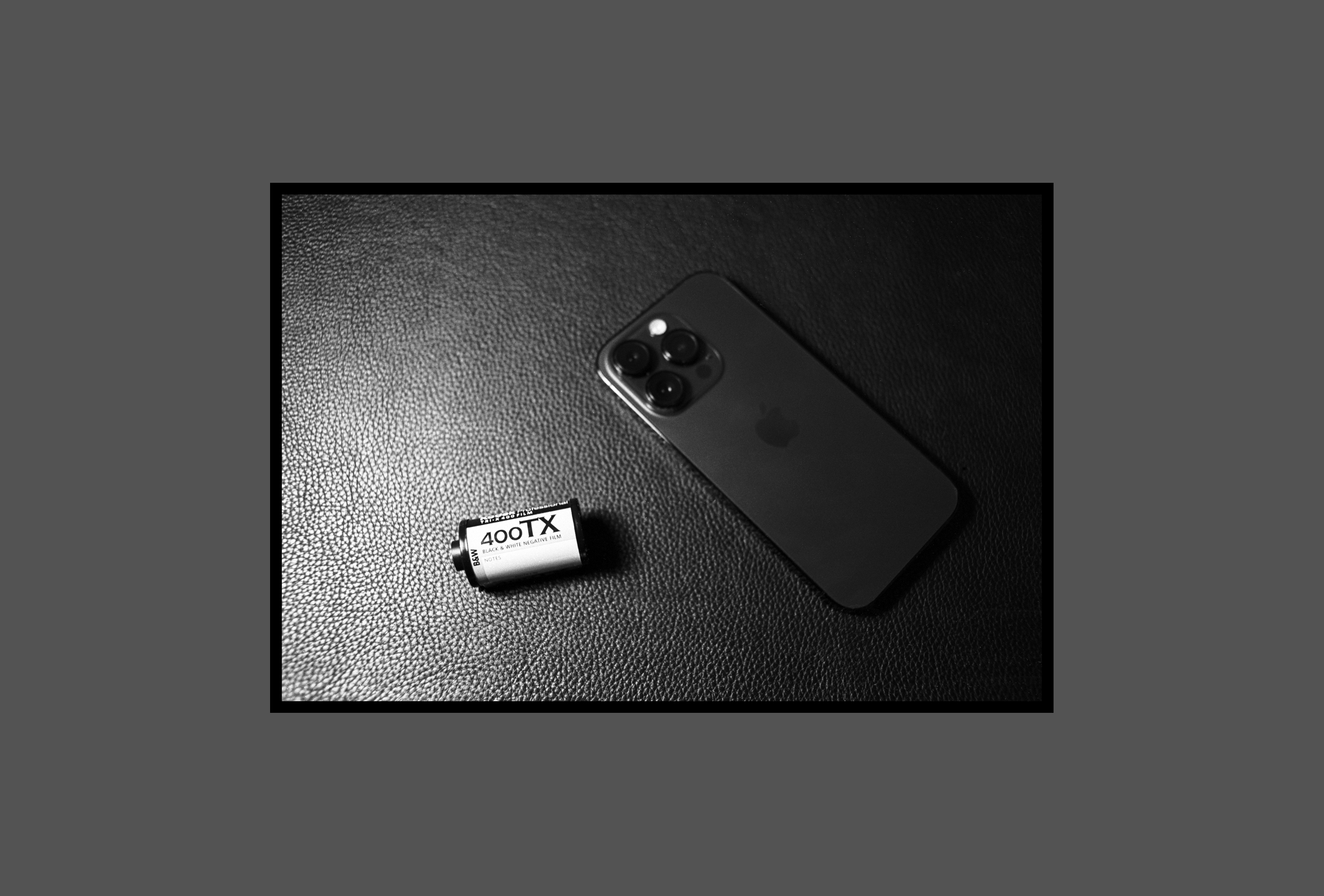
I’ve lost touch with reality. My M11 Monochrom should suffice for B&W and so far I’ve only shot color in my film cameras, but then again, my X2D ii should have that covered. I just ordered five rolls of each, who knows why.. but I have been taken by some of my images taken more than fifteen years ago using these emulsions. I remember using Xtol, TMax Developer and Rodinal..actually still have the Rodinal and probably still good to go. Just wonder if you use these two films and what you use for a developer and dilutions/times. Also, what ISO is your ‘normal’ for these films? Thanks is advance..
I am a one-chemistry (Rodinal) guy, have been happy with Acros and FP4, and I wanted to compare ISO400 films. The main question I had was if any of the usual suspects (HP5, Tri-X, Delta 400, and TMax 400) were faster than the others.
To my surprise, HP5 was faster than the others, and it actually gave me box speed (1+60, 20 minutes).
If ISO400 is important with film, HP5 is good, even with Rodinal. Perhaps it will give you a ton of grain in 35mm ... try to embrace it. Stick to your digital cameras if you want minimal grain at high ISO.
Kodak brought Tri-X , which is a cubic grain film, to the market in 1954. Thirty years later, the tabular grain TMax films were introduced to offer a film with finer grain. I've used a lot of each and they're both decent films that have good dynamic range and if developed properly, can produce fine grain.
First off, if your Rodinal is fifteen years old, it's worth it to buy a fresh bottle of Adox. It dose last a long time but there is always the chance of degradation. XTOL is an excellent choice and will perform a lot like D-76. My biggest problem with XTOL is it's only available in five liter packaging. Adox makes a similar formula, XT-3, and can be found in one liter packages.
With Rodinal, there is a reduction in speed. Rodinal has been my main developer for a few years and I'll set the ISO at 200 to compensate. When developing with Rodinal, it's either gentle, infrequent agitation or @theHUN has excellent results using constant, rotary agitation. A dilution of 1:50 has given me the best results.
With XTOL, there are fans of 1:1, stock or replenished. I've used both 1:1 and 1:3 with good results. The adavantage to XTOL, D-76 or HC-110 is there's no reduction in film speed.
You'll get plenty of other comments but I hope this helps.
madNbad wrote:
... @theHUN@ has excellent results using constant, rotary agitation ...
The results I am showing above did not use constant agitation, instead it was ~5 inversions at the start of each minute. I have since then switched to rotary developing ... which still gives me ISO400 but with more contrast.
It's also interesting to note that even though HP5 gives me box speed, FP4 and Acros give me the usual (for Rodinal) half box speed.
theHUN wrote:
The results I am showing above did not use constant agitation, instead it was ~5 inversions at the start of each minute. I have since then switched to rotary developing ... which still gives me ISO400 but with more contrast.
It's also interesting to note that even though HP5 gives me box speed, FP4 and Acros give me the usual (for Rodinal) half box speed.
My apologies. I knew you are using rotary agitation, I should have left out the "constant".
I pulled this roll 2 stops on a summer noon bright light and love how the shadows and highs came out. I may be odd, but I like the midtones the combo produces.
DF96 Monobath is new to me. It sure seem to simplify the process. On B&H it states that tabular films (TMAX 400) need to be developed twice as long so as to eliminate “the stain”. Has this been a problem? Do you find that grain size increases when compared to other developers? Anyone use it with constant rotation, like in a Jobo? Ahhh.. looked at some of your other images where you mention that the more agitation..the more grain..
Thanks for posting this. It sure seems to make developing only slightly more complicated than packing the film to mail off.
bwcolor wrote:
Wow..those are nice and contrast to my taste.
DF96 Monobath is new to me. It sure seem to simplify the process. On B&H it states that tabular films (TMAX 400) need to be developed twice as long so as to eliminate “the stain”. Has this been a problem? Do you find that grain size increases when compared to other developers? Anyone use it with constant rotation, like in a Jobo? Ahhh.. looked at some of your other images where you mention that the more agitation..the more grain..
Thanks for posting this. It sure seems to make developing only slightly more complicated than packing the film to mail off....Show more →
Tabular grain films like Tmax, Delta etc need twice the dev times to clear the base layer.
You can use this intentionally by NOT doing that to create a hazy, ethereal look but that needs to be very deliberate so you know it’s going to look like that!
DF96 is super easy to use and gives great results w TriX, HP5 and Kentmere films (amongst others).
It is in no way as versatile as regular developers where you can manipulate the look via manipulated the dev criteria.
Think of it as B&W dev for dummies!
Desmolicious wrote:
DF96 is super easy to use and gives great results w TriX, HP5 and Kentmere films (amongst others).
It is in no way as versatile as regular developers where you can manipulate the look via manipulated the dev criteria. Think of it as B&W dev for dummies!
Tri X I think is supposed to look better, Tmax better tech specs, IIRC. I liked Iford better though, used Pan F for a while
I overexposed B&W, maybe a stop or more, maybe not the best idea but underexposure seemed like death in the darkroom since you couldn't get the max black. Might be ok if you're scanning though idk
Thanks for the information. I picked up film and starting chemicals and am replacing some parts on my old Jobo CPE-2 Plus. I’ll start with XTOL and then try DF96 Monobath.
Dust free drying is an issue. I remember running hot water and starting with a bit of steam in the air and closing off the central air while drying.
I've only been souping film again for about a year - 83 rolls. I first fell for Eastman 5222-XX shot at 500, and now I'm addicted to UFX 400. Xtol then Rodinal (don't like the brown oxidation, but it doesn't seem to have any effect) Tri-X has never let me down in the past, and T-max was equally good. This is a lucky time to be shooting black and white. Kentmere 100, 200, 400 plus a bunch of new to me films. It is a lot of fun.
bwcolor wrote:
Just wonder if you use these two films and what you use for a developer and dilutions/times. Also, what ISO is your ‘normal’ for these films? Thanks is advance..
I only shot a bit of T-Max, but quite a lot of Tri-X.
While I have seen some awesome shots on T-Max to my eyes it's too "modern" looking - or in other words: I'm preferring the (traditional grain) "old school" look of Tri-X, also think the tones are nicer.
I use XTOL / XT-3 developer almost exclusively. In the past I used Diafine, and this winter I'm going to check out Rodinal / Adonal / RDL out of curiosity, but XT-3 is just giving me negatives that look (and scan) really good (same as the old XTOL basically), also it's easy to get in powdered form for mixing 1L working solutions, it's inexpensive, and rather eco-friendly 👍
Usually I go with the 1:1 dilution @20°C (was using stock at the beginning but liked the 1:1 more, stock looked a bit "harsh" for lack of a better word). With XTOL / XT-3 there's no speed loss, so I'm shooting the Tri-X at ISO 400.
Tina Kino wrote:
I only shot a bit of T-Max, but quite a lot of Tri-X.
While I have seen some awesome shots on T-Max to my eyes it's too "modern" looking - or in other words: I'm preferring the (traditional grain) "old school" look of Tri-X, also think the tones are nicer.
I use XTOL / XT-3 developer almost exclusively. In the past I used Diafine, and this winter I'm going to check out Rodinal / Adonal / RDL out of curiosity, but XT-3 is just giving me negatives that look (and scan) really good (same as the old XTOL basically), also it's easy to get in powdered form for mixing 1L working solutions, it's inexpensive, and rather eco-friendly 👍
Usually I go with the 1:1 dilution @20°C (was using stock at the beginning but liked the 1:1 more, stock looked a bit "harsh" for lack of a better word). With XTOL / XT-3 there's no speed loss, so I'm shooting the Tri-X at ISO 400.
bwcolor wrote:
Might be interesting to see how T-Max and Rodinal work to get the look that you like.
Yea.. I just threw in a roll of T-Max 400 with my last order as I thought I might give it another try, with the RDL (Bellini's slightly modified version of the Rodinal formula).
I'm usually a fan of all the tones sort-of merging into another, or at least not being "seperated" - which T-Max kinda does, it's analytic / dissecting, in a way, and Rodinal emphasizes that usually.
But we'll see.
Will probably be a good idea for me to make my mind up properly what I shoot with it beforehand 🙂
I like all the T-Max films (especially 100) in Rodinal. The increased 'sharpness' is notable. This was shot with an ei of 320ish.
Jenny by Jim Fischer, on Flickr
Nikon F2, Nikkor 55mm f/3.5, Kodak T-Max 400, Rodinal 1:50
Maybe not quite as sharp in Xtol, but that's probably splitting hairs. It's just a great film. I got lucky a few years ago when a local retailer had 3 x 100' near-date rolls for $99.
Man on Ferry by Jim Fischer, on Flickr
Leica M5, Light Lens Lab 50mm f/2 'Elcan,' Kodak T-Max 400, Xtol 1:1