mudlake wrote:
I didn’t look at the exif data on the third lens but I’m guessing it’s the Loxia 25 based on the field of view and comments you’ve made over the years.
Yeah, it wasn't a huge secret...I was guessing someone would have an easy time of it.
Where is the Typoch influencer when you really need him? He usually floods every thread with his lecturing monologues, but here? Strange. Or is it logical?
Nifty Fifty wrote:
Where is the Typoch influencer when you really need him? He usually floods every thread with his lecturing monologues, but here? Strange. Or is it logical?
I'm definitely not trying to pick a fight with anyone, just trying to reel things back to a bit of a more methodical/objective comparison of equipment.
Also, in cases where two things can be perceived to be different from one another, it is not always that case that one is superior and the other is inferior — sometimes they are just… different.
Kalainen wrote:
Both photographs are competent, even appealing at a casual glance. But hold them side by side for longer than a heartbeat and the underlying optical philosophies begin to reveal themselves.
One of the images presents a kind of engineered cleanliness. The edges bite a little too eagerly, micro-contrast is almost combative, and the transition zone has that familiar aspherical “snap” where mid-distance detail collapses prematurely into an undifferentiated wash. It’s technically impressive, yes, but visually brittle. You can practically sense the design brief: maximum correction, minimum forgiveness.
The other image approaches the scene differently. The air between planes remains intact. Objects recede as they do in the real world, not by vanishing but by softening, holding shape just long enough to maintain the illusion of space. Highlights diffuse rather than fracture. There is coherence here — not the coherence of charts, but the perceptual coherence of how we actually see.
No need to name brands, but one of these lenses carries multiple aspherical surfaces whose job is to polish away every trace of natural behavior. The other follows a more humanistic design lineage, allowing curvature and tonal falloff to work together instead of against each other.
What fascinates me is how decisively the difference shows up in the emotional geometry of the frame. In one image, the subject appears isolated by force. In the other, the subject seems situated in relation, in context, in space. The distinction is subtle but profound: separation versus presence.
MTF charts, as always, are unhelpful here; they are blind to dimensional interplay. They speak in frequencies, not in perception. They can measure sharpness but not the continuity between sharpness and its dissolution — which is where a lens either succeeds or fails at translating the world into a believable image.
To put it simply: One image offers precision without breath. The other offers breath without sacrificing precision.
No need to specify which is which. Anyone who spends time with both photographs will feel the divergence immediately. And that feeling — that almost tactile sense of depth, coherence, and atmospheric integrity — tells you everything you need to know about how differently lenses can interpret the same moment in time.
---
Just kidding a bit here! I respect Philips work and style of writing, even the attempt to push how we see and value lenses, aesthetically and intellectually interesting, but we really needed to have this reality check – just to keep our feet on the ground. Often I feel I would love to hear more about the people and places, the context, when I see Philips pictures. ...Show more →
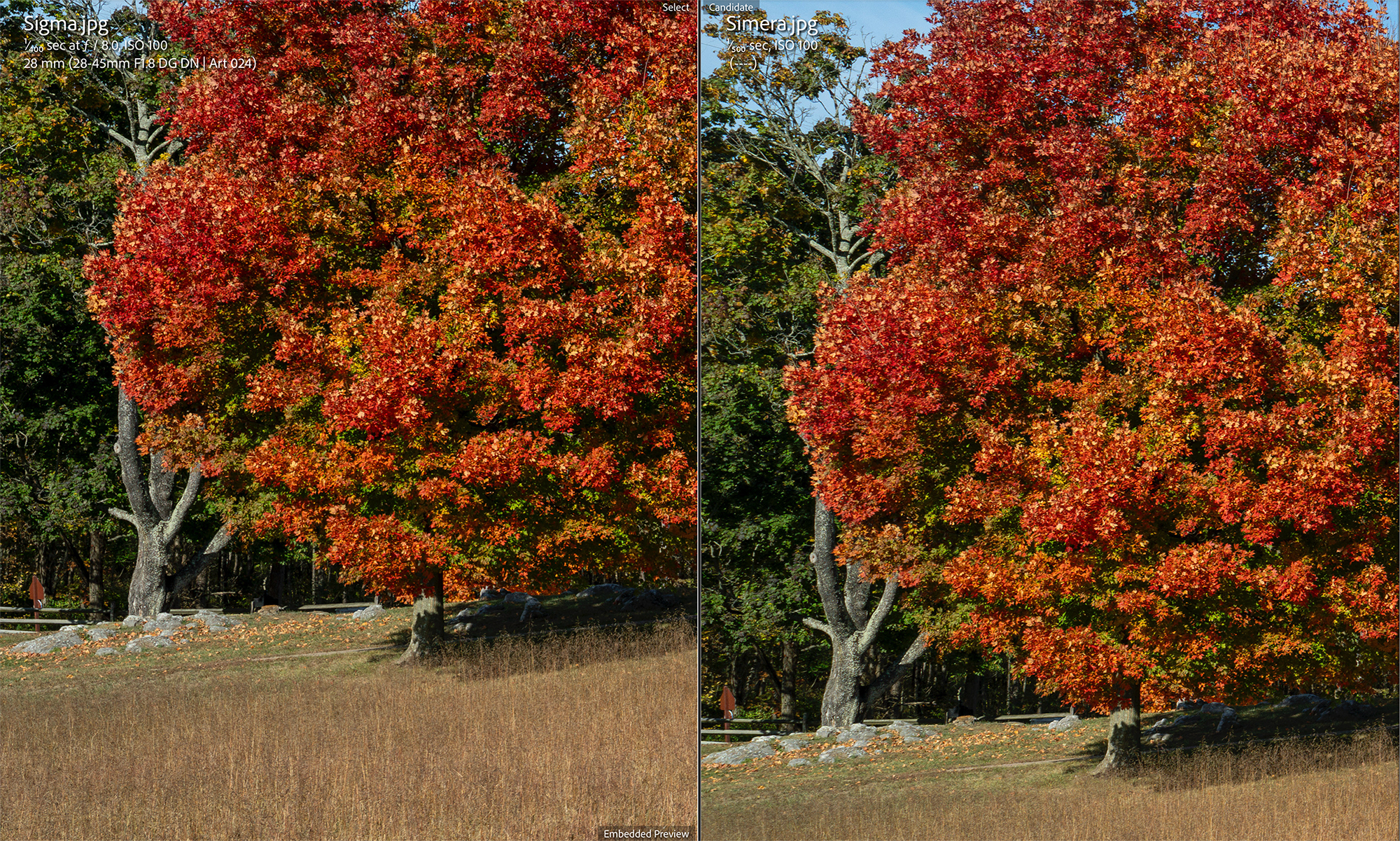
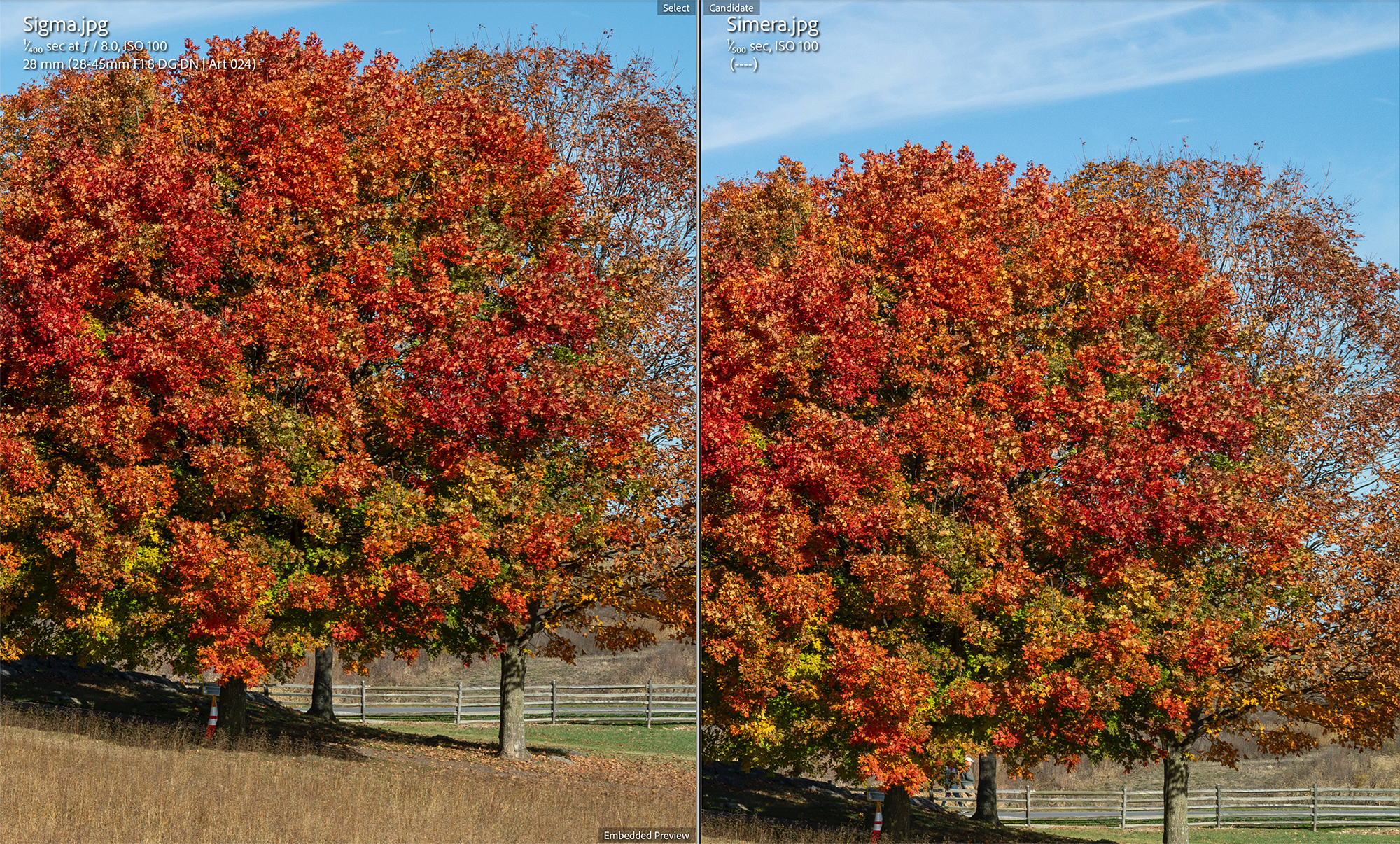
"A" - Simera 28mm f/1.4 in E mount
"B" - Sigma 28-45mm f/1.8 DG DN Art
Maybe if I get free time over the holidays, I'll do some comparisons at wider apertures.
You can see the reason im not a big proponent of fast lenses for landscape. The Simera isn't that heavy but you still need more than one lens. Also Simera probably best before f/8, probably Sigma too
There weren't any major changes in processing between "A" and "B". I did leave the distortion/vignetting correction on for "B" and I tried to correct for vignetting in "A" as best I could, but there was no distortion correction involved. they both were sharpened the same, etc.
RustyRus wrote:
A - looks awful anywhere near the side of the frame-
Almost looks like bad processing or some other issue in post. I don't think that is actually the case but its shockingly bad-
tsdevine wrote:
I'm definitely not trying to pick a fight with anyone, just trying to reel things back to a bit of a more methodical/objective comparison of equipment.
And that is surely the reason for the eloquent silence of the optical poet.
RustyRus wrote:
A - looks awful anywhere near the side of the frame-
Almost looks like bad processing or some other issue in post. I don't think that is actually the case but its shockingly bad-
I'm looking at both images side by side on my 5k Apple monitor and the sides look so similar I can't understand your description of lens A as "awful". The only real difference I see is in the bottom two corners where the Simera is more smeared. Yes, the Simera image is very slightly less sharp on the sides, but no way are they "awful".
Two screenshots of both images side by side at 100%. Both sides of the images.
mudlake wrote:
I'm looking at both images side by side on my 5k Apple monitor and the sides look so similar I can't understand your description of lens A as "awful". The only real difference I see is in the bottom two corners where the Simera is more smeared. Yes, the Simera image is very slightly less sharp on the sides, but no way are they "awful".
Two screenshots of both images side by side at 100%. Both sides of the images.
Ive seen the pictures thanks-
Good for you if you don't see a differnce that matters to you. Keep snapping away and be happy
tsdevine wrote:
Yeah, it wasn't a huge secret...I was guessing someone would have an easy time of it.
Looks like the Loxia 25 is the best of them all, despite the small focal length difference. The way I see it all three lenses are marketed from a bit different starting point. One of them is about characteristics and mood, one is about value and practicality, and one of them is about science based design and good quality control approach. These will all speak to different audiences, and they will have different rationales, but once things are put in the same line with some sort of empirical comparison, the water retreats and shows which lenses really have it - well, the differences so small any way it doesn't break anyone's photography.
Good for you if you don't see a differnce that matters to you. Keep snapping away and be happy
Sure seems like you got a bone to pick with the Simera. If it’s not for you…then get something that is more to your liking…but don’t “shit” all over the Simera. I’ve seen some great photos taken with it.
Kalainen wrote:
Looks like the Loxia 25 is the best of them all, despite the small focal length difference. The way I see it all three lenses are marketed from a bit different starting point. One of them is about characteristics and mood, one is about value and practicality, and one of them is about science based design and good quality control approach. These will all speak to different audiences, and they will have different rationales, but once things are put in the same line with some sort of empirical comparison, the water retreats and shows which lenses really have it - well, the differences so small any way it doesn't break anyone's photography.
chez wrote:
This is only 1 aperture and one distance. Maybe other apertures and subject distances might reveal more.
Absolutely true and I'm sure other use cases will reveal different kind of differences. I should actually take back for what I said as it's not relevant try to pick out which of the lenses is the best - relevant point here is that while they are differences between lenses (even more than this particular situation), things get easily overblown in the forums where many have their taste/ego/money tied on specific brands. My example here, picking out Loxia, just shows how easily one gets sucked into this vortex. I think the fact is that actually they are all fine lenses which can enable anyone to take beautiful/valid pictures. I know either one of these would work with me.
chez wrote:
Sure seems like you got a bone to pick with the Simera. If it’s not for you…then get something that is more to your liking…but don’t “shit” all over the Simera. I’ve seen some great photos taken with it.
I think on the M mount, they are a great value and perform quite well actually. I think the 50 shows great character and looks very similar to my all time favorite lens the 50 Lux.
What I am seeing in these pictures is leaves that look like peanut butter though, which I am guessing is due to Thypochs lazy release on Sony and didn't account for sensor stack differences.
I would happily pick one up for an M mount and probably will one day- I think our reference to animal dung is accurate when looking at this lens at f/8 on a sony stack-
Thats how I see it- If you are taking great pictures, great! Post them up. We are talking about these images though.


 I respect Philips work and style of writing, even the attempt to push how we see and value lenses, aesthetically and intellectually interesting, but we really needed to have this reality check – just to keep our feet on the ground. Often I feel I would love to hear more about the people and places, the context, when I see Philips pictures.