Fuji's marketing concept?
p.1 #1Fuji's marketing concept?
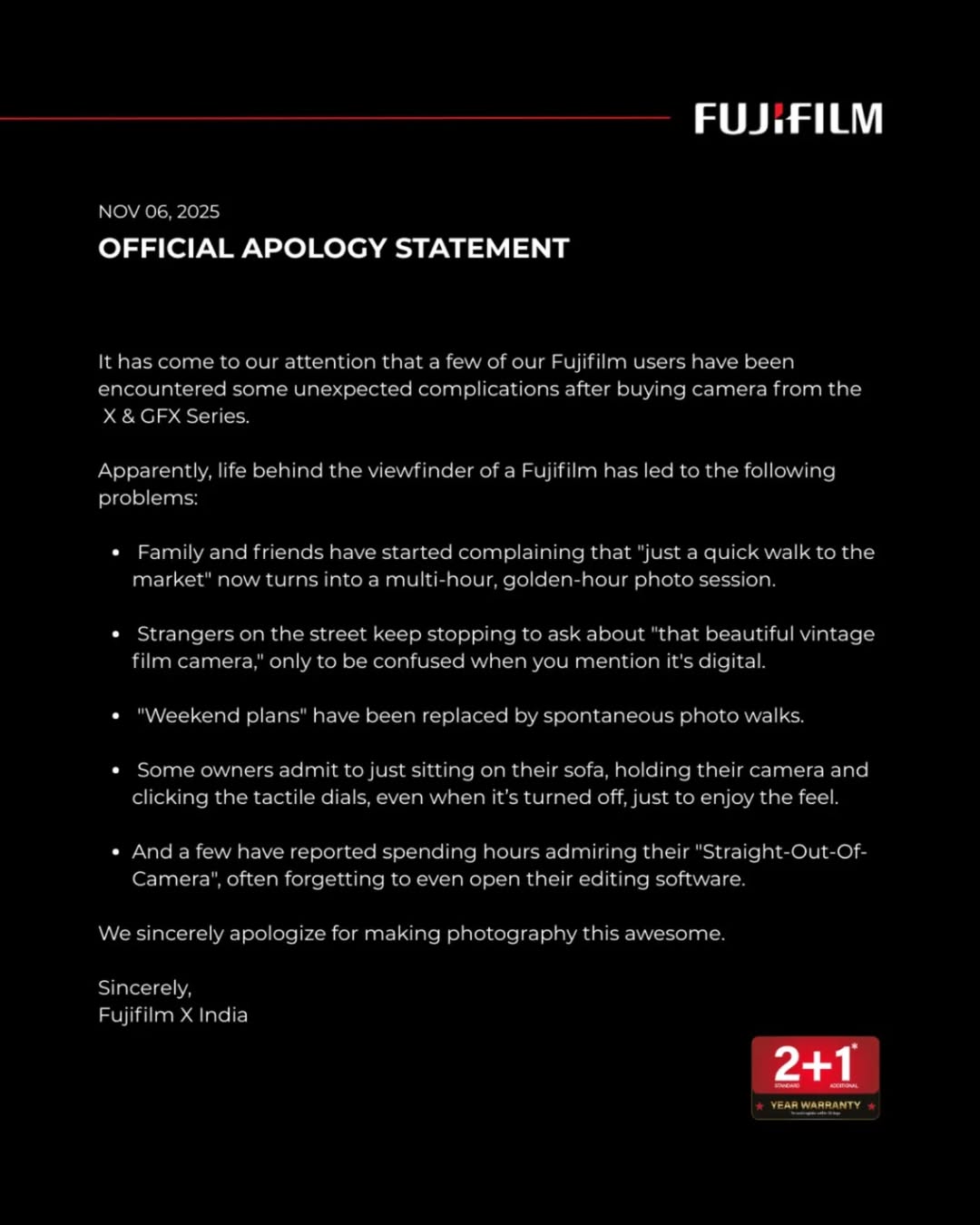
I think this marketing piece explains a lot of why Fuji releases the incremental updates they do, with less focus on usable assets like eyeball sticky AF...
Nov 06, 2025 at 10:26 AM
p.1 #2Fuji's marketing concept?
Their focus on the ostensible "experience" of the gear is mixed blessing, isnt' it.
On the plus side, for those of us who like the old-school non-PASM interface (and I know you are on th e other side of that one, Jack) and the little "Fujicron" lenses, the XPro hybrid viewfinder, and similar stuff this has some benefits.
At the same time, it also makes them susceptible to focusing on some stuff that raises a few eyebrows: the downgrading of the XPro3 with that little square screen, the addition of gimmicks like sims dials, and a few other things like missing the mark. with the XH-1 release timing and integration, odd little bits and pieces (like the gigantic metal hood on the old 60mm macro, and the oddball foot on the excellent 50-140mm f/2.8, etc, and — in my view — the strange set of focal lengths on GFX-series zooms.)
Lots of brilliant ideas come out of Fujifilm — the creation of a less-expensive miniMF camera system, the revitalization of the small fixed lens cameras, the XPro hybrid viewfinder, the excellent small primes for the x-trans bodies, etc. But I often feel like there are gaps in their thinking about how it all fits together as a system.
(PS: Photography was already awesome. ;-) )
Nov 06, 2025 at 11:18 AM
p.1 #3Fuji's marketing concept?
With all their focus on style (and I love the retro style) - they have given up on fixing their AF-system. Plus, for reasons unknown to me: They change the user interface with every single new camera. Forget about muscle memory.
Nov 06, 2025 at 11:41 AM
p.1 #4Fuji's marketing concept?
Nielk Mike wrote:
With all their focus on style (and I love the retro style) - they have given up on fixing their AF-system. Plus, for reasons unknown to me: They change the user interface with every single new camera. Forget about muscle memory.
Agree 100%. I understand some of the UI layout and menu changes as things "improve," but Fuji hasn't really improved or changed much of anything since the XT5/XH2 releases, which are now getting long in the tooth camera-life-wise...
Nov 06, 2025 at 12:04 PM
p.1 #6Fuji's marketing concept?
Just a marketing piece to ignore. Hopefully it doesn't gain the same lasting impact of the "lenses that resolve 40mp" list. Certainly Fuji is capable of doing two things at once. The UI/styling designers are hopefully not the same team that is working on the technical design of auto focus and improving it. IMO, its silly to debate how much a company "cares" about something. They care about hitting sales target each year, just like every other company in business. Fuji has done many things well and if they don't improve AF, eventually the nice look, feel, and experience won't matter to the larger market.
Nov 06, 2025 at 12:45 PM
p.1 #7Fuji's marketing concept?
SGinNorcal wrote:
Just a marketing piece to ignore. Hopefully it doesn't gain the same lasting impact of the "lenses that resolve 40mp" list. Certainly Fuji is capable of doing two things at once. The UI/styling designers are hopefully not the same team that is working on the technical design of auto focus and improving it. IMO, its silly to debate how much a company "cares" about something. They care about hitting sales target each year, just like every other company in business. Fuji has done many things well and if they don't improve AF, eventually the nice look, feel, and experience won't...Show more →
They certainly *could* do both things at once, but it appears improving AF is on a no-bother list.
Nov 06, 2025 at 01:26 PM
p.1 #8Fuji's marketing concept?
gdanmitchell wrote:
Lots of brilliant ideas come out of Fujifilm — the creation of a less-expensive miniMF camera system
(PS: Photography was already awesome. ;-) )
Dan, I'm finding your constant reference to digital medium format as "miniMF" rather amusing. Over the weekend I looked through a photography book from the 1980s which constantly referred to 35mm cameras as "mini" film cameras!
Nov 06, 2025 at 01:37 PM
p.1 #9Fuji's marketing concept?
Jack Flesher wrote:
They certainly *could* do both things at once, but it appears improving AF is on a no-bother list.
Why? Just because they haven't announced it as an initiative? If they did so, they would kill new camera sales. Like every other manufacturer, they will continue to say the current version is awesome, until the new version launches, then the old one will suck and need replacement immediately, lol. I think its a pretty safe bet they are working on a next gen AF for the next gen of X-T/X-H cameras. If not, it would be a huge blunder.
SGinNorcal wrote
Just a marketing piece to ignore. Hopefully it doesn't gain the same lasting impact of the "lenses that resolve 40mp" list. Certainly Fuji is capable of doing two things at once. The UI/styling designers are hopefully not the same team that is working on the technical design of auto focus and improving it. IMO, its silly to debate how much a company "cares" about something. They care about hitting sales target each year, just like every other company in business. Fuji has done many things well and if they don't improve AF, eventually the nice look, feel, and experience won't matter to the larger market.Why? Just because they haven't announced it as an initiative? If they did so, they would kill new camera sales. Like every other manufacturer, they will continue to say the current version is awesome, until the new version launches, then the old one will suck and need replacement immediately, lol. I think its a pretty safe bet they are working on a next gen AF for the next gen of X-T/X-H cameras. If not, it would be a huge blunder.
Nov 06, 2025 at 02:05 PM
p.1 #10Fuji's marketing concept?
Yes because Fuji's AF is utterly unusable:
 XH2S2205 by Marcus Beasley, on Flickr
 XH2S1949 by Marcus Beasley, on Flickr
 XH2S1799 by Marcus Beasley, on Flickr
 XH2S1706 by Marcus Beasley, on Flickr
 XH2S0519 by Marcus Beasley, on Flickr
 XH2S0362 by Marcus Beasley, on Flickr
 XH2S5439 by Marcus Beasley, on Flickr
XH2S2205 by Marcus Beasley, on FlickrXH2S1949 by Marcus Beasley, on FlickrXH2S1799 by Marcus Beasley, on FlickrXH2S1706 by Marcus Beasley, on FlickrXH2S0519 by Marcus Beasley, on FlickrXH2S0362 by Marcus Beasley, on FlickrXH2S5439 by Marcus Beasley, on FlickrNov 06, 2025 at 02:06 PM
|
p.1 #11Fuji's marketing concept?
Geoff D F wrote:
(PS: Photography was already awesome. ;-) )Dan, I'm finding your constant reference to digital medium format as "miniMF" rather amusing. Over the weekend I looked through a photography book from the 1980s which constantly referred to 35mm cameras as "mini" film cameras!
That's lucky for you, Geoff, I find it irritating. Which bothers me because I try to mentally file things like that in a folder titled, "things that don't matter". The struggle is real
gdanmitchell wrote
Lots of brilliant ideas come out of Fujifilm — the creation of a less-expensive miniMF camera system(PS: Photography was already awesome. ;-) )
That's lucky for you, Geoff, I find it irritating. Which bothers me because I try to mentally file things like that in a folder titled, "things that don't matter". The struggle is real
Nov 06, 2025 at 02:11 PM
p.1 #12Fuji's marketing concept?
SGinNorcal wrote:
They certainly *could* do both things at once, but it appears improving AF is on a no-bother list.Why? Just because they haven't announced it as an initiative? If they did so, they would kill new camera sales. Like every other manufacturer, they will continue to say the current version is awesome, until the new version launches, then the old one will suck and need replacement immediately, lol. I think its a pretty safe bet they are working on a next gen AF for the next gen of X-T/X-H cameras. If not, it would be a huge blunder.
I hope you're right, though I'm not optimistic you are. We will see...
To be clear, I don't think Fuji XH2/XT5 AF is unusable. But it doesn't compare to current CaNiSo AF insofar as eye-lock and tracking are concerned.
Edited on Nov 06, 2025 at 02:58 PM · View previous versions
Jack Flesher wrote
SGinNorcal wrote
Just a marketing piece to ignore. Hopefully it doesn't gain the same lasting impact of the "lenses that resolve 40mp" list. Certainly Fuji is capable of doing two things at once. The UI/styling designers are hopefully not the same team that is working on the technical design of auto focus and improving it. IMO, its silly to debate how much a company "cares" about something. They care about hitting sales target each year, just like every other company in business. Fuji has done many things well and if they don't improve AF, eventually the nice look, feel, and experience won't matter to the larger market.I hope you're right, though I'm not optimistic you are. We will see...
To be clear, I don't think Fuji XH2/XT5 AF is unusable. But it doesn't compare to current CaNiSo AF insofar as eye-lock and tracking are concerned.
Edited on Nov 06, 2025 at 02:58 PM · View previous versions
Nov 06, 2025 at 02:56 PM
p.1 #13Fuji's marketing concept?
SGinNorcal wrote:
(PS: Photography was already awesome. ;-) )Dan, I'm finding your constant reference to digital medium format as "miniMF" rather amusing. Over the weekend I looked through a photography book from the 1980s which constantly referred to 35mm cameras as "mini" film cameras!That's lucky for you, Geoff, I find it irritating. Which bothers me because I try to mentally file things like that in a folder titled, "things that don't matter". The struggle is real
We've been left with a lot of marketing terminology to describe the different formats. Somewhere along the line, 35mm digital became "full frame". Those that don't favour APS-c sometimes refer to that format as being crop cameras. In an own goal, Olympus and Panasonic came up with "micro 4/3", despite consumers having irrational insecurities about sensor size. And then there are 1 inch sensors which are nothing like 1 inch in any dimension.
I'm sure Dan does it either to be disparaging to 44x33 users or as a flex to 'educate' that digital MF is smaller than any of the 120 film formats - something I'm sure every user knows.
Geoff D F wrote
gdanmitchell wrote
Lots of brilliant ideas come out of Fujifilm — the creation of a less-expensive miniMF camera system(PS: Photography was already awesome. ;-) )
We've been left with a lot of marketing terminology to describe the different formats. Somewhere along the line, 35mm digital became "full frame". Those that don't favour APS-c sometimes refer to that format as being crop cameras. In an own goal, Olympus and Panasonic came up with "micro 4/3", despite consumers having irrational insecurities about sensor size. And then there are 1 inch sensors which are nothing like 1 inch in any dimension.
I'm sure Dan does it either to be disparaging to 44x33 users or as a flex to 'educate' that digital MF is smaller than any of the 120 film formats - something I'm sure every user knows.
Nov 06, 2025 at 02:56 PM
p.1 #14Fuji's marketing concept?
SGinNorcal wrote:
(PS: Photography was already awesome. ;-) )Dan, I'm finding your constant reference to digital medium format as "miniMF" rather amusing. Over the weekend I looked through a photography book from the 1980s which constantly referred to 35mm cameras as "mini" film cameras!That's lucky for you, Geoff, I find it irritating. Which bothers me because I try to mentally file things like that in a folder titled, "things that don't matter". The struggle is real
He's been hoping since the release of the 50S that someone would think it's (he's) clever.
Geoff D F wrote
gdanmitchell wrote
Lots of brilliant ideas come out of Fujifilm — the creation of a less-expensive miniMF camera system(PS: Photography was already awesome. ;-) )
He's been hoping since the release of the 50S that someone would think it's (he's) clever.
Nov 06, 2025 at 03:02 PM
p.1 #15Fuji's marketing concept?
JadedWriter wrote:
Yes because Fuji's AF is utterly unusable:..
It is far from “utterly unusable,” but performance is uneven. My experience:
Shooting small primes for street/travel the focus accuracy is usually quite good. It isn’t as fast as the fastest from other brands, but it is effectively fast.
Oddly, I have had a less satisfying experience with zooms, including the 16-55mm f/2.8, the 50-140mm f/2.8, and the 100-400mm. I’m still trying to understand why this is. To some extent it appears to be somewhat an issue of consistency — last week I was photographing at a wildlife refuge and I got some quite decent stuff from the 100-400 when shooting landscape subjects, but not quite as good or as consistent with wildlife, which was birds that were mostly nearly stationary.
Some recent misses with the 50-140 has perplexed me, since it has been been very sharp and accurate in the past, Still trying to figure that one out.
Generally the “misses” are still usable, but just not as sharp as i expect.
Nov 06, 2025 at 03:52 PM
p.1 #16Fuji's marketing concept?
Geoff D F wrote:
We've been left with a lot of marketing terminology to describe the different formats. Somewhere along the line, 35mm digital became "full frame". Those that don't favour APS-c sometimes refer to that format as being crop cameras. In an own goal, Olympus and Panasonic came up with "micro 4/3", despite consumers having irrational insecurities about sensor size. And then there are 1 inch sensors which are nothing like 1 inch in any dimension.
“35mm “doesn’t actually make sense with digital since there is nothing about it that is 35mm. As you know, the name came from the width of the sprocketed film stock used for movies. (This is similar to the “6” in 645 which refers to the 6cm width of the film, on which a smaller image is recorded.) There’s not really any confusion now about the term “full frame” after more than two decades of its use to describe the roughly 24mm x 36mm image area.
APS-C is more confusing since it can refer to more than one set of dimensions — the 1.5x crop used by most brands and the 1.6x crop used by Canon, for example. Sigh.
MFT is probably the best case since it does refer to a standard size and format these days.
But various parties have long been kind of loose with their use of the terms. Two examples:
1. When Pentax came out with their revolutionary 33x44 camera fifteen years ago, they called the camera the “645d” and then called its successor the “645z.” That was extremely misleading since there was already an actual 645 format (image with long dimension crosswise on 6cm film) that photographers were long familiar with. Honestly, it seemed intentional misleading.
(To me, something that is more problematic than coming up with a new term for new digital formats — full frame and micro four thirds, for example — is reusing old terms with accepted meanings in ways that make no logical sense… like Pentax using the “645” terminology.”)
2. Then there’s Fujifilm, who have referred to their 33x44 sensor systems as medium format and large format and maybe by other terms. I think Leica or someone may have referred to it (or a related 3:2 aspect ratio version) as super-full-frame! (Of the three, I think that actually makes some sense.)
I'm sure Dan does it either to be disparaging to 44x33 users or as a flex to 'educate' that digital MF is smaller than any of the 120 film formats - something I'm sure every user knows.
It isn’t disparaging, and I’m mystified why you take it to be disparaging. The miniMF sensors are excellent and have advantages over the smaller FF sensors. It is simply an accurate way to refer to the 33x44 format, which lies midway between full frame and 645, the smallest traditional film medium format. I’ve called it this since I first knew about and saw the original Pentax 645d 15 years ago.
Things would be simpler if we could just refer to formats using numbers based on their approximate dimensions, I suppose: 13x17, 15x23, 24x36, 33x44, etc. (We’d probably say “thirteen-seventeen,” up through “thirty-three-forty-four.”
But that’s not gonna happen. We’re stuck with the idiomatic terms that have evolved over time.
Nov 06, 2025 at 04:11 PM
p.1 #17Fuji's marketing concept?
Fuji AF is basically good or bad on a lens by lens basis. It's just what it is. The old XF trio you're using 2/3rds of that needs an update severely. Also sometimes...a lot of the time with Fuji you basically need to act like the camera has 0 subject detection in it and just smallest AF point in AF-C like it's a DSLR for the best results.
gdanmitchell wrote:
It is far from “utterly unusable,” but performance is uneven. My experience:
Shooting small primes for street/travel the focus accuracy is usually quite good. It isn’t as fast as the fastest from other brands, but it is effectively fast.
Oddly, I have had a less satisfying experience with zooms, including the 16-55mm f/2.8, the 50-140mm f/2.8, and the 100-400mm. I’m still trying to understand why this is. To some extent it appears to be somewhat an issue of consistency — last week I was photographing at a wildlife refuge and I got some quite decent stuff from the 100-400 when shooting landscape...Show more →
gdanmitchell wrote:
JadedWriter wrote
Yes because Fuji's AF is utterly unusable:..Shooting small primes for street/travel the focus accuracy is usually quite good. It isn’t as fast as the fastest from other brands, but it is effectively fast.
Oddly, I have had a less satisfying experience with zooms, including the 16-55mm f/2.8, the 50-140mm f/2.8, and the 100-400mm. I’m still trying to understand why this is. To some extent it appears to be somewhat an issue of consistency — last week I was photographing at a wildlife refuge and I got some quite decent stuff from the 100-400 when shooting landscape...Show more →
Nov 06, 2025 at 04:27 PM
p.1 #18Fuji's marketing concept?
gdanmitchell wrote:
“35mm “doesn’t actually make sense with digital since there is nothing about it that is 35mm. As you know, the name came from the width of the sprocketed film stock used for movies. (This is similar to the “6” in 645 which refers to the 6cm width of the film, on which a smaller image is recorded.) There’s not really any confusion now about the term “full frame” after more than two decades of its use to describe the roughly 24mm x 36mm image area.
APS-C is more confusing since it can refer to more than one set of dimensions...Show more →
Dan,
I appreciate your response but you have come up with new nomenclature that AFAIK no one else uses making the problem worse.
As for Fuji, I guess if "full frame" is now the accepted term for 36x24, then "large format digital" might be better than "medium format" though I doubt anyone is seriously confused.
Agree on Pentax 645, though they maintained mount compatibility with their 645 lenses that have "645" in the name, so I can see why they did it.
Anyway, I might go over the the film forum and start referring to 35mm cameras as mini film cameras and see how that is recieved.
Geoff
Geoff D F wrote
We've been left with a lot of marketing terminology to describe the different formats. Somewhere along the line, 35mm digital became "full frame". Those that don't favour APS-c sometimes refer to that format as being crop cameras. In an own goal, Olympus and Panasonic came up with "micro 4/3", despite consumers having irrational insecurities about sensor size. And then there are 1 inch sensors which are nothing like 1 inch in any dimension.APS-C is more confusing since it can refer to more than one set of dimensions...Show more →
Earlier quote
I'm sure Dan does it either to be disparaging to 44x33 users or as a flex to 'educate' that digital MF is smaller than any of the 120 film formats - something I'm sure every user knows.Dan,
I appreciate your response but you have come up with new nomenclature that AFAIK no one else uses making the problem worse.
As for Fuji, I guess if "full frame" is now the accepted term for 36x24, then "large format digital" might be better than "medium format" though I doubt anyone is seriously confused.
Agree on Pentax 645, though they maintained mount compatibility with their 645 lenses that have "645" in the name, so I can see why they did it.
Anyway, I might go over the the film forum and start referring to 35mm cameras as mini film cameras and see how that is recieved.
Geoff
Nov 06, 2025 at 04:29 PM
p.1 #19Fuji's marketing concept?
Geoff D F wrote:
Anyway, I might go over the the film forum and start referring to 35mm cameras as mini film cameras and see how that is recieved.
Geoff
When I started doing this photo thing for a living, "serious" professionals used medium and large format film. Only news and sports photographers used 35mm, and only because the increased portability and the availability of long lenses made sense. It hadn't been that long since the typical newsie was shooting 4x5 or 6x9cm on a "Press" camera.
So I still get something of a chuckle when I read about how "full frame" is the be-all and end-all of quality photography.
Nov 07, 2025 at 12:25 PM
p.1 #20Fuji's marketing concept?
35mm film cameras were referred to as 'miniature' for a long time , smaller than the universally regareded norm of whatever you couod do on a 120 film
APS-C grew out of a misguided marketing exercise in smaller format known, if I remenber right, as 'Advanced Photo System', which failed commercially.
Gerry
APS-C grew out of a misguided marketing exercise in smaller format known, if I remenber right, as 'Advanced Photo System', which failed commercially.
Gerry
Nov 07, 2025 at 03:54 PM